Piss Poor Planning: The Debacle of Nyahuku (Part 2)
March 7, 2026
The journey to Salisbury was fairly uneventful, and except for the occasional stop for the customary pee, smoke and leg stretch, we arrived in good time and still in daylight.
Reporting to the 2 Squadron HQ, where we were expecting a hero’s welcome and friendly smiles turned out to be a pretty poor assumption and was far from reality. No one seemed to have a clue why we were there and evidently we should have pushed all the way through to Mtoko without a stop in Salisbury. This was light years from the instructions given to us in Bulawayo, and it was pretty clear it was another of those military blunders – sadly this was just the first example of many to come on this mission.
We were not keen to travel through to Mtoko immediately, and in any case we would not be allowed to as it would be breaking the curfew if we did, so it would be a night stop sleeping under our vehicles and the stars as there was no accommodation arranged either. This by default also meant no catering arrangements either. I asked that a message be sent to 1 Squadron, informing them of the situation and apparent miscommunication. This of course to cover my arse.
We were given permission to park our trucks on a piece of open ground for the night. After collecting money from the crew we sent a couple of lads with the Unimog to buy beers at the canteen, and cokes for the teetotalers. It was going to be ratpack stew for supper. At least we could have a few drinks and shoot the shit before climbing into our sleeping bags – life was as good as we could make it within our cohort. I fell asleep looking at the stars.
Early the next morning we cleaned up the area, washed and shaved using the taps on our water bowser. I then sent the drivers to fill our vehicles at the Petrol, Oil and Lubricants (POL) point, while one of the sergeants and I paid a visit to the Squadron HQ once again. I recognised one of the junior officers and asked if we could have a word. According to him, he knew we were on the move to Mtoko, but there was never a plan for us to night stop in Salisbury, which I found very strange indeed, considering we would not have enough daylight to get from Bulawayo to Mtoko in a single day without breaking curfew. I considered this and as it was a lovely sunny day, decided that it was just one of those things. He added that the 2 Squadron contingent had left for Mtoko at the same time we left Bulawayo – so they were already there waiting for us, and had already been informed by radio of the change in plan, and that we would be arriving later today.
Our next dilemma was rations. We had only drawn 2 ratpacks each at Brady Barracks and therefore already breaking into our second and last one. Should we encounter any further delays on the way to Mtoko, we would be in a bit of a fix, food-wise. I asked the officer if we could be issued a further 2 packs per man and to my surprise he told me all of our rations were with the 2 Squadron contingent and there was nothing available for us in Salisbury. No use arguing, but the plan was continuing to unravel. If you want to mess with troop moral, take away a soldiers food and pay.
By now our vehicles had refueled and were parked-up close to the Squadron HQ, waiting for the sergeant and I to join them. As we were leaving the HQ, the Squadron Sergeant Major, who I also knew approached me and asked what those waster 1 Squadron vehicles and troops were doing in his lines. I explained the situation we were in and he immediately got very pissed off, not with me but rather the 2 Squadron HQ in general. He berated them for not providing us decent accommodation and a warm meal on arrival and insisted that rations be issued to us for our journey to Mtoko. Whoever his ire was aimed at I do not know, but there was much activity while arrangements were made for us to collect additional rations for the journey. At least there was someone who understood where the fault lay and done his best to make things right. He directed us to the QM store where we were issued what was known as tinned equivalent, not rat packs per se, but rather bulk rations in big cardboard boxes containing larger tins and other bits and pieces that we could share between us when the time came.
Everyone loves a Sergeant Major – and normally avoids pissing them off.
After thanking him for bringing some inter-squadron cooperation to an otherwise hard start to the day, we mounted the trucks and got on our way to Mtoko.
The 140-odd kilometer journey would take around 3 hours – but this was a dangerous route where high vigilance was required. To add context, attacks on this road were frequent, characterised by gook ambushes, minelaying, and infiltration attempts, crucially as the enemy had established so called “liberated zones” in the Mtoko area.
The gooks knew that if they could dominate this road, they would be successful in disrupting Rhodesian Security Force logistics.
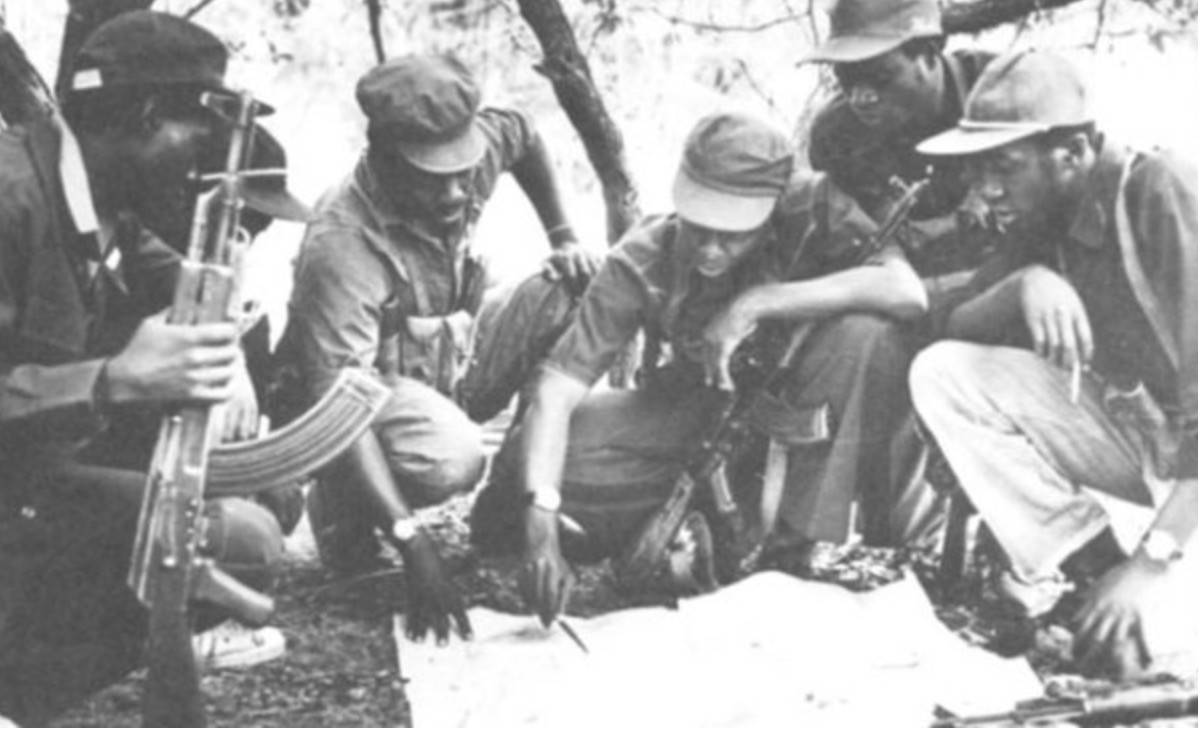
Above: ZANLA CTs making a plan – Owner unknown but I do acknowledge that this is not my media
And we were going to be travelling right through the Zimbabwe African National Liberation Army (ZANLA) hunting grounds.
Would we make it through unscathed? Part 3 will tell.
Copyright
© Mark Richard Craig and Fatfox9’s Blog, 2009-2026. Unauthorised use and/or duplication of this material without express and written permission from this blog’s author and/or owner is strictly prohibited.
On The Boats And Sundry Combat Engineer Duty: A Personal Account Of Rhodesian Sapper Life
May 2, 2015
Another great contribution by Basil Preston to my blog. Many thanks Basil.
Reading through this account, those of you that have been in the bush and taken part on ops will really get the feeling of having had similar experiences. I also worked with Don Price while at 1 Indep in Wankie and always found him to be a professional soldier although he did call me a “dude” one day while we doing stopper group ops for fire-force. Good times and I can really relate to Basils input which follows:
Boats at Binga and Sundry Combat Engineer’s duty 1978/79 (thereabouts)
We were doing a camp with 2RR?, at Binga and Major Don Price was the officer-in-charge. The Engineers were Stan Brazer, Graham Malone and myself and we were operating the boat in between doing mine-road clearance etc. We were to have a Pookie with us, but unfortunately it had been damaged in a mine blast before we arrived.
Major Don Price is well-known for his bush savvy and his company had many kills to their credit. But it was not always in their favour. Major Price was very strict; in that he would not allow any of his guys to catch a lift when their stint on patrol in the bush was complete. However, a stick of four guys had just completed their patrol and had stopped over at the police camp at Siabuwa, to wait for their pick up. (Siabuwa, is a small relatively unknown area and one would only know about it if one travelled to Karoi from Binga through the bush, along the southern edges of Kariba driving a 4×4. Nnear Binga, Matabeleland North, its geographical coordinates are 17° 28′ 0″ South, 28° 3′ 0″ East ). And the police camp was on top of a gomo.
(Inserted by Mark Craig: Below is a map showing Siyabuwa…….those following the blog will see how close it is to my area of boat operations).

Instead of the stick waiting for their pick-up at the pre-arranged position, they hitched a ride with the police in a landrover. However, the terrs had laid a mine in the tracks. And just before the police track entered the main dirt road, they hit the mine. Richard (?) Kashula and one/two other/s sitting in the back of the landy, where there is no mine protection were killed. John Sholts lost a leg. The one chap sitting in front of the landy plus the cop had minor injuries. The other guy was badly burnt from a white phosphorous grenade which had gone off in his back-pack at the time of the explosion. Kashula was an up and coming Rhodesian cricketer. My recollection of this is a bit hazy as far as the names go. But it was a sad day indeed for all of us.
We were all given a lambasting as to why the Major had rules and now we could all see what happens when ignored. We all felt shit….But then we all celebrated with the Major the good things they had done.
But life goes on. An Air Force chap, who was based at Binga at the same time had his private boat moored at the back harbour. Stan convinced him to take us fishing, which he gladly did. We tied the boat to a tree overhanging the water’s edge. This was at the mouth/entrance from the lake to the back harbour, as this guy said you catch “monsters” here. All we had to do was let the line out for a while, straight down; no casting, and then jiggle the line up and down. Stan had a strike which broke the rod where the reel is connected, but after recovering the line, all the tackle was gone. We all became very excited now, hoping to catch a “monster”.
But this was not to be. We had all been told to be on the look out for a Romanian chap, who supposedly ferried terrs across Kariba, and also that he had a 20mm cannon on his boat. Also, the odd police boat had been hijacked from its moorings and taken to the Zambian side from the front harbour. Hence why we now used the back harbour. {This was about the time the Janet was being used as the mother ship, with two strike boats operating from her. She had radar etc and were hoping to catch up with the Romanian. An Engineer, surname Tailor did his whole camp with one contact lens as the other had been blown out by the wind during a boat patrol.}
All of a sudden, bullets were zapping over our heads. We all shat ourselves, as we thought that the Romanian had seen us and was giving us a go. But the bullets stopped; then resumed again, and again. But the bullets were cracking rather high above us. Then we saw what was going on. The cops had floated a 44 gallon drum, and were doing “drive-by” firing practice at the drum, and the bullets were ricocheted off the water and ending up above us. We departed in a hurry and returned to the back harbour and safety (by road to the back harbour from Binga is about 15ks, and from the front harbour to the back harbour by boat, was about 30ks.)
We became rather friendly with the Air Force chap, based at Binga at the time, who loaned us his boat whenever we wanted a bit of R and R. But this soon came to a stop. We were going out on another R and R trip. And on arriving at the back harbour, we could not see the boat. But on closer inspection, we noticed the tie-up rope, and it was taught. We went closer and saw that it was still attached to the boat. It had sunk by itself. We were lost for any logical reason. Perhaps one of the cop’s bullets had done it an injury, but we will never know.
On another short patrol, this time in our Hercules, Graham Malone and I explored a part of the back harbour, which was off the beaten track so to speak (the army has given us plenty of opportunities of seeing “virgin” Rhodesia, which under normal circumstances one would never ever travel to and fishing sprees where no one has fished in years due to the terr activities. So this may sound like bullshit, but it is not). We were told that the tiger fish in the back harbour were a sub-species of the lake tiger; and were a smaller version and had a more snub head which was blueish in colour. But were just as sporty as the river tiger [the lake tiger is shorter and its girth bigger; is sluggish and basically only jumps once to rid itself of the hook.] (the record for a tiger in the lake is 42 lbs caught in a net, this is old information….1972…. and the river tiger is longer and more streamlined as it has to swim against currents etc and gives a better fight). We were able to confirm this sub species as we caught a few.
However, on a more humorous note, we were speeding along, and as we were rounding a bend, we surprised a hippo, which normally are not on land during day time, but this area was human-free and I doubt whether the hippo had ever seen a boat before. Not only did we surprise this huge animal, it put the shits up us, as we had not seen it. But all of a sudden, we heard this thrashing sound of something hitting water at speed. When we saw it, it was a mass of moving, terrified animal pushing water either side of itself, similar to when a Kariba sluice gate is open full. And it was heading directly towards us, well that’s what we thought. It was charging along the shortest route to get back into the water and safety. We were out of there in no time. It is just a pity that we did not have a camera with us. But I doubt whether any of us could have taken a picture, as things were happening at a terrific speed.
One night Don Price sent us on a night ambush. We were to ambush the bottle store (Tolotsho Bottle Store, I think, as intel from BSAP Special Branch had heard that the terrs were going to have a beer drink) about 30ks from Binga, back on the main road towards Kamativi. It was full moon and we were being driven by Louis Ribero. A whizz at de-governing the TCVs. As usual, the old Bedfords always back-fired, but Louis could make this happen as if it was a natural noise of the truck; so just after passing where we were to have the ambush, he induced the Bedford to back-fire, and slowed down so that we could hop off without killing ourselves, and once we were all off, the vehicle suddenly recovered and he continued for a couple of k’s so that the terrs would not know that we had hopped off. Then he turned and set off back to Binga and a cold chibulie.
About 15 minutes after being dropped off, we heard this tremendous explosion. Things always sound much louder at night. We all knew that Louis had hit a mine. The terrs (obviously on their way to the beer drink) had put one down just after we had passed them. They could have ambushed us. Anyway, we were then told to hump it back and ambush the truck. Also, a Provost was being sent from Wankie to drop a flare in order for us to have a look-see around the truck etc.
But, the timing was out. Ribero had been going so fast that the Major had incorrectly estimated the time it would take us to get into position and be able to use the light from the flare. Louis had told the Major that the old Bedford could not speed. Anyway, the plane flew over head, dropped his flare and we were still miles away.
Our adrenaline was pumping and as one knows, induces plenty of pissing time, and I just stepped off the main road onto the verge; we did not stop, so when I rejoined the line, a Rifleman nearly took me out as he had not seen me step aside. I learnt another lesson that night. Make sure everyone knows where every one is at all times.
Anyway, we eventually arrived at the RL, we could see enough to confirm that Louis was speeding; fortunately for him, it was on a straight and it was a right-back wheel detonation and no injuries, other than Louis’s pride. His truck was airborne for about 50 metres before the back axle touched down again. Another RL from the camp had already fetched Louis and his escorts before we arrived back at the injured old RL (the terrs had learnt too that when an RL back-fires that we were setting up something and the vehicle had to return, they were not all stupid as one thought and used this opportunity to plant a surprise, this was done on many occasions to other chaps).
We could not see all that good, but good enough to choose a spot for our ambush and then crept into our fart-sacks and did guard, by touching the guy next to you when your stint was over. However, my fear of Kariba spiders was with me again. After I crept into my sleeping bag, and just above my head, I saw this huge spider. The type that eats innocent Sappers. I did not move much for fear that this spider would make me his nightly snack.
I did eventually fall asleep, and when my eyes opened, the first thing I did was to see where the spider was (it’s funny how the mind works; bushes start moving, all shapes become the enemy, etc.). Well, I had been stressed for nothing, as the huge spider was in fact the head of a grass seed, the size of a semi-closed hand. I was thankful that I had not shared this with anyone that night, as I would not have heard the end of it. But perhaps they also had their own spiders to contend with.
And Louis Ribero continued to drive like Speedy Gonsalas. And survived, I hope, as he was a pleasant character.
Sapper B.R.Preston (RhE); 72860
Please also have a look at my website dedicated to Rhodesian and South African Military Engineers. Please join us on the forums by using the following link:
http://www.sasappers.net/forum/index.php
Copyright
© Mark Richard Craig and Fatfox9’s Blog, 2009-2015. Unauthorised use and/or duplication of this material without express and written permission from this blog’s author and/or owner is strictly prohibited.
On The Boats……Up The Creek With The SAS (Part 4: Also known as Eight Men In A Leaky Boat)
March 28, 2015
ZAMBEZI RIVER DOWNRIVER FROM MAPETA ISLAND: EN-ROUTE TO THE SAS DROP-OFF POINT
The boat was heavy and she laboured through the water and it felt as if invisible claws were trying to hold her back…..not wanting to let us go. An omen perhaps?
Tony was doing the best he could but try as he might he could not get us up on the plane even though we had moved as much kit to the back of the boat as possible to lift the bows. This in turn caused the stern to dip dangerously low towards the waterline and it was a little unsettling to say the least. Port and starboard trim was good though and we remained straight and level, not tilted to one side. We settled on a half-throttle pace, and taking our direction from the SAS Operator on the front bench the twin Evinrudes burbled us slowly back down the river.
We travelled within Rhodesian territory for quite some time, and for youngsters that had no previous experience of this type of operation this took away some of the tension of what may be ahead of us. It was somehow reassuring to know Rhodesia, our safe haven, was not too far away if the shit hit the fan. The SAS Operators were as always the ultimate professionals and I was proud to be working with them. They instilled a sense of security. You knew instinctively that if things turned nasty they would know exactly what to do. They were good men.
We had passed the Maungwa River mouth to the north, and then our second home the British South Africa Police (BSAP) camp at Sibankwazi. Msuna Mouth glided by in the darkness to our right and I craved for the ice-cold beers and battered barbel snacks I had consumed there on many a visit to the friendly owners of the fishing resort. It was easy to let ones mind roam and that was dangerous. We meandered on down the river, passing two large islands……both pitch-black and foreboding.
I was jerked back to the present, my mind having begun to wander off. Tony had swung us hard a-port and I lost my balance slightly while at the same time keeping a beady eye on the bow wave. The SAS man at the front had given a silent direction change to Tony. In a few minutes we would be crossing the invisible line that marked the international border between Rhodesia and Zambia. It was an eerie feeling, crossing into another country without permission, no passports, no questions. I began to warm to the idea of doing something I had never done before, and indeed I had crossed that point where fear no longer exists. You were committed to the mission, personal weakness or doubts could no longer be a consideration and there was no turning back. On every high-risk mission I have taken part in there was always a short period when I was afraid, sometimes very afraid. With me this is usually at the start and moving into the advance-to contact-phase, but once time crosses that indefinable moment that I cannot explain, a wonderful warm feeling washes over me….a feeling of being in control of my own emotions and destiny. The dye had been cast and there was no return.
It was that time for me now……approaching enemy shores on a dark and lonely river.
(Reservoir by StrongSteve)
The atmosphere on the boat had changed in a very subtle way. No one said anything but you could feel it. The SAS men began to check small details on their kit. Weapons were moved into more convenient positions, the smell of gun-oil permeating the air, masculine and comforting. Webbing was tightened over shoulders, shifting the weight of equipment onto the hips. Legs were stretched in the cramped confines of the boat.
A small red light came on as one of the Operators checked a plastic covered map with a small torch…….looking up at me he nodded his head, managing a white-toothed smile that shone through the darkness of the night and his camouflage cream. We were now well into Zambian waters and heading towards the Mulola River, one of the biggest rivers that emptied from that country into the Zambezi. We could see its gaping mouth ahead of us……a huge dark maw of emptiness seemingly waiting to swallow its victim. As we exited the Zambezi and entered the Mulola it became claustrophobic…….or so it seemed to me. After having vast expanses of water between the boat and land previously, we were now being enclosed by the high, almost invisible banks of the Mulola. The feeling of vulnerability returned to me, this would be the perfect place for an ambush and a mans imagination can run amok. This is good in some ways as it keeps you switched on. We were trained to always look for cover to move to if attacked. On land this is great idea but in the middle of a river it means absolutely bugger all. if the gooks were waiting for us we were well and truly fucked. Even if we made it to one of the banks, climbing to safe ground would be a challenge in the thick, rich vegetation. I unconsciously thought of gunfire and green tracers arching through the night sky……..willing them to stay away.
I cannot be sure how far we went up the river but probably about 2 kilometers as far as I can remember. Tony had the engines throttled right back now and we were just making enough way for the con to respond. At this speed the engines were almost silent but in the still dark night sounded to me like a pair of screaming banshees. it seemed to me that any gook within 100 clicks would hear us.

The map above shows our general route from the pick-up point to the drop-off point. Places of note along the way are also shown. The Mulola was, to the best of my recollection dry in some areas at that time and we navigated up river via quite narrow channels.
The boat rocked as the SAS Operator at the front stood up. He was studying the bank on the western side of the river. Understandably there had been no pre-recce of a drop-off point for security reasons and getting these lads off safely was now our top priority. It was past midnight and we also needed to get back before first light. We kept moving further into Zambia. The SAS navigator indicated to Tony that we should get closer to the bank and stop. He took out his map, again a little red torch was used, the only sound the two idling engines. The navigator moved us forward again…….one, two, three minutes passed and then just before the river took a sharp turn to the left he had Tony pull us into a wide hippo-track that led up the river bank. We had arrived at the drop-off point.
These men were well-trained. There was no need for chatter or briefings. That was all done before we left Rhodesia. And they were so silent….no clanking or scraping of metal. Preparation was perfect in all respects. Everyone knew what he had to do and what kit he needed to carry. They disembarked fast and before we knew it all except one had disappeared up the hippo-track to the top of the river bank. The boat seemed to breathe a huge sigh as the weight was lifted from her trusty old frame and she rose proudly up and out of the water, rocking gently to and fro. The Operator that remained with us spoke in low tones. He thanked us on behalf of the others and added that the plan had changed. We no longer needed to go back to the old farm at Mapeta, nor would we need to pick them up. We were to go straight back to Sibankwazi.
And then he was gone…….a grey ghost vanishing into the night. I was a little sad really and I would miss those guys.
There was a lot of water in the boat, all pooled at the stern under my booted feet. This was not as bad as it seemed and it would drain through a manually operated ball-cock on the way back when we got up on the plane. It was time for Tony and I to change over. The first thing to be done was to connect the reserve fuel tanks without killing the motors. We wanted to keep them running to avoid any type of technical failure on a restart. This was not too much of a challenge and we managed to bring the new fuel on-line without incident.
Tony took his place at the stern and I got behind the wheel…………it was time for the lonely journey back. Thats when my imagination started working overtime again. What if the evil gooks had planned it this way? Let us in and then shoot the shit out of us on the way out? it seemed plausible to me and something I might try if I were in their position. Just one of those things though and we needed to get moving.
Both engines were gurgling sweetly on idle and Tony gave me a thumbs-up to start moving astern. I took a sip of Coke from a can I had opened and shifted both engines into reverse……..and heard the sickening crack of a propeller shear-pin snapping. I had somehow manged to break the golden rule…….too many revs when changing gear normally equals shear-pin failure. I had just screwed-up fifty percent of our motive power and possibly placed us in harm’s way.
We were now two clicks up a Zambian Creek in a leaky boat with a dead engine………and the possibility we were being watched by bad guys was very real.
This mission was far from over………….
Please also have a look at my website dedicated to Rhodesian and South African Military Engineers. Please join us on the forums by using the following link:
http://www.sasappers.net/forum/index.php
Copyright
© Mark Richard Craig and Fatfox9’s Blog, 2009-2015. Unauthorised use and/or duplication of this material without express and written permission from this blog’s author and/or owner is strictly prohibited.
On The Boats……Up The Creek With The SAS (Part 2: Also known as Eight Men In A Leaky Boat)
February 14, 2015
ON THE ZAMBEZI RIVER ENROUTE FROM SIBANKWAZI BRITISH SOUTH AFRICA POLICE CAMP TO MAPETA ISLAND
The wind had picked up as we made our way to the RV and the mystery contact man.
Although not dark it was overcast and last light would be upon us quicker than expected. I cursed myself severely for not adding some slack to our travel time. Too late now though as we were about half way there according to our 1:50,000 map. Tony was navigating and sitting right beside me on the hard wooden bench, spray flying at us over the bows of the Hercules, stinging the skin, but in a perverse way also refreshing. It had been a sweltering hot day and the coolness of the oncoming night was welcome.
I had the motors at full throttle and we were well up on the plane. The boat was perfectly trimmed and like this she handled like a thoroughbred, riding the wavelets smoothly as I ensured we ploughed through them at just the right angle. Tony and I were enjoying this, but ever vigilant. It was all too easy to fall into a false state of security on this river. Besides the possibility of gooks taking a shot at us there was the ever-present danger of logs and trees floating down the river. If we hit one of those at speed we were stuffed.
I was scared of the unknown. I’m not afraid to admit it. Still a young Sapper I took comfort in knowing we had been trained by the best instructors we could have wished for, both Infantry and Engineer……….but they cannot teach a man to be courageous, how to be dauntless. That has to come from inside when he is in deadly peril or facing an up close enemy who wants to kill him……only then will he really know the limits of his nerve and mettle. (Note that I did not use the word fearless…….my own opinion is that it is dangerous to be in the company of fearless men).
Tony nudged me and indicated on the map that we were approaching Mapeta Island (Latitude -18.05, Longitude 26.73333). It loomed out of the twilight, huge in its size. There was no mistaking it and I was pleased with the timing. We needed to be careful now as part of Mapeta Island was Zambian territory and there could be gooks present although we had never had trouble from there before.
The light was almost perfect as I throttled back and steered us to port, entering the Islands left side channel. Checking the map Tony made the call and pointed towards land. We were at the spot given to us as the RV. I just hoped we had not fucked-up.
We slipped slowly towards the river bank, the engines just ticking over to give enough headway to steer. Tony was standing on the bows now, doing his best to see and guide me around anything that may damage the boat. The wind was coming from behind us here and the exhaust from the motors blew over us, the acrid smell of the fuel mixture seeming to corrupt the beauty of this part of the great river.
I carefully eased the boat into a cleared area of the river bank I could see. This would make it easier for mooring and disembarking. I killed the two engines as we gently grounded in soft sand……..and then there was nothing.
The silence was almost deafening and anyone who has never experienced this void of any noise will never truly understand what I mean here. The only sound was the pinging of the engines cooling down…….and the gentle lapping of water against the side of the boat.
It was now simply a waiting game……….
Copyright
© Mark Richard Craig and Fatfox9’s Blog, 2009-2015. Unauthorised use and/or duplication of this material without express and written permission from this blog’s author and/or owner is strictly prohibited.
On The Boats……Up The River With The SAS (Part 1)
February 7, 2015
DEKA ARMY BASE: LATE AFTERNOON
Conversation between Camp OC and ourselves:
“I want you two wasters to get your boat ready for a night operation. You are to take your boat to this grid reference (him indicating on the map) and wait there for someone to make contact with you. You will need spare fuel tanks, 24 hours rations and full ammo. I cannot tell you anything else but make sure you get there just as last light falls and don’t fuck up on the position I just gave you”
That was it. Short and to the point.
It quickly became time to go. As Tony and I climbed into the back of the Mercedes 25 Troop Carrying Vehicle (TCV) we looked at each other and wondered what the hell this was all about. We didn’t even know who we were supposed to meet and more importantly, what for. The driver fired the Unimog up and with a characteristic torque-induced jerk we were off, easing through the camp entrance, and then turning sharp left onto the road to Sibankwazi. To our boat……..and the Zambezi River.
I had looked at the Ops Room map as the Captain briefed us and taken down the grid reference we were headed for. As far as my memory serves me it was at the position marked SAS pick-up position on the map shown below, near to Mapeta Island:

Tony and I had worked the time and distance calculation to get us to the Rendezvous Point (RV) just as last light was coming on. We were both edgy and rather subdued on the journey down to the boat, each of us respecting one another’s silence. Travelling the Zambezi River during the day was a challenge at the best of times, always having to ensure that we never strayed across the international boundary (Rhodesia/Zambia), which was an invisible line running up and down the river, but not necessarily in the middle. We were now going to be travelling on the water towards dusk and more than likely in darkness if our suspicions were right. Logic told us that no one would want us to meet them with a boat if they were not going to use it. We were spot on!
We had trained to work on the Zambezi River at night and knew that the landmarks that we used for daytime navigation, could also be used at night. We always chose high features that would silhouette easily against the sky or stars for navigation. Simply put we would know what feature to point our bows at and which feature our stern should be pointing at to stay safe. Quite an easy task in daylight but in darkness a mans eyes play games, confusing the mind as to what feature is what, what is true and what is false. Making you doubt your own judgement, possibly leading you into a bad place. No GPS in those days…….maps, compass, eyes and dead reckoning. I loved that kind of navigating though. Seat of the pants stuff and a small victory when you arrived at the right location.
We debussed at Sibankwazi, close to our boat. First on the agenda was to check in with the British South African Police (BSAP) personnel at the camp and let them know we were going out on the water. There was nothing to tell really, just that we were going up river and would stay in comms with them. We took comfort in knowing they would come out and help us if the shit hit the fan. They were good lads and always watched our backs. And they had nice, shiny fast boats with big guns on.
Tony and I finished our preparations, cleaning the inside of the boat, filling fuel tanks (2 per engine), checking our small supply of boat spares, running up the engines (which had no covers), checking radio comms with the police and Deka Base, and checking our personal weapons and kit. I would take us on the outward leg and Tony would bring us back. What happened in between we would share.
The picture below shows Sappers carrying out typical boat preparation activities. This is the exact same type of boat we were using on this mission (Basil Preston):

It was time to move out. I moved the throttles to the start position and made sure the engines were in neutral. Tony pumped the primer balls to get juice into the carbs, wound the starting rope around the first engine and pulled it. The engine fired and I adjusted the throttle to a gentle idle. He started the second engine and we were ready. I let the two engines idle for a minute or two while Tony made sure water was being expelled from the cooling system outlets.
I gave Tony a thumbs up and he slipped the mooring line. I moved both engines to reverse and we began gently edging astern and away from land. Once far enough out I put the engines in forward gear, pushed up the revs and pointed our bows north-west…..into the gathering gloom……we were on our way.
The picture below gives an idea of the Zambezi River at night……..a very dodgy place to be, especially if there was no moon:

Please also have a look at my website dedicated to Rhodesian and South African Military Engineers. Please join us on the forums by using the following link:
http://www.sasappers.net/forum/index.php
Copyright
© Mark Richard Craig and Fatfox9’s Blog, 2009-2015. Unauthorised use and/or duplication of this material without express and written permission from this blog’s author and/or owner is strictly prohibited.
On The Boats……Spinning Flywheels and Dodgy Sergeants
December 17, 2014
I received this personal account from Neil Potter…….another veteran of the Rhodesian Engineer Boats!
Neil takes up the post from here:
I had the dubious honour of falling over and between a pair of those Evinrudes, running without the covers on, after just pull starting both. The idiot at the controls, a 2 Indep. NS Sargeant fresh out of Hooters, decided that it would be funny if he gave both motors full throttle when I asked him to give the port motor more revs (via the warm up lever as I had instructed him beforehand as that motor always stalled). I had both legs badly cut up by the flywheels, a hundred plus stitches later, and friction burns around the wounds. What really irked me was a few years later I pulled my file in the orderly room in Kariba and read his statement to the effect that I had caused the accident by pull starting the motors in gear! He even had one of his troopies verify that by making another statement to that effect, even though that individual was not even on the boat with the others going out on patrol.
One of the drawbacks of not having a crew member with you I guess, but I’d enjoy a conversation with that idiot if I could only remember his name.
Now that’s just the sort of thing that can happen when you have idiots at the controls. Good to know Neil got out of it in one piece though and a big thanks to him for the recollection.
For those of you that don’t know what an outboard motor flywheel look like, here is a picture for illustration:
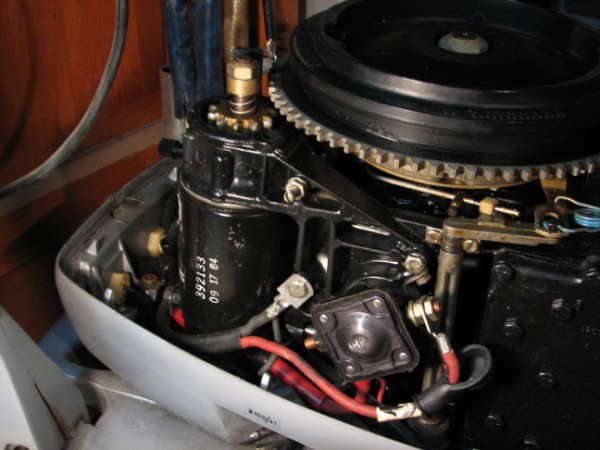
The flywheel is the big round black thing on top and when the engine is running it spins at very high revolutions. Imagine two of those spinning side by side and like Neil, falling onto them because some asshole opened the throttles………..and our flywheels were a lot less smooth than this one. We had all sorts of jagged bits sticking out to bite us.
More on outboard motors, flywheels, shear-pins and other animals in the next post.
Please also have a look at my website dedicated to Rhodesian and South African Military Engineers. Join us on the forums by using the following link:
http://www.sasappers.net/forum/index.php
Copyright
© Mark Richard Craig and Fatfox9’s Blog, 2009-2014. Unauthorised use and/or duplication of this material without express and written permission from this blog’s author and/or owner is strictly prohibited.
On The Boats…………(Part 1)
December 6, 2014
I watched the snake slither along the wooden rafter of the hut, its black tongue flicking ahead, feeling the way. Lying on my bed and looking up at the bright green reptile I wondered what my escape plan was. It was the first time a mamba had come into our billet but I always knew our luck would run out one day. We were after all in the middle of the bush, working out of Deka Army Base and snakes were quite commonplace. I didn’t like snakes then and I don’t like snakes now. Just one of those things. Anything else I can handle.
Here is a picture of a Green Mamba (greenmambasnake.com)…..a very dodgy visitor indeed:

There were two of us. Both Sappers from 1 Engineer Squadron and attached to the infantry unit at the camp. I think it was 1 Independent Company from Wankie based there most of the time on Border Control operations. Tony Carinus and I were tasked with operating a Hercules Assault Boat within our area of responsibility on the Zambezi River, and our boat was moored with the British South Africa Police (BSAP) boats at the Sibankwazi Police post. We had approximately 60 kilometres of river to patrol which was quite a stretch and we tried to cover this as often as we could.
Our boats were shite-looking and the police boats were all shiny and painted in cute pastel colours with lots of aerials on them so they could listen to Sally Donaldson and Forces Requests on Sundays. Papa5 was a particularly nice police boat that I would have given my left testicle to take onto the river but big John Arkley, the Member-In-Charge of the Sibankwazi BSAP would not allow it. We never had any aerials as we had no one in particular to talk to and the boats were painted a matt dark green, or at least they were green when they were new which must have been in 1945 or earlier.
Here is a picture of one of our boats (Basil Preston):
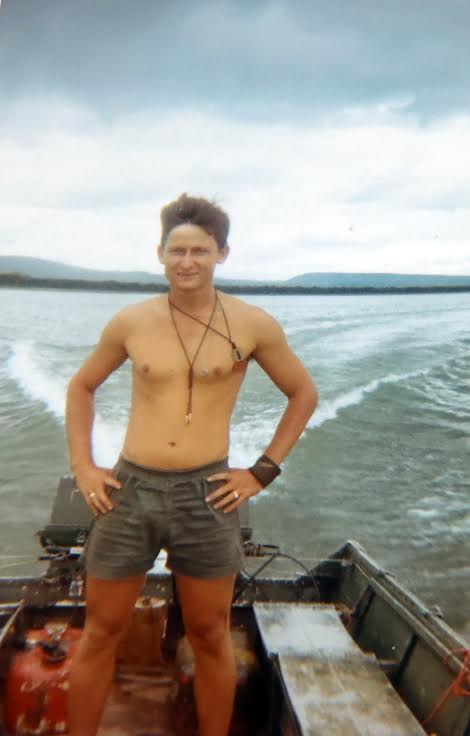
Please note the warped wooden seats made for extreme anal comfort, and the generally dodgy state of seaworthiness. I must say that this boat at least has engine covers on the twin 40 ponypower Evinrude outboards so is probably a VIP version. A close look at the red fuel tank also indicates it was probably “borrowed” from a civvy fisherman on a long-term basis as ours were a dull drab brown colour. Either that or the QM ran out of camo paint or brushes, or both.
Here is a picture of the area of the Sibankwazi Police Post (www.bsap.org) where we moored up.

Our boat was not allowed under the shelter because there were too many shiny police boats in there. We normally tied up to the left of the shelter near the launching area (see above). Having said that the bobbies were always very good to Tony and I and we had many good piss-ups and braais with them. They were also destined to get me out of some fairly serious shit in the years to come.
Tony and I normally planned our own activities and it seemed in retrospect that the infantry Sunray (OC) at the camp never had much interest in what we got up to all day. Only occasionally would we drop-off or pick-up infantry sticks along the Rhodesian side of the river. This resulted in a lot of tiger fishing, game viewing, stopping off at Msuna Mouth or Deka Drum resorts for beers and a meal, or simply patrolling up and down the river looking for gook crossing points or even better still, some gooks.
This is the Deka Drum area of the Zambezi (Craig Haskins)………

A pretty enjoyable time for me and Tony in general and I have fond memories of my days on the boats. We did however have some dodgy experiences and these will part of the next few posts.
Please also have a look at my website dedicated to Rhodesian and South African Military Engineers. Please join us on the forums by using the following link:
http://www.sasappers.net/forum/index.php
Copyright
© Mark Richard Craig and Fatfox9’s Blog, 2009-2014. Unauthorised use and/or duplication of this material without express and written permission from this blog’s author and/or owner is strictly prohibited.
Farewell to Cordon Sanitaire…….for a while
November 9, 2014
The previous posts focussing on laying Cordon Sanitaire took more time and research than I thought they would. These operations were truly the Rhodesian Corps of Engineers own private battle within the Rhodesian Bush War. Thanks to the input of former Rhodesian Sappers (and in some cases, non-Sappers), I think we have managed to bring those challenging days to life once again. As I mentioned in a foregoing post, I feel enriched and privileged to have been part of these operations. It was and still is an honour to have shared the hardships and dangers with that very special Band of Brothers. Mukumbura will never be forgotten.
There will be more on Cordon Sanitaire later but now is not the time. These future posts will fall under the main title of Cordon Sanitaire Phase 2 (Minefield Maintenance). In so many ways this was the biggest challenge we had as a Corps. The dangers faced by maintenance crews were far greater than those faced during the laying of the Cordon which in relation to this blog was Phase 1. Indeed, the majority of Rhodesian Engineer fatalities and serious injuries were a result of minefield maintenance operations. As a Regular Army sergeant I commanded minefield maintenance operations at both the Deka Minefield and the Victoria Falls Encirclement and will discuss both of these at a later stage.
For now it is time to say farewell to Operation Hurricane as we move to the Operation Tangent area (see map below).
The next post will start off with my recollections as a boat operator on the Zambezi River, based at Deka Camp and operating out of Sibankwazi with the British South Africa Police (BSAP).
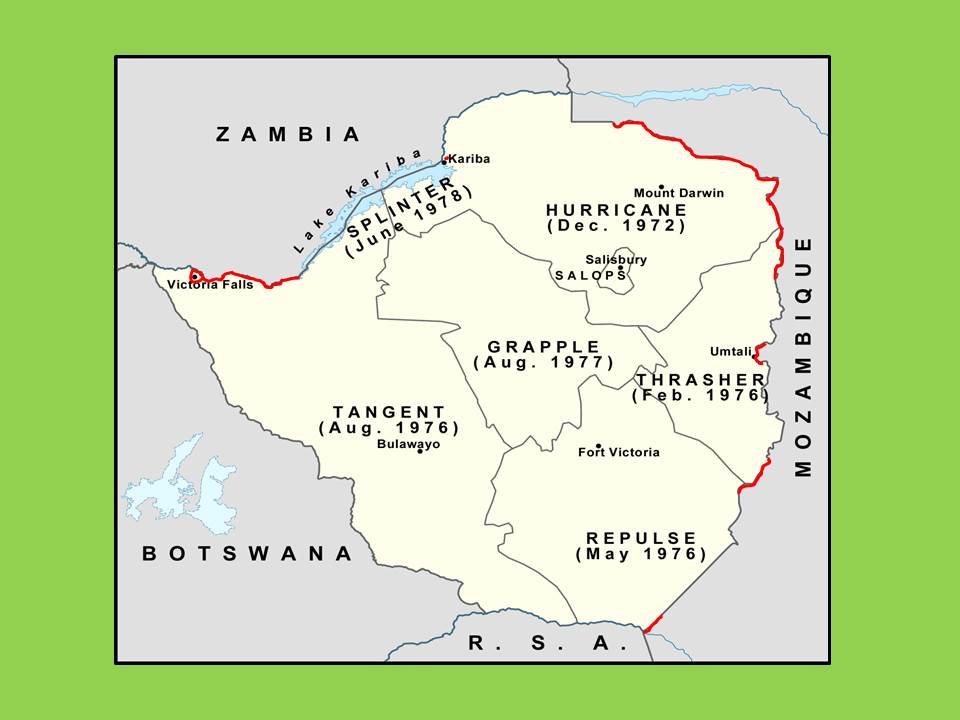
Interesting times indeed and I hope that you will continue the journey with me.
Please also have a look at my website dedicated to Rhodesian and South African Military Engineers. Please join us on the forums by using the following link:
http://www.sasappers.net/forum/index.php
Copyright
© Mark Richard Craig and Fatfox9’s Blog, 2009-2014. Unauthorised use and/or duplication of this material without express and written permission from this blog’s author and/or owner is strictly prohibited.
Cordon Sanitaire: Personal Experiences (3: Basil Preston)
November 2, 2014
The response to my request for personal experiences on Cordon Sanitaire has resulted in a number of submissions from people who clearly want to see our history recorded and celebrated. Long forgotten names are being mentioned, sparking the grey matter into life once again and there is so much to be gained by reading about other people’s experiences on the Cordon. I for one feel enriched by all of this.
The following is from Basil Preston, a Rhodesian Sapper who I am sure has many more stories to share with us and I really hope that he does. I have slightly redacted Basils submission, however it is mostly exactly the way he sent it to me.
Hi Mark,
My name is Basil Preston army number was 72860 and I became an Engineer after I did my basics at Llewellyn starting 07/06/1972, Intake 132.
I have just read your blog about the Cordon Sanitare (sp) mine-field starting at Mukumbura.
We were the first Engineers to start this field, in either February/March or April 1973, can’t remember the exact date, (but ABBA, the Swedish group had just announced that they were in support of the freedom fighters at that time, we all dropped them from our favourites after this announcement).
We were tasked with the clearing of the bush etc with bulldozers and graders. Our main chap who loved the grader work was Gordon Paterson, who was black by the end of his shift from all the dust and sweat.
We were broken up into 3 groups; clearing party, guarding the workers and the clearance party comprising 3 sappers, who did a 360 around the whole group. Tetse workers were busy with the fencing.
Corporal Gleson was in charge of us, and Corporal Charlie Mcquillan and Sergeant Hitchins/Hutchuns (sp) were there too, but did nothing special as they were imports from the UK who joined the army as regulars and were being bushed trained. These chaps were electricians by trade, but knew nothing much about our conditions or bush. We were about 20 sappers all told, and were looking forward to our demobbing in June. We were due to pass out on the 13/05/1973. Melvin Hein, Tommy Dickinson, Basil Kirby, Mike Travaglini, Gordon Paterson, Gumbie Dixon are just a few names I remember.
We were told that if we saw anyone foreign to our people, we were to first contact base camp to confirm, as they could be Tetse workers.
On our first outing, I was part of the 360 group, comprising Tommy (Dicky) Dickinson, Gumbie Dixon and myself, and we had just collected Marula fruit and were busy eating them when I noticed movement about 400 metres away from us. As I passed a huge palm leaf, the 2 images I saw went to ground. I shouted “ters” and we took cover, made contact with base camp, who told us to wait one, and they would come and assist. (contact via our radio was a laugh, as Dicky’s hand was shaking so much, the coms was interrupted going out, as the hand press-switch was also being pushed on and off as the shakes continued)
We were high on adrenalin and got impatient waiting for back-up, and started to leopard crawl through a dried out mealie field, which was cutting our knees to pieces. We then ran to where we saw the 2 images go down, all the grass was laid flat.
Back-up arrived nearly an hour late, and off we went. By this time, the Cts were back in Mocambique. But we still did a follow up. Crossing our own freshly graded mine field was hectic. Crossing by running across the open one at a time The Sergeant got stuck on the fence as the strain of wire wedged between his back-pack and his back, I ran forward to help the guy,who did not appreciate it as we were now both sitting targets.
Nevertheless, we were the first group of sappers to have a “contact” be it visual only. We were not impressed with the time it took the back-up to arrive and we voiced our views on this.
But to cut a long story short. After weeks doing the same thing, day in and day out, and nightly ambushes along the field, we started to get gut-vol.
On our return from the field one day, Charlie Mcquillan, wanted to put my group on extras as he had found a tin of jam in our bivy area, full of stinkbugs and ants eating the left-overs. One of our group had acquired the tin of jam from the kitchen. We were short on every thing by this time. We lost it and asked him why he was snooping around; and threatened him with his life. Dicky was going to see that he never left the country, as he was “customs” back in civy life, I was a banker and told him that he would never get foreign exchange when he left Rhodesia and Melvin just wanted to hit him with a pick-handle. The rest of the guys just wanted to bury him in our trench. Corporal Gleson saved Charlie that day.
I also went onto doing the Dekka mine-field, and the one at Villers. Did boats in Kariba with Ant White, at the time they were forming the Selous Scouts and served with RAR, 2RR for almost the whole of the continuous period at Malapati and various other RR Companies. Looking back, I had a tough 8 years of army life as a sapper. My son was 3 weeks old when I was called up for the “Continuous” period and was 13 months old when I saw him proper again. All told, the guys I served with were a great bunch indeed. Mick (Chum) Jones was in my intake too. He was killed with Leroy Duberly, Charles Small, Peter Fox and one other during the second Chimoi external. They were with a bunch of RLI all in a Puma which was shot down, all 17 in the chopper were killed.
Thats all for now.
Regards, Basil Preston
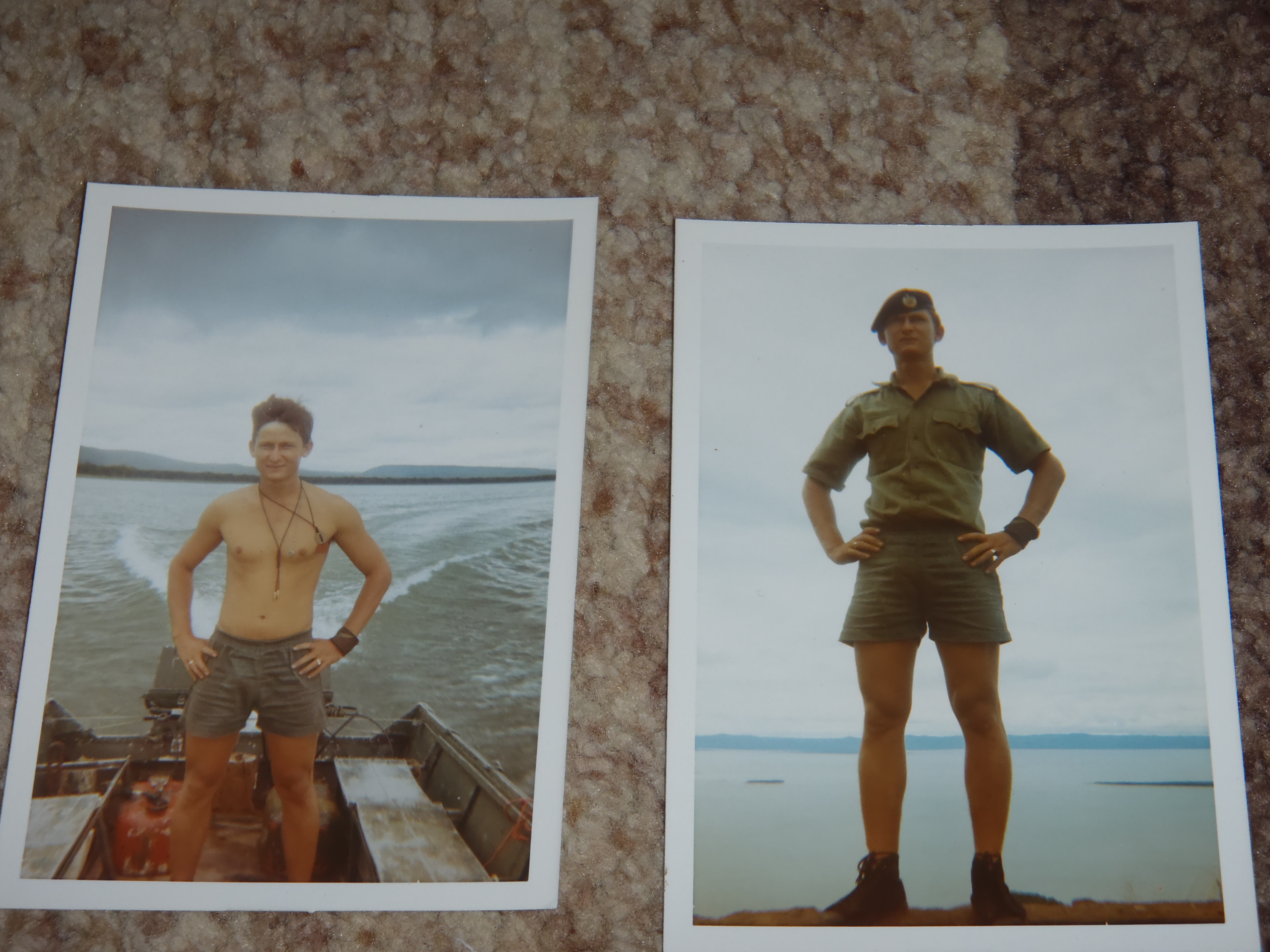
Photos of Basil are shown below:
Please also have a look at my website dedicated to Rhodesian and South African Military Engineers. Please join us on the forums by using the following link:
http://www.sasappers.net/forum/index.php
Copyright
© Mark Richard Craig and Fatfox9’s Blog, 2009-2014. Unauthorised use and/or duplication of this material without express and written permission from this blog’s author and/or owner is strictly prohibited.

