Fast forward to about 5 weeks of being at Nyahuku.  Nothing has changed as far as decent logistic support and we seem to have become a self-sufficient sub-unit of whatever Squadron cared to consider us theirs.  Morale was rock bottom, arguments broke out between friends, and there was little that could raise the gloomy atmosphere that prevailed.

We had been on dry food since we had started this mission and it was beginning to tell on the men’s stamina and general health.  I must add that the tinned food we were getting was not terrible, it just couldn’t provide the vitamins and nutrients that vegetables and meat did.  We all knew how to take a punch and were not weaklings, but you need proper fuel at some stage to keep the engine running efficiently.

Adam Foya, who I mentioned in an earlier post, ran a shop at a business center not far from our base.  He had become a great source of help to us and we all considered him a friend, no matter who or what he supported politically.  We never spoke of his leanings and I personally didn’t care – he was a good bloke.  Now here is a thing – I had discovered that many of the local tribes people were partial to good old bully beef, and we had tons of the stuff.  We had set up a kind of bartering day when we would take a load of tinned food to the business center and the locals would bring their home made beer, watermelons and goats to exchange for what we had.  It helped us greatly and I am forever in the debt of those people.  Livestock was a high value commodity to a local tribesman and the fact that they would trade one for our tinned food said a lot. So to say we never had fresh meat was not entirely true, but pretty damn close.  Goat meat and sadza was a welcome change from tinned sausages – especially when our cook made that extra special tomato and onion gravy.  It was literally a banquet.

Adam Foyas shop had some pretty interesting stock.  One of the back rooms that I went into with him was literally stocked from floor to ceiling with boxes of Black and White Scotch Whisky…….the little black and white Scotties smiling at me from the white boxes.  Real Scotch whisky was like gold in Rhodesia at the time and here was Adam with probably the biggest stash of the stuff hidden away in the Rhodesian bush.  We, of course managed to get a few bottles for the camp and that mixed with coke or cream soda made sure of a good nights sleep.  The purists of course scoffed at this concoction and stuck to drinking it either neat or with water from one of the bowsers.  I preferred the latter version.

Another treasured item found in Adams store was cigarettes.  He had plenty of the locally made brands when we first got there but his stock had dwindled as we had taken the bulk of his stock.  For some reason he was unable to bring more in so we were pretty frugal with sharing those that we had.

Although we survived with whatever we could buy from the shop, we had to pay in cash and most of us were really low on funds.  We could not draw money as there was no bank, and Brigade HQ did not see their way clear to send a paymaster out to assist us.

Sadly, it would be a cigarette that caused the tragic incident that will for always be the legacy of the Nyahuku mission.

This specific day had started out as it always did.  Wash, shave and have whatever the chef had cobbled together for breakfast.  He baked his own bread with ingredients from Adams store, and it was a winner, especially if you managed to get a warm piece, smothered in mixed fruit jam……we seemed to have gallons of the stuff.  And then it was onto the vehicles to begin the journey to the minefield.

On arrival we debussed at the point where we had finished laying the previous day, and split into out three work parties – diggers, layers, and armers.  See  https://fatfox9.net/2014/01/14/mukumbura-learning-the-ropes-part-2/ for more details of the Cordon Sanitaire methodology.

I was working in the arming party in the middle row (bravo line) on this particular day.  Work was progressing well and there was nothing to indicate that anything would get in the way of this being just another day of Cordon Sanitaire operations.

Jimmy Datsun was working the home side row (alpha line) – his team were also arming mines, but a safe distance behind my team so that we could get to safety if the gooks attacked us from the enemy side.  One of the control staff called for a rest break and the drill was to complete arming the cluster you were working on and step back before sitting down and having a short rest.  This was also when those of us who had cigarettes lit one up – I was one of the fortunate ones.

I heard Jimmy shout from behind me, asking of I could spare him a smoke as he had run out and of course I replied in the affirmative.  What happened next will forever be burned into my memory.  For some unknown reason, Jimmy did not come around the safe route to me but stepped over the cluster of mines he had just laid, stepping on the 12 o’clock mine and blowing his foot off – if I remember rightly it was his right foot.  Bits of his foot and boot flew in my direction as well as a cork container of detonators – he had landed on his back and writhing around .  And then he started screaming and I immediately shouted for everyone to stand still and not to move – our radio operator had already called for a casevac as it was obvious that we would need one and our medic was being escorted to Jimmy’s location, which was right next to where I was standing.  Things happened so fast and if you have never been in such a situation it is difficult to explain how time seems to fly by, and yet in slow motion at the same time.  I knelt next to Jimmy, ever cautious of other armed mines and tried to keep him a still as possible – he talked to me and I did my best to keep him calm, telling him he would be fine and the chopper was on the way.  I remember to this day his words to me as he looked at the awful damage to his foot……he simply looked at me with tears in his eyes from the pain and shock and said “look at the state of that”.  This was the measure of the man and I held his hand while he bit down on my dog-tags…..and the medic moved me out of the way to begin his work.  Jimmy held my hand and wouldn’t let go while we set up a drip and applied a tourniquet half way up his calf, this to stop bone marrow getting into his blood stream, not to quell any blood loss.  His wound had been cauterised by the heat of the blast and there was little blood. The main thing was bone marrow and shock.  As the morphine that the medic had administered took effect, Jimmy’s grip on my hand relaxed and he drifted into a painless daze.  I wiped sweat from his forehead and the medic stuck a piece of plaster on it indicating the dose of morphine administered and the time it was given.

The casevac chopper did not take long to get to us as they were based at Kotwa and the flying time in a straight line was thankfully quite short.  In the meantime we had carried Jimmy out on a stretcher and placed him outside the minefield in the shade.  I sat with him while we waited and although he was a tough man, I could see the fear in his eyes.  I stayed with him until the gunship arrived with an additional medic to take him to Mount Darwin where he would be in the best hands possible.  Jimmy was fully stabilised by now and they loaded him up – the chopper pilot hit the collective and it rose into the sky in a cloud of dust and avtur fumes.  I stood watching it as it went on its way…..until it disappeared over the horizon.  And then the deafening silence as we all took in what had just happened.

I slumped down next to a tree and lit up a cigarette……this one was for Jimmy.

The Nyahuku operation was closed down shortly after Jimmy lost his leg.  There never was a terrorist crossing there, there never was any explanation for the piss poor support we received, and no one ever spoke to any of us who were there.  Nyahuku remains one of the saddest and most badly planned missions I took part in during a 25 year career in the military. The total lack of accountability at the highest level remains a dark memory that somewhat taints my pride for having served in the Rhodesian Army.

Jimmy survived his ordeal and now lives in the UK, and although a number of people, me included, have tried to make contact with him, he is incommunicado.  I respect that, but will keep on trying – its my duty.  After all, we still have to have that smoke together.


As a member of the Regular army within the Rhodesian Corps of Engineers, it was not unusual to be redeployed to different operational areas to assist where additional manpower or specialist military engineering expertise was required.  If you were in-between missions, and idling around at Squadron HQ in Bulawayo (Brady Barracks), you were a prime target for any dodgy task that might be dreamt up by the upper echelons.

The following posts recount one of those occasions.

I was in the Squadron admin office doing my best to look busy, operating the Gestetner machine, rolling off precis for the next intake of recruits from Llewellin Barracks – they would have just finished their basic training, and been selected for Engineers. 

There was much to prepare for their arrival, and to be honest I was not into this arranging barracks rooms, stapling A4 sheets together and arranging bed-linen lark – luckily I was about to snivel out of it – although I would have been much better off staying and helping with the incoming Gobbies1. 

Someone shouted my name from one of the offices in the HQ. I recognised the voice – it was Staff Sergeant Vic Hydes and he was someone you never kept waiting and I quickly doubled-away to see what he wanted. Vic was often referred to as “Little Hitler”, and it was for a good reason – he was the bloke that had made me swim from one end of Umzingwane Dam, to the other – at night. For more on these aquatic activities please follow this link: https://fatfox9.net/2010/05/22/mzingwane-dam-part-1-combat-engineer-practical-training-phase/.

Vic briefed me, although with the little he knew himself, I was only marginally wiser after leaving his office. The short of it was that hot intelligence (laughing my head off) had been received (laughing again) that a large group of gooks2 were planning to cross into Rhodesia somewhere along a 30 kilometer stretch of the border with Mozambique in an area of East Mashonaland within the next two to three weeks. The general location of the suspected crossing point was within an area known as Nyahuku, and is shown below in the orange circle:
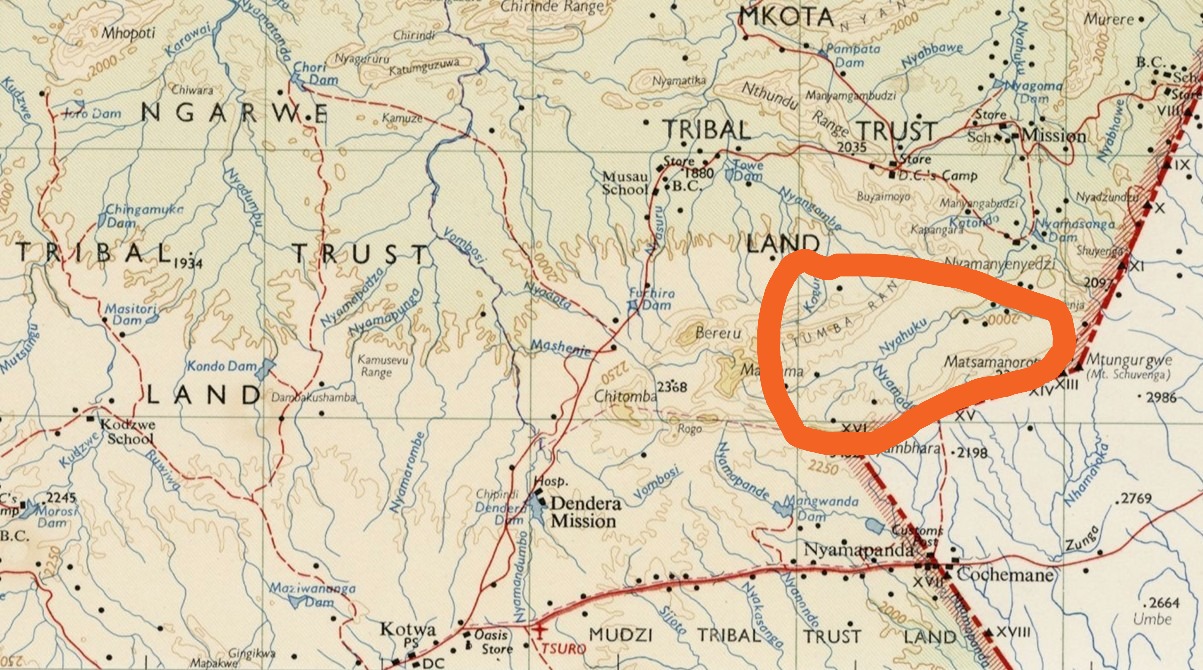
During the day more information came to light and I learnt that we had been tasked, together with elements of 2 Engineer Squadron from Salisbury, to lay a rapid barrier minefield (Cordon Sanitaire pattern – see https://fatfox9.wordpress.com/wp-admin/post.php?post=491&action=edit) to block the suspected enemy line of advance where it would cross the Mozambique/Rhodesian border, and kill them.

Due to the geographic location of the target area, 2 Engineer Squadron would be calling the shots on this one, with overall command, control, administrative and logistic responsibility. 1 Engineer Squadron was only providing personnel.

1 Engineer Squadron would mobilise approximately 30 Territorial Force and National Service Field Troop (NSFT) personnel for this mission and they were due to arrive at Brady Barracks in drips and drabs over the next 48 hours. In the meantime I would be working to get 3 troop carrying vehicles prepped for the 650 kilometer journey that lay ahead of us. Nyahuku was a world away from Bulawayo and it was going to be a monster of a drive of 10 to 15 hours, not including stops. Our route would take us through Salisbury where we would night stop and join the 2 Squadron personnel, and then on to Mtoko the next day. Joint Operations Center (JOC) Mtoko, was a key fire-force and intelligence hub within the Operation Hurricane area, and we would take our last stop there before making the final leg to Nyahuku via Kotwa.

Over the next few days I cobbled together 1 x Unimog 25, and 2 x Rodef 45s for the force that would deploy with me. These were reliable Mercedes-based vehicles and I was pleased that we had these three available for us to use, as we would also be towing a full water bowser and fuel bowser.

On the night before we were due to depart we had a good session in the pub, the usual banter between Regulars, Territorials and National Servicemen continued well into the night. Most of us knew one another – we were a small band of brothers, highly experienced in our craft and more than capable of carrying out the task ahead.

The last thing to be done on the morning we left was to test our TR48 radio for comms with 1 Engineer Squadron ops room, plus inter vehicle comms with A76’s, draw our weapons,/ammunition, and 48 hours of rations per man – 2 rat-packs each.

With vehicles full of fuel and final trips made to empty bladders, we fired the Mercedes engines up, and were on our way before noon, most of the passengers dozing-off before we hit the road to Salisbury.

Salisbury would prove to be where things started going wrong at pace.

More to follow in Part 2

  1. The newest intake to arrive from Basic Training are lovingly referred to as Gobbies by the more senior intakes, or to use the full term, Gob-Shites ↩︎
  2. Communist Terrorists or CTs ↩︎