Piss Poor Planning: The Debacle of Nyahuku (Part 2)
March 7, 2026
The journey to Salisbury was fairly uneventful, and except for the occasional stop for the customary pee, smoke and leg stretch, we arrived in good time and still in daylight.
Reporting to the 2 Squadron HQ, where we were expecting a hero’s welcome and friendly smiles turned out to be a pretty poor assumption and was far from reality. No one seemed to have a clue why we were there and evidently we should have pushed all the way through to Mtoko without a stop in Salisbury. This was light years from the instructions given to us in Bulawayo, and it was pretty clear it was another of those military blunders – sadly this was just the first example of many to come on this mission.
We were not keen to travel through to Mtoko immediately, and in any case we would not be allowed to as it would be breaking the curfew if we did, so it would be a night stop sleeping under our vehicles and the stars as there was no accommodation arranged either. This by default also meant no catering arrangements either. I asked that a message be sent to 1 Squadron, informing them of the situation and apparent miscommunication. This of course to cover my arse.
We were given permission to park our trucks on a piece of open ground for the night. After collecting money from the crew we sent a couple of lads with the Unimog to buy beers at the canteen, and cokes for the teetotalers. It was going to be ratpack stew for supper. At least we could have a few drinks and shoot the shit before climbing into our sleeping bags – life was as good as we could make it within our cohort. I fell asleep looking at the stars.
Early the next morning we cleaned up the area, washed and shaved using the taps on our water bowser. I then sent the drivers to fill our vehicles at the Petrol, Oil and Lubricants (POL) point, while one of the sergeants and I paid a visit to the Squadron HQ once again. I recognised one of the junior officers and asked if we could have a word. According to him, he knew we were on the move to Mtoko, but there was never a plan for us to night stop in Salisbury, which I found very strange indeed, considering we would not have enough daylight to get from Bulawayo to Mtoko in a single day without breaking curfew. I considered this and as it was a lovely sunny day, decided that it was just one of those things. He added that the 2 Squadron contingent had left for Mtoko at the same time we left Bulawayo – so they were already there waiting for us, and had already been informed by radio of the change in plan, and that we would be arriving later today.
Our next dilemma was rations. We had only drawn 2 ratpacks each at Brady Barracks and therefore already breaking into our second and last one. Should we encounter any further delays on the way to Mtoko, we would be in a bit of a fix, food-wise. I asked the officer if we could be issued a further 2 packs per man and to my surprise he told me all of our rations were with the 2 Squadron contingent and there was nothing available for us in Salisbury. No use arguing, but the plan was continuing to unravel. If you want to mess with troop moral, take away a soldiers food and pay.
By now our vehicles had refueled and were parked-up close to the Squadron HQ, waiting for the sergeant and I to join them. As we were leaving the HQ, the Squadron Sergeant Major, who I also knew approached me and asked what those waster 1 Squadron vehicles and troops were doing in his lines. I explained the situation we were in and he immediately got very pissed off, not with me but rather the 2 Squadron HQ in general. He berated them for not providing us decent accommodation and a warm meal on arrival and insisted that rations be issued to us for our journey to Mtoko. Whoever his ire was aimed at I do not know, but there was much activity while arrangements were made for us to collect additional rations for the journey. At least there was someone who understood where the fault lay and done his best to make things right. He directed us to the QM store where we were issued what was known as tinned equivalent, not rat packs per se, but rather bulk rations in big cardboard boxes containing larger tins and other bits and pieces that we could share between us when the time came.
Everyone loves a Sergeant Major – and normally avoids pissing them off.
After thanking him for bringing some inter-squadron cooperation to an otherwise hard start to the day, we mounted the trucks and got on our way to Mtoko.
The 140-odd kilometer journey would take around 3 hours – but this was a dangerous route where high vigilance was required. To add context, attacks on this road were frequent, characterised by gook ambushes, minelaying, and infiltration attempts, crucially as the enemy had established so called “liberated zones” in the Mtoko area.
The gooks knew that if they could dominate this road, they would be successful in disrupting Rhodesian Security Force logistics.
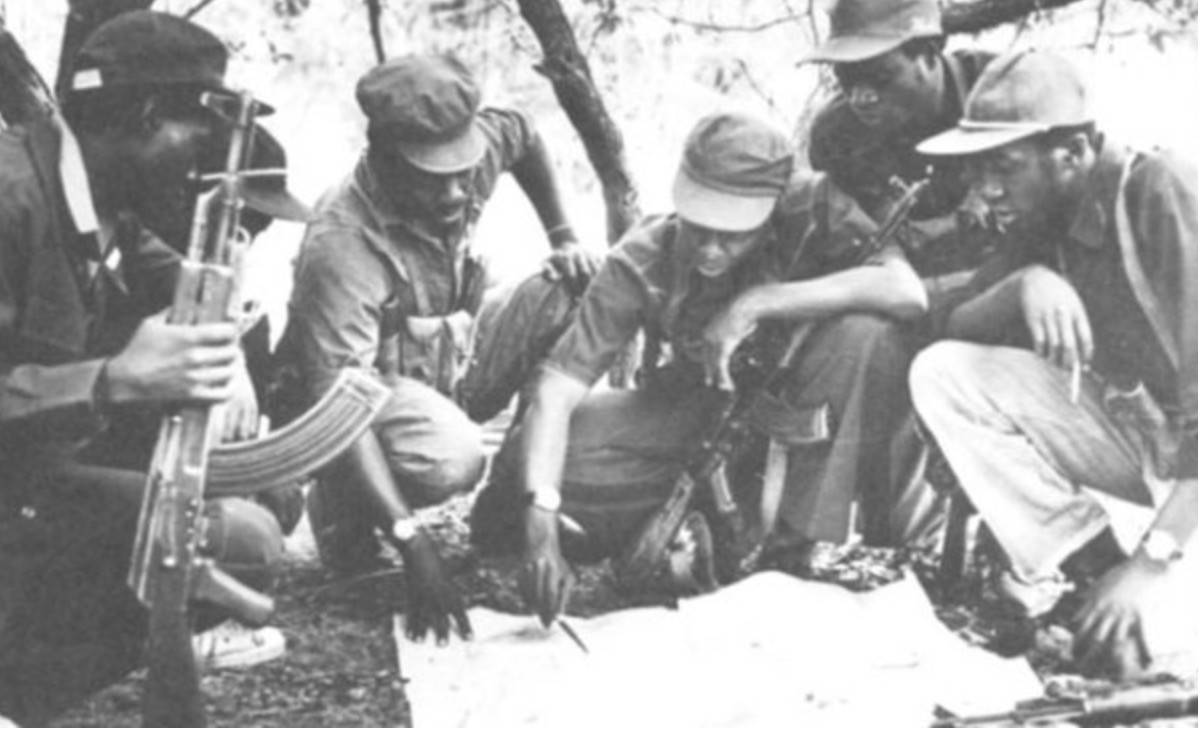
Above: ZANLA CTs making a plan – Owner unknown but I do acknowledge that this is not my media
And we were going to be travelling right through the Zimbabwe African National Liberation Army (ZANLA) hunting grounds.
Would we make it through unscathed? Part 3 will tell.
Copyright
© Mark Richard Craig and Fatfox9’s Blog, 2009-2026. Unauthorised use and/or duplication of this material without express and written permission from this blog’s author and/or owner is strictly prohibited.
Piss Poor Planning: The Debacle of Nyahuku (Part 1)
February 28, 2026
As a member of the Regular army within the Rhodesian Corps of Engineers, it was not unusual to be redeployed to different operational areas to assist where additional manpower or specialist military engineering expertise was required. If you were in-between missions, and idling around at Squadron HQ in Bulawayo (Brady Barracks), you were a prime target for any dodgy task that might be dreamt up by the upper echelons.
The following posts recount one of those occasions.
I was in the Squadron admin office doing my best to look busy, operating the Gestetner machine, rolling off precis for the next intake of recruits from Llewellin Barracks – they would have just finished their basic training, and been selected for Engineers.
There was much to prepare for their arrival, and to be honest I was not into this arranging barracks rooms, stapling A4 sheets together and arranging bed-linen lark – luckily I was about to snivel out of it – although I would have been much better off staying and helping with the incoming Gobbies1.
Someone shouted my name from one of the offices in the HQ. I recognised the voice – it was Staff Sergeant Vic Hydes and he was someone you never kept waiting and I quickly doubled-away to see what he wanted. Vic was often referred to as “Little Hitler”, and it was for a good reason – he was the bloke that had made me swim from one end of Umzingwane Dam, to the other – at night. For more on these aquatic activities please follow this link: https://fatfox9.net/2010/05/22/mzingwane-dam-part-1-combat-engineer-practical-training-phase/.
Vic briefed me, although with the little he knew himself, I was only marginally wiser after leaving his office. The short of it was that hot intelligence (laughing my head off) had been received (laughing again) that a large group of gooks2 were planning to cross into Rhodesia somewhere along a 30 kilometer stretch of the border with Mozambique in an area of East Mashonaland within the next two to three weeks. The general location of the suspected crossing point was within an area known as Nyahuku, and is shown below in the orange circle:
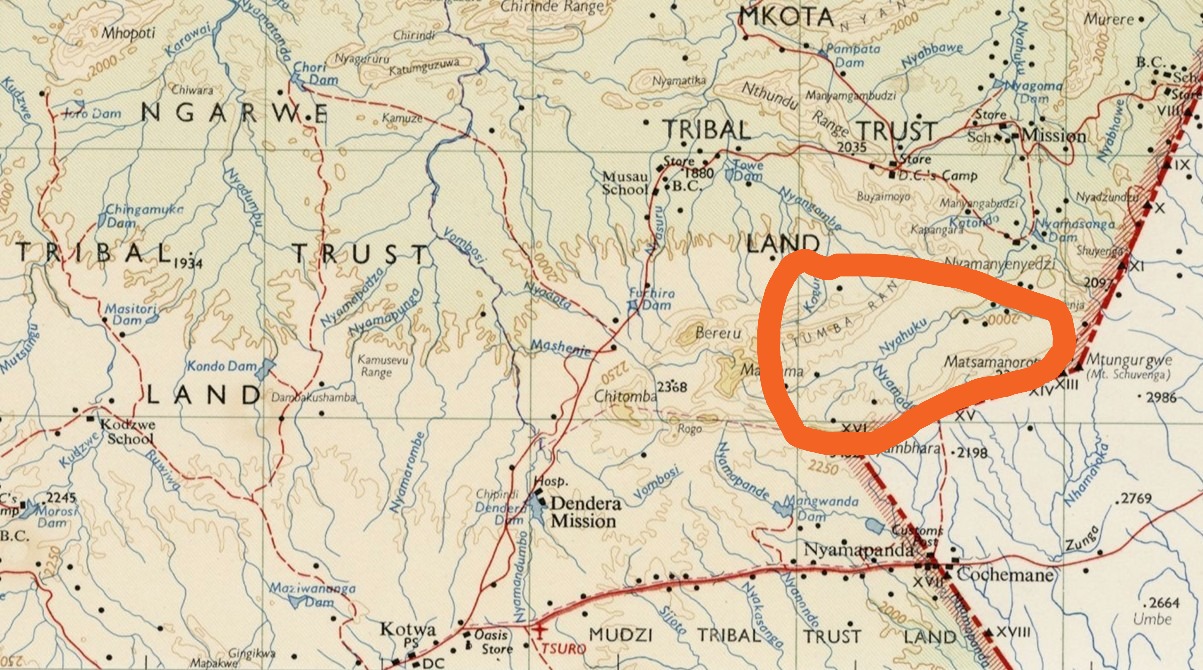
During the day more information came to light and I learnt that we had been tasked, together with elements of 2 Engineer Squadron from Salisbury, to lay a rapid barrier minefield (Cordon Sanitaire pattern – see https://fatfox9.wordpress.com/wp-admin/post.php?post=491&action=edit) to block the suspected enemy line of advance where it would cross the Mozambique/Rhodesian border, and kill them.
Due to the geographic location of the target area, 2 Engineer Squadron would be calling the shots on this one, with overall command, control, administrative and logistic responsibility. 1 Engineer Squadron was only providing personnel.
1 Engineer Squadron would mobilise approximately 30 Territorial Force and National Service Field Troop (NSFT) personnel for this mission and they were due to arrive at Brady Barracks in drips and drabs over the next 48 hours. In the meantime I would be working to get 3 troop carrying vehicles prepped for the 650 kilometer journey that lay ahead of us. Nyahuku was a world away from Bulawayo and it was going to be a monster of a drive of 10 to 15 hours, not including stops. Our route would take us through Salisbury where we would night stop and join the 2 Squadron personnel, and then on to Mtoko the next day. Joint Operations Center (JOC) Mtoko, was a key fire-force and intelligence hub within the Operation Hurricane area, and we would take our last stop there before making the final leg to Nyahuku via Kotwa.
Over the next few days I cobbled together 1 x Unimog 25, and 2 x Rodef 45s for the force that would deploy with me. These were reliable Mercedes-based vehicles and I was pleased that we had these three available for us to use, as we would also be towing a full water bowser and fuel bowser.
On the night before we were due to depart we had a good session in the pub, the usual banter between Regulars, Territorials and National Servicemen continued well into the night. Most of us knew one another – we were a small band of brothers, highly experienced in our craft and more than capable of carrying out the task ahead.
The last thing to be done on the morning we left was to test our TR48 radio for comms with 1 Engineer Squadron ops room, plus inter vehicle comms with A76’s, draw our weapons,/ammunition, and 48 hours of rations per man – 2 rat-packs each.
With vehicles full of fuel and final trips made to empty bladders, we fired the Mercedes engines up, and were on our way before noon, most of the passengers dozing-off before we hit the road to Salisbury.
Salisbury would prove to be where things started going wrong at pace.
More to follow in Part 2
Sleeping Snakes and the Whistling Sapper
September 22, 2025
I mentioned in previous posts that the Engineers were often utilised in the Infantry role, or at the very least expected to carry out what are customarily Infantry tasks. There was no operational or tactical issue with this concept as all Rhodesian soldiers, regardless of any additional Corps affiliation, were also Infantiers – the fundamentals of these skills being taught during basic training. The Rhodesian Corps of Engineers were Combat Engineers in the true sense of the word, trained to take on the enemy in face-to-face combat, and also carry out a wide variety of Military Engineering tasks. The account that follows is one of these times and is vividly burnt into my brain……despite an ever-fading memory of an event that took place over 50 years ago.
Early that morning I had just finished a sickly sweet condensed milk coffee and going through the guard commanders evening occurrence book in the ops room when I heard a vehicle pull up. I stepped outside to see who our visitors were, recognising the doorless dark green Land Rover straight away as a British South Africa Police (BSAP) vehicle from Wankie. The two occupants were already standing next to the vehicle, both in civilian dress. I knew both of them – one was a BSAP Special Branch (SB) officer, the other was my Engineer OC from our Wankie (4 Indep Coy) office. After the usual greetings and inter-service banter I invited the two of them over to my office, ordering a jug of more sickly sweet coffee and mugs as we went.
The SB officer got straight into explaining the reason for their early and unannounced visit, informing me that I had been allocated a special task that was time-sensitive. My boss-man was there to add context to the briefing during which he confirmed that the operation had been authorised by 1 Squadron HQ in Bulawayo.
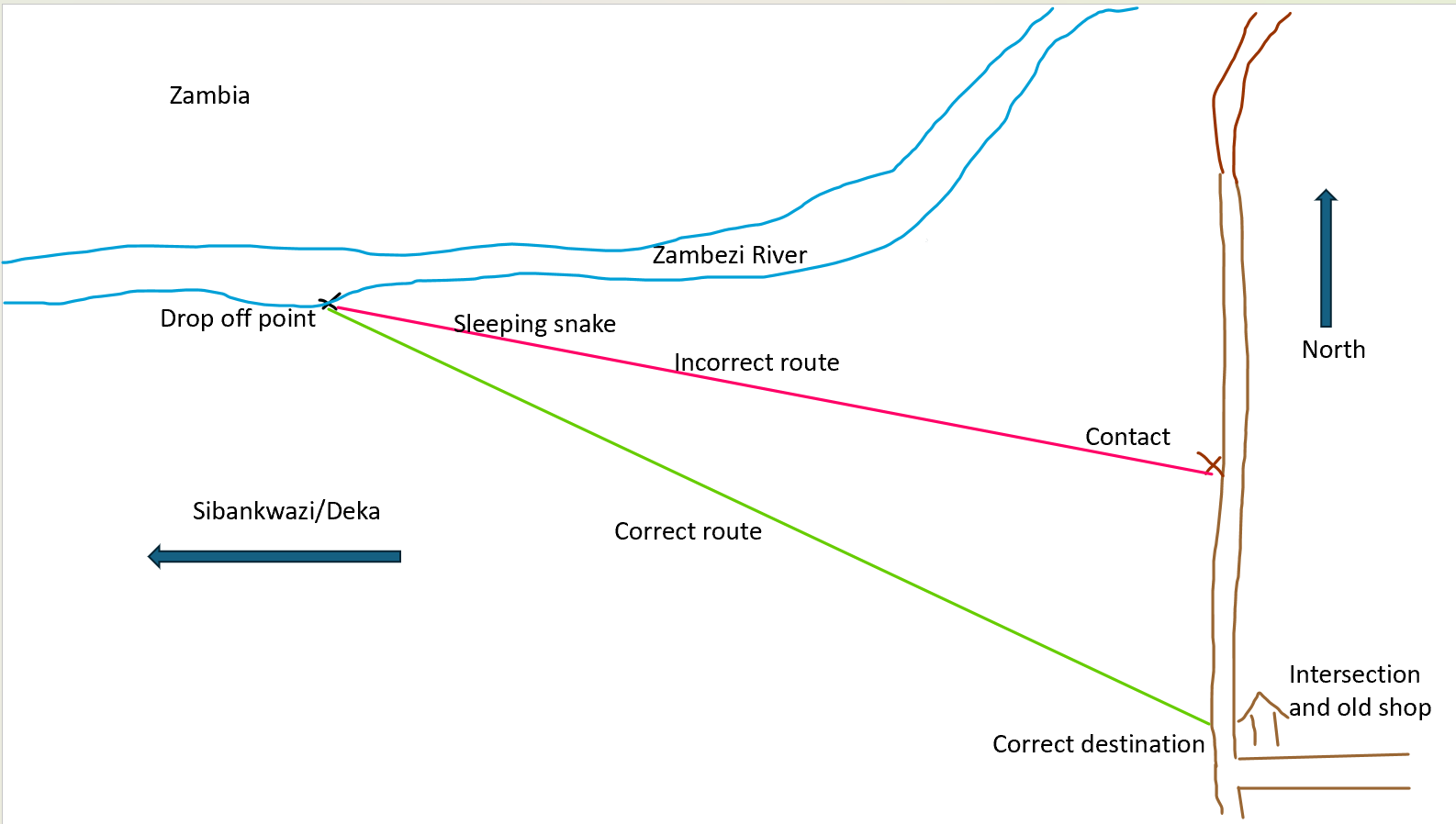
The mission was straightforward enough. “Hot”1 intelligence (I had to resist rolling my eyes – as I had been down that road before) had been received that a group of terrorists were going to be using a certain road intersection as a navigation point – a well-known terrorist method of moving from point A to B without getting lost or disoriented. They were expected to be at this point within a fairly short space of time – from what was known, within the next 24 hours. I was to lead a reinforced “stick”2 of 8 Combat Engineers to set up an ambush position adjacent to the said road intersection, and hopefully make contact with the enemy. The road that we would initiate the ambush on ran along a fence line from north to south, the intersecting road running east to west off of this at a very neat 90 degrees. There used to be a small general store at the intersection, but this was now derelict and in ruins. This feature should make it easy to confirm that we were in the right place.
Lastly I was ordered not to cross the fence under any circumstances – we were to stay on the western side of the road. No reason was given but I assumed this to mean we may have pseudo units in the area.
The tricky part was going to be getting there in time. We were going to be deployed by a BSAP patrol boat as the planners figured that this would be the quickest way, seeing that there were no Cyclone 7’s (Alouettes) to troop us in – they had other commitments. There would however be one Gunship on stand-by at Wankie Forward Air Field 1 (FAF 1) in case of a Casevac requirement.
Once we had confirmed callsigns, map numbers, grid references and the proposed route to the target area, our two visitors left, travelling the short distance down to the BSAP post at Sibankwazi to arrange the boats that would deploy us to our drop-off point along the river.
We had an hour or so to prepare before we too would travel down to Sibankwazi, and wasting no time I summoned the two Corporals whose sections would take part in the mission, and after briefing them, ordered them to ensure their men would be ready to move within the hour. Rations, water, weapons and ammunition needed to be inspected – radios checked and extra batteries drawn from the signaler. The chef was given instructions to make an early lunch for the troops going out with me – this would ensure we would all have full tummies before we moved out and sustain us until late afternoon.
With all preparations complete, I issued last orders to my second in command and we embussed onto an idling Rodef 45 Troop Carrying Vehicle (TCV). Handing my weapon and kit up to one of my troops, I hauled myself over the side of the vehicle and settled into one of the seats. My second in-command was standing next to the vehicle and I looked down at him – he was a good lad and would look after the camp while I was away – he was destined to become one of the first Black officers in the Rhodesian Corps of Engineers, and decorated with the Bronze Cross of Rhodesia.
The journey to Sibankwazi took no more than 30 minutes and we travelled down in silence, each of us thinking of the task ahead. We debussed on arrival and the troops moved the kit down to the jetty where the police launches were moored – the vehicle that dropped us off doing a three-point turn and returning to Deka camp. I asked one of the Corporals to carry out a radio check with our TR48 HF radio and confirm comms with both Deka camp and our Wankie HQ.
There was time for a quick brief with the Sibankwazi Member in Charge, a great friend of mine to this day, and we walked down to the boats together – he would skipper one of the boats out. I remember her callsign was Papa 5, she was a beautiful cruciform-hulled craft, painted white and light blue. We split my team between the two boats – the two skippers setting the trim, and we shoved off, travelling east down the Zambezi River.
Having made a time and distance appreciation while still at Deka camp, I had decided that we would be dropped off at a suitable point along Devils Gorge, approximately 20-30 kilometers east of Sibankwazi. The trip out was pleasant and the river calm and peaceful. By stretching the imagination, one could even believe that we were on a pleasure cruise, except we knew where we were. And always we had to remember that Zambia, home to our ZIPRA enemies was just a stones throw away off our port side – we had probably been observed through a pair of high-quality Russian binoculars or a Dragunov3 telescopic sight from the moment we had shoved off the jetty.
I was looking for a good place to be dropped off, the Devils Gorge towering high above us. It would be a hard climb to the top and I wanted to find the easiest access route up for us. I found what I hoped was the best place, a disused (hopefully) elephant trail that led from the river up to the top of the gorge. Elephants are pretty good at crushing everything that got in their way and they made wide super- highways down to the edge of the river from the top of the gorge – these for them to quench their thirst in the sweltering Zambezi Valley . In theory this should make our haul up the gorge much easier than hacking our way through virgin bush. The boats moved into the cleared space sideways on and we jumped onto the river bank, one by one. Before the boats departed I double checked my location on the map with our skipper and we both agreed on my current position. He would send the coordinates of our drop-off point back to Wankie HQ when he got back to Sibankwazi.
As the two boats disappeared from view we began the climb up and out of the gorge. Elephant are intelligent creatures and therefore clever enough to choose the shortest route up and down, meaning it didn’t take all that long to get to the top. Initially our progress was hindered by lack of grip as our boots slid and slipped on the crushed and slippery, elephant-crushed reeds close to the river but as we got higher it became easier and the super-highway was kinder to us. We eventually all made it out of the gorge safely in what I felt was reasonable time. Just off the crest, we went into all-round defence and I gave the stick a 15 minute rest. I would use this time to do some map work – check the grid bearing to the target on the map, and set my compass, making the necessary adjustments for magnetic declination.
Before leaving our rest area we all checked our kit for for rattles and loose items. We needed to sort these details out now as one thing that was a dead giveaway to the enemy was the sound of a stick moving through the bush like a bunch of church bell-ringers on a Sunday. With one look back towards the mighty Zambezi, I stepped the men off, heading south-east. I had calculated we would need to travel roughly 12 kilometers to the target area – and keeping a steady patrol speed of around 3 kilometers per hour we could be close to our destination in 4 or so hours, including stops. This would bring us to where we wanted to be just before last light – our chosen killing ground.
If climbing out of the gorge was reasonably easy, descending the other side was even easier as we still had the benefit of the jumbo super-highway and now we were going downhill……..some slips and slides along the way but we all arrived on the escarpment floor unscathed. I was happy to note that the men’s kit was nice and quiet, even when making sudden movements – the MAG gunner had done his very best to keep his ammo belts behaving themselves as well. As we reached flat ground, I got the men into extended line, and double checking the direction we were heading, gave the signal to move out.
We had been on the move for about 30 minutes when I noticed a rather large fallen log on the ground that I needed to step over. As I placed one foot on the other side of the log I looked down more closely to ensure I didn’t stumble and almost pissed in my pants. The “log” was actually one of the biggest pythons that I have ever seen – just lying there in the sun and minding its own business, its silvery-grey and black scales shining in the sun. I got my other foot over the sleeping snake, making sure not to touch this magnificent creature, and moved off quickly, leaving it to continue snoozing. I assumed the snake had recently had a big meal as it had no interest in me at all, and its quite true that if you avoid annoying them they will leave you alone. Fortunately my troops were blissfully unaware of the python, as had they seen it there would have been much shouting and running about – possibly bringing an unwelcome reaction from our sleepy friend.
Having walked for an hour we took a short break and carried out a radio check with the TR48 – all good and we marched on. I wanted to pace our advance to allow us to be within 1 kilometer of the road intersection just before last light – moving in only after we had had something to eat and a warm drink some distance beforehand. We also had to assume that the bad guys may have already crossed the road and were on our side of the road – alert levels were high, as with any patrol and we needed to keep our eyes and ears well tuned, or we could be going home in body bags.
I managed to get the timing just the way I wanted it – last light about 30 minutes away and we could see the north-south road just up ahead. If my map-reading was accurate the intersection and ruined shop should be just south of us. I got the troops into the prone position and I moved slowly forward on my own to confirm our position was correct. Leopard crawling through the long grass I edged towards the road until I was on the verge. I needed to be able to look both ways up and down the road which I managed to do – but there was no intersection and there was no old shop. I quickly checked my map after moving back from the road – I couldn’t make out where I had gone wrong. My problem now was working out which side of the intersection we were. Should we move south or north to locate it? With the sun now disappearing fast there was no time to waste and I decided to move a little more to the south. Getting the troops moving again we proceed until it would be not be in our interest to continue any further. I checked for the intersection and old shop again but there was nothing. It would appear my map reading skills were rubbish. I made the decision to set our ambush where we were and bite the bullet if we missed the gooks – the only consolation I had was maybe the intelligence was wrong in any case.
It was almost dark before we had finished our preparations and I was happy with our position. I had decided on a spot about 30 meters from the road with good visibility – we settled down for the long wait, the MAG gunner next to me – he would initiate the ambush on my command.
It was indeed a long night, taking turns to catch some much needed sleep we waited, and waited. My concern was that we we were nowhere near our intended position and we were simply wasting our time. Ones mind plays games in the bush at night – rustling in the undergrowth, owls calling and a myriad of animal sounds all around. Someone snored and was quickly silenced with a whispered curse – and the hours ticked by, seeming like days.
We were all awake before first light and this was a critical time – nothing had happened overnight and we could easily be drawn into a false sense of security. It was deathly quiet – nothing moved.
We all heard it at the same time – someone talking in African dialect, accompanied by the sound of people moving. I strained my eyes in the dim light, squinting through the wet grass- all of us now on full alert, adrenalin pumping. And then, incredulously, there was man standing on the opposite side of the fence that ran alongside the road – right in front of us. I couldn’t quite make out who he was as he started to climb over the fence. More of them followed – my brain began making a million calculations as doubt set in. We were out of position and what were the chances that the terrorists had made the same miscalculation and were now right in front of us? For some unknown reason I whistled at them and it was then that I saw the tell-tale AK magazine and gave my gunner the order to open fire.
All hell broke loose as my stick began firing towards the enemy……..screaming coming from their direction but no return fire as they scrambled back over the fence and started running – discarding equipment on the way. We started to move forward to the road, but the gooks had disappeared into thick bush and we took up the chase, cautious in case they laid an ambush on their tracks. There was blood on the ground and in the grass, enemy kit strewn about. We would collect it later – no kills for now, but at least we knew we had caused these guys some pain and seriously fucked-up their day.
I decided to get the stick into a defensive position while we radioed the contact into Wankie HQ – in reality this probably only a few minutes after we first opened fire. By chance, there was a Copper (Police Reserve Air Wing – PRAW) callsign flying close-by to us and the pilot had monitored our radio communication. He contacted us and asked for our location, which I passed onto him as well as the terrorist line-of-flight. He immediately flew to our position and established overhead cover and observation, at the same time making a plan to get stop groups placed ahead of the gooks. He was a very welcome addition to our little force as he was able to arrange Fire-Force from another location, together with Alouette gunships to join in. Until they arrived we would continue to follow the spoor until qualified trackers were flown in with more troops to continue the follow-up.
Once relieved we were instructed to collect all of the kit we could and await uplift from where the contact had originally taken place. We would be flown to Deka base by two Alouettes -at least we weren’t walking home this time.
While waiting for our lift I had time to reflect on the days work. My troops were magnificent and done exactly what they had to do – of this there was no doubt. I wasn’t so sure about my own performance though. I had made some fundamental errors and to this day I question a number of my actions. Firstly, I had made a navigation error, or perhaps we were dropped off further east than I thought we had been, making my approach route inaccurate. Either way, by a quirk of fate, we still made contact with the enemy – possibly due to them also not being where they wanted to be. Secondly, I wasted precious milliseconds by being indecisive as far as giving the order to open fire. It is very easy to criticise myself for this as I was there to kill the enemy that was expected to be coming my way – I knew they were meant to be coming but I hesitated. I have tried to justify this by the fact that a) we were not in the correct position to make contact, and b) the order not to cross the fence to the east made me think that there were pseudo teams in that area.
I would like to end this post by asking my readers – if you were in my position what would you have done? All I know is that when you have the power to end someone’s life just because they are there, but you are not entirely sure that they are indeed the bad guys, then perhaps it is prudent to proceed with caution. You decide.
- Hot intelligence was often just the opposite – a waste of time and effort, with sources often providing misleading information. ↩︎
- A section of soldiers on patrol – in Rhodesia this usually consisted of 4 troops ↩︎
- The Dragunov, officially the SVD (Snayperskaya Vintovka Dragunova), is a Soviet-designed, semi-automatic designated marksman rifle that was adopted by the Red Army in 1963. Developed by Yevgeny Dragunov, it is chambered in 7.62x54mmR, uses a detachable 10-round box magazine, and is characterized by its skeletal stock and long, narrow profile. ↩︎
Mystery at the Morgue
September 11, 2024
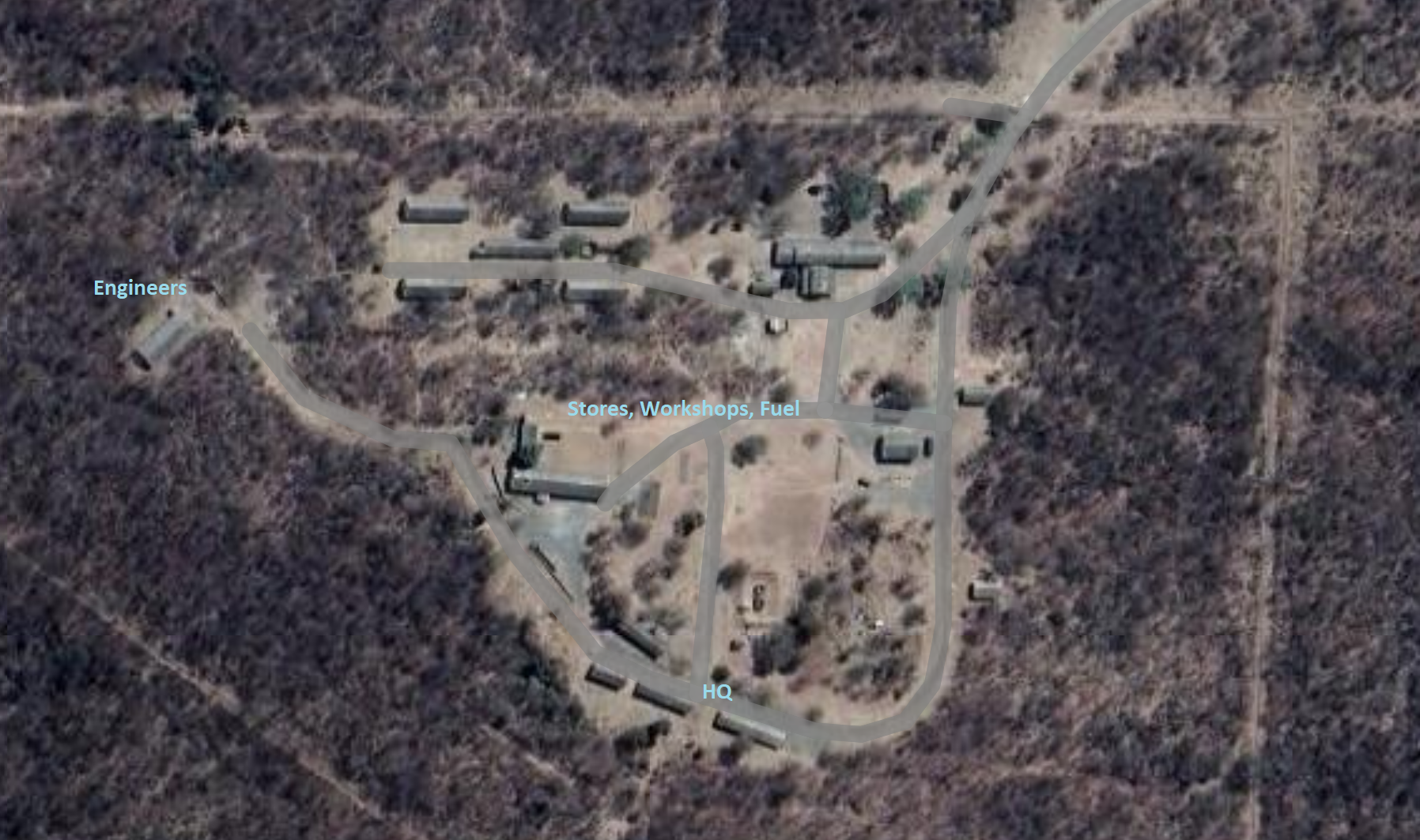
For a time I was based with 4 Independent Company (4 Indep) at Wankie, and those familiar with this unit will remember that it was on top of a hill and on the left, as you came into Wankie from Bulawayo. 1 Engineer Squadron (1 RhE Bulawayo) maintained a small Forward HQ within this base with the task of providing Engineer logistic and operational support to our two sub-callsigns at Deka and Victoria Falls. We also supported the British South Africa Police (BSAP) and 4 Indep throughout the Operation Tangent theatre of operations, as and when required. Captain George Jenkinson was the commander (Sunray) of our little team, with me as his second in command (Sunray Minor). We also had a number of Sappers with us to do the heavy-lifting and man the radios (which were active 24/7). All-in-all we were a happy bunch who just got on with doing Sapper things.
The picture below shows the 4 Indep camp layout.
This particular morning (probably mid to late 1979) I was going through the radio messages to see if there was anything for immediate action when the telephone rang. Captain Jenkinson was away at the time on another mission so it was just me and the lads on deck. The caller was a Special Branch (SB) Inspector from Wankie BSAP. I had got to know him quite well and after exchanging the usual pleasantries he asked me to come down to his office as he had a job for me. Knowing SB it was probably going to be something dodgy, dangerous, or both. Little did I know that this would be one of the strangest tasks I would ever be asked to take part in.
Leaving one of the Sappers to hold the fort, I jumped into our Unimog and drove down to the police station, a short 10 minute drive. Entering the charge office I winked at one of the Woman Patrol Officers – they were all great girls and often played darts with us at No1 Club in Wankie. They definitely were not prudes. She waved me though to a side door that led to the back of the police station – this was where the SB offices were. A pair of dark green Series 3, 6-cylinder Land Rovers stood silently in their parking bays – both of them fitted with 2 x AK 47s – mounted transversely in the back, directly behind the cab. These could be fired from inside the cab by means of a solenoid in case of an ambush – spitting death left and right within the killing ground. Some vehicles had a third forward-firing AK mounted at the front in the engine bay. Very useful set-ups indeed. Whilst marveling at these instruments of death I heard a shout and someone cry out, obviously in pain. Not my business and I continued on my way towards a locked steel gate and rang the bell.
The SB Inspector took a long pull on his Madison cigarette, held out his hand for the regulatory handshake and offered me a seat opposite his desk. A large map covered with plastic was attached to the wall behind him – different color chino graph lines and secret symbols dotted its surface. I looked at him – these were hard men doing a hard job – never easy and always laced with danger and sudden death. Our conversation did not last very long and the gist of it was that I was to assist in identifying ammunition that had somehow ended up at the Wankie Hospital – a strange place for it to be I thought, but anything was possible. He never gave me any further details except the name of a contact person at the hospital and a warning that the task may take some time, and I needed to go there directly. I used his phone to let my people know not to expect me back until late, and after a few minutes of arranging to catch-up again soon I went on my way.
The Wankie Hospital was run by Anglo American. It was not big, but it was modern, clean and efficient. I had spent a few days there previously with malaria and found the treatment and staff excellent – the only downside being the constant moans of a Portuguese guy who had caught his arm in some kind of machine at the colliery, mangling it badly. He was in the same ward as me and I felt his pain – which must have been considerable- the nurses done their best for him but a person can only have so much morphine.
Having found my contact person and identifying myself, I was directed to the mortuary where I was told I would be met by one of the pathologists. This was becoming more and more bizarre, but I done as asked.
See below for location of mortuary at Wankie Hospital.

Before I was anywhere near the mortuary, I was struck by the sound of crying and wailing – lots of it and clearly there was something going on here. People do cry at a mortuary though so not too unexpected. What was unexpected was the amount of people milling around outside the mortuary, police officers doing their best to contain those trying to get into the building. Much shouting was taking place, finger-pointing at the police and then at me as I came into view. The police must have been warned that I was on my way as they ensured I got to the mortuary entrance without being mugged. On pressing the bell an African gentleman dressed in a surgical gown and plastic apron opened up and ushered me inside.
The site that greeted me is something that will be forever burned into my slowly fading memory. There were bodies everywhere. On the autopsy table, on the floor, on trolleys and in the fridges. I estimate that there must have been in the region of 20 bodies all-in-all. The smell of decomposition, blood, urine and faeces permeated the air – this was the smell of death. Some were wrapped in clear plastic, some in unzipped body-bags, and some simply lying on the floor.
There was hardly any space to move, but the man who looked to be in charge ushered me into a small office, and after thanking me for coming down explained what he needed from me. He turned out to be the only pathologist available in Wankie at the time and he sure seemed to have his hands full. He proceeded to brief me up. Apparently an African bus had been attacked the previous evening by persons unknown on one of the many bush roads within our operational area. The bus driver had been injured but managed to bring the bus to a safe stop on the road, whereby the attackers boarded and began firing at the passengers indiscriminately with automatic weapons. Dozens were injured and those I had just seen lying dead next door, were killed.
My readers should understand that during this period of the war, there were many actors vying for popularity with the local population, and I had learnt a long time ago that nothing was ever at it seemed – there was lot of smoke and mirrors and in fact sometimes you couldn’t see the mirrors. We had ZIPRA (Joshua Nkomo), ZANLA (Robert Mugabe), Bishop Abel Muzorewa and his crew, The Rhodesian Security Forces, the Monitoring Force, various intelligence services and probably other organisations I more than likely had never heard of. So it became an evil, cruel game, played between the actors with the aim of seeing who could look like the good guys. If that meant killing innocent bus passengers and getting the blame pinned on someone else, then that would do just fine. According to them, the means justified the end.
My mission was to assist in identifying who had carried out this attack – I’m not a pathologist so cannot make medical conclusions, but I can tell the difference between AK and FN ammunition. My job was therefore the following:
- Attend the post-mortem of each of the deceased
- Witness the removal of bullets and bullet-fragments from each body
- Where possible identify non-fragmented bullets as either AK or FN (wishful thinking)
- Ensure that each bullet or bullet-fragment was placed in its own sealed container for further analysis at a specialist facility (chain of custody was not my responsibility to maintain – this was a police responsibility as the investigating authority).
Each body had a brown tag on the big toe. Amazingly most of the victims had been identified by the teams that recovered them from the bus – the same team now carrying out a forensic investigation of the vehicle. I imagined what the interior looked like. Blood, bits of brain tissue, vomit and skull fragments – and the pitiful belongings of the deceased. Handbags, shopping bags, multi-coloured blankets, groceries and shoes. Shoes always seem to come off during a violent death. And of course, the cartridge cases.
And so we began the unpleasant task of examining each cadaver. Some were straightforward, with the bullet still in one piece within the body, some not so easy, especially where they had fragmented on bones, sending bits of bullet in all directions throughout the fleshy mass. It was then a matter of literally digging around in the flesh until the pieces were found. In other cases the bullets had exited the body cleanly and there was nothing to find. Each piece was put into a stainless steel tray for me to examine. There was very little blood considering the number of bodies and type of injury – all of the bleeding would have taken place on the bus.
There was no dignity for these poor souls – time was of the essence and the pathologist and his assistants stripped the victims until completely naked and hurriedly poked about inside the pink and red cavities of damaged flesh until they were satisfied they they had found everything they could. And then it was onto the next one. As most of the victims had been shot in the torso or chest, all of the bodies were cut open from neck to groin, and the chest cavities pulled open for examination. This was a brutal process beginning with a large scalpel incision from neck to pubis followed by the cutting of the sternum and ribs with what can only be described as bolt-cutters, allowing the the chest to be completely opened up. Others with head wounds and half a skull missing, brains left behind in the bus, staring, lifeless eyes hanging out, were quicker to process. It was grisly work and although I had seen my fair share of death and traumatic injuries over the years I was still shocked at what I was seeing. The small children were the hardest for all of us – probably going home with a new toy or clothes after a day out with mum and dad in the city. Now there was no tomorrow for them. No playing with their friends around the kraal, or helping to tend the goats and chickens – there was nothing for them. It was just so bloody sad.
As each body was completed the chest cavity was forced back into place, and sewn up by one of the assistants while the pathologist wrote up his report. The needle was thick as a finger and unlike anything else I had seen from a medical perspective – the gut used to make the stitches similar to brown string. The stitches were spaced widely apart and pulled tight to force the two sides of the chest together. There was no need for cosmetic considerations here. Once complete the body was taken to another area of the morgue, and I assume handed to the relatives waiting outside, as the volume of wailing and crying increased from time to time.
I guess some of the victims were terrorist sympathisers, either by choice or intimidation, but here and now they were human beings who had been in the wrong place at the wrong time, the majority going about their business and hoping for a better future. That was all gone now – all that was left was for the pathologist and his team to cut them up, looking for little bits of metal which I tried my best to identify. It was, no matter how shocking, the right thing to do for them.
We continued well into the night and until all of the victims had been examined. No one was hungry. We had all opted to work until we had handed all of the remains back to the relatives. There were a few that no one claimed immediately, hopefully they would come tomorrow after the word spread.
It was past midnight when I finally left. All of the relatives had departed. A policeman stood guard at the door and I stood in the cool African night, breathing in deeply, the fresh air not helping to dissipate the the smell of death clinging to my clothes and deep in my nostrils. Walking to my Unimog I wondered what would become of the work we had done today. Would the effort prove useful or was it just a deceitful game of which I had now become part of?
Either way, I hoped that in some small way I would have helped these poor people obtain some form of justice, and closure for their loved ones.
Sadly, I would never find out.
Twin Browning’s On The Bridge (Part 1)
August 12, 2023
Some time back I had a rather spirited conversation with an individual over the idea of mounting twin 7,62 mm x 51 mm Browning machine guns atop the cab of a Hippo (converted Bedford RL), with the trigger mechanisms activated by push-bike (bicycle) handle-bar brake levers. The handle-bars were located in a convenient position for the co-driver of the Hippo to be able to fire the guns without sticking his head outside of the vehicle – thus avoiding a third-eye. All he had to do was pull the brake levers from inside the cab and the cables that led to the gun triggers, fired the weapons.
The Rhodesians thought that this was a brilliant idea, and in theory it probably was considering we were forced into using all kinds of solutions to problems that we had to overcome due to international sanctions and the arms embargo. Rhodesia used South African (Armscor) built Hippos. To the best of my knowledge Rhodesia never produced any of their own. Those that we used were former South African Police vehicles, donated to Rhodesia after their withdrawal.
In this episode I am going to relate my own personal experience firing these guns from a Hippo in a live contact with the enemy.
Firstly it would be remiss of me not to first give a bit of background to the two main actors of this episode – the Browning Machine Gun, or to use its correct nomenclature, the M1919A4 Browning Medium Machine Gun, and the Hippo personnel carrier (Bedford RL variant designed to protect against landmines and small arms fire).
M1919 Browning Medium Machine Gun
Lets start with a quick look at the weapon specifications:
- Weight: 14 kg
- Caliber: 7,62 mm x 51 mm (Springfield .30-06)
- Length: 964 mm (includes barrel of 610 mm)
- Action: Recoil operated
- Rate of fire: 400-600 rounds per minute
- Muzzle velocity: 853 meters/second
- Maximum firing range: 1,500 meters
- Ammunition feed: Belt-fed
The M1919 Browning is a .30 caliber medium machine gun which saw widespread service during WW2, The Korean war, and The Vietnam war. It was used by most NATO countries until the 1990s and is still in use today in some theatres.
Similar in design to the larger Browning .50 caliber M2, it is a recoil operated machine gun, highly versatile and was used widely as a light infantry weapon or mounted in some way on armoured vehicles. It was fitted to aircraft and also used in an anti-aircraft role, making it truly a weapon for all theatres of war.

Above – The air-cooled, belt-fed M1919A4 machine gun with its M2 tripod weighed only about 48 lbs., compared to more than 100 lbs. for the water-cooled M1917A1 machine gun. (National Rifle Association of America).

Above – In this original color photo from 1944, U.S. Army paratroopers train with the M1919A4 machine gun. (National Rifle Association of America).

Above – The Browning .30-cal. M1919A4 light machine gun was used to great effect in all theaters during World War II. A U.S. Army soldier (above) crews an M1919A4 during operations on Jan. 16, 1945, in northwest Europe. (National Rifle Association of America).
When used in the Infantry role the gun required at least a two man team but more usually four men were used; the gunner, the assistant gunner and two ammunition carriers. We never used them like this in the Rhodesian Corps of Engineers – and I definitely never saw them being lugged about by Infantry patrols.
Originally introduced as the M1919A1 the concept was of a light and easy to transport weapon featuring a bipod and light barrel. However, it soon became apparent that it was too heavy to be carried and also too light to withstand sustained rates of fire (the barrel would overheat causing a runaway gun), and so with the addition of a tripod and a heavier barrel, the M1919A4 had, at least addressed the sustained fire problem. It just needed more men to get it to where it was needed.
Usually mounted on a lightweight, low-slung tripod for use by the infantry the M1919A4 weighed in at 14 kg’s. Using fixed vehicle mounts it could be mounted on a variety of vehicles including Jeeps, tanks, Armoured Personnel Carriers, and of course – our Hippo’s.
The Hippo Armoured Personnel Carrier
Again, lets first have a look at the specifications of this beast:
- Weight: 8.8 tonnes
- Length: 6.53 meters
- Width: 2.46 meters
- Height: 3.3 meters
- Crew: 2
- Passengers: 10
- Main Armament: 2 x 7,62 mm Browning manchine guns, front mounted
- Chassis: Bedford RL
- Engine: 2.5 liter in-line 6 cylinder water-cooled, petrol
- Transmission: 4-speed manual synchromesh
- Ground clearance: 32 cm
- Fuel capacity: 240 liters
- Maximum operational range: 640 kilometers
- Maximum speed: 73 km/h
The Hippo is a South African designed Armoured Personnel Carrier (APC). Specially designed to be mine-resistant, it can carry ten infantrymen and a crew of two. The vehicle’s remote-operated turret mounts dual 7.62mm Browning machine guns, but like other improvised fighting vehicles, it is only lightly protected. An interim solution adopted to deal with the threat of landmines deployed by the South West African People’s Organization (SWAPO) in northern Ovamboland, the Hippo was simply a blast-proof hull fitted to a Bedford RL chassis. Similar to the BTR-152, it offered a staggered troop compartment with seating facing inwards. Vision was restricted to narrow plate glass windows. This layout was universally unpopular and later corrected with subsequent vehicle development. There were firing ports for the occupants and a powered machine gun turret could be braced on the open top, though these were seldom fitted. Passengers and crew debussed from the rear. The Hippo Mk1R was based on a M1961 Bedford truck chassis, which was being phased from South African service in 1974. Some 150 were shipped to the South African Police that year, another 5 being donated to the South-West African authorities. South African Police units left several behind when they withdrew from Rhodesia in 1976, and these were retained by Rhodesian Security Forces.
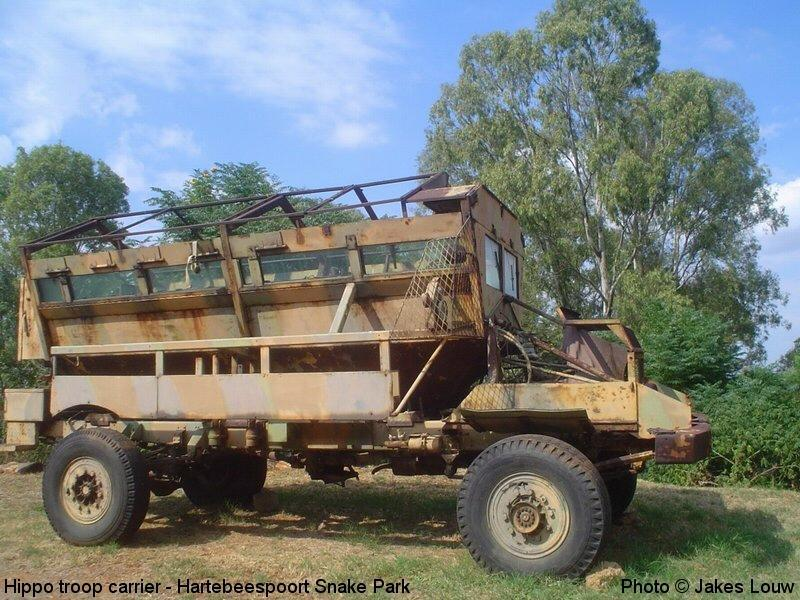


Sadly most, if not all of these grand old ladies of the bush, that probably saved countless lives, have now ended up as rusted hulks, waiting to be cut up and sold for scrap. The photographs above, whilst giving the reader excellent examples of what the Hippo was, are at the same time bringing me a personal sense of nostalgia and sadness – I have travelled in them, driven them and fought the enemy with them- they are therefore part of me, and I a part of them. We are inseparable in this sense.
In Part 2 of Browning’s on the Bridge, I will describe how one of these beautiful (to me at least) vehicles and my crew done what we were paid to do – make contact with the enemy.
And it was in such an unusual way – sort of a meant-to-be-moment.
Ambush!
July 18, 2017
Ambush!
It all started with manpower, or rather the lack of it.
In the mid-seventies Rhodesia found herself not out-gunned, but rather out-manned in the bush, specifically Infantry-wise. The quick solution to this was to deploy specialist units (like the Rhodesian Corps of Engineers (RhE)), in the Infantry role. Those of you who have been following my Blog will remember that all Rhodesian troops were primarily Infantiers and secondly specialists.
The RhE seemed particularly well-adapted to the pseudo-Infantry role and we often deployed into the hottest areas, at times taking over from “pure” infantry units including the Rhodesian African Rifles (RAR), Rhodesia Regiment (RR) and Rhodesian Light Infantry (RLI).
In some instances we had more success in these areas than our Infantry Brothers.
We were carrying out advance-to-contact foot patrols from of a place called Tshiturapadsi, an unused District Commissioners camp that served us well as it had buildings, water and shelter. There was also an airstrip nearby (See Figure 1 below). It also happened to be located in one of the most gook-infested Tribal Trust Lands, the Matibi TTL, notorious for terrorist gangs. We had been sent there to relieve a RLI call-sign that had been in the area for weeks and who had not even seen a track let alone a gook.
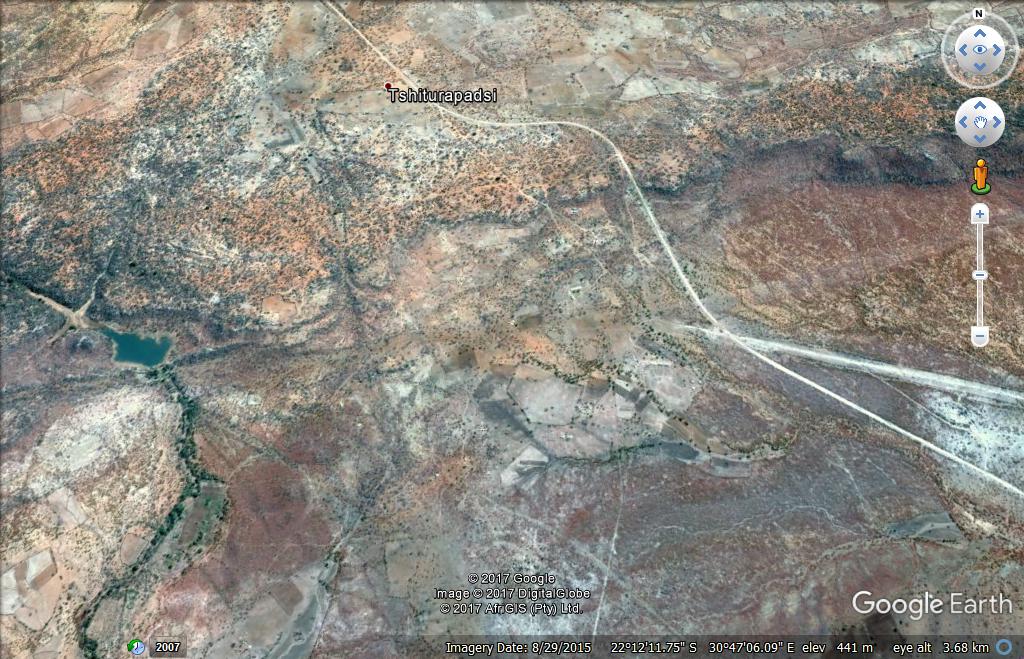
Figure 1
It had been a long day and an even longer patrol. The sun was beginning to dip over the horizon, heralding the start of one of those wonderful picture-postcard African sunsets. A cool breeze brushed my face, refreshing, and surprisingly, despite the heat, sending small shivers down my spine. There was invigoration with coolness also. We paced briskly now, still a little tired but no longer exhausted, rejuvenated with the thought that we would go into a temporary base as soon as it got semi-dark. I was on the far left flank of our ten-man extended line and felt vulnerable with no one out on the left of me…….tall grass blowing in the wind played games with my imagination….I was seeing gooks where none existed. I glanced across to my right, comforted by the presence of one of my mates in the dim light, a safe distance from me, ready to give mutual support if I needed it. As the day turned slowly into night the patrol commander, a young RhE officer passed the signal down the line to move into our temporary base for the night. We changed into single file formation (with me at the back), and took a wide dog-leg route into where the patrol commander had decided we would stay for the night. I was never a great supporter of eating and sleeping in the same place at night and in fact this practice was against our training doctrine. The gooks had Mujibas[i] everywhere and they would report our presence…..and then the gooks could come and fuck-up a pleasant evening. A patrol should eat, carry out personal admin, and then move to a new location, moving into their night location after dark and then there should be absolute silence…..no tins being opened, food warmed, farting or talking. We broke rules that night and within 12 hours we would break another one that would seem to bring hell itself upon us.
First light……always a magic time in the bush. Wet grass, dripping trees, cattle bells and screaming children. The smell of wood fires and fresh cow dung. And all of these things also meant there were people close by. The last guard had roused us all and we grudgingly extracted ourselves from our fart-sacks (sleeping bags). Dog-biscuits soaked in tea or coffee would come later in the morning, but for now we needed to move from this place quickly as this was also a dangerous time when gooks liked to attack. As it was the resident gook gang in the area had bigger plans for us on this specific day.
Still wiping the sleep out of our eyes we prepared to vacate the temporary base, taking care to cover our presence as best we could. We were surrounded by thick bush, the site being chosen for this exact characteristic as it was ideal for a temporary base. It was not however suitable for an extended line formation and so we exited in single file with me more or less in the middle of the patrol. As if by magic we were walking on a well-used path and I soon realised the patrol commander was using the path purposely, leading us to a nearby kraal. We had just broken another rule…..never walk on a well-used path……straddle it yes, but never have your entire patrol on it.
We entered the kraal and went into a well-rehearsed all-round-defence. The entire kraal had one of us on its perimeter looking out for signs of the enemy. The patrol commander and one of our Black Sappers found the Head Man and questioned him on gook presence in the area. In the Matibi TTL there was little chance of the Local Population helping the Security Forces and we decided not to waste time on this place. After searching all the huts for signs of gooks we got the signal to prepare to move on. To my utter amazement the patrol commander put us back on a well-used track leading out of the kraal and once again we were in single file. What was this guy thinking and no one challenged his judgement?
We had walked for about 500 meters when I noticed a single upturned munyatella[ii] next to the path. This in itself was not really out-of-place but it struck a chord somewhere in my survival instincts and I became uneasy. From my position in the patrol I could see we were about to take a right turn on the path. To the right of us the ground rose sharply and soon we were walking parallel to a fairly high, boulder strewn, steep kopje.
There was no warning…..these gooks were good and had chosen their killing ground well…and we had walked right into it.
The gooks initiated with what I now know was a PKM[iii] light machine gun (see Figure 2), capable of firing 650 rounds per minute. This was followed by a fair mix of AK47, SKS and RPD fire……initially. We all instinctively hit the deck not quite sure where the fire was coming from. These kind of events are pretty confusing at first and don’t believe what you see in the movies…..that’s all bullshit. My most vivid memory of this attack was and still is the crack of high velocity rounds going over my head and dirt spraying up all around me and into my eyes. We had all somehow remained in that rather silly single-file formation on the ground even though it was now pretty ragged and we were all horizontal, amazingly unscathed and all facing the kopje, the direction of the attack. We were badly exposed but because we were flat on the ground the gooks could not bring really effective fire onto us although we were all getting near misses. I began to think I was the sole target of a hundred gooks, and perhaps I was as I am quite a big bloke.
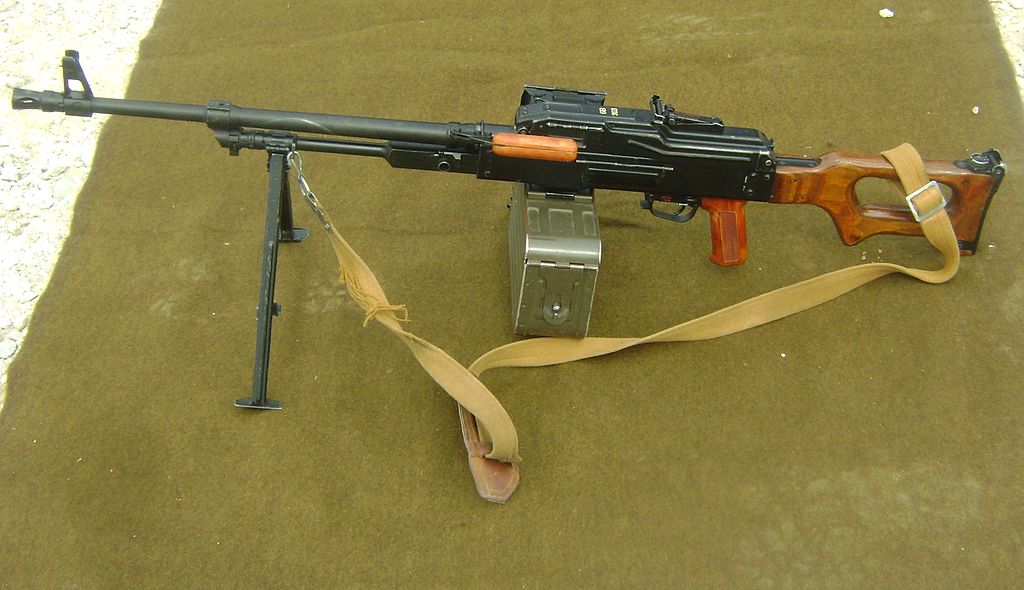
Figure 2
And then two things happened simultaneously…….firstly a new sound came from the kopje, a sound so specific that one ever forgets it….the sound of a mortar leaving a tube………and secondly the shouted order from our line to advance on the enemy using fire and movement. The mortar bombs rained down one after the other, precisely straddling the path we were lying on……encouraging us to advance more rapidly. It was clear to me the gooks had sufficient time to plan this ambush and had accurately estimated the distance from their base-plate position to the path. There was now so much noise, smoke and dust in the air that it was difficult to see. I remember clearly advancing a few yards up the kopje and taking cover, the second section following us while we pumped rounds into the gook positions. Sweat running down my face, the saltiness burning my eyes…adrenaline pumping through my veins…..all fear gone now…….just the job of surviving at the forefront of my mind. My hands were cut from the jagged rocks, the pistol grip on my FN sticky with blood. We were moving higher up the hill, almost half way and we still couldn’t see any gooks……all we could hear was the firing of their weapons. The whiplash of rounds hurting our ears. The mortar was no longer a danger as we were too close to them for them to use it safely as we systematically moved up the kopje………and then there was a relative silence as if nothing had disturbed that cool African morning. All we could hear was the tell-tale clinking of gooks running at high speed with loose kit jumping about in packs and pockets, shouting to one another. We moved up the kopje faster, ignoring the threat of an in-depth ambush……over-running now empty enemy firing positions…the only occupants expended cartridge cases, discarded AK and RPD magazines, and empty cardboard ammunition boxes. We worked through the position, wary now for booby-traps or mines but keeping our wits together. Things were slowing down but the adrenaline was still hot in our veins as we reached the top of the kopje. The gooks were gone and we had them running scared by using tried and tested infantry tactics. I silently thanked those bastard Llewellin Barracks instructors for all the blood, sweat and tears they took from me.
While some of us collected any booty we could find the patrol commander finally found space to get a message off and give the direction of flight of the gooks…….there was hopefully a Fire-Force element with gun-ships somewhere around but I had my doubts. Perhaps they could get an armed fixed-wing up to deal with the gooks but that was also doubtful. These assets were just too thin on the ground and because there had been no recent sightings of gooks in the area, there was nothing positioned close-by. Fair enough.
We gathered at the bottom of the kopje where it all began, carefully avoiding the track but recording the mortar strikes, easily found by the craters they made. They were close to where a number of us were lying and I consider myself lucky not to have been seriously injured or worse. As it was none of us sustained injuries serious enough to call a casevac. We were lucky…..this time.
Still alert and in a form of all-round-defence we found shady spots to sit and reflect on what just happened……..the entire contact not lasting more than 5 or so minutes perhaps but seeming to take an eternity to end. And now that sense of euphoria that only men just out of combat will know…….a great weight seeming to leave your shoulders as you sit back, shaking hands lighting-up a Madison, and let the calmness flow through you as the adrenaline wears off…….the calmness of knowing you survived a situation of grave danger where someone wanted to kill you and failed. There is no feeling in the world like it…….and little did I know that within a very short space of time I would go through the whole process once again…….only this time we would not be so lucky.
[i] Teenage spies, normally unarmed who observed Rhodesian Security Force patrols and informed the gooks on our whereabouts
[ii] Munyatellas were African sandals made out of car tyres and widely used out in the bush as they lasted for ever.
[iii] https://en.wikipedia.org/wiki/PK_machine_gun
Please also vist my website dedicated to Rhodesian and South African Military Engineers. Please join us on the forums by using the following link:
http://www.sasappers.net/forum/index.php
Copyright
© Mark Richard Craig and Fatfox9’s Blog, 2009-2017. Unauthorised use and/or duplication of this material without express and written permission from this blog’s author and/or owner is strictly prohibited.
S TROOP (RHODESIAN CORPS OF ENGINEERS): OPERATION 1
February 3, 2016
NAME OF OPERATION: NOT ALLOCATED OR UNKNOWN
TYPE OF OPERATION: RECONNAISSANCE
DATE OF OPERATION: MID 1970’s
AREA OF OPERATION: SEE MAP 1 BELOW
PURPOSE OF OPERATION: CONFIRM OR DISPROVE PRESENCE OF COMMUNIST TERRORISTS (CHARLIE TANGO’s OR CT’s) WITHIN AREA IN QUESTION (AIQ)

MAP 1
MAP 1 LEGEND:
- Red Track: Insertion Route (1 RhE HQ to Khami Prison (approx 35 kilometers))
- Green Track: Sweep Route (Khami Prison to AIQ (approx 10 kilometers))
- Blue Polygon: AIQ
We had been ordered to report to 1 Squadron RhE the following afternoon in civilian dress and told that our final mission briefing would take place at 16:00 hours. We were also to bring our personal weapons and ammunition, together with our combat kit. There was still no indication as to what the mission was as we were told very little at the briefing the previous evening except that we would be doing a reconnaissance for a possible CT presence.
The smelly little red and white Rixi Taxi dropped me off at the main gate to Brady Barracks. I hoisted my kit bag onto my shoulder after putting on my webbing and picked up my rifle. A grim-looking, red-sashed Colour Sergeant Duty NCO glared down at me as I passed the steps of the Brigade guard-room on the right. Bracing-up to pay him respect the best I could under my load, I made my way to our Squadron HQ. He smiled and gave an exaggerated brace-up in return.
I was surprised to see a Rhodesian Prison Service 65-seater bus parked next to the traffic circle adjacent to our modest Squadron parade ground. Some of the other S-Troop members had already arrived and were leaning against it smoking, talking crap amid loud bursts of laughter and a bunch of howzits greeted me as I arrived and some derogatory remark was thrown in for good measure. We were always taking the piss out of one another and the camaraderie within the Troop was infectious.
There were about a dozen of us on this mission and once we had all arrived we were told to go to one of the lecture rooms behind our HQ and wait for the ops brief. Terry Griffin came into the room and we all stood up and he saluted us, motioning for us to sit with a cursory wave of his hand. He wasted no time in getting to the point. In short there had been a report from one of our local African sources who also looked after our training camp at Khami Dam, that CT’s were visiting the camp at night asking for information with regards to Rhodesian Security Forces. Apparently they had indicated that they would return this specific evening. We could not be certain the source was on the level of course but we needed to either disprove or prove his information. It had been decided at Brigade level that as this was a RhE facility and other resources were unavailable that we should do the reconnaissance ourselves. And rightly so too.
We were to be infiltrated by bus to the general area posing as prisoners being transported to Khami Prison, a large penal facility outside Bulawayo. The map above shows the entire area of the operation as well as the route taken from 1 RhE HQ for infiltration to the Area In Question (AIQ). Prison issued clothing would be worn on the bus to avoid any suspicion that security forces were moving into the area. CT’s had eyes everywhere and the Mujiba system was well-developed throughout Rhodesia. Mujibas were unarmed African children/youths who idolised the CT’s and often acted as useful intelligence sources for the gooks, indicating movement and the location of Rhodesian Forces.
Our mission was purely reconnaissance and we were not to make contact with the enemy unless compromised and our lives put at risk. We wanted the big fish and not the plebeians feeding at the at the bottom of the pond.
With the briefing over all that remained was for us to change into prison garb, load up our kit and weapons into the bus and get ourselves seated comfortably. It would be about a two-hour drive to Khami Prison and rush hour was upon us. The gooks apparently always arrived after midnight and we needed to be in position long before then.
The journey took a little less than planned, the driver taking us through the western suburbs of Bulawayo including Luveve, one of the African townships. On arrival at the prison the large wooden gates were opened and the driver stopped just inside the courtyard of the complex. This can clearly be seen in the photo above when zoomed. We did not enter the prison itself and we were hidden from any eyes looking out from inside. We debussed with our kit and moved to a position along the prison wall where we could square things away. The bus moved into the main prison area belching blue diesel fumes as it did so, leaving us in a smoky silence.
The plan was to wait until last light and then change into our camo-kit, blacken-up and move out to the planned target approach start-point. Our civilian kit was taken to a secure area by a prison official for collection on our way out. Up to now I had a feeling things were going to plan and we had a chance to sit back against the wall once we were prepared and just relax. Most of us lit-up and I could smell gun-oil mixed with the cigarette smoke.
The Territorial Force Sergeant who would lead the mission was a good friend of mine and still is to this day. He knew that for some of us, including me that this would be the first time we would be carrying out a task of this nature. He talked to us and encouraged us, went over the plan again and made sure we all knew what we had to do and the Immediate Action Drills in the event of being ambushed on the way in. All the last-minute confirmations……radio frequencies, where the medic would be, and general march discipline. Orders were given to check the Night Vision kit and I heard the high-pitched whine they made when warming –up.
We rechecked our weapons and cocked them; ensuring change levers were on safe, and prepared to move out. Last light had come and gone……..it was now pitch black and there was a sharp, cool wind about. There would be no moon until after midnight and this would help us on the way in.
As the high wooden gates swung open the prison perimeter floodlights were switched off. Our departure was being coordinated from somewhere inside the prison. We filed through one by one, out into the darkness. As if on cue, the incarcerated prisoners began to sing one of their mournful songs. It was if they were bidding us a final farewell and a slight shiver ran down my back.
We walked parallel and close to the prison north wall until we reached the main road to the west. We crossed this individually and quickly, headed off into the bush for 15 minutes and then stopped to regroup. Once we were all accounted for we moved off to the start position which was adjacent to a wide stretch of water and began the march to the AIQ. It had been decided that we would move into our Observation Post (OP) position in single file and this should only take a few hours with breaks in between. As it was the approach was uneventful save for the odd curse when someone tripped on a root or got a thorn in the face from a low-hanging acacia. The cool wind made it easy to keep up a good pace and we made it to the AIQ before we had planned, went into an all-round defence, and settled into silence.
The training camp itself was flat but surrounded on two sides by steep rocky kopjes. We had chosen one of these as our OP and it gave us a good view of the target area as well as good cover in case of attack. All was quiet. The moon had come up and we could see quite clearly without night vision equipment. There was no movement at all. It was so still that anyone approaching would be heard and we relied on this to give us an early heads-up of visitors. It struck me then that we would also have been heard moving into position on the kopje.
We had arranged that we would do 2-man watches for 30 minutes at a time. No one slept but it was nice to just lie down on the uncomfortable ground and stare up at the stars in the crystal clear sky above. The night wore on and when it came to my second watch the first golden slivers of a typical Rhodesian sunrise were visible low in the sky. Dogs barked in competition with children’s shouts in the distance and the sad sound of a cow-bell rang in the air. The smell of wood fires filtered through the air…….the smell and sounds of Africa, and a new day had dawned.
We had planned a first-light sweep through the camp to see if we could pick-up any sign that the gooks had been in the area previously. They definitely had not visited while we were there. The Sergeant gave us the signal to move back down the kopje, the same way we had gone up. We would wind our way around the kopje and then form a north/south extended line and sweep through the camp from west to east. We would be exposed now as the camp was on cleared ground with 5 or six rondavel arrangements as accommodation. Although we were fairly sure no gooks were around, first light attacks were common and we needed to remain switched on. This was not the time for complacency. As we swept through, each and every one of us knew that there was no cover except for the rondavels and most of us were a fair distance from them. If the gooks had somehow managed to get into a good position on the high ground last night without us knowing we would be in harm’s way. This was improbable but a man thinks strange thoughts in such situations. It also keeps a man alert. We were in a perfect killing ground for them, literally challenging them to have a crack at us. As it happened, there were no gooks to be found here today. We ended the sweep and moved back around to the back of the kopje, set up a secure temporary base and got the hot water on. It was time for coffee and doggos (dog biscuits) and soon the air was filled with the familiar fragrance of Esbit heating tablets and at that stage it was the sweetest smell of all.
We were to be collected by Squadron troop carriers close to the start position from the previous evening. Hopefully they would have remembered to load our left-over kit at the prison. On the walk back to the pick-up point we moved in extended line and had not relaxed our vigilance. Suddenly one of my mates on the flank called a halt and we stopped and got into a kneeling position. Ever observant he had located a chevron pattern boot print on the ground and the Sergeant confirmed this was gook spoor for sure. Sadly it was old and probably not worth following but we decided we would do so anyway, at least for a little way just to see if they led anywhere interesting. They didn’t and we lost them soon after. At least we now knew there was clear evidence that gooks, or at the minimum, someone wearing a gook boot had been in the area recently. Even though we never got any kills this was useful information for Special Branch and they deployed Ground Coverage assets into the area to sniff things out. I never heard any more of the gooks that came to visit us.
I learnt a lesson on this operation. Rhodesia has an approximate area of 391,000 square kilometres. It was not saturated with gooks. The odds of bumping into gooks every day was fairly remote unless you were on Fire-Force or just happened to be in the right place at the right time.
The wheel of chance was turning though…….and soon I would also learn that those 391,000 square kilometres were not so big after all.
Please also visit my website dedicated to Rhodesian and South African Military Engineers. Join us on the forums by using the following link:
http://www.sasappers.net/forum/index.php
Copyright
© Mark Richard Craig and Fatfox9’s Blog, 2009-2023. Unauthorised use and/or duplication of this material without express and written permission from the blog’s author and/or owner is strictly prohibited.
On The Boats And Sundry Combat Engineer Duty: A Personal Account Of Rhodesian Sapper Life (Part 2)
June 17, 2015
Basil Preston continues with his brilliant recollections…….a fantastic addition to a blog that is slowly becoming a definitive part of the Rhodesian Corps of Engineers history.
Rhodesian Navy: Boats on Kariba Binga stint (Oct 1973)
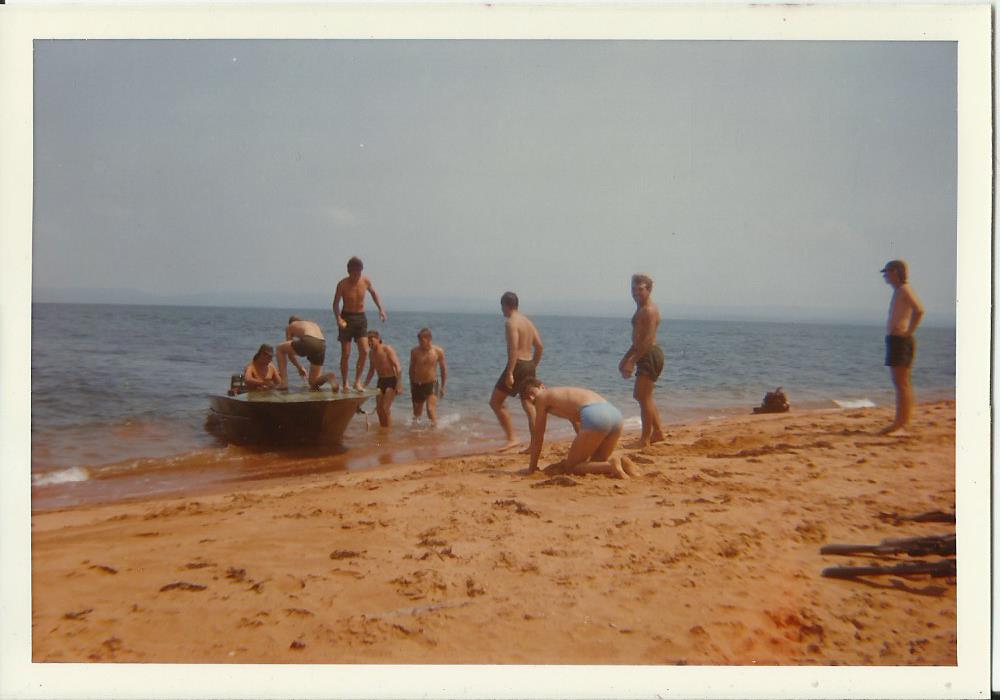
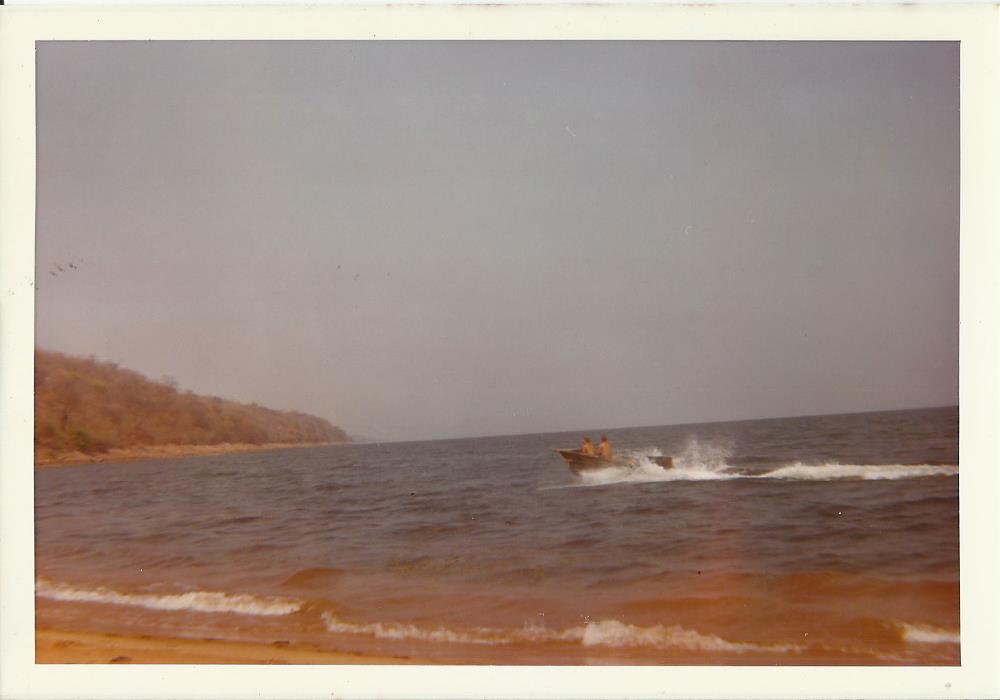
Intake 132 did their boat-training at Binga. We made camp at the back harbour. Corporal Hydes was our instructor at the time. We trained in the 1945 Hercules and a South African Sail Fish boat. See pics below: 


 Kariba stint (Oct 1973-Feb 1974)
Doug ******* and I were attached to the Selous Scouts based at Kariba Heights. Sergeant Ant White was in charge of us. I was a banker by profession and Doug was; I don’t really know, as he was a jack of all trades, but master of none, except womanizing. He was engaged to two women at the same time, one was a Wankie mine disaster widow and the other was a sweet young lady he met in Salisbury. At Kariba, he picked up another potential fiancé, I suppose this was his strategy of getting laid… Our first job was to retrieve our Hercules boat from below the Kariba Dam wall, where it was used by the previous operators, don’t know who they were. Apparently, at full throttle, both Johnsons kept the boat at a standstill. And this was against the water current from the dam turbines’ out-let only. Also, apparently, when the Sappers who operated this boat originally, went down to the boat, the Zambians would come down and try to intimidate them, by pointing their weapons at them and shouting abuse. The Sappers responded by giving them a full bare-butt salute. See pics below: 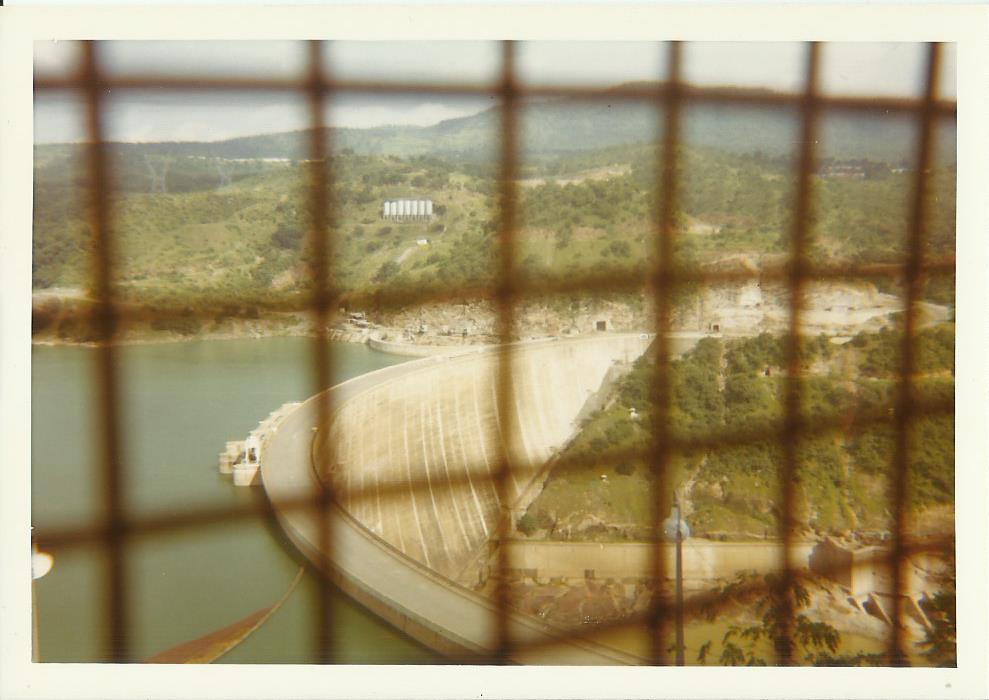


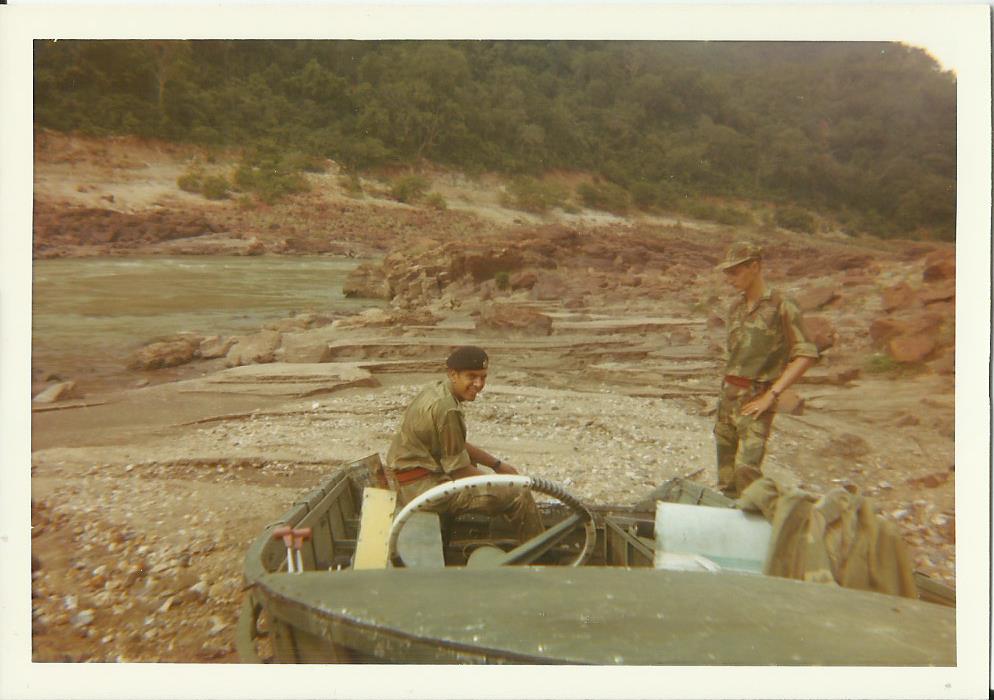 Our second job on the boat was basically to service our 2 x 40hp Johnsons, which Doug did exceptionally well. During our training, no one told us that whilst in a harbour, we were not allowed to do speed-tests, which was just messing around really. But when we were called in front of Col Ron Reid-Daly, we realized that we had caused major upsets with the other civilian boat people, as their tools etc could have been donated to Andora harbour’s murky waters. We both were made to feel like “you know what” and we both were taught a valuable life-lesson that day.
Early January 1974, during our service with Ant White, we (Ant, myself and Doug) were choppered out to a land-mine blast at “D” Camp, at Chirundu. These camps were hunting lodges alongside the Zambezi. A South African Police team were returning to their base camp when they bummed a lift from the National Parks guys; they were using two Rhino vehicles and both were over flowing with SAP and National Parks rangers, Kevin Woods, who was with the National Parks and travelling in the second vehicle, was sitting over the step-up of the Rhino vehicle. As they were leaving “D” camp, the second Rhino hit a land-mine. Kevin’s feet were badly injured, he lost one foot. And the SAP in the vehicle were all injured, one having a broken back. As our chopper dropped us, so it took the first bunch of casualties to Wankie hospital and had to return for more. We started our mine clearance immediately and the three of us were off. I noticed elephant footprints and they were fresh, so I prodded them too, and was rewarded with my first land-mine discovery. The terrs had laid one and disguised it in a footprint. Shit, I started to shake and then we realised that the laying had been done very recently, as when the Rhino vehicles had gone into “D” camp, they would have popped one as the vehicle tracks went right over the mine. So the terrs were close by. We disarmed the mine and then were told that we had to sleep over as the chopper could not return to collect us as it was too dark. I don’t think the three of us got any sleep that night. As when we were choppered in, we just had our webbing and prodders with us, no food etc. Again I had visions of the Kariba spider doing its worst to me. Another lesson was learnt here; be prepared for the unknown, as your lift back may be delayed.
On another mission we attempted to take one stick of (1 x 4) Selous Scouts to Fothergill Island in our Hercules boat, but right from the start into the trip we started to take on water as the waves got progressively bigger as the day grew older, and we set off late in the morning; rushed idea by someone at the top. Luckily we were assisted by the “Janet” launch, (sister ship to the Armenal; Janet, was Ian Smith’s wife’s name, and the Armanel was President Du Pont’s wife’s name, the wives were sisters too if I recall correctly). We were thankful for this as we were following instruction only and still had a lot to learn about actual mission work. For example the thumb tip of an open hand to the tip of the “bird” finger equaled 2 x full tanks of juice. And our boats could only take 4 x passengers and two Sappers only, and 2 x fuel tanks only, so our mission was aborted. We could have been the first boat crew to go down (not only been sunk) in history but with the Selous Scouts not being too happy either.
Ops from here on were better planned and were not so ambitious. Another op was very secretive, in that no one, not even Doug was allowed to know of. I had to take two Selous Scouts to a destination beyond Chirara, and help set up a terr base camp. This included everything one would expect to find in a base camp, even dirty woman’s clothing, cooking pots, food, fire places, uniforms etc. We even had to build make-shift lean-to’s. Plus dig shell-scrapes and some trenches. This was for training purposes. Ant White’s trainees were to find this base and then, who knows what? Interesting out-door work to say the least.
At about the same time, Ant was training up the first Territorial tracker unit, which also had to undergo a form of Selous Scout training. One such op related to survival training. After an intensive 6 weeks of training, these chaps were then told that they are off to go see the snake park, and they were to come as they were dressed; PT shorts, camo shirt and takkies only. They were taken to the harbour, and before boarding “The Janet”, they were searched. The search was to find anything that these guys could use to help survive. As they had to survive by using what skills they had been taught during their training. Sometime during their training, someone lets a few tricks of the trade out of the bag, and these trainees were told to expect the unknown and to hide things like match-heads, short pieces of wire, in the seam of the shirt-pockets and PT shorts. But Ant White was wise to this. Each guy was thoroughly searched and I doubt anything got passed him. We dropped a group off on each Island. One island was called “189”, it’s the biggest island you can see from Kariba Heights, and then there are two smaller islands to its right. (The very small island on the extreme right, I was told, is where Andre Rabe, the first Selous Scout killed is buried.) See pics of the two teams, one guy is holding the shell of a tortoise he found and ate: 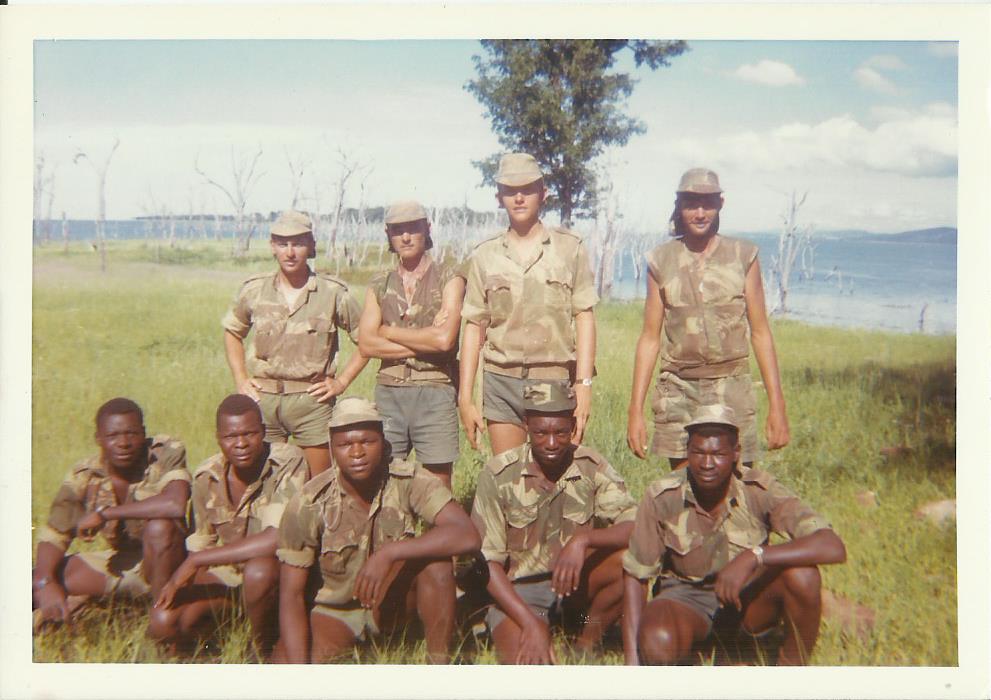

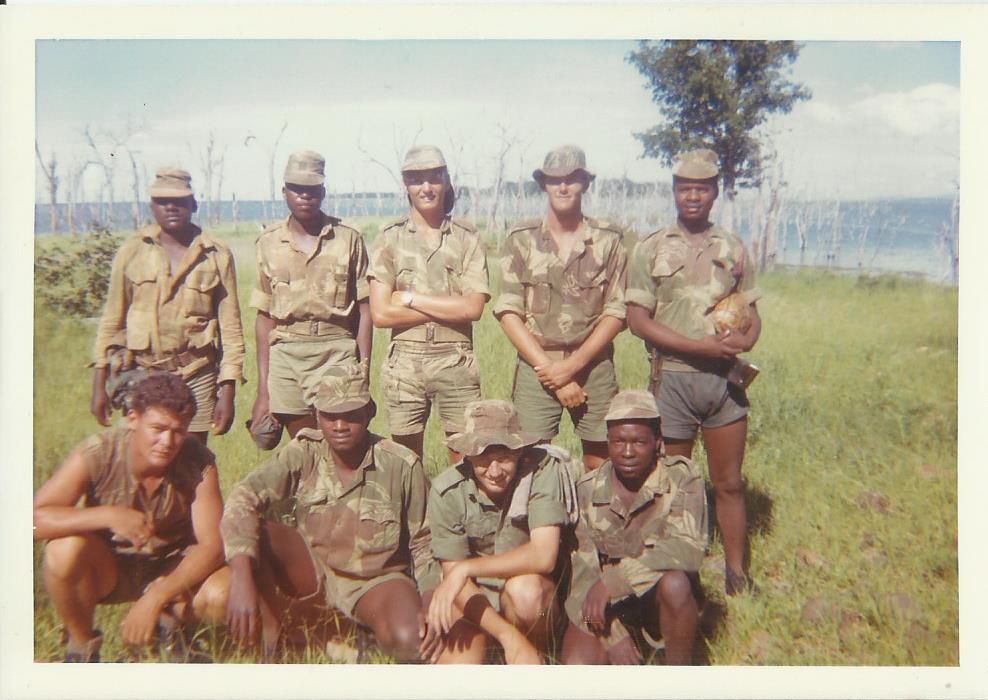 Our function as the boat crew was to be on stand-by during the week these trainee trackers spent on the islands. We speared fished daily and generally had a good time. We smoked the fish over a fire etc. The only problem we had was with mother-natures hippo, as we set up our camp right on a hippo path, because it was clear of vegetation and the dreaded Kariba Spider, these spiders caught birds in their webs etc, and innocent Sappers too. However we made sure our fire was kept burning, especially at night. Not my idea of an ideal camp site…..see pics:


 If anything was wrong with the trainees, they were to build a fire and we would come boating. Yes, we had a couple of night fires that we had to attend to. One was a snake bite, and another was a scorpion bite. Also one guy’s venereal disease played a role of him being boated off the island and off the course. Good thing that the trainees knew how to make fire. Our biggest problem on Kariba, especially at night is navigating the boat through the dead forest of Mopani trees. We destroyed a few share-pins, and changing these at night was a nightmare (also see https://fatfox9.wordpress.com/2015/04/02/on-the-boatsup-the-creek-with-the-sas-part-5-also-known-as-eight-men-in-a-leaky-boat/). When it was my turn to change one, I could always see a dam crock in my mind, so I did this job very quickly while Doug watched with his FN at the ready. Perhaps if a crock did show, would Doug know what to do? I am still here, so no crock fancied me. I also had the pleasure of spear-fishing with Sergeant Stretch Franklin, of the Pioneer experimental pseudo group. We and some others took the boat out for a fun day, i.e. spear-fishing.
2nd Binga stint (1975)
(The Binga stint was during the period we were building Causeways through out the roads off the main Binga road, towards the dam area between Mlibizi and Binga. Keith Bing was with us and what a character he was; he was the grader operator. It was our luck that the RAR needed boat operators, and they were camped at Binga), Dave Stewart, he was from Fort Victoria, was my partner on the boat when we were attached to Major Drake of 1RAR at Binga. We also undertook combat engineer duties too. We operated from the front harbour of Binga, left to Mlibizi, and right to Sinamawenda, (sp) the research station past Chete gorge and all the little islands between these two points. RAR soldiers on a boat is a nightmare, as they have a fear of the water. By this time, we had learnt that being on the lake, ones mission had to start at 04h00, this was when the lake was at its calmest. Kariba’s progressive waves can get as big as 3 metres or more, this is the radius height, so in actual fact, the progressive wave’s diametre is 3 metres in size. I.e. imagine an “S”, from the top of the S to its middle, is what is above the water, this will be 1.5 metres and the bottom is under the water, another 1.5 metres, and is moving in whichever direction the wind was blowing. And popping these waves head-on, sends shudders through the whole body. It was a wonder that our little boat survived the thrashing. The RAR guys turn white/grey and just hang onto their dog chains and pray to their ancestors, all their weapons and kit is also secured to the chain. We also had a Machine gun mounted on the front deck, which also took a beating. We were a Mercedes crew travelling in a Mini. I have often had a stand-up shouting match with Sergeant Majors who want to move around on the boat. As before we start our mission, we balance out the weight, and any movement upsets the plane etc. We explain all this shit to them, but having a fear of water is very strong. Major Drake would tell these guys that we are in charge, no matter what, but we still had plenty of verbal punch-ups. We took sticks of RAR soldiers to the islands, dropped them off on one side, and then tiger-fished all the way round to the meet-up point. Great fun, but nothing went to waste. The RAR cooks got most of the tiger we caught. And we also threw some tigers to the beloved fish-eagle, the one with the white head and brown body. A true african beauty, especially its cry. I have a 5kg Tiger from my RAR stint on my wall to-day (1975). Plus one from Mtetsi Mouth caught whilst doing the Deka mine-field in 1978.
Dave and I had to go to Sinamawenda (sp) Research station as the terrs had crossed over and took some of the staff hostage. This trip with a stick of RAR soldiers was worth a medal in itself as it was a fairly far trip with non swimmers. The terrs also ransacked the place. However, months later it came out that a certain RR company were there and had also ransacked the place as well as Sijarera Fishing camp (sp), which is on the same route. This came about when an Engineer Lieutenant ******* acquired a pistol and tried to license it. During the license process it was discovered that this weapon was reported stolen from Sinamawenda (sp) Research station. This discovery was bad news for Senior Military personnel as a few officers were “cashiered” from the army. A sad day indeed.
Van der Riet’s hunting camp 1975
During Dave’s and my camp with the RAR, the District Commissioner of Kariba was flying to Wankie, and was overhead Van der Riet’s hunting camp when he spotted a Land Cruiser which had detonated a land-mine. A chopper was dispatched to collect the injured, and Dave and I spent nearly 12 hours in a 4.5 getting there to look for more mines. Peter Parnell had started the up-grade of this escarpment road, but was ambushed a couple of months earlier and killed at Crocroft Bridge (sp). We arrived late at night and started to clear the area. But being so dark etc we were not doing justice. So we slept a crap night and resumed our search in the morning. The road had a “Y” intersection, and the mine was placed on the hunting camps road. We did a 2 kilometre length search on the other section of the “Y” to no avail. It was the norm for the terrs to lay 2 mines in tandem, so after doing 2 kilometres we decided that it was clear and also no antii-personal mines were planted on the verges. We were thorough Combat Engineers back then. We then were treated to a breakfast at the hunting lodge, where a group of Americans were visiting. They wanted to take pictures of all of us. But Dave and I refused. We had one RAR machine gunner with us, and when the yanks wanted to take pictures, the other RAR guys nearly killed themselves, all diving for the machine-gun. This is a prestigious weapon to be photographed with. Dave and I lost respect with the Yanks, they showed us their bragging photo albums. There were pictures of taxidermied squirrels holding ashtrays, etc , and when David saw the Yanks posing with a Sable bull which they had shot, he lost it. He was very vociferous about this. Van der Riet took us aside and tried to calm us down. He said that Rhodesia needed the foreign currency etc, and each guy was paying $1,000.00 USA a day, (1975) plus each animal shot had its own price tag above the daily rate, and they had already over-stayed by a week and were threatening to leave soon if they had not got their quota elephant. Van der Riet went on to explain, that his trackers would strategically place elephant dung in the opposite direction of where the elephant was, just to get more days out of the yanks. But at the end of it, the elephant had to be sacrificed for the good of the Rhodesian economy. The people injured by the mine blast had shit for luck. As on their way to Wankie, their chopper developed mechanical problems, and Kariba having the forest of dead Mopani trees and Kariba weed etc the pilot wanted to crash-land his chopper without damaging the rotors, as we were told that SA was selling them to us at a hugely inflated price. Being dusk, he took the Kariba weed as being solid ground and seemed to be clear of dead wood, he was able to put his chopper down, but it sank, and the rotors were also damaged. So, instead of us heading back to Binga from the hunting camp, we were directed to go and assist with the recovery of the sunken chopper, just short of Mlibizi Also, on a follow-up call-up to Binga, Peter Parnell’s team were still busy with the road to the hunting camp, when his grader operator unearthed the tandem mine. This time we were choppered there, and were thankful that the mine was not found in the section of road we had cleared, we were about 500 metres short of finding it the first time. So we learnt that a tandem mine has no set distance.
What a camp?
Basil Preston.
Please also have a look at my website dedicated to Rhodesian and South African Military Engineers. Please join us on the forums by using the following link:
http://www.sasappers.net/forum/index.php
Copyright
© Mark Richard Craig and Fatfox9’s Blog, 2009-2015. Unauthorised use and/or duplication of this material without express and written permission from this blog’s author and/or owner is strictly prohibited.
On The Boats……Up The Creek With The SAS (Part 4: Also known as Eight Men In A Leaky Boat)
March 28, 2015
ZAMBEZI RIVER DOWNRIVER FROM MAPETA ISLAND: EN-ROUTE TO THE SAS DROP-OFF POINT
The boat was heavy and she laboured through the water and it felt as if invisible claws were trying to hold her back…..not wanting to let us go. An omen perhaps?
Tony was doing the best he could but try as he might he could not get us up on the plane even though we had moved as much kit to the back of the boat as possible to lift the bows. This in turn caused the stern to dip dangerously low towards the waterline and it was a little unsettling to say the least. Port and starboard trim was good though and we remained straight and level, not tilted to one side. We settled on a half-throttle pace, and taking our direction from the SAS Operator on the front bench the twin Evinrudes burbled us slowly back down the river.
We travelled within Rhodesian territory for quite some time, and for youngsters that had no previous experience of this type of operation this took away some of the tension of what may be ahead of us. It was somehow reassuring to know Rhodesia, our safe haven, was not too far away if the shit hit the fan. The SAS Operators were as always the ultimate professionals and I was proud to be working with them. They instilled a sense of security. You knew instinctively that if things turned nasty they would know exactly what to do. They were good men.
We had passed the Maungwa River mouth to the north, and then our second home the British South Africa Police (BSAP) camp at Sibankwazi. Msuna Mouth glided by in the darkness to our right and I craved for the ice-cold beers and battered barbel snacks I had consumed there on many a visit to the friendly owners of the fishing resort. It was easy to let ones mind roam and that was dangerous. We meandered on down the river, passing two large islands……both pitch-black and foreboding.
I was jerked back to the present, my mind having begun to wander off. Tony had swung us hard a-port and I lost my balance slightly while at the same time keeping a beady eye on the bow wave. The SAS man at the front had given a silent direction change to Tony. In a few minutes we would be crossing the invisible line that marked the international border between Rhodesia and Zambia. It was an eerie feeling, crossing into another country without permission, no passports, no questions. I began to warm to the idea of doing something I had never done before, and indeed I had crossed that point where fear no longer exists. You were committed to the mission, personal weakness or doubts could no longer be a consideration and there was no turning back. On every high-risk mission I have taken part in there was always a short period when I was afraid, sometimes very afraid. With me this is usually at the start and moving into the advance-to contact-phase, but once time crosses that indefinable moment that I cannot explain, a wonderful warm feeling washes over me….a feeling of being in control of my own emotions and destiny. The dye had been cast and there was no return.
It was that time for me now……approaching enemy shores on a dark and lonely river.
(Reservoir by StrongSteve)
The atmosphere on the boat had changed in a very subtle way. No one said anything but you could feel it. The SAS men began to check small details on their kit. Weapons were moved into more convenient positions, the smell of gun-oil permeating the air, masculine and comforting. Webbing was tightened over shoulders, shifting the weight of equipment onto the hips. Legs were stretched in the cramped confines of the boat.
A small red light came on as one of the Operators checked a plastic covered map with a small torch…….looking up at me he nodded his head, managing a white-toothed smile that shone through the darkness of the night and his camouflage cream. We were now well into Zambian waters and heading towards the Mulola River, one of the biggest rivers that emptied from that country into the Zambezi. We could see its gaping mouth ahead of us……a huge dark maw of emptiness seemingly waiting to swallow its victim. As we exited the Zambezi and entered the Mulola it became claustrophobic…….or so it seemed to me. After having vast expanses of water between the boat and land previously, we were now being enclosed by the high, almost invisible banks of the Mulola. The feeling of vulnerability returned to me, this would be the perfect place for an ambush and a mans imagination can run amok. This is good in some ways as it keeps you switched on. We were trained to always look for cover to move to if attacked. On land this is great idea but in the middle of a river it means absolutely bugger all. if the gooks were waiting for us we were well and truly fucked. Even if we made it to one of the banks, climbing to safe ground would be a challenge in the thick, rich vegetation. I unconsciously thought of gunfire and green tracers arching through the night sky……..willing them to stay away.
I cannot be sure how far we went up the river but probably about 2 kilometers as far as I can remember. Tony had the engines throttled right back now and we were just making enough way for the con to respond. At this speed the engines were almost silent but in the still dark night sounded to me like a pair of screaming banshees. it seemed to me that any gook within 100 clicks would hear us.

The map above shows our general route from the pick-up point to the drop-off point. Places of note along the way are also shown. The Mulola was, to the best of my recollection dry in some areas at that time and we navigated up river via quite narrow channels.
The boat rocked as the SAS Operator at the front stood up. He was studying the bank on the western side of the river. Understandably there had been no pre-recce of a drop-off point for security reasons and getting these lads off safely was now our top priority. It was past midnight and we also needed to get back before first light. We kept moving further into Zambia. The SAS navigator indicated to Tony that we should get closer to the bank and stop. He took out his map, again a little red torch was used, the only sound the two idling engines. The navigator moved us forward again…….one, two, three minutes passed and then just before the river took a sharp turn to the left he had Tony pull us into a wide hippo-track that led up the river bank. We had arrived at the drop-off point.
These men were well-trained. There was no need for chatter or briefings. That was all done before we left Rhodesia. And they were so silent….no clanking or scraping of metal. Preparation was perfect in all respects. Everyone knew what he had to do and what kit he needed to carry. They disembarked fast and before we knew it all except one had disappeared up the hippo-track to the top of the river bank. The boat seemed to breathe a huge sigh as the weight was lifted from her trusty old frame and she rose proudly up and out of the water, rocking gently to and fro. The Operator that remained with us spoke in low tones. He thanked us on behalf of the others and added that the plan had changed. We no longer needed to go back to the old farm at Mapeta, nor would we need to pick them up. We were to go straight back to Sibankwazi.
And then he was gone…….a grey ghost vanishing into the night. I was a little sad really and I would miss those guys.
There was a lot of water in the boat, all pooled at the stern under my booted feet. This was not as bad as it seemed and it would drain through a manually operated ball-cock on the way back when we got up on the plane. It was time for Tony and I to change over. The first thing to be done was to connect the reserve fuel tanks without killing the motors. We wanted to keep them running to avoid any type of technical failure on a restart. This was not too much of a challenge and we managed to bring the new fuel on-line without incident.
Tony took his place at the stern and I got behind the wheel…………it was time for the lonely journey back. Thats when my imagination started working overtime again. What if the evil gooks had planned it this way? Let us in and then shoot the shit out of us on the way out? it seemed plausible to me and something I might try if I were in their position. Just one of those things though and we needed to get moving.
Both engines were gurgling sweetly on idle and Tony gave me a thumbs-up to start moving astern. I took a sip of Coke from a can I had opened and shifted both engines into reverse……..and heard the sickening crack of a propeller shear-pin snapping. I had somehow manged to break the golden rule…….too many revs when changing gear normally equals shear-pin failure. I had just screwed-up fifty percent of our motive power and possibly placed us in harm’s way.
We were now two clicks up a Zambian Creek in a leaky boat with a dead engine………and the possibility we were being watched by bad guys was very real.
This mission was far from over………….
Please also have a look at my website dedicated to Rhodesian and South African Military Engineers. Please join us on the forums by using the following link:
http://www.sasappers.net/forum/index.php
Copyright
© Mark Richard Craig and Fatfox9’s Blog, 2009-2015. Unauthorised use and/or duplication of this material without express and written permission from this blog’s author and/or owner is strictly prohibited.
On The Boats……Up The Creek With The SAS (Part 3: Also known as Eight Men In A Leaky Boat)
February 19, 2015
PICK-UP POINT: WEST OF MAPETA ISLAND
Tony and I had disembarked after deciding sitting on the boat was a bad idea and made us look like two shit-scared school boys.
We had found a position from where we could observe the boat and anyone approaching it. We needed to be careful here as in the poor light, we, or someone else approaching could be mistaken for the enemy with catastrophic consequences. We waited, and then waited some more. I juggled with the idea of letting the BSAP know we were in position but decided against it. We had agreed we would only make comms if we were in trouble.
Somewhere close by a tiger fish broke the surface, crashing back down into the water………a baboon barked in the early darkness, signalling danger. That was all…….nothing else stirred except the mosquitos that had found a new source of fresh blood. I began to think we were in the wrong position and had indeed fucked-up.
The man appeared silently from our right and immediately reassured us that he was one of us and showed no aggression. Without introductions he instructed us to follow him further inland until we arrived at what looked like a typical Rhodesian farm-house with a huge verandah facing the river. We had climbed a bit while following our mysterious stranger and the view from our present position would have been stunning in the daylight………at night all one could see was a black blob of nothingness.
There were about ten of them on the verandah. These were serious looking men. Clean shaven, neat military style hair and in full camouflage uniform. No beards so they were probably not Selous Scouts. I figured they were Rhodesian SAS. AK 47’s leant against the low verandah wall, an RPD and PKM rested lopsided on their bipods on the once highly polished floor.
There were still no introductions and that is the way it stayed. No names and in any case if there were they would have been pseudo. Thats how these men worked. We knew who they were and they knew who we were. That was good enough for me and Tony. There was quite a bit of banter going back and forth and we were drawn into it. I savoured the moment of working with a Unit that I considered probably the best in the world. I was more than a little in awe of these men. And so I should have been.
One of them called us aside and for the first time we were told what our mission was. We were to take the SAS into Zambia by inserting them up the Mulola River by boat. Our old Hercules was about to get her moment of glory…….and perhaps we were too. I was about to take part in my first external operation and who better to do this with than the men who wore the Winged Dagger and Wings On Chest? The job was straightforward enough…….take an SAS callsign up a Zambian creek and drop them off…….then pick them up at the same spot 24 hours later.
We went back onto the verandah where the other Operators were busy preparing a strange brown, round object that had 2 halves to it, like a cake tin and about the same size. Instinctively I knew it was a landmine of some sorts but nothing I had ever seen before. As a Rhodesian Combat Engineer I prided myself on my knowledge of the various mines we may encounter in Rhodesia but this was something else. And this is when I gained immense respect for our “hosts”. They told us what it was and how it worked. It was called a “Rose” mine and had been designed to kill anyone trying to lift it once armed. This anti-vehicle mine had a number of initiation triggers. If my memory serves me correctly it could be set off in five or six different ways , including a light-sensitive switch that would activate when the mine was uncovered. It also had a delayed arming fuse to ensure the person laying the mine was not on a one-way ticket when he pulled the pin. This was highly secret stuff and the last thing I expected was to be invited to help prepare them for the mission. After a quick lesson from one of the Operators Tony and I were only too willing to put the devices together……plastic explosives (lots of it), primers, detonators, ignitors. The last part of the preparation was putting the top and bottom of the mine together…….closing the cake tin and taping it up. All that would be needed now was to find a nice busy road in Zambia, dig a hole, emplace the mine, remove the safety device, and cover everything up.
I really warmed to these guys. Utter professionals from their full camo dress to the way they treated us as equals. Quiet men with nothing to prove. No rank showing and no rank used. Making us tea and even sharing a light meal with us. When they blackened-up they helped us to get it right too while joking among themselves but never taking the piss. I decided that one day I wanted to be like them and do what they do. I never quite made it but came close as dammit.
It was pitch black when we started back down the trail to the boat. The moon glowed behind wispy clouds……stars twinkled in the dark heavens. The Operators wore Bergen back-packs that looked like they weighed a ton and we helped them with some of the other kit they were taking with them. It seemed to me the mines were in the Bergens. Only six of the Operators were going into Zambia. The remainder had stayed behind to act as a rear link.
Going downhill in the dark while carrying a lot of kit is not easy and it was a relief when we broke out onto the smooth open sand where the boat was tied up. A million things start to go through your head at this time. Engine reliability, fuel, getting shot at and the lonely trip back that awaited Tony and I. One thing I was not worried about was navigating to the drop-off point in Zambia. We had a bunch of the best navigators in the world with us! Getting back to the old farmhouse on our own was something entirely different!
We started to load the kit onto the boat. This was serious stuff now as we needed to get the trim right or the Hercules would be a bitch to handle and very unstable. We were going to be really heavy on this outward trip and we literally played a balancing act as to where everything and everyone would be located during the journey. The placing of the kit and personnel was the responsibility of the boat commander who was Tony on the drop-off phase. He had complete control of who sat where and there were no arguments, irregardless of rank. This was the rule and everyone knew it. I would position myself next to the motors on the way into Zambia and one of the Operators would sit next to Tony and navigate us in.
I would be the last person to board. Once everyone was where they should be one of the Operators and I shoved the boat out into the channel and jumped onboard. Moving to the back I started the already primed motors and Tony eased us slowly into the darkness………
Please also have a look at my website dedicated to Rhodesian and South African Military Engineers. Please join us on the forums by using the following link:
http://www.sasappers.net/forum/index.php
Copyright
© Mark Richard Craig and Fatfox9’s Blog, 2009-2015. Unauthorised use and/or duplication of this material without express and written permission from this blog’s author and/or owner is strictly prohibited.
 Fatfox9's Blog