Piss Poor Planning: The Debacle of Nyahuku (Part 2)
March 7, 2026
The journey to Salisbury was fairly uneventful, and except for the occasional stop for the customary pee, smoke and leg stretch, we arrived in good time and still in daylight.
Reporting to the 2 Squadron HQ, where we were expecting a hero’s welcome and friendly smiles turned out to be a pretty poor assumption and was far from reality. No one seemed to have a clue why we were there and evidently we should have pushed all the way through to Mtoko without a stop in Salisbury. This was light years from the instructions given to us in Bulawayo, and it was pretty clear it was another of those military blunders – sadly this was just the first example of many to come on this mission.
We were not keen to travel through to Mtoko immediately, and in any case we would not be allowed to as it would be breaking the curfew if we did, so it would be a night stop sleeping under our vehicles and the stars as there was no accommodation arranged either. This by default also meant no catering arrangements either. I asked that a message be sent to 1 Squadron, informing them of the situation and apparent miscommunication. This of course to cover my arse.
We were given permission to park our trucks on a piece of open ground for the night. After collecting money from the crew we sent a couple of lads with the Unimog to buy beers at the canteen, and cokes for the teetotalers. It was going to be ratpack stew for supper. At least we could have a few drinks and shoot the shit before climbing into our sleeping bags – life was as good as we could make it within our cohort. I fell asleep looking at the stars.
Early the next morning we cleaned up the area, washed and shaved using the taps on our water bowser. I then sent the drivers to fill our vehicles at the Petrol, Oil and Lubricants (POL) point, while one of the sergeants and I paid a visit to the Squadron HQ once again. I recognised one of the junior officers and asked if we could have a word. According to him, he knew we were on the move to Mtoko, but there was never a plan for us to night stop in Salisbury, which I found very strange indeed, considering we would not have enough daylight to get from Bulawayo to Mtoko in a single day without breaking curfew. I considered this and as it was a lovely sunny day, decided that it was just one of those things. He added that the 2 Squadron contingent had left for Mtoko at the same time we left Bulawayo – so they were already there waiting for us, and had already been informed by radio of the change in plan, and that we would be arriving later today.
Our next dilemma was rations. We had only drawn 2 ratpacks each at Brady Barracks and therefore already breaking into our second and last one. Should we encounter any further delays on the way to Mtoko, we would be in a bit of a fix, food-wise. I asked the officer if we could be issued a further 2 packs per man and to my surprise he told me all of our rations were with the 2 Squadron contingent and there was nothing available for us in Salisbury. No use arguing, but the plan was continuing to unravel. If you want to mess with troop moral, take away a soldiers food and pay.
By now our vehicles had refueled and were parked-up close to the Squadron HQ, waiting for the sergeant and I to join them. As we were leaving the HQ, the Squadron Sergeant Major, who I also knew approached me and asked what those waster 1 Squadron vehicles and troops were doing in his lines. I explained the situation we were in and he immediately got very pissed off, not with me but rather the 2 Squadron HQ in general. He berated them for not providing us decent accommodation and a warm meal on arrival and insisted that rations be issued to us for our journey to Mtoko. Whoever his ire was aimed at I do not know, but there was much activity while arrangements were made for us to collect additional rations for the journey. At least there was someone who understood where the fault lay and done his best to make things right. He directed us to the QM store where we were issued what was known as tinned equivalent, not rat packs per se, but rather bulk rations in big cardboard boxes containing larger tins and other bits and pieces that we could share between us when the time came.
Everyone loves a Sergeant Major – and normally avoids pissing them off.
After thanking him for bringing some inter-squadron cooperation to an otherwise hard start to the day, we mounted the trucks and got on our way to Mtoko.
The 140-odd kilometer journey would take around 3 hours – but this was a dangerous route where high vigilance was required. To add context, attacks on this road were frequent, characterised by gook ambushes, minelaying, and infiltration attempts, crucially as the enemy had established so called “liberated zones” in the Mtoko area.
The gooks knew that if they could dominate this road, they would be successful in disrupting Rhodesian Security Force logistics.
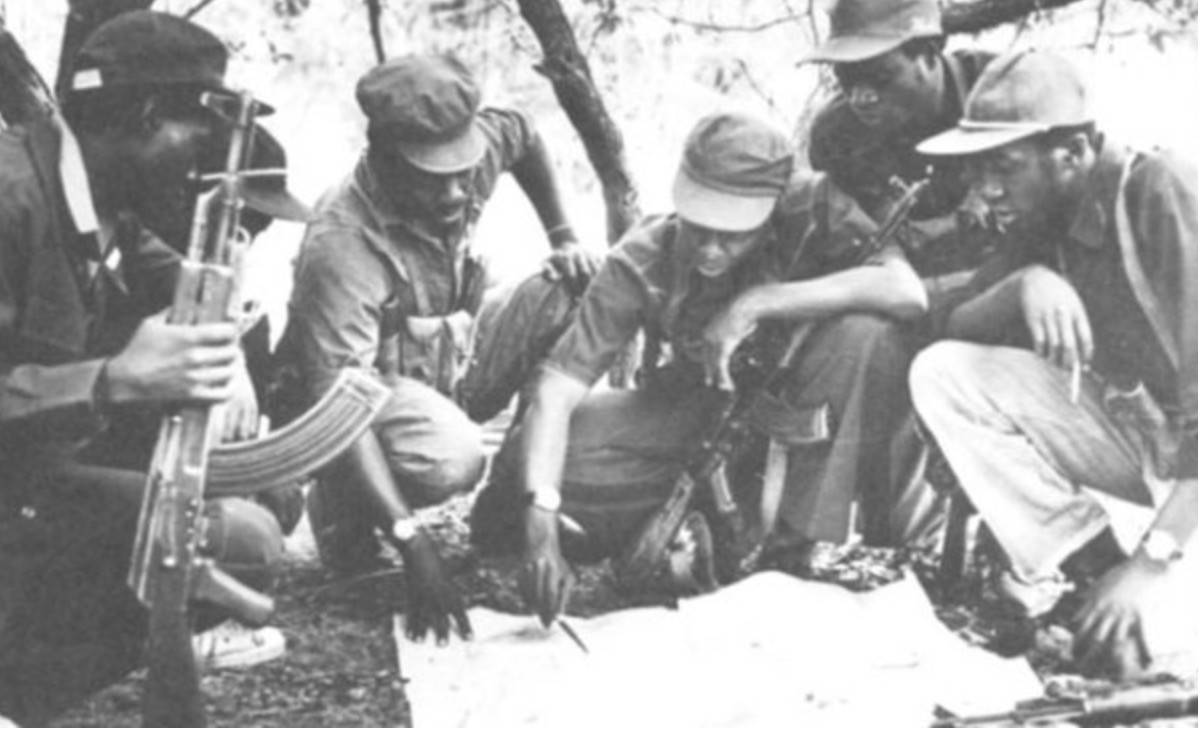
Above: ZANLA CTs making a plan – Owner unknown but I do acknowledge that this is not my media
And we were going to be travelling right through the Zimbabwe African National Liberation Army (ZANLA) hunting grounds.
Would we make it through unscathed? Part 3 will tell.
Copyright
© Mark Richard Craig and Fatfox9’s Blog, 2009-2026. Unauthorised use and/or duplication of this material without express and written permission from this blog’s author and/or owner is strictly prohibited.
Piss Poor Planning: The Debacle of Nyahuku (Part 1)
February 28, 2026
As a member of the Regular army within the Rhodesian Corps of Engineers, it was not unusual to be redeployed to different operational areas to assist where additional manpower or specialist military engineering expertise was required. If you were in-between missions, and idling around at Squadron HQ in Bulawayo (Brady Barracks), you were a prime target for any dodgy task that might be dreamt up by the upper echelons.
The following posts recount one of those occasions.
I was in the Squadron admin office doing my best to look busy, operating the Gestetner machine, rolling off precis for the next intake of recruits from Llewellin Barracks – they would have just finished their basic training, and been selected for Engineers.
There was much to prepare for their arrival, and to be honest I was not into this arranging barracks rooms, stapling A4 sheets together and arranging bed-linen lark – luckily I was about to snivel out of it – although I would have been much better off staying and helping with the incoming Gobbies1.
Someone shouted my name from one of the offices in the HQ. I recognised the voice – it was Staff Sergeant Vic Hydes and he was someone you never kept waiting and I quickly doubled-away to see what he wanted. Vic was often referred to as “Little Hitler”, and it was for a good reason – he was the bloke that had made me swim from one end of Umzingwane Dam, to the other – at night. For more on these aquatic activities please follow this link: https://fatfox9.net/2010/05/22/mzingwane-dam-part-1-combat-engineer-practical-training-phase/.
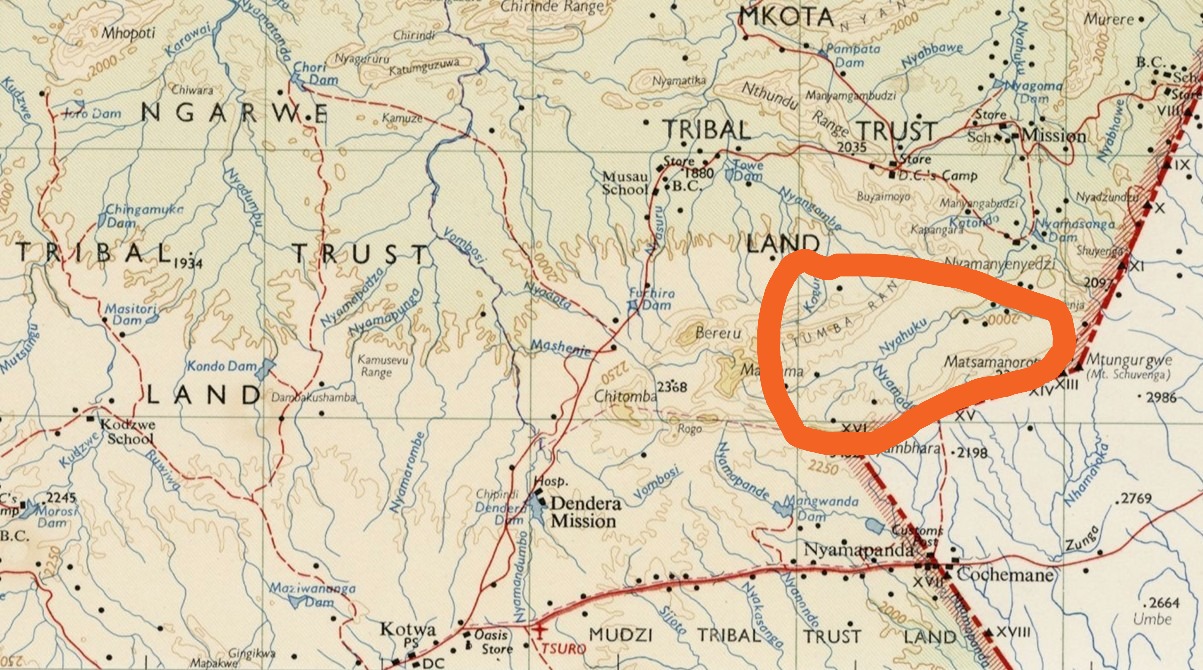
Vic briefed me, although with the little he knew himself, I was only marginally wiser after leaving his office. The short of it was that hot intelligence (laughing my head off) had been received (laughing again) that a large group of gooks2 were planning to cross into Rhodesia somewhere along a 30 kilometer stretch of the border with Mozambique in an area of East Mashonaland within the next two to three weeks. The general location of the suspected crossing point was within an area known as Nyahuku, and is shown below in the orange circle:
During the day more information came to light and I learnt that we had been tasked, together with elements of 2 Engineer Squadron from Salisbury, to lay a rapid barrier minefield (Cordon Sanitaire pattern – see https://fatfox9.wordpress.com/wp-admin/post.php?post=491&action=edit) to block the suspected enemy line of advance where it would cross the Mozambique/Rhodesian border, and kill them.
Due to the geographic location of the target area, 2 Engineer Squadron would be calling the shots on this one, with overall command, control, administrative and logistic responsibility. 1 Engineer Squadron was only providing personnel.
1 Engineer Squadron would mobilise approximately 30 Territorial Force and National Service Field Troop (NSFT) personnel for this mission and they were due to arrive at Brady Barracks in drips and drabs over the next 48 hours. In the meantime I would be working to get 3 troop carrying vehicles prepped for the 650 kilometer journey that lay ahead of us. Nyahuku was a world away from Bulawayo and it was going to be a monster of a drive of 10 to 15 hours, not including stops. Our route would take us through Salisbury where we would night stop and join the 2 Squadron personnel, and then on to Mtoko the next day. Joint Operations Center (JOC) Mtoko, was a key fire-force and intelligence hub within the Operation Hurricane area, and we would take our last stop there before making the final leg to Nyahuku via Kotwa.
Over the next few days I cobbled together 1 x Unimog 25, and 2 x Rodef 45s for the force that would deploy with me. These were reliable Mercedes-based vehicles and I was pleased that we had these three available for us to use, as we would also be towing a full water bowser and fuel bowser.
On the night before we were due to depart we had a good session in the pub, the usual banter between Regulars, Territorials and National Servicemen continued well into the night. Most of us knew one another – we were a small band of brothers, highly experienced in our craft and more than capable of carrying out the task ahead.
The last thing to be done on the morning we left was to test our TR48 radio for comms with 1 Engineer Squadron ops room, plus inter vehicle comms with A76’s, draw our weapons,/ammunition, and 48 hours of rations per man – 2 rat-packs each.
With vehicles full of fuel and final trips made to empty bladders, we fired the Mercedes engines up, and were on our way before noon, most of the passengers dozing-off before we hit the road to Salisbury.
Salisbury would prove to be where things started going wrong at pace.
More to follow in Part 2
Ambush!
July 18, 2017
Ambush!
It all started with manpower, or rather the lack of it.
In the mid-seventies Rhodesia found herself not out-gunned, but rather out-manned in the bush, specifically Infantry-wise. The quick solution to this was to deploy specialist units (like the Rhodesian Corps of Engineers (RhE)), in the Infantry role. Those of you who have been following my Blog will remember that all Rhodesian troops were primarily Infantiers and secondly specialists.
The RhE seemed particularly well-adapted to the pseudo-Infantry role and we often deployed into the hottest areas, at times taking over from “pure” infantry units including the Rhodesian African Rifles (RAR), Rhodesia Regiment (RR) and Rhodesian Light Infantry (RLI).
In some instances we had more success in these areas than our Infantry Brothers.
We were carrying out advance-to-contact foot patrols from of a place called Tshiturapadsi, an unused District Commissioners camp that served us well as it had buildings, water and shelter. There was also an airstrip nearby (See Figure 1 below). It also happened to be located in one of the most gook-infested Tribal Trust Lands, the Matibi TTL, notorious for terrorist gangs. We had been sent there to relieve a RLI call-sign that had been in the area for weeks and who had not even seen a track let alone a gook.
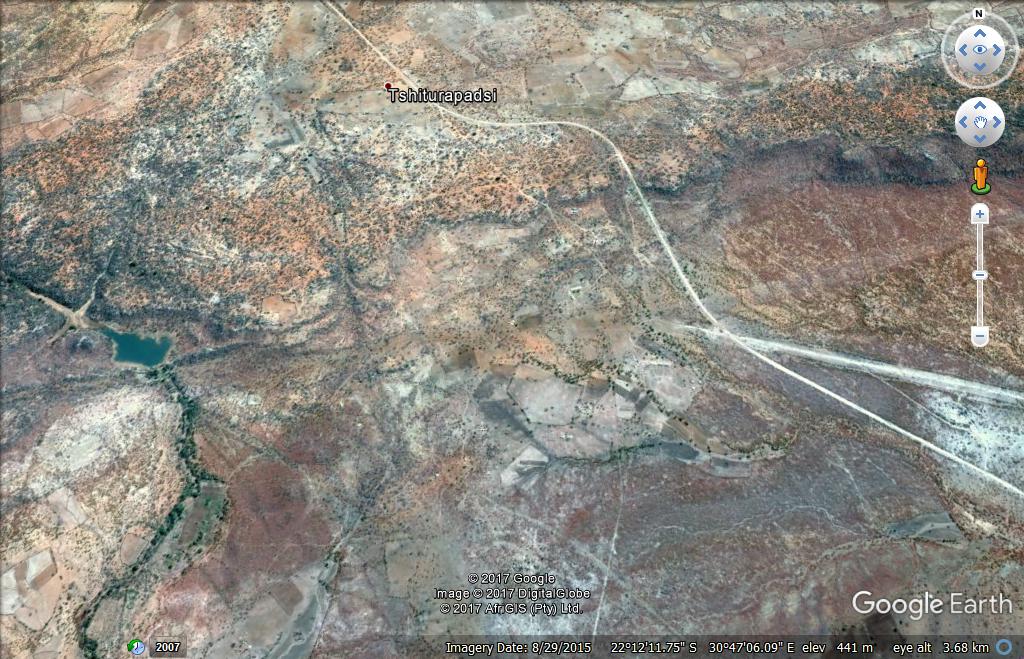
Figure 1
It had been a long day and an even longer patrol. The sun was beginning to dip over the horizon, heralding the start of one of those wonderful picture-postcard African sunsets. A cool breeze brushed my face, refreshing, and surprisingly, despite the heat, sending small shivers down my spine. There was invigoration with coolness also. We paced briskly now, still a little tired but no longer exhausted, rejuvenated with the thought that we would go into a temporary base as soon as it got semi-dark. I was on the far left flank of our ten-man extended line and felt vulnerable with no one out on the left of me…….tall grass blowing in the wind played games with my imagination….I was seeing gooks where none existed. I glanced across to my right, comforted by the presence of one of my mates in the dim light, a safe distance from me, ready to give mutual support if I needed it. As the day turned slowly into night the patrol commander, a young RhE officer passed the signal down the line to move into our temporary base for the night. We changed into single file formation (with me at the back), and took a wide dog-leg route into where the patrol commander had decided we would stay for the night. I was never a great supporter of eating and sleeping in the same place at night and in fact this practice was against our training doctrine. The gooks had Mujibas[i] everywhere and they would report our presence…..and then the gooks could come and fuck-up a pleasant evening. A patrol should eat, carry out personal admin, and then move to a new location, moving into their night location after dark and then there should be absolute silence…..no tins being opened, food warmed, farting or talking. We broke rules that night and within 12 hours we would break another one that would seem to bring hell itself upon us.
First light……always a magic time in the bush. Wet grass, dripping trees, cattle bells and screaming children. The smell of wood fires and fresh cow dung. And all of these things also meant there were people close by. The last guard had roused us all and we grudgingly extracted ourselves from our fart-sacks (sleeping bags). Dog-biscuits soaked in tea or coffee would come later in the morning, but for now we needed to move from this place quickly as this was also a dangerous time when gooks liked to attack. As it was the resident gook gang in the area had bigger plans for us on this specific day.
Still wiping the sleep out of our eyes we prepared to vacate the temporary base, taking care to cover our presence as best we could. We were surrounded by thick bush, the site being chosen for this exact characteristic as it was ideal for a temporary base. It was not however suitable for an extended line formation and so we exited in single file with me more or less in the middle of the patrol. As if by magic we were walking on a well-used path and I soon realised the patrol commander was using the path purposely, leading us to a nearby kraal. We had just broken another rule…..never walk on a well-used path……straddle it yes, but never have your entire patrol on it.
We entered the kraal and went into a well-rehearsed all-round-defence. The entire kraal had one of us on its perimeter looking out for signs of the enemy. The patrol commander and one of our Black Sappers found the Head Man and questioned him on gook presence in the area. In the Matibi TTL there was little chance of the Local Population helping the Security Forces and we decided not to waste time on this place. After searching all the huts for signs of gooks we got the signal to prepare to move on. To my utter amazement the patrol commander put us back on a well-used track leading out of the kraal and once again we were in single file. What was this guy thinking and no one challenged his judgement?
We had walked for about 500 meters when I noticed a single upturned munyatella[ii] next to the path. This in itself was not really out-of-place but it struck a chord somewhere in my survival instincts and I became uneasy. From my position in the patrol I could see we were about to take a right turn on the path. To the right of us the ground rose sharply and soon we were walking parallel to a fairly high, boulder strewn, steep kopje.
There was no warning…..these gooks were good and had chosen their killing ground well…and we had walked right into it.
The gooks initiated with what I now know was a PKM[iii] light machine gun (see Figure 2), capable of firing 650 rounds per minute. This was followed by a fair mix of AK47, SKS and RPD fire……initially. We all instinctively hit the deck not quite sure where the fire was coming from. These kind of events are pretty confusing at first and don’t believe what you see in the movies…..that’s all bullshit. My most vivid memory of this attack was and still is the crack of high velocity rounds going over my head and dirt spraying up all around me and into my eyes. We had all somehow remained in that rather silly single-file formation on the ground even though it was now pretty ragged and we were all horizontal, amazingly unscathed and all facing the kopje, the direction of the attack. We were badly exposed but because we were flat on the ground the gooks could not bring really effective fire onto us although we were all getting near misses. I began to think I was the sole target of a hundred gooks, and perhaps I was as I am quite a big bloke.
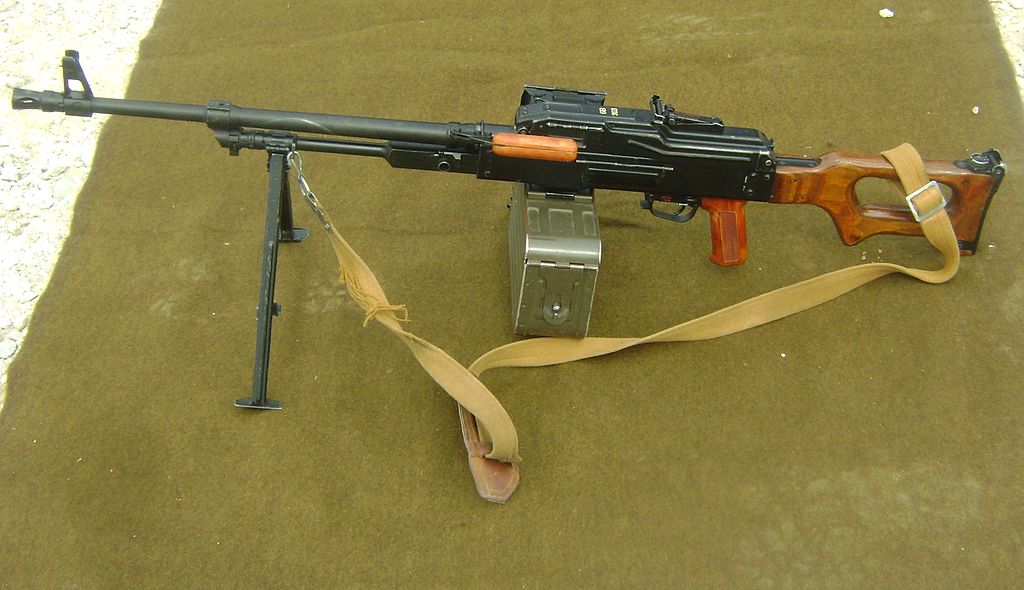
Figure 2
And then two things happened simultaneously…….firstly a new sound came from the kopje, a sound so specific that one ever forgets it….the sound of a mortar leaving a tube………and secondly the shouted order from our line to advance on the enemy using fire and movement. The mortar bombs rained down one after the other, precisely straddling the path we were lying on……encouraging us to advance more rapidly. It was clear to me the gooks had sufficient time to plan this ambush and had accurately estimated the distance from their base-plate position to the path. There was now so much noise, smoke and dust in the air that it was difficult to see. I remember clearly advancing a few yards up the kopje and taking cover, the second section following us while we pumped rounds into the gook positions. Sweat running down my face, the saltiness burning my eyes…adrenaline pumping through my veins…..all fear gone now…….just the job of surviving at the forefront of my mind. My hands were cut from the jagged rocks, the pistol grip on my FN sticky with blood. We were moving higher up the hill, almost half way and we still couldn’t see any gooks……all we could hear was the firing of their weapons. The whiplash of rounds hurting our ears. The mortar was no longer a danger as we were too close to them for them to use it safely as we systematically moved up the kopje………and then there was a relative silence as if nothing had disturbed that cool African morning. All we could hear was the tell-tale clinking of gooks running at high speed with loose kit jumping about in packs and pockets, shouting to one another. We moved up the kopje faster, ignoring the threat of an in-depth ambush……over-running now empty enemy firing positions…the only occupants expended cartridge cases, discarded AK and RPD magazines, and empty cardboard ammunition boxes. We worked through the position, wary now for booby-traps or mines but keeping our wits together. Things were slowing down but the adrenaline was still hot in our veins as we reached the top of the kopje. The gooks were gone and we had them running scared by using tried and tested infantry tactics. I silently thanked those bastard Llewellin Barracks instructors for all the blood, sweat and tears they took from me.
While some of us collected any booty we could find the patrol commander finally found space to get a message off and give the direction of flight of the gooks…….there was hopefully a Fire-Force element with gun-ships somewhere around but I had my doubts. Perhaps they could get an armed fixed-wing up to deal with the gooks but that was also doubtful. These assets were just too thin on the ground and because there had been no recent sightings of gooks in the area, there was nothing positioned close-by. Fair enough.
We gathered at the bottom of the kopje where it all began, carefully avoiding the track but recording the mortar strikes, easily found by the craters they made. They were close to where a number of us were lying and I consider myself lucky not to have been seriously injured or worse. As it was none of us sustained injuries serious enough to call a casevac. We were lucky…..this time.
Still alert and in a form of all-round-defence we found shady spots to sit and reflect on what just happened……..the entire contact not lasting more than 5 or so minutes perhaps but seeming to take an eternity to end. And now that sense of euphoria that only men just out of combat will know…….a great weight seeming to leave your shoulders as you sit back, shaking hands lighting-up a Madison, and let the calmness flow through you as the adrenaline wears off…….the calmness of knowing you survived a situation of grave danger where someone wanted to kill you and failed. There is no feeling in the world like it…….and little did I know that within a very short space of time I would go through the whole process once again…….only this time we would not be so lucky.
[i] Teenage spies, normally unarmed who observed Rhodesian Security Force patrols and informed the gooks on our whereabouts
[ii] Munyatellas were African sandals made out of car tyres and widely used out in the bush as they lasted for ever.
[iii] https://en.wikipedia.org/wiki/PK_machine_gun
Please also vist my website dedicated to Rhodesian and South African Military Engineers. Please join us on the forums by using the following link:
http://www.sasappers.net/forum/index.php
Copyright
© Mark Richard Craig and Fatfox9’s Blog, 2009-2017. Unauthorised use and/or duplication of this material without express and written permission from this blog’s author and/or owner is strictly prohibited.
S TROOP (RHODESIAN CORPS OF ENGINEERS): OPERATION 1
February 3, 2016
NAME OF OPERATION: NOT ALLOCATED OR UNKNOWN
TYPE OF OPERATION: RECONNAISSANCE
DATE OF OPERATION: MID 1970’s
AREA OF OPERATION: SEE MAP 1 BELOW
PURPOSE OF OPERATION: CONFIRM OR DISPROVE PRESENCE OF COMMUNIST TERRORISTS (CHARLIE TANGO’s OR CT’s) WITHIN AREA IN QUESTION (AIQ)

MAP 1
MAP 1 LEGEND:
- Red Track: Insertion Route (1 RhE HQ to Khami Prison (approx 35 kilometers))
- Green Track: Sweep Route (Khami Prison to AIQ (approx 10 kilometers))
- Blue Polygon: AIQ
We had been ordered to report to 1 Squadron RhE the following afternoon in civilian dress and told that our final mission briefing would take place at 16:00 hours. We were also to bring our personal weapons and ammunition, together with our combat kit. There was still no indication as to what the mission was as we were told very little at the briefing the previous evening except that we would be doing a reconnaissance for a possible CT presence.
The smelly little red and white Rixi Taxi dropped me off at the main gate to Brady Barracks. I hoisted my kit bag onto my shoulder after putting on my webbing and picked up my rifle. A grim-looking, red-sashed Colour Sergeant Duty NCO glared down at me as I passed the steps of the Brigade guard-room on the right. Bracing-up to pay him respect the best I could under my load, I made my way to our Squadron HQ. He smiled and gave an exaggerated brace-up in return.
I was surprised to see a Rhodesian Prison Service 65-seater bus parked next to the traffic circle adjacent to our modest Squadron parade ground. Some of the other S-Troop members had already arrived and were leaning against it smoking, talking crap amid loud bursts of laughter and a bunch of howzits greeted me as I arrived and some derogatory remark was thrown in for good measure. We were always taking the piss out of one another and the camaraderie within the Troop was infectious.
There were about a dozen of us on this mission and once we had all arrived we were told to go to one of the lecture rooms behind our HQ and wait for the ops brief. Terry Griffin came into the room and we all stood up and he saluted us, motioning for us to sit with a cursory wave of his hand. He wasted no time in getting to the point. In short there had been a report from one of our local African sources who also looked after our training camp at Khami Dam, that CT’s were visiting the camp at night asking for information with regards to Rhodesian Security Forces. Apparently they had indicated that they would return this specific evening. We could not be certain the source was on the level of course but we needed to either disprove or prove his information. It had been decided at Brigade level that as this was a RhE facility and other resources were unavailable that we should do the reconnaissance ourselves. And rightly so too.
We were to be infiltrated by bus to the general area posing as prisoners being transported to Khami Prison, a large penal facility outside Bulawayo. The map above shows the entire area of the operation as well as the route taken from 1 RhE HQ for infiltration to the Area In Question (AIQ). Prison issued clothing would be worn on the bus to avoid any suspicion that security forces were moving into the area. CT’s had eyes everywhere and the Mujiba system was well-developed throughout Rhodesia. Mujibas were unarmed African children/youths who idolised the CT’s and often acted as useful intelligence sources for the gooks, indicating movement and the location of Rhodesian Forces.
Our mission was purely reconnaissance and we were not to make contact with the enemy unless compromised and our lives put at risk. We wanted the big fish and not the plebeians feeding at the at the bottom of the pond.
With the briefing over all that remained was for us to change into prison garb, load up our kit and weapons into the bus and get ourselves seated comfortably. It would be about a two-hour drive to Khami Prison and rush hour was upon us. The gooks apparently always arrived after midnight and we needed to be in position long before then.
The journey took a little less than planned, the driver taking us through the western suburbs of Bulawayo including Luveve, one of the African townships. On arrival at the prison the large wooden gates were opened and the driver stopped just inside the courtyard of the complex. This can clearly be seen in the photo above when zoomed. We did not enter the prison itself and we were hidden from any eyes looking out from inside. We debussed with our kit and moved to a position along the prison wall where we could square things away. The bus moved into the main prison area belching blue diesel fumes as it did so, leaving us in a smoky silence.
The plan was to wait until last light and then change into our camo-kit, blacken-up and move out to the planned target approach start-point. Our civilian kit was taken to a secure area by a prison official for collection on our way out. Up to now I had a feeling things were going to plan and we had a chance to sit back against the wall once we were prepared and just relax. Most of us lit-up and I could smell gun-oil mixed with the cigarette smoke.
The Territorial Force Sergeant who would lead the mission was a good friend of mine and still is to this day. He knew that for some of us, including me that this would be the first time we would be carrying out a task of this nature. He talked to us and encouraged us, went over the plan again and made sure we all knew what we had to do and the Immediate Action Drills in the event of being ambushed on the way in. All the last-minute confirmations……radio frequencies, where the medic would be, and general march discipline. Orders were given to check the Night Vision kit and I heard the high-pitched whine they made when warming –up.
We rechecked our weapons and cocked them; ensuring change levers were on safe, and prepared to move out. Last light had come and gone……..it was now pitch black and there was a sharp, cool wind about. There would be no moon until after midnight and this would help us on the way in.
As the high wooden gates swung open the prison perimeter floodlights were switched off. Our departure was being coordinated from somewhere inside the prison. We filed through one by one, out into the darkness. As if on cue, the incarcerated prisoners began to sing one of their mournful songs. It was if they were bidding us a final farewell and a slight shiver ran down my back.
We walked parallel and close to the prison north wall until we reached the main road to the west. We crossed this individually and quickly, headed off into the bush for 15 minutes and then stopped to regroup. Once we were all accounted for we moved off to the start position which was adjacent to a wide stretch of water and began the march to the AIQ. It had been decided that we would move into our Observation Post (OP) position in single file and this should only take a few hours with breaks in between. As it was the approach was uneventful save for the odd curse when someone tripped on a root or got a thorn in the face from a low-hanging acacia. The cool wind made it easy to keep up a good pace and we made it to the AIQ before we had planned, went into an all-round defence, and settled into silence.
The training camp itself was flat but surrounded on two sides by steep rocky kopjes. We had chosen one of these as our OP and it gave us a good view of the target area as well as good cover in case of attack. All was quiet. The moon had come up and we could see quite clearly without night vision equipment. There was no movement at all. It was so still that anyone approaching would be heard and we relied on this to give us an early heads-up of visitors. It struck me then that we would also have been heard moving into position on the kopje.
We had arranged that we would do 2-man watches for 30 minutes at a time. No one slept but it was nice to just lie down on the uncomfortable ground and stare up at the stars in the crystal clear sky above. The night wore on and when it came to my second watch the first golden slivers of a typical Rhodesian sunrise were visible low in the sky. Dogs barked in competition with children’s shouts in the distance and the sad sound of a cow-bell rang in the air. The smell of wood fires filtered through the air…….the smell and sounds of Africa, and a new day had dawned.
We had planned a first-light sweep through the camp to see if we could pick-up any sign that the gooks had been in the area previously. They definitely had not visited while we were there. The Sergeant gave us the signal to move back down the kopje, the same way we had gone up. We would wind our way around the kopje and then form a north/south extended line and sweep through the camp from west to east. We would be exposed now as the camp was on cleared ground with 5 or six rondavel arrangements as accommodation. Although we were fairly sure no gooks were around, first light attacks were common and we needed to remain switched on. This was not the time for complacency. As we swept through, each and every one of us knew that there was no cover except for the rondavels and most of us were a fair distance from them. If the gooks had somehow managed to get into a good position on the high ground last night without us knowing we would be in harm’s way. This was improbable but a man thinks strange thoughts in such situations. It also keeps a man alert. We were in a perfect killing ground for them, literally challenging them to have a crack at us. As it happened, there were no gooks to be found here today. We ended the sweep and moved back around to the back of the kopje, set up a secure temporary base and got the hot water on. It was time for coffee and doggos (dog biscuits) and soon the air was filled with the familiar fragrance of Esbit heating tablets and at that stage it was the sweetest smell of all.
We were to be collected by Squadron troop carriers close to the start position from the previous evening. Hopefully they would have remembered to load our left-over kit at the prison. On the walk back to the pick-up point we moved in extended line and had not relaxed our vigilance. Suddenly one of my mates on the flank called a halt and we stopped and got into a kneeling position. Ever observant he had located a chevron pattern boot print on the ground and the Sergeant confirmed this was gook spoor for sure. Sadly it was old and probably not worth following but we decided we would do so anyway, at least for a little way just to see if they led anywhere interesting. They didn’t and we lost them soon after. At least we now knew there was clear evidence that gooks, or at the minimum, someone wearing a gook boot had been in the area recently. Even though we never got any kills this was useful information for Special Branch and they deployed Ground Coverage assets into the area to sniff things out. I never heard any more of the gooks that came to visit us.
I learnt a lesson on this operation. Rhodesia has an approximate area of 391,000 square kilometres. It was not saturated with gooks. The odds of bumping into gooks every day was fairly remote unless you were on Fire-Force or just happened to be in the right place at the right time.
The wheel of chance was turning though…….and soon I would also learn that those 391,000 square kilometres were not so big after all.
Please also visit my website dedicated to Rhodesian and South African Military Engineers. Join us on the forums by using the following link:
http://www.sasappers.net/forum/index.php
Copyright
© Mark Richard Craig and Fatfox9’s Blog, 2009-2023. Unauthorised use and/or duplication of this material without express and written permission from the blog’s author and/or owner is strictly prohibited.
On The Boats……Up The River With The SAS (Part 1)
February 7, 2015
DEKA ARMY BASE: LATE AFTERNOON
Conversation between Camp OC and ourselves:
“I want you two wasters to get your boat ready for a night operation. You are to take your boat to this grid reference (him indicating on the map) and wait there for someone to make contact with you. You will need spare fuel tanks, 24 hours rations and full ammo. I cannot tell you anything else but make sure you get there just as last light falls and don’t fuck up on the position I just gave you”
That was it. Short and to the point.
It quickly became time to go. As Tony and I climbed into the back of the Mercedes 25 Troop Carrying Vehicle (TCV) we looked at each other and wondered what the hell this was all about. We didn’t even know who we were supposed to meet and more importantly, what for. The driver fired the Unimog up and with a characteristic torque-induced jerk we were off, easing through the camp entrance, and then turning sharp left onto the road to Sibankwazi. To our boat……..and the Zambezi River.
I had looked at the Ops Room map as the Captain briefed us and taken down the grid reference we were headed for. As far as my memory serves me it was at the position marked SAS pick-up position on the map shown below, near to Mapeta Island:

Tony and I had worked the time and distance calculation to get us to the Rendezvous Point (RV) just as last light was coming on. We were both edgy and rather subdued on the journey down to the boat, each of us respecting one another’s silence. Travelling the Zambezi River during the day was a challenge at the best of times, always having to ensure that we never strayed across the international boundary (Rhodesia/Zambia), which was an invisible line running up and down the river, but not necessarily in the middle. We were now going to be travelling on the water towards dusk and more than likely in darkness if our suspicions were right. Logic told us that no one would want us to meet them with a boat if they were not going to use it. We were spot on!
We had trained to work on the Zambezi River at night and knew that the landmarks that we used for daytime navigation, could also be used at night. We always chose high features that would silhouette easily against the sky or stars for navigation. Simply put we would know what feature to point our bows at and which feature our stern should be pointing at to stay safe. Quite an easy task in daylight but in darkness a mans eyes play games, confusing the mind as to what feature is what, what is true and what is false. Making you doubt your own judgement, possibly leading you into a bad place. No GPS in those days…….maps, compass, eyes and dead reckoning. I loved that kind of navigating though. Seat of the pants stuff and a small victory when you arrived at the right location.
We debussed at Sibankwazi, close to our boat. First on the agenda was to check in with the British South African Police (BSAP) personnel at the camp and let them know we were going out on the water. There was nothing to tell really, just that we were going up river and would stay in comms with them. We took comfort in knowing they would come out and help us if the shit hit the fan. They were good lads and always watched our backs. And they had nice, shiny fast boats with big guns on.
Tony and I finished our preparations, cleaning the inside of the boat, filling fuel tanks (2 per engine), checking our small supply of boat spares, running up the engines (which had no covers), checking radio comms with the police and Deka Base, and checking our personal weapons and kit. I would take us on the outward leg and Tony would bring us back. What happened in between we would share.
The picture below shows Sappers carrying out typical boat preparation activities. This is the exact same type of boat we were using on this mission (Basil Preston):

It was time to move out. I moved the throttles to the start position and made sure the engines were in neutral. Tony pumped the primer balls to get juice into the carbs, wound the starting rope around the first engine and pulled it. The engine fired and I adjusted the throttle to a gentle idle. He started the second engine and we were ready. I let the two engines idle for a minute or two while Tony made sure water was being expelled from the cooling system outlets.
I gave Tony a thumbs up and he slipped the mooring line. I moved both engines to reverse and we began gently edging astern and away from land. Once far enough out I put the engines in forward gear, pushed up the revs and pointed our bows north-west…..into the gathering gloom……we were on our way.
The picture below gives an idea of the Zambezi River at night……..a very dodgy place to be, especially if there was no moon:

Please also have a look at my website dedicated to Rhodesian and South African Military Engineers. Please join us on the forums by using the following link:
http://www.sasappers.net/forum/index.php
Copyright
© Mark Richard Craig and Fatfox9’s Blog, 2009-2015. Unauthorised use and/or duplication of this material without express and written permission from this blog’s author and/or owner is strictly prohibited.
On The Boats……Spinning Flywheels and Dodgy Sergeants
December 17, 2014
I received this personal account from Neil Potter…….another veteran of the Rhodesian Engineer Boats!
Neil takes up the post from here:
I had the dubious honour of falling over and between a pair of those Evinrudes, running without the covers on, after just pull starting both. The idiot at the controls, a 2 Indep. NS Sargeant fresh out of Hooters, decided that it would be funny if he gave both motors full throttle when I asked him to give the port motor more revs (via the warm up lever as I had instructed him beforehand as that motor always stalled). I had both legs badly cut up by the flywheels, a hundred plus stitches later, and friction burns around the wounds. What really irked me was a few years later I pulled my file in the orderly room in Kariba and read his statement to the effect that I had caused the accident by pull starting the motors in gear! He even had one of his troopies verify that by making another statement to that effect, even though that individual was not even on the boat with the others going out on patrol.
One of the drawbacks of not having a crew member with you I guess, but I’d enjoy a conversation with that idiot if I could only remember his name.
Now that’s just the sort of thing that can happen when you have idiots at the controls. Good to know Neil got out of it in one piece though and a big thanks to him for the recollection.
For those of you that don’t know what an outboard motor flywheel look like, here is a picture for illustration:
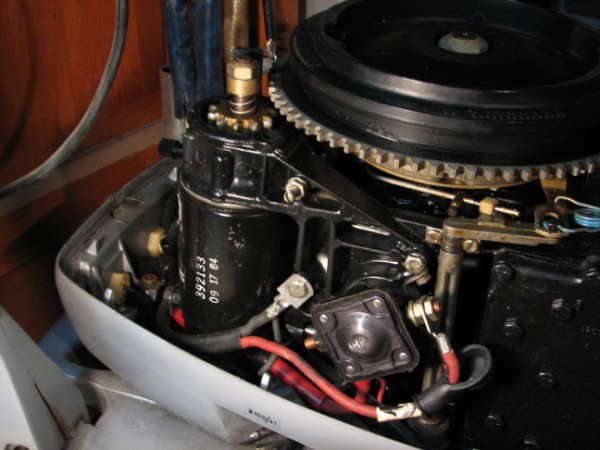
The flywheel is the big round black thing on top and when the engine is running it spins at very high revolutions. Imagine two of those spinning side by side and like Neil, falling onto them because some asshole opened the throttles………..and our flywheels were a lot less smooth than this one. We had all sorts of jagged bits sticking out to bite us.
More on outboard motors, flywheels, shear-pins and other animals in the next post.
Please also have a look at my website dedicated to Rhodesian and South African Military Engineers. Join us on the forums by using the following link:
http://www.sasappers.net/forum/index.php
Copyright
© Mark Richard Craig and Fatfox9’s Blog, 2009-2014. Unauthorised use and/or duplication of this material without express and written permission from this blog’s author and/or owner is strictly prohibited.
On The Boats…………(Part 1)
December 6, 2014
I watched the snake slither along the wooden rafter of the hut, its black tongue flicking ahead, feeling the way. Lying on my bed and looking up at the bright green reptile I wondered what my escape plan was. It was the first time a mamba had come into our billet but I always knew our luck would run out one day. We were after all in the middle of the bush, working out of Deka Army Base and snakes were quite commonplace. I didn’t like snakes then and I don’t like snakes now. Just one of those things. Anything else I can handle.
Here is a picture of a Green Mamba (greenmambasnake.com)…..a very dodgy visitor indeed:

There were two of us. Both Sappers from 1 Engineer Squadron and attached to the infantry unit at the camp. I think it was 1 Independent Company from Wankie based there most of the time on Border Control operations. Tony Carinus and I were tasked with operating a Hercules Assault Boat within our area of responsibility on the Zambezi River, and our boat was moored with the British South Africa Police (BSAP) boats at the Sibankwazi Police post. We had approximately 60 kilometres of river to patrol which was quite a stretch and we tried to cover this as often as we could.
Our boats were shite-looking and the police boats were all shiny and painted in cute pastel colours with lots of aerials on them so they could listen to Sally Donaldson and Forces Requests on Sundays. Papa5 was a particularly nice police boat that I would have given my left testicle to take onto the river but big John Arkley, the Member-In-Charge of the Sibankwazi BSAP would not allow it. We never had any aerials as we had no one in particular to talk to and the boats were painted a matt dark green, or at least they were green when they were new which must have been in 1945 or earlier.
Here is a picture of one of our boats (Basil Preston):
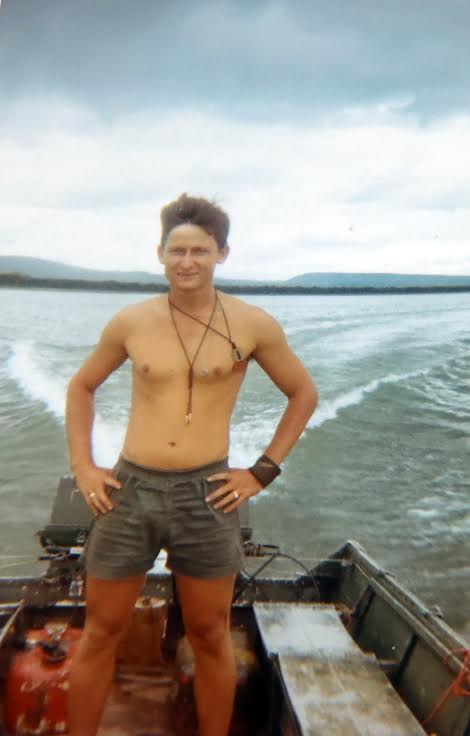
Please note the warped wooden seats made for extreme anal comfort, and the generally dodgy state of seaworthiness. I must say that this boat at least has engine covers on the twin 40 ponypower Evinrude outboards so is probably a VIP version. A close look at the red fuel tank also indicates it was probably “borrowed” from a civvy fisherman on a long-term basis as ours were a dull drab brown colour. Either that or the QM ran out of camo paint or brushes, or both.
Here is a picture of the area of the Sibankwazi Police Post (www.bsap.org) where we moored up.

Our boat was not allowed under the shelter because there were too many shiny police boats in there. We normally tied up to the left of the shelter near the launching area (see above). Having said that the bobbies were always very good to Tony and I and we had many good piss-ups and braais with them. They were also destined to get me out of some fairly serious shit in the years to come.
Tony and I normally planned our own activities and it seemed in retrospect that the infantry Sunray (OC) at the camp never had much interest in what we got up to all day. Only occasionally would we drop-off or pick-up infantry sticks along the Rhodesian side of the river. This resulted in a lot of tiger fishing, game viewing, stopping off at Msuna Mouth or Deka Drum resorts for beers and a meal, or simply patrolling up and down the river looking for gook crossing points or even better still, some gooks.
This is the Deka Drum area of the Zambezi (Craig Haskins)………

A pretty enjoyable time for me and Tony in general and I have fond memories of my days on the boats. We did however have some dodgy experiences and these will part of the next few posts.
Please also have a look at my website dedicated to Rhodesian and South African Military Engineers. Please join us on the forums by using the following link:
http://www.sasappers.net/forum/index.php
Copyright
© Mark Richard Craig and Fatfox9’s Blog, 2009-2014. Unauthorised use and/or duplication of this material without express and written permission from this blog’s author and/or owner is strictly prohibited.
Farewell to Cordon Sanitaire…….for a while
November 9, 2014
The previous posts focussing on laying Cordon Sanitaire took more time and research than I thought they would. These operations were truly the Rhodesian Corps of Engineers own private battle within the Rhodesian Bush War. Thanks to the input of former Rhodesian Sappers (and in some cases, non-Sappers), I think we have managed to bring those challenging days to life once again. As I mentioned in a foregoing post, I feel enriched and privileged to have been part of these operations. It was and still is an honour to have shared the hardships and dangers with that very special Band of Brothers. Mukumbura will never be forgotten.
There will be more on Cordon Sanitaire later but now is not the time. These future posts will fall under the main title of Cordon Sanitaire Phase 2 (Minefield Maintenance). In so many ways this was the biggest challenge we had as a Corps. The dangers faced by maintenance crews were far greater than those faced during the laying of the Cordon which in relation to this blog was Phase 1. Indeed, the majority of Rhodesian Engineer fatalities and serious injuries were a result of minefield maintenance operations. As a Regular Army sergeant I commanded minefield maintenance operations at both the Deka Minefield and the Victoria Falls Encirclement and will discuss both of these at a later stage.
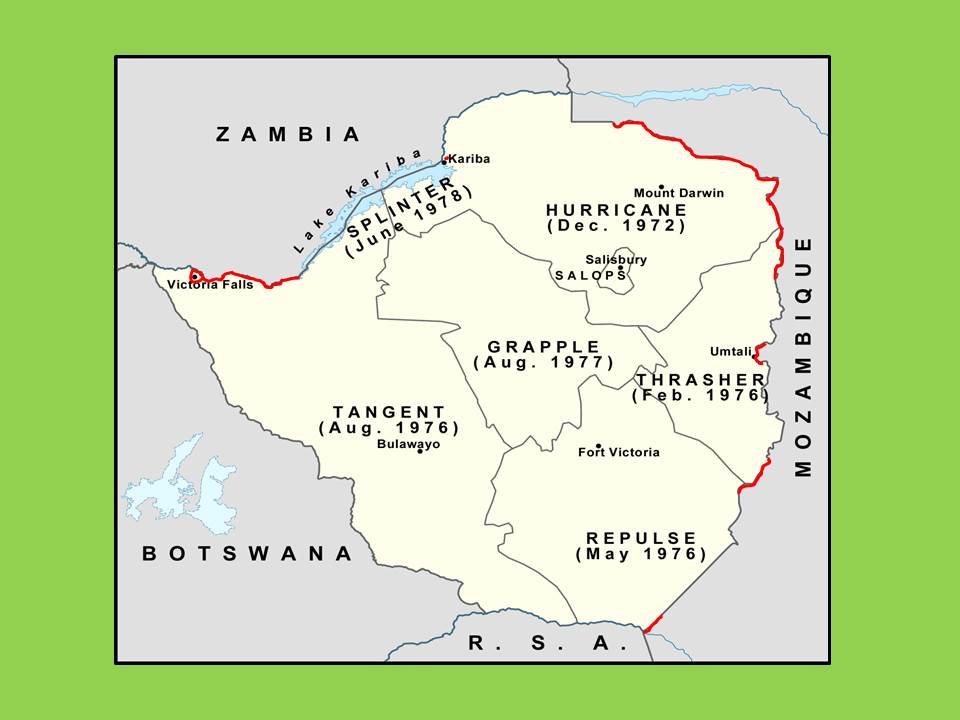
For now it is time to say farewell to Operation Hurricane as we move to the Operation Tangent area (see map below).
The next post will start off with my recollections as a boat operator on the Zambezi River, based at Deka Camp and operating out of Sibankwazi with the British South Africa Police (BSAP).
Interesting times indeed and I hope that you will continue the journey with me.
Please also have a look at my website dedicated to Rhodesian and South African Military Engineers. Please join us on the forums by using the following link:
http://www.sasappers.net/forum/index.php
Copyright
© Mark Richard Craig and Fatfox9’s Blog, 2009-2014. Unauthorised use and/or duplication of this material without express and written permission from this blog’s author and/or owner is strictly prohibited.
Cordon Sanitaire: Personal Experiences (3: Basil Preston)
November 2, 2014
The response to my request for personal experiences on Cordon Sanitaire has resulted in a number of submissions from people who clearly want to see our history recorded and celebrated. Long forgotten names are being mentioned, sparking the grey matter into life once again and there is so much to be gained by reading about other people’s experiences on the Cordon. I for one feel enriched by all of this.
The following is from Basil Preston, a Rhodesian Sapper who I am sure has many more stories to share with us and I really hope that he does. I have slightly redacted Basils submission, however it is mostly exactly the way he sent it to me.
Hi Mark,
My name is Basil Preston army number was 72860 and I became an Engineer after I did my basics at Llewellyn starting 07/06/1972, Intake 132.
I have just read your blog about the Cordon Sanitare (sp) mine-field starting at Mukumbura.
We were the first Engineers to start this field, in either February/March or April 1973, can’t remember the exact date, (but ABBA, the Swedish group had just announced that they were in support of the freedom fighters at that time, we all dropped them from our favourites after this announcement).
We were tasked with the clearing of the bush etc with bulldozers and graders. Our main chap who loved the grader work was Gordon Paterson, who was black by the end of his shift from all the dust and sweat.
We were broken up into 3 groups; clearing party, guarding the workers and the clearance party comprising 3 sappers, who did a 360 around the whole group. Tetse workers were busy with the fencing.
Corporal Gleson was in charge of us, and Corporal Charlie Mcquillan and Sergeant Hitchins/Hutchuns (sp) were there too, but did nothing special as they were imports from the UK who joined the army as regulars and were being bushed trained. These chaps were electricians by trade, but knew nothing much about our conditions or bush. We were about 20 sappers all told, and were looking forward to our demobbing in June. We were due to pass out on the 13/05/1973. Melvin Hein, Tommy Dickinson, Basil Kirby, Mike Travaglini, Gordon Paterson, Gumbie Dixon are just a few names I remember.
We were told that if we saw anyone foreign to our people, we were to first contact base camp to confirm, as they could be Tetse workers.
On our first outing, I was part of the 360 group, comprising Tommy (Dicky) Dickinson, Gumbie Dixon and myself, and we had just collected Marula fruit and were busy eating them when I noticed movement about 400 metres away from us. As I passed a huge palm leaf, the 2 images I saw went to ground. I shouted “ters” and we took cover, made contact with base camp, who told us to wait one, and they would come and assist. (contact via our radio was a laugh, as Dicky’s hand was shaking so much, the coms was interrupted going out, as the hand press-switch was also being pushed on and off as the shakes continued)
We were high on adrenalin and got impatient waiting for back-up, and started to leopard crawl through a dried out mealie field, which was cutting our knees to pieces. We then ran to where we saw the 2 images go down, all the grass was laid flat.
Back-up arrived nearly an hour late, and off we went. By this time, the Cts were back in Mocambique. But we still did a follow up. Crossing our own freshly graded mine field was hectic. Crossing by running across the open one at a time The Sergeant got stuck on the fence as the strain of wire wedged between his back-pack and his back, I ran forward to help the guy,who did not appreciate it as we were now both sitting targets.
Nevertheless, we were the first group of sappers to have a “contact” be it visual only. We were not impressed with the time it took the back-up to arrive and we voiced our views on this.
But to cut a long story short. After weeks doing the same thing, day in and day out, and nightly ambushes along the field, we started to get gut-vol.
On our return from the field one day, Charlie Mcquillan, wanted to put my group on extras as he had found a tin of jam in our bivy area, full of stinkbugs and ants eating the left-overs. One of our group had acquired the tin of jam from the kitchen. We were short on every thing by this time. We lost it and asked him why he was snooping around; and threatened him with his life. Dicky was going to see that he never left the country, as he was “customs” back in civy life, I was a banker and told him that he would never get foreign exchange when he left Rhodesia and Melvin just wanted to hit him with a pick-handle. The rest of the guys just wanted to bury him in our trench. Corporal Gleson saved Charlie that day.
I also went onto doing the Dekka mine-field, and the one at Villers. Did boats in Kariba with Ant White, at the time they were forming the Selous Scouts and served with RAR, 2RR for almost the whole of the continuous period at Malapati and various other RR Companies. Looking back, I had a tough 8 years of army life as a sapper. My son was 3 weeks old when I was called up for the “Continuous” period and was 13 months old when I saw him proper again. All told, the guys I served with were a great bunch indeed. Mick (Chum) Jones was in my intake too. He was killed with Leroy Duberly, Charles Small, Peter Fox and one other during the second Chimoi external. They were with a bunch of RLI all in a Puma which was shot down, all 17 in the chopper were killed.
Thats all for now.
Regards, Basil Preston
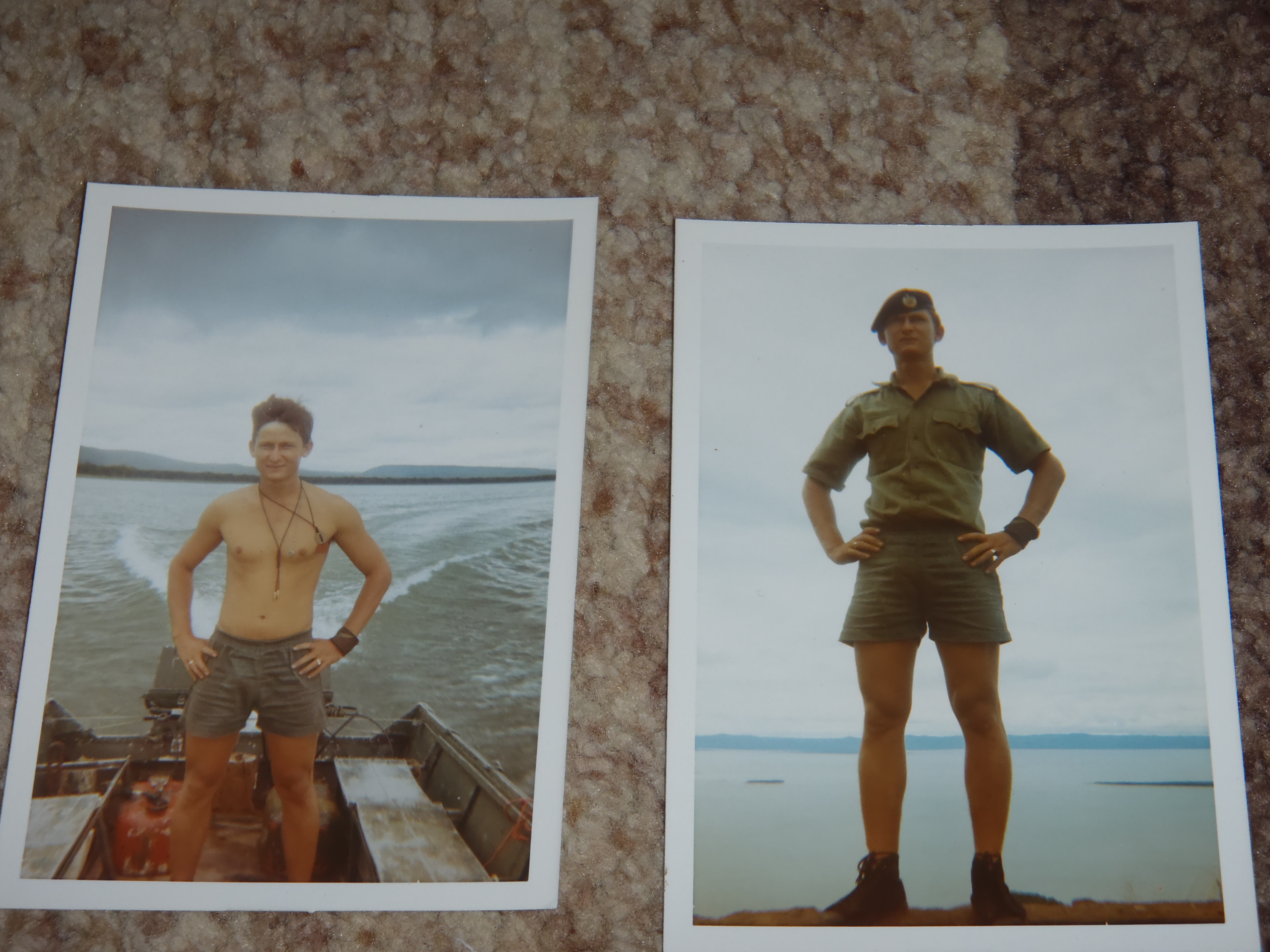
Photos of Basil are shown below:
Please also have a look at my website dedicated to Rhodesian and South African Military Engineers. Please join us on the forums by using the following link:
http://www.sasappers.net/forum/index.php
Copyright
© Mark Richard Craig and Fatfox9’s Blog, 2009-2014. Unauthorised use and/or duplication of this material without express and written permission from this blog’s author and/or owner is strictly prohibited.
Cordon Sanitaire: Personal Experiences (2: Vic Thackwray)
October 19, 2014
As mentioned in my previous post we will continue with the personal recollections of some of those that worked on Cordon Sanitaire. In this post we have accounts from Vic Thackwray, another former Commanding Officer of mine. I had the pleasure to work with Vic in the Rhodesian Army (RhE), the South African Defence Force (SADF (SAEC)), and also in the private sector after we had both ended our military careers. Vic and I remain close friends and I wish to thank him here publicly for all of the help and sage advice he has given me over the years, and will probably also need to do in the future. I am bound to ask him something and he always responds rapidly and with a genuine willingness. Thanks for everything Vic…..you are one of a kind.
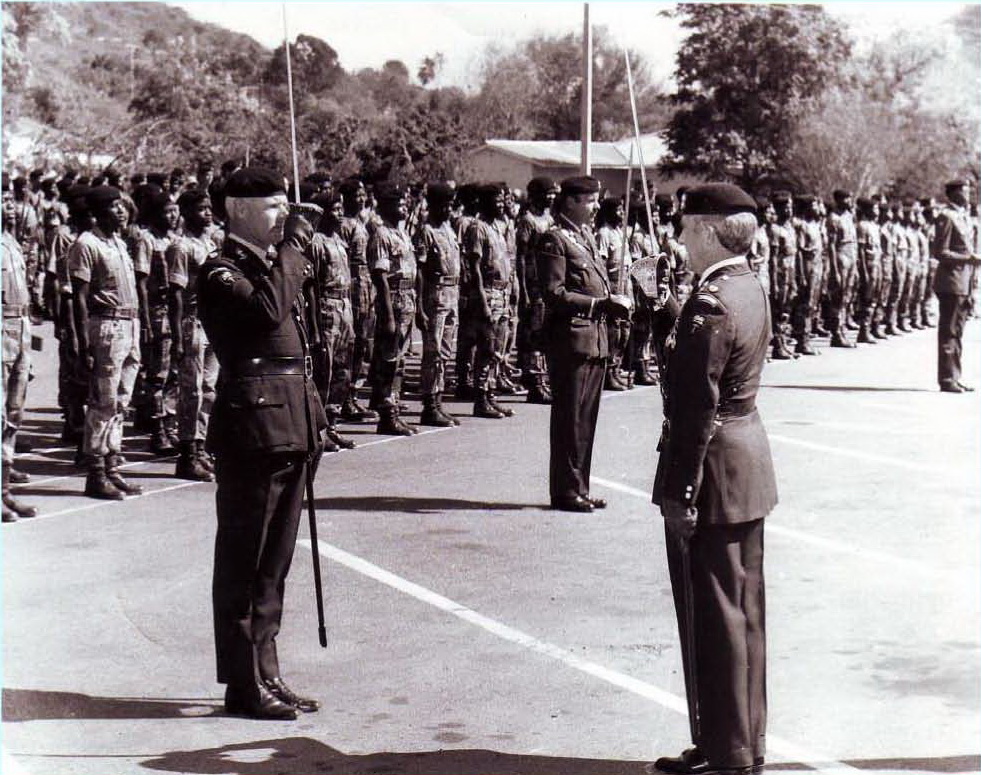
The picture below shows Vic (left, saluting with the sword) as Parade Commander at the Last Official Parade of the Rhodesia Corps of Engineers in 1979……..a sad day indeed and the end of an era but how proud he must have been!!
Vic takes up the post from here…………starting with an interesting and sobering Cordon Sanitaire Fact Sheet:
‘CORDON SANITAIRE’ FACT SHEET
The following illustrates my involvement with the Rhodesian Cordon Sanitaire.
- My initial deployment to Cordon Sanitaire was to take over from Terry Griffin (see previous post) who had trained the first mine laying teams in Mukumbura.
- My second in command was a Corporal Charlie MacQuillan who had recently attested into the Rhodesian Corps of Engineers from the British Army.
- We commenced laying the Portuguese M969 mine. This was followed by the South African R2M1 mine, the South African R2M2 mine, the Rhodesian Engineer manufactured RAP mine (commonly referred to as the ‘Carrot Mine’), and the Italian VS50 mine.
- The Cordon concept was based on the Israeli Defence Force minefield which separates Lebanon from Israel and is called the ‘Blue Line’, the electronics used in Israel were used for the first 50 km or so in Rhodesia but was soon ‘binned’ for financial reasons coupled with the constant triggering of the system by wild animals.
- The total length of the combined minefields is 696 km
- The density of mines was 3,000 mines per kilometer with 300 ploughshares per kilometer for approx 500 kilometers.
- A committee was inaugurated comprising the SADF, the Rhodesian Army, and elements of CSIR in SA and was called the ‘Geisha Committee’. It was formed to discuss, workshop and plan all mine action activities between the two countries.
- One of the senior CSIR members, (name removed) was instrumental in the design and manufacture of the R2M1 and R2M2 AP mines. I was tasked to assist on the ground in the Mukumbura area and established a ‘Seed Minefield’ within our minefield. In this area we laid many mines at predetermined depths and other technical data. On frequent occasions the Professor would travel to the field and I would be instructed to remove selected mines for observation and assessment.
- Accidents involving own troops during laying, maintenance and some clearance numbered 97, of which the majority were traumatic amputations of one leg, and 1 member both legs, (1 above and 1 below the knee) (Sgt. Willem Snyder). Several of the 96 members lost hands, fingers and eyes, 1 unfortunate member Spr Ndlovu lost both hands and blinded in both eyes during the arming of a plough share. The deaths of members numbered 30, however, this figure is not confirmed but estimated by me and several other officers of the Corps. he majority of accidents and ALL the deaths are attributable to the Maintenance phase of the Cordon. I am aware of members being killed when the point Sapper walking down a safe lane was confronted by a snake, normally a Black Mamba or Cobra and he just ran blindly into the minefield and subsequently triggered the trip wire of a plough share instantly dying and often a few of the maintenance team were injured by shrapnel. Additionally other members were killed or severely injured when replacing plough shares during which the 30 metre trip wire was hit by Doves, guinea fowl, small antelope, and turkey buzzards. In the Umtali forest areas where I spent considerable time, several members were injured or killed when the plough share was triggered by falling bark from Gum trees as the Cordon went through many Gum Tree plantations. Again in the Umtali area some 5 accidents were attributed to terrain problems, whilst maintaining the minefield the 15-20 cm. thick soggy/wet leaf mould caused the members to slip/slide and subsequently hit a mine on their rapid descent. One young Sapper lost his leg when he foolishly attempted to retrieve a set of Kudu trophy Horns in the Northern minefield.
- The Cordon, in 99% of cases employed the International Border as the Enemy fence, for obvious political reasons.
- When the terrain dictated that the Cordon could not follow the Border, the proposed route of the field was assessed and this information subjected to a high level detailed Military Appreciation. Changing the minefield routing obviously required high level Political input as it involved, Private land, farms, forestry, National parks, Police, Internal Affairs, and Tribal burial grounds, to mention a few. This appreciation and request was forwarded to Parliament via Engineer Directorate to Army Commander to COMOPS for approval. The agreed rerouting on the Rhodesian side of the border together with detailed maps of the new routing was then subsequently issued from Engineer Directorate.
- The Cordon including all maps, diagrams, drawings, mine stocks and all reports etc., was officially handed over to the New ZANU Commander of the Zimbabwe Corps of Engineers over period April 1980 to December 1980.
Vic continues with anecdotes he recalls from the time:
During the maintenance of the Cordon Sanitaire, we frequently had to deal with wounded terrorists in the field, on one occasion near the Mazoe river bridge on the Northern border with Mocambique we were informed of four terrorists injured in the field, I proceeded with my team, ably protected by “Dads Army” , (the over 50-year-old soldiers)!
On arrival I deployed the protection troops to give me covering fire, gave them strict orders on the rules of engagement and proceeded to clear into the field.
Of the four terrorists, one dead, one youth (more a porter of equipment than a combatant), and two combatants, one had lost both feet and the other, one foot. Both with AK rifles close by and lying with their injuries slightly elevated on packs to reduce pain and bleeding. I gave them the usual warning that if they moved during my clearance in to save them, the troops would not hesitate to take them out.
All prepared, focused and fully hyped, I commenced clearance, when suddenly out of the blue, one of the “old soldiers”, a bank manager, called out to me in a loud and very posh voice:
Quote
“ I say sir, there is no threat here, it appears that all these chaps have been defe(e)ated”
unquote .
That just cracked me up, I needed a few minutes to regain my composure, and focus before resuming clearance.
And another…………………….
First Version of the Ploughshare
Based with Major Henk Meyer 1st. Battalion RLI at Mukumbura,
I had been tasked by Colonel Parker (affectionately called the ‘King’) who was based at Mount Darwin to strengthen the minefield over a certain area as they were expecting a thrust from Mocambique.
I installed 30 trip wire operated devices (First version of the ploughshare, using old pull switch devices.
Major Henk Meyer instructed me to show and explain the procedure to Captain Keith Sampson RhE., and a Selous Scouts Officer Major John Murphy (ex American Military), with parting words from Major Henk, ‘be careful Thackwray’.
I was dressed in Veldskoens, no socks, camo shorts, camo shirt, chest webbing, Camo floppy hat, water bottles and rifle .
We walked about 2 km along the fence with army protection on our left hand side, crossed the minefield at my clearance lane into Mocambique and walked 400 metres along the minefield fence to the position of the devices.
At a safe distance from the devices, I instructed them to wait at the fence whilst I made the device safe, I went in, removed 2 of the 3 ‘keeper mines’ from the base of the device and removed the detonator from the trip wire device, placing the detonator below my lower legs .
I commenced describing the device when (according to the protection force members) a bird some 20 metres down, flew into the trip wire, the detonator blew and I received detonator shrapnel, mainly to face, head, arms, legs and lost an eardrum, fortunately I had my prescription glasses on.
The two very agitated visitors were trying to come through the fence to assist me, I calmed them down stating that I was OK just a little blood, Major John Murphy then said words to the effect that ‘Rhodesians had big balls’. With ringing in my ears I only remember hearing the word balls, to which I immediately and instinctively checked my 6 o’ clock position, all was found to be good and this reaction was enjoyed by my visitors.
I relaid the 2 mines around the base and we walked back the 400 metres and along the 2 km road to base, it was amusing because all the supporting troops were staring at this walking bloodied apparition.
We finally arrived back at RLI base and my shoes were swimming in blood I was an apparition to behold, Major Henk Meyer was not amused and taking off his beret swiped me with it, saying “I told you to be careful Thackwray and what am I going to tell the King (Colonel Parker)”?.
I was casevaced to salisbury two days later.
Below I have included pictures from Vics contributions showing the types of mines he mentions :
Portuguese M969

South African R2M2 (R2M1 was very similar in overall design but had a different ignitor)

Rhodesian Carrot Mine (RAP)
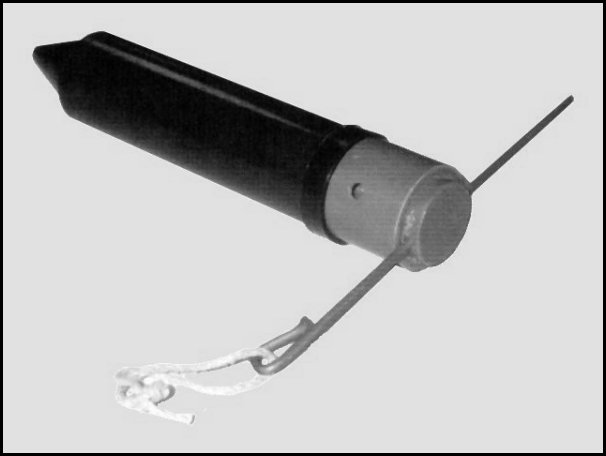
Some of the items may vary in colour from what the Cordon Sanitaire veterans remember but the general shape and design are spot on.
I would like to thank Vic once again for his input here
………..and just before I sign off this post:
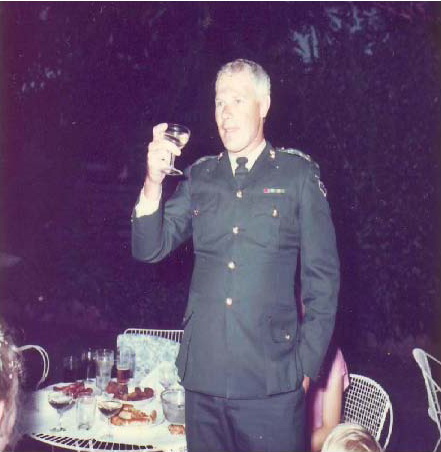
CHEERS VIC!!!!!!
Please also join me on my website dedicated to Rhodesian and South African Military Engineers. Sign up to the forums by using the following link:
http://www.sasappers.net/forum/index.php
Copyright
© Mark Richard Craig and Fatfox9’s Blog, 2009-2014. Unauthorised use and/or duplication of this material without express and written permission from this blog’s author and/or owner is strictly prohibited.
 Fatfox9's Blog