Cordon Sanitaire: Electronic Alarms and Monitoring
August 25, 2014
If I thought that getting historical background to Cordon Sanitaire defoliation efforts (see previous post) was challenging, I was wrong!
Trying to find anyone who has in-depth information on the electronic early warning systems installed on the fences was an even more daunting task. To be very honest I am not in any way convinced that what I have managed to find holds too much water and this is once again where I will be hoping that someone, somewhere reads this post, tells me I have written complete rubbish and puts things right. I can take it and no offence will be taken I assure you. We simply need to get this as factual as we can. There has to be Rhodesian Army veterans that actually installed and monitored the electronic side of things that can help here.
The following redaction comes from more than one source, the reliability of which has not been confirmed to me. From an intelligence source and reliability perspective I therefore have no option but to rate it as F/6 (Insufficient information to evaluate reliability. May or may not be reliable/The validity of the information cannot be determined) and should therefore by no means be quoted as being the way things actually were. Read on………..
For the sake of simplicity we will consider the Cordon to be 25 metres wide, fenced on both sides, and containing anti-personnel blast mines.
On the home side a system of electronic sensors divided into monitored sectors and wired to sector control boxes formed the basis of the early warning system. I have not been able to find any information as to what type of sensors (movement, vibration, broken electrical circuit, audio, etc.) were used, nor who was responsible for installing them (possibly the Rhodesian Corps of Signals (8 Signal Squadron)). According to one source these control boxes were placed in bunkers close to the home side fence and manned full-time by troops waiting for an alarm to be set off.
Logic makes me think that a combination of activation triggers may have been used. Apparently the idea was that any penetration of the Cordon would be detected by detonations or some form of electronic sensor. My information claims that reaction to these events was primarily by vehicle and took place within 10 minutes of a signal being received. In addition to the vehicular response, artillery fire was also used to put down fire on ranged, pre-selected targets. I imagine this would be from 25 pounder howitzers or possibly 120mm mortars.
It is my understanding that the only parts of Cordon Sanitaire to be fitted with an electronic early warning system were the Musengezi/Mukumbura, and Nyamapanda to Ruenya minefield. Soon after these areas were completed a significant amount of false alarms were being recorded. This resulted in finding no enemy presence at the alarm trigger point. Due to the significant cost of ammunition being expended on these false-positive events, it was decided to curtail the rapid response on these areas in 1975. An ongoing Cordon Sanitaire review shelved the whole idea of an early warning system shortly thereafter.
And so ended the Cordon Sanitaire early warning system.
I do not know how effective these measures were as I never encountered them during my time serving in the Rhodesian Corps of Engineers. Personally I do not think the electronic system was as successful as the planners initially thought it would be and with the Rhodesian economy heavily burdened by sanctions and an ever-increasing defence budget there was little chance of any project surviving unless it showed significant success indicators (body count, infiltration mitigation, etc.).
I located the following on the issafrica.org website. They seem to confirm in some ways parts of the foregoing:


I will continue to seek further sources to help unravel this interesting and little known subject.
Please also have a look at my website dedicated to Rhodesian and South African Military Engineers. Please join us on the forums by using the following link:
http://www.sasappers.net/forum/index.php
Copyright
© Mark Richard Craig and Fatfox9’s Blog, 2009-2014. Unauthorised use and/or duplication of this material without express and written permission from this blog’s author and/or owner is strictly prohibited.
Cordon Sanitaire: Defoliation Efforts
July 26, 2014
I never realised how challenging it would be to get information on Rhodesian Army defoliation efforts on Cordon Sanitaire or anywhere else for that matter. One of the main reasons for this is that these activities took place, and were more or less completed by the time I joined the army. It is disappointing that so little is known of these activities and I apologise in advance for the scant information at hand. This is definitely one of those posts where I could do with all the help I can get.
However I have managed to cobble some data together thanks to Terry Griffin and Vic Thackwray (a big thanks to both of them who incidentally were also both my Commanding Officers, at different times of course), and also a number of publications. It would however seem that very little information on this aspect is available.
As a starter to this post it is probably useful for some readers to have a better understanding of what defoliation is all about, why it is used during military operations, the main methodologies used, and historical results both positive and negative. Without question the use of defoliant by the US military during the Vietnam War (and Korea before that) is the best example of these activities and they are well documented, mainly for all the wrong reasons.
A short preamble will therefore follow and we will then look at Rhodesian Army efforts according to my understanding of things.

Chemical Defoliation
Probably the most well-known chemical defoliant used to date is Agent Orange.
Agent Orange was a powerful mixture of chemical defoliant used by U.S. military forces during the Vietnam War to eliminate forest cover for North Vietnamese and Viet Cong troops, as well as crops that might be used to feed them. The U.S. program of defoliation, codenamed Operation Ranch Hand (http://en.wikipedia.org/wiki/Operation_Ranch_Hand), sprayed more than 19 million gallons of herbicides over 4.5 million acres of land in Vietnam from 1961 to 1972. Agent Orange, which contained the chemical dioxin, was the most commonly used of the herbicide mixtures, and the most effective. It was later revealed to cause serious health issues–including tumors, birth defects, rashes, psychological symptoms and cancer–among returning U.S. servicemen and their families as well as among the Vietnamese population.

Above picture shows a four-plane defoliant run, part of Operation Ranch Hand (wikipedia)
Agent Orange was the most commonly used, and most effective, mixture of herbicides and got its name from the orange stripe painted on the 55-gallon drums in which the mixture was stored (see picture below). It was one of several “Rainbow Herbicides” used, along with Agents White, Purple, Pink, Green and Blue. U.S. planes sprayed some 11 million to 13 million gallons of Agent Orange in Vietnam between January 1965 and April 1970. According to the U.S. Department of Veterans Affairs (VA), Agent Orange contained “minute traces” of 2,3,7,8-tetrachlorodibenzo-p-dioxin (TCDD), more commonly known as dioxin. Through studies done on laboratory animals, dioxin has been shown to be highly toxic even in minute doses; human exposure to the chemical could be associated with serious health issues such as muscular dysfunction, inflammation, birth defects, nervous system disorders and even the development of various cancers.
Photo and parts of the above paragraphs in italics are from http://www.history.com/topics/vietnam-war/agent-orange.

We should also be clear here that the US were not the only ones using Agent Orange. This interesting fact is expanded on below:
The British used Agent Orange in Malaya, but for the very British reason of cutting costs…The alternative was employing local labor three times a year to cut the vegetation. British stinginess over this matter in one respect helped to avoid the controversies provoked by the use of Agent Orange in Vietnam. The original intention was to crop spray but even this was deemed too expensive by the protectorate authorities. Eventually someone struck on the idea of simply hosing the jungle from the back of bowser trucks and this is what the British did, in limited areas and to no great effect. This happily amateur effort at chemical warfare undoubtedly saved future British governments from the litigation suffered by post-Vietnam US governments (http://www.psywarrior.com/DefoliationPsyopVietnam.html).
In fact the US were largely inspired to use chemical defoliation from the good old Brits.
Mechanical Defoliation
Mechanical defoliation makes use of heavy earth moving machinery to excavate, bulldoze or scrape vegetation out of the ground. This cannot be considered as permanent a method as using chemical agents but it has the advantage of being localised to where the machinery is being used. Crucially it does not spray poisonous herbicides from here to eternity, or cause long-lasting sickness and disease.
Deduction
So from the above two methodologies we can determine that the main use of defoliation was to:
a. Deny the enemy cover to attack from
b. Deny the enemy the ability to grow crops to feed themselves with
c. For Cordon Sanitaire purposes it also had the added use of allowing us cleared areas in which to lay mines
Rhodesian Army Defoliation Efforts
The Rhodesians used a combination of mechanical and chemical defoliation methods on Cordon Sanitaire and Non-Cordon Sanitaire operations.
So Rhodesia was apparently not squeaky clean as far as using herbicides was concerned although very little is known of their use, or the extent of such use. There is also no objective evidence that shows what if any residual effect there was on the local population and indeed our own troops. Perhaps this is an aspect that no one wants to talk about or perhaps it was just one of those activities no one knows much about. Somehow I have a feeling there is someone out there who knows a lot more about this activity.
I managed to dig up the following and once again I apologise for the lack of real meat for this post:
The Rhodesian Corps of Engineers were responsible for clearing the 25 meter wide strip of land that would eventually become the minefield with bulldozers. This mechanical defoliation methodology was used primarily to make the job of laying mines easier and to make the terrain more suitable in general for manual, dismounted operations. Laying mines in vegetated areas is both dodgy and dangerous. One can very easily become disoriented with disastrous results.
The Tsetse Fly Department (the “Fly-Men”…….see previous posts) were apparently responsible for the Rhodesian chemical warfare effort. I found this very surprising when I read about this but it appears to be quite true. Apparently they used back-pack hand-operated sprayers containing HYVAR-X. (PRODUCT INFORMATION: DuPont™ HYVAR® X herbicide is a wettable powder to be mixed in water and applied as a spray for non-selective weed and brush control in non-cropland areas and for selective weed control in certain crops. HYVAR® X is an effective general herbicide that controls many annual weeds at lower rates and perennial weeds and brush at the highest rates allowed by this label. It is particularly useful for the control of perennial grasses). You can read more about HYVAR-X at http://www.afpmb.org/sites/default/files/pubs/standardlists/labels/6840-01-408-9079_label.pdf
It seems that the Cordon Sanitaire planners were not happy with only a 25 meter defoliated corridor and gave orders to chemically remove vegetation 150 meters either side of the Cordon fences (I have to wonder how this was achieved using back-pack hand-operated sprayers). In a bid to save on costs they substituted HYVAR-X with a different chemical known as TORDON 225. This would prove to be a costly mistake as this product was ineffective and resulted in Rhodesia instituting court action against the South African manufacturers of TORDON 225.
I found only one record of chemical defoliation usage. This was apparently on the Musengezi, Mukumbura, and Nyamapanda to Ruenya minefield. Nothing else is available.
The following two photos were sent to me by Vic Thackwray, a Cordon Sanitaire veteran. They show the cleared areas between the minefield perimeter fences. In the first picture the minefield is on the left of the fence. A parallel minefield maintenance road can be see on the right of the fence. This specific photo was taken at Mukumbura.


The second photo is a great shot of Vic Thackwray standing next to the Cordon fence. Note the thick vegetation inside the mined area.
I also have some interesting input from Terry Griffin which I have added below:
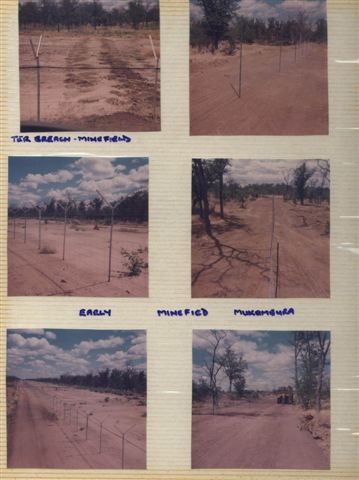
The photos above were provided by Terry. They too show the type of terrain and vegetation of the Cordon at Mukumbura. I must add the terrain was not always as good as what is shown and from my own experience this was as good as it got (so don’t think we had it easy all the time).
Terry also highlighted some non-Cordon defoliation and I felt it was appropriate to include in this post. It makes very interesting reading. Terry takes up the story:
The very first minefield laying etc (again) I was OC of that – starting at Mukambura. Lt Col Horne actually came up with the team I had trained – for a look see.
Tsetse were (as per normal) responsible for erecting fences but we also had plant tp folk with bulldozers and graders clearing all so we had bare earth in and outside the minefield to work on. This was also to prevent gooks taking cover in the bush. At that stage the minefield was approx. 25m wide. In no time I realised this method was an absolute waste of time money etc, etc as we also provided armed protection for the dozer drivers etc way ahead of laying teams. To keep a definitive 25m width etc was patently stupid so I wrote a paper and suggested fences meander to create doubt as to depth of field – albeit still 3 rows – and do NOT clear vegetation as it then aided in camouflaging all. I sent you some pics of the first gook breach and just look at the nice clear earth with fences visible at exactly 25m. Boy did we have a lot to learn – and quickly. This is the only defoliation that I am aware of??
And after I prodded him for more:
Basically I was tasked with doing the defoliation on Chete Island after the gooks wacked the civvy ferry. I called up S Tp from 1 Sqn albeit I was OC Boats at the time and then we sailed plus Tsetse in the Army ferry (Ubique) from Kariba to Chete. Had strike craft as back up and positioned one at each entry to the gorge as it had been declared a frozen area for all craft during the OP. Went ashore (after anchoring on the island – invading enemy territory !! – to clear it of gooks – if any. There were none. Tsetse also provided back up (Jack Kerr plus another) with ,458 rifles in case elephants had a go at us. They did not. After positioning the guys in a defensive role we cleared the area where the gooks had fired from – onto the ferry – which still had much kit lying around from the firing point. Tsetse folk then used a defoliant called Hivar (as I recall) and by hand distributed like it was fertiliser along the entire bank facing the gorge and inland a short way. This would (as it did) clear that sector of all foliage and thereby (hopefully) deny natural cover. After the first rains it was evident all was dying off and it did clear all fairly quickly creating a rather bare scar along that section of the island. Some 10 years later it was still very visible but on my last fishing trip there + – 4 years ago all had now regrown. The gooks never did use the original firing position again.
Looking at this post I realise that although I would have liked to give the reader more on the actual defoliation in Rhodesia, what we have here is real Rhodesian Millitary Engineering history. The accounts by Terry have probably never been recorded in this format before and the photos from Vic still give me goose-bumps, bringing back a part of my history that must be told or it will be gone forever. Thanks to both of them once again for all the help and support they provide to me.
I would like to end this post with a cruel irony:
Perhaps no two people embodied the moral complexities and the agony of Agent Orange more graphically than Adm. Elmo R. Zumwalt Jr. and his son Elmo R. Zumwalt III. Admiral Zumwalt led American naval forces in Vietnam from 1968 to 1970, before he became chief of naval operations. He ordered the spraying of Agent Orange. The son was in Vietnam at about the same time as the father, commanding a Navy patrol boat. Years later, doctors found that he had lymphoma and Hodgkin’s disease. He died in 1988 at 42. His son, Elmo IV, was born with congenital disorders.
Perhaps this post has digressed a bit from the title but it does make for interesting reading I hope.
In the next post we will look at Cordon Sanitaire with electronic alarms.
Copyright
© Mark Richard Craig and Fatfox9’s Blog, 2009-2014. Unauthorised use and/or duplication of this material without express and written permission from this blog’s author and/or owner is strictly prohibited.
The Road To Mukumbura (Part 3)
July 14, 2013
I had already unclipped and shrugged off my safety harness before the vehicle had come to a halt. A couple of the lads had started to release the tailgate catches and it fell outwards onto its rubber stoppers with a dull thud. Some of us debussed via the tailgate step or simply jumped over the side of the vehicle, FN in one hand and the other used for balance. The smell of burning oil, hot tyres and exhaust gases filled the air. The heat seemed to make them stronger.
Most of us immediately looked for the nearest tree to pee under, others carrying entrenching tools and bog-roll for more serious business moved further away. This would not be a long stop so no one had tea-making kit out. The best we could expect was a sip of water from our water bottles. There is a funny thing about plastic water-bottles……the water always tastes like plastic……especially when it is warm. Those of you who know this taste will understand what I mean. The best solution to this was to chuck a bag of Jungle Juice from a rat-pack in the water and enjoy the orange-like taste.
It was all silent now. Men cowering from the sun in the shadows cast by the vehicles and trees next to the road. Always vigilant…..looking outwards for gooks…….sweat filled eyes burning, vision blurred and playing tricks.
The only sound was the metallic pinging of the engines and exhausts cooling down.
Drivers walked around their vehicles, checking tyres and cargo, at the same time stretching their limbs. They would change-over with the co-drivers now and perhaps find time to relax a little once back on the road.
As the cab doors slammed shut we made our way back to our seats, strapped-in and readied ourselves for the next stretch of our journey……taking us further into the gook badlands…….closer to Mavhuradonha, the “Place Of Falling Water”.

With every turn of the wheels we were also getting closer to another place….a place infamous in Rhodesian Bush War history……a place called Ambush Alley.
The Road To Mukumbura: Part 2
July 8, 2013
The hypnotic whine of the water-filled tyres on the tarmac and the side-to-side roll of the heavy Rodef Troop Carrying Vehicle (TCV) lulled one to sleep in a surprisingly short period of time. The sun blazed down on us, burning our arms and faces. The matt-painted metal bodywork of the vehicle was hot enough to fry an egg on. We were meant to wear our webbing while traveling in case of an emergency de-bus but the majority of us took it off to gain some comfort. It gets quite irritating having a water- bottle stuck in each of your kidneys for 400 clicks. It would still be a few years before we progressed far enough to have chest-webbing, similar to that worn by the gooks.
Here are the different types of webbing I wore in Rhodesia
Standard Rhodesian Army Webbing complete with FN bayonet frog and bayonet (and kidney bruising water-bottles plus other paraphernalia):

More practical Chest Webbing came a little later and is shown below:

Thanks to Military Photos for the items shown above
Normally I would try to get the seat facing the near-side and up front next to the cab. This had two advantages from my perspective. Firstly if one fell asleep you could use the vehicle cab as a pillow and secondly if a person stood up to stretch their legs they had something to grab onto as the front roll-bar was right next to this position. The cab was also a pretty good wind-deflector. On the Rodef 45 and 75 versions, the passenger side of the cab had a turret at the top and one of the nicest places to be was standing on the softish passenger seat with your head and upper body outside the vehicle. I had many a conversation with blokes at the back from this position and vice-versa.
One of the most irritating things that could happen to you on the back of a TCV was getting hot cigarette ash in your eye. This could be your own ash or someone else’s. Boredom was a big problem on these journeys and smoking seemed to help a lot so plenty of ash flying through the air. Not good for the lungs or the eyes. Most of us smoked Madison, one of local equivalents as we could not get the international brands. Not a bad cigarette though.
 Thanks to cigarettespedia.com
I must have looked like one of those nodding dogs on the back shelf of a ’65 Ford Cortina. As the miles slipped by my head bobbed sleepily up and down. I felt the vehicle driver change down, the revs climbed, brakes coming on and the vehicle slowed. My head banged into the cab with the changed momentum and I was wide awake. It was time for a break and driver change. It couldn’t have come at a better time as I was bursting for a piss.
The Road To Mukumbura
June 22, 2013
We usually left Salisbury at first light, probably nursing massive hangovers. I was always amused by the fact that one could drink gallons of beer but still be thirsty the next morning.
Prior to departure however we would have had to load our vehicles. Cargo could consist of anything from land-mines to letters and fuel to food. It was common practice that whenever word got out that there was a convoy going to Mukumbura, everyone suddenly had urgent kit or personnel to get up there. This regularly resulted in overloading of vehicles and little space left for personnel to sit. One would often find oneself sitting next to ammunition or explosives. Not really ideal but that was the way things worked. Another combination of cargo that didn’t work well was fuel and food. It always seemed that we had to have leaky jerry-cans and bread on the same vehicle. If you have never had a bacon sandwich made with bread that has been splashed with petrol/diesel you haven’t lived in a real man’s world. It gets a bit dodgy when you put a slice of this in the toaster though. There is however nothing like a good old whiff of diesel soaked bread to really whet ones appetite for breakfast.
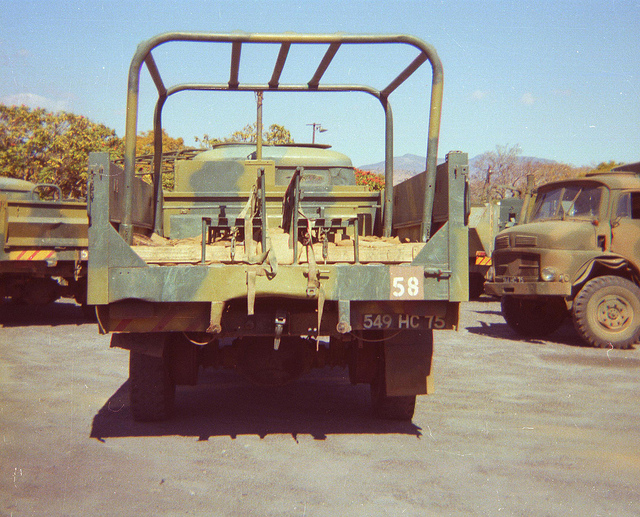
The road to Mukumbura was a long one. Long, hot and dangerous. The sun, wind, or rain could be merciless to the unprotected, and there were a number of places where the gooks could bushwhack us along the way. Not all of our vehicles had canvas covers on and in any case we needed to know what was going on around us if ambushed so our seats were in the middle of the load-bed facing outwards. Here is a picture of a Rodef Troop Carrying Vehicle (TCV), which is actually a Mercedes Benz with a dodgy sanctions-busting name:
(thanks to loosecannon55)
These vehicles were “soft-skinned” and offered no protection from small-arms fire. The seats at the back were fitted with four-point safety belts that were a great help if the vehicle hit a land-mine. Additionally the vehicles had filled sandbags on the floor of the load-bed to stop fragmentation from mine blasts coming through the floor and ripping ones anal region apart. There is no doubt that personnel wearing these seat belts had a much better chance of survival than those who never used them. Standard procedure was to wear them but there will are always be those that know better. As a vehicle it was smooth on the road and a pleasure to drive (once you had got used to the water-filled tyres). In comparison to the Bedford RL it was a dream machine.
As our convoy snaked it’s way through the streets of Salisbury, heading for the road that would take us north, people on the streets walking to work would wave at us, silently wishing us luck and wondering where we were going.
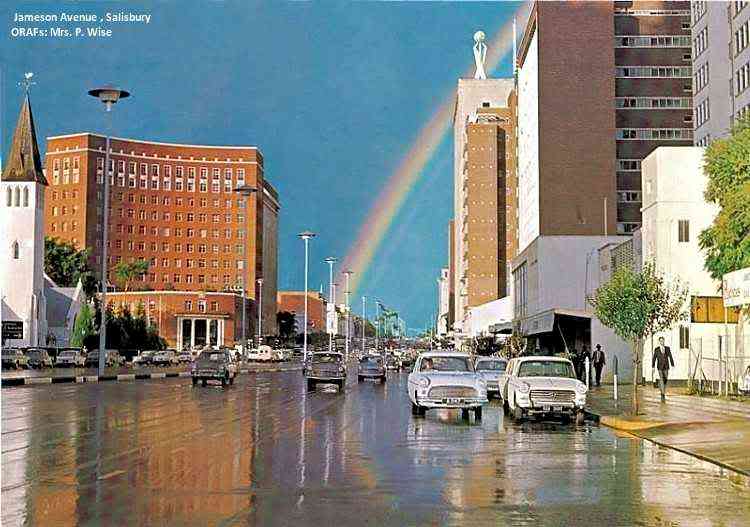
(thanks to ORAFS and Mrs P Wise)
Once we reached the outskirts of Rhodesia’s capital city it would be time to cock our weapons and switch-on. We were on our way to Indian country.
Mukumbura: Salisbury Sojourn (Part 1)
February 14, 2013
Getting to Mukumbura was a pain in the arse……literally. If you have had the opportunity to sit on the steel benches in the back of a Bedford RL for 400 clicks you will understand exactly what I mean. Your arse goes numb and so does your scrotum for some reason. I have even had pins and needles in my dick during these trips, loosing all sensation and not knowing if it was still an appendage to my body. Here is a picture of a Bedford RL:

Bedford RL
Secondly, and more irritating than numb-nuts was the fact we had to deploy through Salisbury. This involved having to accept the hospitality of either 2 or 3 Engineer Squadron (Rhodesian Corps of Engineers). These units were based at either King George the Sixth Barracks (KGVI), or Cranborne Barracks (also home of the Rhodesian Light Infantry (RLI)). It seemed to many of us from 1 Engineer Squadron (Brady Barracks, Bulawayo), that the Salisbury Squadrons had an air of superiority about them. This was probably a result of Engineer Directorate also being in Salisbury. I cannot say that I enjoyed any of my visits to these units and the sooner we had done what we had to do there and got on our way the better. Having said all of that there were some good men in the Salisbury Squadrons and I made a number of close friends from these units during my 7 years in the Rhodesian Army. Here is a picture of the entrance to Cranborne Barracks:

Our normal stop over was about 2 or three days and during this time we would do retraining, load up any logistics that needed to get to Mukumbura (including anti-personnel mines), and get pissed in the many watering holes in Salisbury. One of these pubs was La Coq D’or which the RLI considered to be their personal domain and woe betide any other Unit that encroached on their territory. There have been a number of memorable punch ups there. Here is a picture of the place (courtesy of New Rhodesian Website):

And a menu cover from way back when:

All good things come to an end however and we had to move on. We had a mission after all…..to lay mines and stop the gooks getting into Rhodesia. We climbed up into the Bedford’s, and with the stench of exhaust fumes polluting the air and stinging our eyes we were off. Wrapped up against the cold in my prickly grey army issue blanket I could still taste the bacon, eggs and coffee we had for breakfast as I settled in for another ball-numbing journey.
Chasing Gooks With The Infantry
January 21, 2013
Wankie (1 Independent Company): 1974/75-ish
Besides landmine incident call-outs, the days at 1 Indep also consisted of camp guard duties, patrolling the married quarters at night, and escorting ration-runs to deployed call-signs in the Company area of responsibility.
Late one afternoon this somewhat laid-back routine was, without warning, rudely interrupted.
Contact had been made with a large group of gooks and they were on the run. Normally in these types of situations the general idea would be to get as many additional feet on the ground as quickly as possible to track the gooks and kill them. At the same time as the follow-up was taking place, stopper groups would be placed ahead of them and straddling their likely axis of advance.
The best way to get a good grip on the situation was to have an aircraft up above the gooks to give the trackers an idea which way they were heading. Choppers would then drop Fire-Force sticks off to give chase. The choppers would also drop of the stopper-groups into which the gooks would hopefully run. One of the aircraft used for the top-cover and gook tracking was the Cessna Skymaster or as we called it, the “push-pull” due to its engine configuration (one back and one front). This aircraft was also known as the “fuck me-suck me” by many of us. Here she is:

This specific aircraft had the callsign prefix of “Hornet” due to the twin Browning’s at the top looking very much like insect probiscae. These aircraft also carried Frantan bombs that acted very much like Napalm and it was a pleasure to see these being used. Gooks normally quickly lost the urge to do anything bad after one of these was dropped near to them.
The helicopter of choice for the deployment of troops was the good old Alouette 3, also known in the Rhodesian Forces as Cyclone 7. These could be armed with either twin Light Machine Guns (G-Car), or a 20mm cannon (K-Car). The plan would be for G-Cars to drop troops off on the tails of the gooks who would then chase them into the waiting stopper groups (if they were in position) where they would hopefully be killed or captured. This picking up and dropping off of troops took time as the G-Car could only take 5 troops at a time and many opportunities were probably missed because of this lack of an appropriate trooping capability. Here is one of the choppers we used (Beaver Shaw behind the guns and photo by Dominique Hoyet) :

I had managed to get dragged into leading one of the stopper-groups this specific day (by Don Price) and had been dropped off with whatever and whoever was available at the camp. The area that needed to be covered to catch the running gooks was so wide that we had cooks, medics, bottlewashers, and mechanics in the stop-groups. Remember that in the Rhodesian Army we were all Infantrymen first and specialists second. It was in these circumstances that the training model really paid off.
By last light we were still lying there waiting for the gooks to run into us but nothing happened. It gets a little creepy in these situations as you need to be really careful not to shoot your own people chasing the gooks. With non-combat type troops with me this was a real possibility and I knew it. I was not quite sure what the next move was going to be and was hoping that we were not going to be expected to stay out the entire night. Due to the rushed and calamitous deployment, none of us who were normally non-Fire Force troops were carrying warm clothing or rations. As fate would have it I received a radio message that we needed to stay in position for the night. I informed the gentleman on the other end of the line that my callsign was not equipped for a night stop and he (the same Don Price) had the temerity to call us dudes (yes, dudes!) over the air. This annoyed me a bit, but we had a job to do, and we got on with it. I could not have worried less, but the welfare of my troops came first, and we did get the necessary support for the night.
As far as I can remember they never did get any of those gooks either so all-in-all an unsuccessful day all-round and perhaps in some way I contributed to this poor result. I doubt it, although in retrospect I should have been more prepared for this type of call-out though, and I would not be caught out again. It was pretty piss-poor preparation on my part.
I didnt know it at the time but as we flew back to Wankie there was planning taking place in Bulawayo that would soon see me redeployed to a place synonymous with the history of the Rhodesian Corps of Engineers…..Mukumbura!
First Blood…..Sidindi Island (Part 5)
February 28, 2011
I can remember walking past palm trees and what looked like sea sand as we followed Don back down to wherever he had come from…..the Zambezi flowing smoothly on my right hand side….gurgling on its merry journey to the mighty Kariba Dam…..many miles away. Where it crashed over the countless rocks it foamed and sprayed a fine mist……the wind blowing it into our hot and sweaty faces…..cooling and refreshing.
A radio crackled near to me and the 1 Indep stick leader answered with his call-sign. He had a short and sharp conversation with someone on the other end consisting of “copied”, “affirmative”, “say again”…..and finally “roger out”. He moved up closer to me and let me know that a recovery vehicle had arrived but was standing off some distance from the mine victim until I gave the all clear on the road.
Don had diverted us onto a path that left the dirt road and led along the river bank……and it was then we saw a couple of soldiers up ahead….on guard and highly alert. They let Don through and we entered a place of carnage……and what was until a few hours ago an SAS temporary base.
All around us were bits and pieces of kit..neatly piled up as if waiting for collection…webbing, weapons, eating utensils..some damaged by gunfire…the stuff that soldiers carry….and shockingly, a heap of bloody sleeping bags and Rhodesian uniforms….now tattered and ripped apart…blood stains mingling with the camouflage pattern…riddled with bullet holes. There was indeed a certain smell about the place…..a smell I would get to know well……the smell of blood. Nothing else like it. Clearly something bad had happened here….you could feel and see the despair in the faces of the few grim men that were there. Cartridge cases that were not familiar lay scattered all around, the wrappings of first field dressings and used inter-venal drips, some with their tubes still attached littered the ground……the bits and pieces of medical kit that were the signature that some serious shit had gone down not too long ago.
Don took us into a shady part of the camp and sat us down. It was the measure of the man that although he wore the coveted wings of perhaps the finest special forces unit in the world, he treated us as equals at this time. He proceeded to brief us on the events of the past hours…..not in too much detail to endanger security, but enough for us to understand the background as to why we were there, and the seriousness of the situation.
Apparently the SAS were on an external operation in Zambia doing what they do and had been over there for some time. On their return to Rhodesian soil they were well and truly knackered and formed a temporary base at Sidindi Island so that they could rest before being picked up and returned to their main base. They ate and they slept. They had arranged their sleeping positions in two lines close to each other with a narrow path between the two. A guard was posted and the rest slept. Sometime in the early hours of the next morning when one sleeps the deepest a group of terrorists entered the camp and walked down the path between the two rows of sleeping men and machine-gunned them mercilessly as they lay in their sleeping bags. I do not recall if anyone was killed but there were some severe injuries received. Those that could managed to fight the gooks off but the damage was done. They were understandably devastated….but also professionals…..and immediately began the task of helping the injured and getting them out. The blown up Bedford was also part of the reaction force coming to assist them. These gooks who attacked were definitely not the normal run of the mill banditos……they were very clever…they knew there was only one road where help would come from and they had mined it with a successful hit…..a tactic that I would encounter on more than one occasion. They had also clearly observed the SAS go into a temporary base and had waited patiently for their chance to strike……showing great restraint before attacking.
We drank tea and offered what help we could and made our way back up to the road…..all of us deep in thought……and a lot more switched on than when we first arrived. If those who had so audaciously attacked the SAS camp with so much success were still around we had a problem. However we completed our mission without incident or more mines on the raod and the recovery vehicle was able to come in and take the sad old girl away to fight another day.
It was time to return to Wankie……and the gunship was summoned by TR48 radio carried in the recovery vehicle. It was late when we boarded and the pilot informed us he would not be taking us back that evening but rather to the South African Police base at Sidindi (or it could have been Mapeta?) where we were destined to be treated to some real South African hospitality….good food…steaks and boerewors and cold Castle beers…we even had coffee bought to us in bed by the Padre after he had read us all an evening prayer.
I hoped that he was also praying for all the SAS boys we had just left behind.
Sometime later stories about the Sidindi incident began to circulate..some of it obvious bullshit…but the most plausible one was that the sentry, being exhausted just like the rest of them, had fallen asleep at his post and the gooks had simply walked past him and into the camp. I have no proof that this is the case but the importance of an effective guard system remained with me for the rest of my military career. A few years on and in a different country I was to see first hand the result of a sentry falling asleep……except this time I was one of those on the receiving end. The result might not be what you expected.
The Quarter Masters Stores……
October 13, 2010
1974……Brady Barracks
Time to find out where we were getting posted to.
Rock and Roll was over and we had all returned to the Squadron HQ at Brady Barracks (alias Headquarters 1 Brigade). The Squadron HQ was a rather dilapidated collection of buildings not too far from the Brigades Warrant Officers and Sergeants Mess, which meant nothing to me but is worth mentioning. Inside the HQ it always smelt of paper and stationery and chemicals used for the Gestetner roneo machine. The ones that had some kind of red waxy paper to type on. This specific machine was hand operated and there was always someone there cranking the big black handle on the side that was the trigger to pick up paper, print, and spew out paper the other side. It only printed on newsprint or at least that’s the quality we got with our precis. In those days this was a very serious piece of kit.
Anyway I am getting side-tracked.
I had been informed that my first posting was going to be to a place called Wankie (yes there were some Wankers there)…..up the Victoria Falls road to an outfit named 1 Independent Company, Rhodesia Regiment (1 Indep Coy RR). I was a little disappointed at first as all my mates or most of them anyway were going to Mukumbura in the North-Eastern border area to lay mines on Cordon Sanitaire. I shouldn’t have worried for two reasons. Firstly I would get more than enough tours to various parts of the Cordon, and secondly it was not too bad at 1 Indep once I got used to arrogant Infantry Officers who had more domestic scandals surrounding them than I care to remember. It was really bad there at one stage and the extramarital shagging that went on in the background was the stuff that legends were made of. Extramarital shagging is fine but not in front of the troops…….and no effort was made to be discrete. One of these people doing the shagging actually had the temerity to call me a dude one day because he had sent me and my crew out as a stop group without the opportunity to get fully prepared…….knobber.
My specific job-title was “Mine-Standby”,a really strange coincidence seeing that 1 Indep was based inside an old mine compound in those days. Wankie was one of the biggest collieries in the world at the time and the army had taken over one of the disused compounds. Dozens of little cottages……better than tents that’s for sure. As the job title implied my mission was to stand-by and wait for a landmine to go off somewhere. I would then be flown out by chopper to sweep the road 2 kilometers either side of whatever or whoever the victim was in case the evil gooks had laid additional mines…..a common tactic.
It was about this time (and before my first deployment) that I realised that our Squadron Quarter Master was a rather nasty piece of work and a tosser to boot. He was a bully who seemed to think that everything in the store belonged to him and that all of the kit belonged on the shelf so he could show it off to the Squadron Commander when he was brown-nosing the boss. There is no place in the field for these possessions of his either. If one of us asked for a replacement first field dressing we were asked for the old one. I could name this individual but I wont. He knows who he is…..an infantry officer, not even a Sapper. And I really hope he reads this because by now he realises that we only saluted his rank and not him. There was actually talk of fragging him amoungst us……hope that woke him up. The other ranks in the stores were OK but he needed shooting. The only time I saw him in the bush was to come and count knives and forks……I jest not with you. Woe betide the Troop Sergeant who was a fork down on his camp inventory when the Major came calling. This was tantamount to treason and equaled the loss of the entire vehicle fleet of the Rhodesian Engineer Corps……including all the Pookies!! I saw his name on an e-mail distribution list the other day so he survived the war staying out the combat zone……brave bugger you have to be to survive in the stores. I think he was impotent too.
Anyway enough slagging off the officers for now……but to be honest some of them really deserve it as you will find out later.
And now it was time to draw my weapon and first-line ammo, pack my kit, and depart on some of the greatest adventures of my life.

A much thinner FatFox9 testing the MMD1...1974 Wankie
 Fatfox9's Blog