Mystery at the Morgue
September 11, 2024
For a time I was based with 4 Independent Company (4 Indep) at Wankie, and those familiar with this unit will remember that it was on top of a hill and on the left, as you came into Wankie from Bulawayo. 1 Engineer Squadron (1 RhE Bulawayo) maintained a small Forward HQ within this base with the task of providing Engineer logistic and operational support to our two sub-callsigns at Deka and Victoria Falls. We also supported the British South Africa Police (BSAP) and 4 Indep throughout the Operation Tangent theatre of operations, as and when required. Captain George Jenkinson was the commander (Sunray) of our little team, with me as his second in command (Sunray Minor). We also had a number of Sappers with us to do the heavy-lifting and man the radios (which were active 24/7). All-in-all we were a happy bunch who just got on with doing Sapper things.
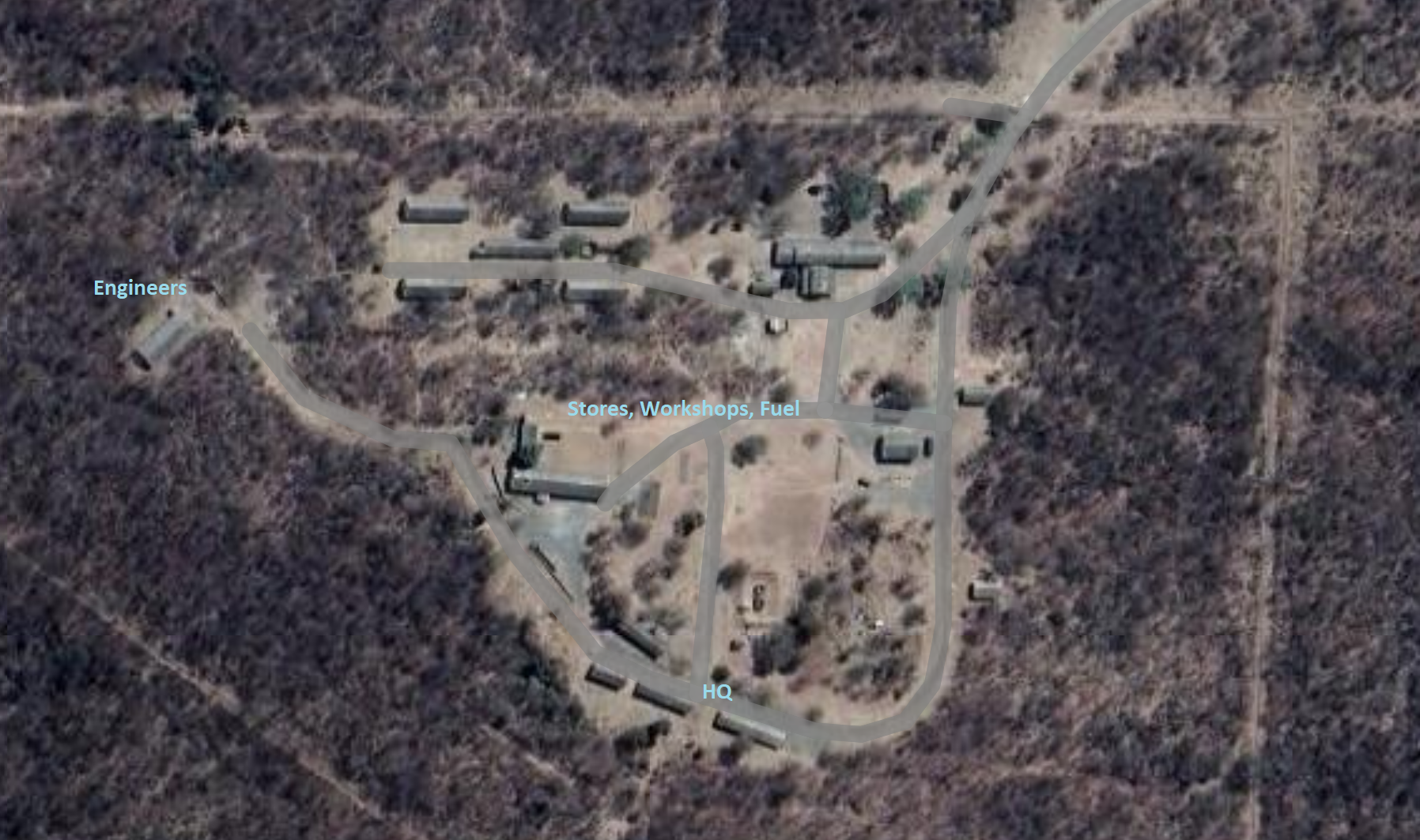
The picture below shows the 4 Indep camp layout.
This particular morning (probably mid to late 1979) I was going through the radio messages to see if there was anything for immediate action when the telephone rang. Captain Jenkinson was away at the time on another mission so it was just me and the lads on deck. The caller was a Special Branch (SB) Inspector from Wankie BSAP. I had got to know him quite well and after exchanging the usual pleasantries he asked me to come down to his office as he had a job for me. Knowing SB it was probably going to be something dodgy, dangerous, or both. Little did I know that this would be one of the strangest tasks I would ever be asked to take part in.
Leaving one of the Sappers to hold the fort, I jumped into our Unimog and drove down to the police station, a short 10 minute drive. Entering the charge office I winked at one of the Woman Patrol Officers – they were all great girls and often played darts with us at No1 Club in Wankie. They definitely were not prudes. She waved me though to a side door that led to the back of the police station – this was where the SB offices were. A pair of dark green Series 3, 6-cylinder Land Rovers stood silently in their parking bays – both of them fitted with 2 x AK 47s – mounted transversely in the back, directly behind the cab. These could be fired from inside the cab by means of a solenoid in case of an ambush – spitting death left and right within the killing ground. Some vehicles had a third forward-firing AK mounted at the front in the engine bay. Very useful set-ups indeed. Whilst marveling at these instruments of death I heard a shout and someone cry out, obviously in pain. Not my business and I continued on my way towards a locked steel gate and rang the bell.
The SB Inspector took a long pull on his Madison cigarette, held out his hand for the regulatory handshake and offered me a seat opposite his desk. A large map covered with plastic was attached to the wall behind him – different color chino graph lines and secret symbols dotted its surface. I looked at him – these were hard men doing a hard job – never easy and always laced with danger and sudden death. Our conversation did not last very long and the gist of it was that I was to assist in identifying ammunition that had somehow ended up at the Wankie Hospital – a strange place for it to be I thought, but anything was possible. He never gave me any further details except the name of a contact person at the hospital and a warning that the task may take some time, and I needed to go there directly. I used his phone to let my people know not to expect me back until late, and after a few minutes of arranging to catch-up again soon I went on my way.
The Wankie Hospital was run by Anglo American. It was not big, but it was modern, clean and efficient. I had spent a few days there previously with malaria and found the treatment and staff excellent – the only downside being the constant moans of a Portuguese guy who had caught his arm in some kind of machine at the colliery, mangling it badly. He was in the same ward as me and I felt his pain – which must have been considerable- the nurses done their best for him but a person can only have so much morphine.
Having found my contact person and identifying myself, I was directed to the mortuary where I was told I would be met by one of the pathologists. This was becoming more and more bizarre, but I done as asked.
See below for location of mortuary at Wankie Hospital.

Before I was anywhere near the mortuary, I was struck by the sound of crying and wailing – lots of it and clearly there was something going on here. People do cry at a mortuary though so not too unexpected. What was unexpected was the amount of people milling around outside the mortuary, police officers doing their best to contain those trying to get into the building. Much shouting was taking place, finger-pointing at the police and then at me as I came into view. The police must have been warned that I was on my way as they ensured I got to the mortuary entrance without being mugged. On pressing the bell an African gentleman dressed in a surgical gown and plastic apron opened up and ushered me inside.
The site that greeted me is something that will be forever burned into my slowly fading memory. There were bodies everywhere. On the autopsy table, on the floor, on trolleys and in the fridges. I estimate that there must have been in the region of 20 bodies all-in-all. The smell of decomposition, blood, urine and faeces permeated the air – this was the smell of death. Some were wrapped in clear plastic, some in unzipped body-bags, and some simply lying on the floor.
There was hardly any space to move, but the man who looked to be in charge ushered me into a small office, and after thanking me for coming down explained what he needed from me. He turned out to be the only pathologist available in Wankie at the time and he sure seemed to have his hands full. He proceeded to brief me up. Apparently an African bus had been attacked the previous evening by persons unknown on one of the many bush roads within our operational area. The bus driver had been injured but managed to bring the bus to a safe stop on the road, whereby the attackers boarded and began firing at the passengers indiscriminately with automatic weapons. Dozens were injured and those I had just seen lying dead next door, were killed.
My readers should understand that during this period of the war, there were many actors vying for popularity with the local population, and I had learnt a long time ago that nothing was ever at it seemed – there was lot of smoke and mirrors and in fact sometimes you couldn’t see the mirrors. We had ZIPRA (Joshua Nkomo), ZANLA (Robert Mugabe), Bishop Abel Muzorewa and his crew, The Rhodesian Security Forces, the Monitoring Force, various intelligence services and probably other organisations I more than likely had never heard of. So it became an evil, cruel game, played between the actors with the aim of seeing who could look like the good guys. If that meant killing innocent bus passengers and getting the blame pinned on someone else, then that would do just fine. According to them, the means justified the end.
My mission was to assist in identifying who had carried out this attack – I’m not a pathologist so cannot make medical conclusions, but I can tell the difference between AK and FN ammunition. My job was therefore the following:
- Attend the post-mortem of each of the deceased
- Witness the removal of bullets and bullet-fragments from each body
- Where possible identify non-fragmented bullets as either AK or FN (wishful thinking)
- Ensure that each bullet or bullet-fragment was placed in its own sealed container for further analysis at a specialist facility (chain of custody was not my responsibility to maintain – this was a police responsibility as the investigating authority).
Each body had a brown tag on the big toe. Amazingly most of the victims had been identified by the teams that recovered them from the bus – the same team now carrying out a forensic investigation of the vehicle. I imagined what the interior looked like. Blood, bits of brain tissue, vomit and skull fragments – and the pitiful belongings of the deceased. Handbags, shopping bags, multi-coloured blankets, groceries and shoes. Shoes always seem to come off during a violent death. And of course, the cartridge cases.
And so we began the unpleasant task of examining each cadaver. Some were straightforward, with the bullet still in one piece within the body, some not so easy, especially where they had fragmented on bones, sending bits of bullet in all directions throughout the fleshy mass. It was then a matter of literally digging around in the flesh until the pieces were found. In other cases the bullets had exited the body cleanly and there was nothing to find. Each piece was put into a stainless steel tray for me to examine. There was very little blood considering the number of bodies and type of injury – all of the bleeding would have taken place on the bus.
There was no dignity for these poor souls – time was of the essence and the pathologist and his assistants stripped the victims until completely naked and hurriedly poked about inside the pink and red cavities of damaged flesh until they were satisfied they they had found everything they could. And then it was onto the next one. As most of the victims had been shot in the torso or chest, all of the bodies were cut open from neck to groin, and the chest cavities pulled open for examination. This was a brutal process beginning with a large scalpel incision from neck to pubis followed by the cutting of the sternum and ribs with what can only be described as bolt-cutters, allowing the the chest to be completely opened up. Others with head wounds and half a skull missing, brains left behind in the bus, staring, lifeless eyes hanging out, were quicker to process. It was grisly work and although I had seen my fair share of death and traumatic injuries over the years I was still shocked at what I was seeing. The small children were the hardest for all of us – probably going home with a new toy or clothes after a day out with mum and dad in the city. Now there was no tomorrow for them. No playing with their friends around the kraal, or helping to tend the goats and chickens – there was nothing for them. It was just so bloody sad.
As each body was completed the chest cavity was forced back into place, and sewn up by one of the assistants while the pathologist wrote up his report. The needle was thick as a finger and unlike anything else I had seen from a medical perspective – the gut used to make the stitches similar to brown string. The stitches were spaced widely apart and pulled tight to force the two sides of the chest together. There was no need for cosmetic considerations here. Once complete the body was taken to another area of the morgue, and I assume handed to the relatives waiting outside, as the volume of wailing and crying increased from time to time.
I guess some of the victims were terrorist sympathisers, either by choice or intimidation, but here and now they were human beings who had been in the wrong place at the wrong time, the majority going about their business and hoping for a better future. That was all gone now – all that was left was for the pathologist and his team to cut them up, looking for little bits of metal which I tried my best to identify. It was, no matter how shocking, the right thing to do for them.
We continued well into the night and until all of the victims had been examined. No one was hungry. We had all opted to work until we had handed all of the remains back to the relatives. There were a few that no one claimed immediately, hopefully they would come tomorrow after the word spread.
It was past midnight when I finally left. All of the relatives had departed. A policeman stood guard at the door and I stood in the cool African night, breathing in deeply, the fresh air not helping to dissipate the the smell of death clinging to my clothes and deep in my nostrils. Walking to my Unimog I wondered what would become of the work we had done today. Would the effort prove useful or was it just a deceitful game of which I had now become part of?
Either way, I hoped that in some small way I would have helped these poor people obtain some form of justice, and closure for their loved ones.
Sadly, I would never find out.
More Cunning Contrivances
April 17, 2023
As a follow-on to my previous post I would like to share another booby-trap mission I took part in with you.
All armies and that includes the Rhodesian Army, have ammunition stores. Here they can keep anything from small arms ammunition, artillery shells, mortar bombs and hand-grenades. The number of ways that we can kill one another on the battlefield is endless and only restricted by the imagination of those that manufacture the means for us to do so. The interesting thing about ammunition and explosives is that it does not last forever, even if stored in ideal conditions – it is either used as intended, or much like the food in your pantry or fridge, it will reach a use-by date, after which it needs to be disposed of. Food is easy to deal with – but what do you do with hundreds of items of possibly dodgy out-of-date ordnance when they come to the end of their safe storage life?
Well, the EASY way is to take it to a demolition range, lay it all out nice and neatly, and destroy it in a safe and controlled manner, normally with plastic explosive donor charges, although I have also used TNT which was the only thing we had available at the time. We call this Sympathetic Detonation. Simply put, if we correctly place and detonate a donor charge next to a mortar bomb, the donor charge and mortar bomb will be destroyed – that’s the plan anyway. The theory of explosives is an interesting subject but I do not intend to discuss that at this time – possibly in another blog in the future.
Problem solved and everyone goes home happy and with all body parts in the right place.
The HARD way to do it is to let someone with an extremely vivid imagination and apparent lack of technical expertise have a think about it in the shower, and come up with a hairbrained and dangerous idea that actually added no value whatsoever to the Rhodesian war effort.
This post is about one of those hairbrained ideas that I reluctantly got dragged into executing on the ground. I was oblivious as to what had triggered the mission (probably “hot” int again) or what the result was.
I was running the Cordon Sanitaire Maintenance Teams out of Deka base at the time these events took place. I had been tasked to report to Wankie Ops Room (4 Indep Coy) for a special mission, leaving my second-in-command (also a sergeant) to run things at Deka base. He was highly competent and I had no qualms in leaving things in his hands. I was also ordered to bring 4 of my Sappers with me. One of them was my regular driver and I sat in the Unimog 25 right-hand passenger seat and enjoyed the scenery on the trip to Wankie, which usually took a couple of hours. I was not in a particular hurry and glad to be out of the camp with some my troops.
On arrival at the Wankie Ops Room for a briefing I was surprised to see one of our Staff Sergeants from 1 Engineer Squadron HQ (Bulawayo, Brady Barracks) there – I had no idea he was even in the area of operations so this was interesting. He was a good bloke though and I have good memories of working with him. Also present was an Infantry officer and one or two others who I cannot remember. A map of Ops Tangent was up on the wall – it had been overlaid with plastic so chinagraph pens of different colours could be used to emphasise different aspects. The briefing began and by the time it was finished I just could not believe that someone had thought this one up.
Apparently the idea was for me to return to my base at Deka and await the arrival of a convoy of vehicles carrying a number of boxes. Inside the boxes were dozens, possibly hundreds of obsolete or out-of-date rounds of ammunition including 3-inch, 60mm and 81mm mortar bombs, 25-pounder artillery shells, aircraft bombs and various hand-grenades. These items would be used as improvised booby-traps – not just any old kind of booby-trap though – these were going to be hung in trees and all connected up with detonating cord and connected to an electrical initiation ringmain – ready for command detonation. My job was to lead the convoy from my Deka base, up a back road to Victoria Falls. I will talk more about this back road to Victoria Falls in an upcoming post. As this was a supposedly secret mission we had to travel in darkness and I would meet up with more personnel from 1 Engineer Squadron at a secluded area near the Victoria Falls shooting range. All very cloak-and-dagger stuff which at times seemed to be over the top.
After doing some shopping in Wankie, we made our merry way back to Deka. Apparently the convoy carrying all of the ordnance would arrive during the following day and we would deploy to Victoria Falls in the evening after last light. Sure enough they arrived as planned and just after the sun dipped below the horizon, I led the convoy out of Deka Base and we were on our way. The trip up the back road could be a little dodgy, especially at night, however we travelled well and arrived at the junction where the back-road met the main Victoria Falls road in good time. Here we would turn right but I halted the convoy at this point to let the guys stretch their legs and make themselves something hot to drink.
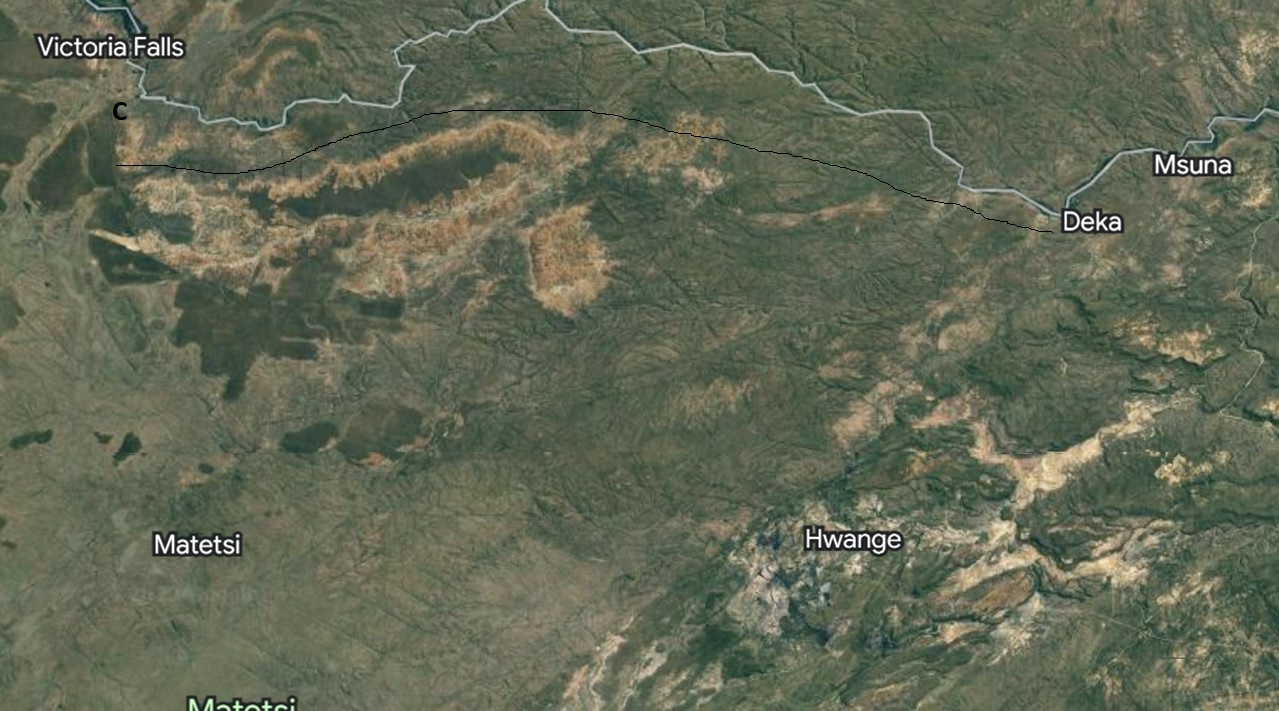
The approximate location of this rest-stop is shown below as Point A, with Point B being the location of the mission forward base.

After a short break we moved the convoy the few kilometers to Point B where we met up with other elements as planned – including more personnel from Bulawayo and a protection group. The final tasking was now discussed in more detail and the plan now took quite a turn as it had been decided that laying these booby-traps at night was far too dangerous and we would proceed at first light to a position that is shown below as Point C below. This picture also shows the approximate back road route.
At first light we moved to a position close to Point C and began unloading the ordnance and other bits we would need to lay, or rather hang the traps. This included rolls of detonating cord and electrical initiation ringmain stores. The job itself was hard going as we needed to go down into the gorge to complete the work and it was hot and humid, with steep terrain. Dangerous if you lost your footing and I had to wonder who would want to infiltrate into Rhodesia using this route – but there we were hanging bombs in trees like Christmas decorations. The more we worked, the more this idea seemed to be a waste of time. Just try to imagine a bunch of guys tripping and cursing, sweating and swatting mopani flies from their eyes and ears while hanging bombs in trees. You couldn’t make it up but sadly this is what we were tasked to do. I don’t know how long it took but we never used everything we had and by late afternoon we had set the electrical ringmain and it was time for me to take my guys back to Deka. It seems that there was going to be a stay-behind team and these individuals would lie in wait for goodness knows how long and set off the bombs when the bad guys came across the border via the Zambezi River, and hopefully spoil there plans. I had no intention of asking any further questions or getting involved further, and after a quick meal we set of to Deka Base. Again, I have no idea what the result of this operation was as there were no reports of any crossings or enemy contact that came across my desk and I never heard anything about this mission ever again. My personal opinion is that the plan was abandoned quite quickly after we left as common sense should surely have eventually prevailed and the personnel in the ambush party redeployed to more useful activities. There is no glamour in this account and my intent is only to share some of the more bizarre activities that I got dragged into. An outlandish idea which came to nothing – all it really achieved was to put good men’s lives in danger once again.
Cunning Contrivances: Booby Traps (Part 1)
January 2, 2023
The definition of a Booby-Trap according to the Rhodesian Corps of Engineers (RhE) training pamphlet was as follows:
“A booby trap is a cunning contrivance, usually of an explosive and lethal nature, designed to catch the unwary enemy; a savage practical joke. It is aimed directly at the reduction of morale and mobility, both of which are vitally important to success in war.“.
In this post I would like to recall two occasions where I was tasked by my higher HQ to lay Booby-Traps. These operations were to take place in the Operation Tangent area and were to be sighted in such a way that terrorists would be well into the kill-zone before the traps were initiated, meaning that we were going for maximum gook casualties. Concealment of the entire set-up was therefore of critical importance, and this includes clandestine insertion of the Booby-Trap team, as we knew that there were eyes and ears everywhere in the bush. We therefore had to apply counter surveillance techniques from insertion to extraction as it is pointless to lay a Booby-Trap that can be seen, or the laying team are observed moving into the target area.
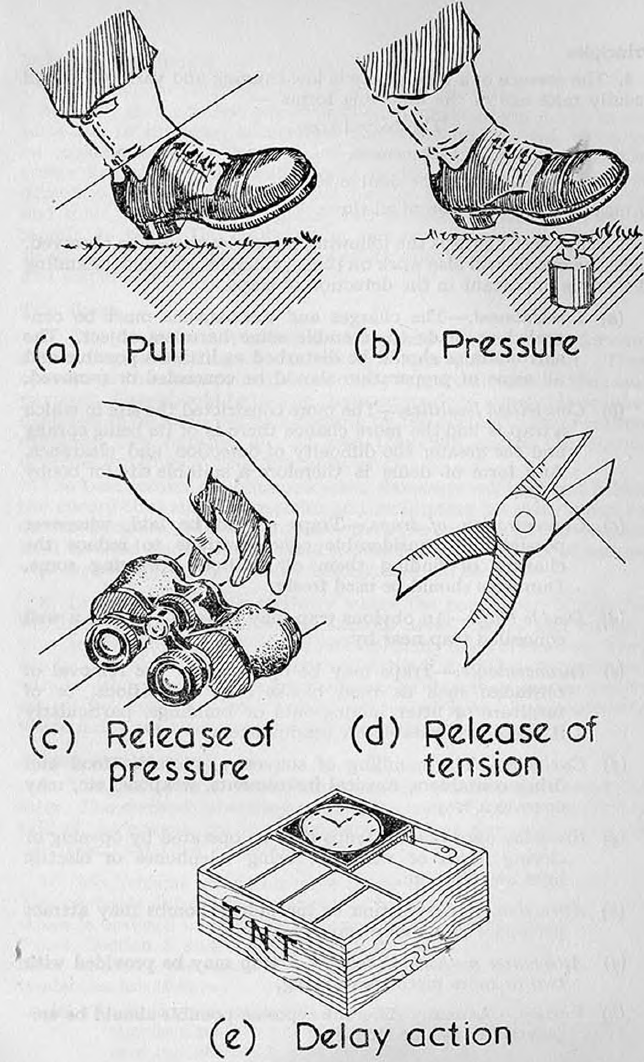
Without going into too much detail, Booby-Traps can be initiated (set-off) by a number of actions, the most popular at the time being the application of pressure, the release of pressure, pull, pull (or tension) release, or the application of some form of Delay. There are many other ways that Booby-Traps can be initiated but I am not going to cover these here. We had specially manufactured devices known as switches, available to us, however for the specific tasks that I was to lead on we would be using Pressure switches only. In other words the required action for success was for someone or something to stand on the pressure switch for the Booby-Trap to detonate. Please note that I used the term “someone or something” as these devices cannot tell friend from foe and would therefore activate the trap regardless of who or what applied the pressure. Sadly animals and friendly forces have been collateral damage to these devices on a number of occasions causing death or injury. The following illustrations show the abovementioned methods in simple to understand detail:
Looking at the previous paragraphs, my readers will appreciate that there are a number of fundamental pre-requisites for a successful Booby-Trap result. One does not simply pick a spot on a map and Booby-Trap it and there are a number of basic principles that we observed when sighting and laying Booby-Traps, and these are as follows:
- Concealment: The charges and mechanisms must be concealed or made to resemble some harmless object. The surroundings should be disturbed as little as possible and all signs of preparation should be concealed or removed.
- Constricted Localities: The more constricted the site in which a trap is laid the more chance there is of its being sprung and the greater the difficulty of detection and clearance. Any form of defile is therefore a suitable site for boobytraps.
- Concentration of Traps: Traps should be laid, whenever possible, in considerable concentrations to reduce the chances of finding them all without springing some. Dummies should be used freely.
- Double bluff: An obvious trap may be used to mask a well concealed trap near by.
- Inconvenience: Traps may be operated by the removal of obstacles such as road blocks and demolitions, or of furniture or litter in dug-outs or buildings, particularly if these are suitable for headquarters.
- Curiosity: The handling of souvenirs, pictures, food and drink containers, musical instruments, weapons, etc, may operate a trap.
- Everyday operations: Traps may be operated by opening or closing doors or windows, using telephones or electric light switches etc.
- Attraction: Delay-action or incendiary bombs may attract personnel to a booby trapped site.
- Alternative methods of firing: A trap may be provided with two or more methods of firing.
- Variety: As many different types as possible should be employed in any one locality.
Before continuing I would like to be clear on what I was expected to achieve on both missions and you will note that this ties in closely with the foregoing paragraphs:
- Inflict maximum casualties on the enemy.
- Use Pressure as the initiating action.
- Use of the following Principles – Concealment, Constricted Localities, Concentration of Traps, Alternative methods of firing and Variety.
- Covert infiltration to laying site
- Operational Security (Opsec)
A brief description of the two missions are as follows:
Mission 1
- Operational Area: Tangent
- Environment: Forest
- Type of Booby-Trap: Multi-device, pressure operated
- Concealment method: Existing vegetation
- Explosives to be used: Date expired Air Force and Army ordnance
- Insertion: Vehicle and night-march
Mission 2
- Operational Area: Tangent
- Environment: Existing dirt road
- Type of Booby-Trap: Multi-device, pressure operated
- Concealment method: Existing soil on dirt road
- Explosives to be used: Anti-personnel and anti-vehicle mines
- Insertion: Boat and night-march
In the next post I will describe in detail Mission 1 and Mission 2.
Farewell to Cordon Sanitaire…….for a while
November 9, 2014
The previous posts focussing on laying Cordon Sanitaire took more time and research than I thought they would. These operations were truly the Rhodesian Corps of Engineers own private battle within the Rhodesian Bush War. Thanks to the input of former Rhodesian Sappers (and in some cases, non-Sappers), I think we have managed to bring those challenging days to life once again. As I mentioned in a foregoing post, I feel enriched and privileged to have been part of these operations. It was and still is an honour to have shared the hardships and dangers with that very special Band of Brothers. Mukumbura will never be forgotten.
There will be more on Cordon Sanitaire later but now is not the time. These future posts will fall under the main title of Cordon Sanitaire Phase 2 (Minefield Maintenance). In so many ways this was the biggest challenge we had as a Corps. The dangers faced by maintenance crews were far greater than those faced during the laying of the Cordon which in relation to this blog was Phase 1. Indeed, the majority of Rhodesian Engineer fatalities and serious injuries were a result of minefield maintenance operations. As a Regular Army sergeant I commanded minefield maintenance operations at both the Deka Minefield and the Victoria Falls Encirclement and will discuss both of these at a later stage.
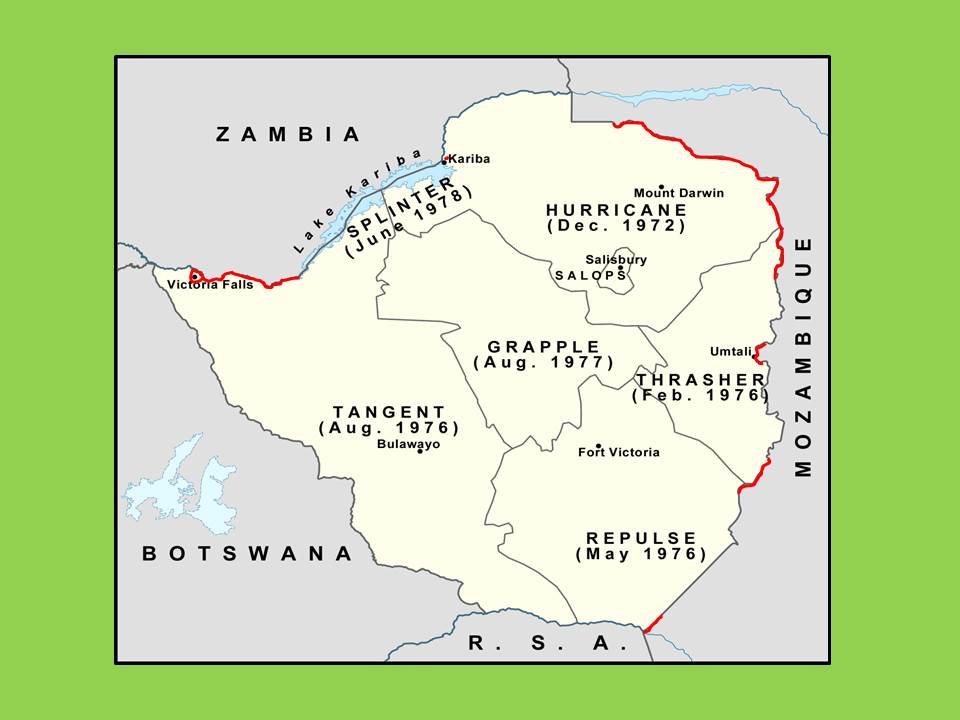
For now it is time to say farewell to Operation Hurricane as we move to the Operation Tangent area (see map below).
The next post will start off with my recollections as a boat operator on the Zambezi River, based at Deka Camp and operating out of Sibankwazi with the British South Africa Police (BSAP).
Interesting times indeed and I hope that you will continue the journey with me.
Please also have a look at my website dedicated to Rhodesian and South African Military Engineers. Please join us on the forums by using the following link:
http://www.sasappers.net/forum/index.php
Copyright
© Mark Richard Craig and Fatfox9’s Blog, 2009-2014. Unauthorised use and/or duplication of this material without express and written permission from this blog’s author and/or owner is strictly prohibited.
Cordon Sanitaire: Electronic Alarms and Monitoring
August 25, 2014
If I thought that getting historical background to Cordon Sanitaire defoliation efforts (see previous post) was challenging, I was wrong!
Trying to find anyone who has in-depth information on the electronic early warning systems installed on the fences was an even more daunting task. To be very honest I am not in any way convinced that what I have managed to find holds too much water and this is once again where I will be hoping that someone, somewhere reads this post, tells me I have written complete rubbish and puts things right. I can take it and no offence will be taken I assure you. We simply need to get this as factual as we can. There has to be Rhodesian Army veterans that actually installed and monitored the electronic side of things that can help here.
The following redaction comes from more than one source, the reliability of which has not been confirmed to me. From an intelligence source and reliability perspective I therefore have no option but to rate it as F/6 (Insufficient information to evaluate reliability. May or may not be reliable/The validity of the information cannot be determined) and should therefore by no means be quoted as being the way things actually were. Read on………..
For the sake of simplicity we will consider the Cordon to be 25 metres wide, fenced on both sides, and containing anti-personnel blast mines.
On the home side a system of electronic sensors divided into monitored sectors and wired to sector control boxes formed the basis of the early warning system. I have not been able to find any information as to what type of sensors (movement, vibration, broken electrical circuit, audio, etc.) were used, nor who was responsible for installing them (possibly the Rhodesian Corps of Signals (8 Signal Squadron)). According to one source these control boxes were placed in bunkers close to the home side fence and manned full-time by troops waiting for an alarm to be set off.
Logic makes me think that a combination of activation triggers may have been used. Apparently the idea was that any penetration of the Cordon would be detected by detonations or some form of electronic sensor. My information claims that reaction to these events was primarily by vehicle and took place within 10 minutes of a signal being received. In addition to the vehicular response, artillery fire was also used to put down fire on ranged, pre-selected targets. I imagine this would be from 25 pounder howitzers or possibly 120mm mortars.
It is my understanding that the only parts of Cordon Sanitaire to be fitted with an electronic early warning system were the Musengezi/Mukumbura, and Nyamapanda to Ruenya minefield. Soon after these areas were completed a significant amount of false alarms were being recorded. This resulted in finding no enemy presence at the alarm trigger point. Due to the significant cost of ammunition being expended on these false-positive events, it was decided to curtail the rapid response on these areas in 1975. An ongoing Cordon Sanitaire review shelved the whole idea of an early warning system shortly thereafter.
And so ended the Cordon Sanitaire early warning system.
I do not know how effective these measures were as I never encountered them during my time serving in the Rhodesian Corps of Engineers. Personally I do not think the electronic system was as successful as the planners initially thought it would be and with the Rhodesian economy heavily burdened by sanctions and an ever-increasing defence budget there was little chance of any project surviving unless it showed significant success indicators (body count, infiltration mitigation, etc.).
I located the following on the issafrica.org website. They seem to confirm in some ways parts of the foregoing:


I will continue to seek further sources to help unravel this interesting and little known subject.
Please also have a look at my website dedicated to Rhodesian and South African Military Engineers. Please join us on the forums by using the following link:
http://www.sasappers.net/forum/index.php
Copyright
© Mark Richard Craig and Fatfox9’s Blog, 2009-2014. Unauthorised use and/or duplication of this material without express and written permission from this blog’s author and/or owner is strictly prohibited.
Cordon Sanitaire: Scope Of Operations
March 1, 2014
Mukumbura………to any Rhodesian Sapper worth his/her salt the name conjures up Cordon Sanitaire operations. Indeed to most of us this was the Mother of all Rhodesian Cordon Sanitaire operations. However there were other areas where we laid mines, usually along the conventional lines of what I have described previously, but also some in more unconventional ways (will describe these in future posts).
Here is a diagram showing the extent of Cordon Sanitaire operations throughout Rhodesia. It also shows the various operational areas:
I would like to point out the following:
1. This map is not to scale
2. The information is to the best of my knowledge/memory correct (but fairly accurate and I do not suggest walking on the red bits).
3. Red bits (added by me) denote armed Cordon Sanitaire strips.
4. Base map courtesy of shelf3d.
Known mined areas:
1. 220 kilometers: Victoria Falls to Mlibizi
2. 359 kilometers: Musengetsi to Nyamapanda to Ruwenya
3. 72 kilometers: Junction Gate to Jersey Tea Estate to Muzite Mission
4. 50 kilometers: Stapleford Forest to Umtali
5. 61 kilometers: Malvernia/Villa Salazar to Crooks Corner
6. +-1 kilometer: Kariba Power Station
Not all of the areas above were laid to the same pattern. Some were standard pattern, others double-density, and some contained additional trip-wire operated fragmentation stake-mines. The double-density/trip-wire minefields were the most dangerous for us to work in, especially when carrying out minefield maintenance tasks. I will show diagrams of these variants in future posts to give you a better idea what they looked like and what we were up against.
The above information (Rupiah) is probably reasonably accurate distance wise but definitely does not account for what I will call “other” mined/booby-trapped areas. I know these “other” areas exist because I laid some of them while serving on special operations. My conclusion regarding these “other” areas is therefore that they remain unknown and uncleared.
Please also have a look at my website dedicated to Rhodesian and South African Military Engineers. Please join us on the forums by using the following link:
http://www.sasappers.net/forum/index.php
Copyright
© Mark Richard Craig and Fatfox9’s Blog, 2009-2014. Unauthorized use and/or duplication of this material without express and written permission from this blog’s author and/or owner is strictly prohibited.
 Fatfox9's Blog