The Road To Mukumbura
June 22, 2013
We usually left Salisbury at first light, probably nursing massive hangovers. I was always amused by the fact that one could drink gallons of beer but still be thirsty the next morning.
Prior to departure however we would have had to load our vehicles. Cargo could consist of anything from land-mines to letters and fuel to food. It was common practice that whenever word got out that there was a convoy going to Mukumbura, everyone suddenly had urgent kit or personnel to get up there. This regularly resulted in overloading of vehicles and little space left for personnel to sit. One would often find oneself sitting next to ammunition or explosives. Not really ideal but that was the way things worked. Another combination of cargo that didn’t work well was fuel and food. It always seemed that we had to have leaky jerry-cans and bread on the same vehicle. If you have never had a bacon sandwich made with bread that has been splashed with petrol/diesel you haven’t lived in a real man’s world. It gets a bit dodgy when you put a slice of this in the toaster though. There is however nothing like a good old whiff of diesel soaked bread to really whet ones appetite for breakfast.
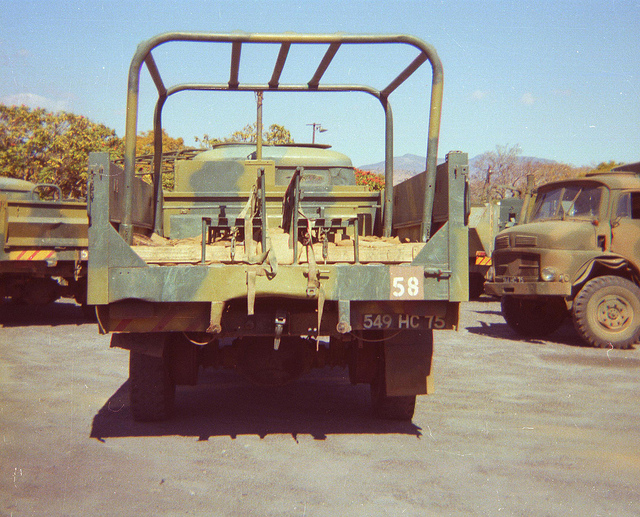
The road to Mukumbura was a long one. Long, hot and dangerous. The sun, wind, or rain could be merciless to the unprotected, and there were a number of places where the gooks could bushwhack us along the way. Not all of our vehicles had canvas covers on and in any case we needed to know what was going on around us if ambushed so our seats were in the middle of the load-bed facing outwards. Here is a picture of a Rodef Troop Carrying Vehicle (TCV), which is actually a Mercedes Benz with a dodgy sanctions-busting name:
(thanks to loosecannon55)
These vehicles were “soft-skinned” and offered no protection from small-arms fire. The seats at the back were fitted with four-point safety belts that were a great help if the vehicle hit a land-mine. Additionally the vehicles had filled sandbags on the floor of the load-bed to stop fragmentation from mine blasts coming through the floor and ripping ones anal region apart. There is no doubt that personnel wearing these seat belts had a much better chance of survival than those who never used them. Standard procedure was to wear them but there will are always be those that know better. As a vehicle it was smooth on the road and a pleasure to drive (once you had got used to the water-filled tyres). In comparison to the Bedford RL it was a dream machine.
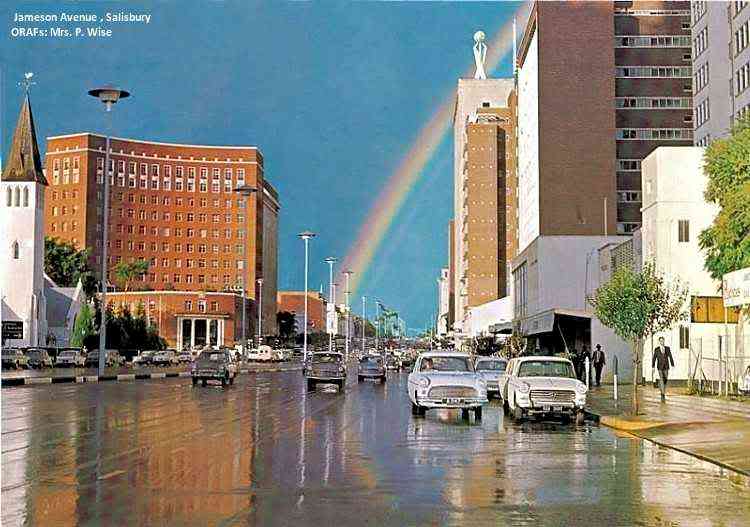
As our convoy snaked it’s way through the streets of Salisbury, heading for the road that would take us north, people on the streets walking to work would wave at us, silently wishing us luck and wondering where we were going.
(thanks to ORAFS and Mrs P Wise)
Once we reached the outskirts of Rhodesia’s capital city it would be time to cock our weapons and switch-on. We were on our way to Indian country.
Mukumbura: Salisbury Sojourn (Part 1)
February 14, 2013
Getting to Mukumbura was a pain in the arse……literally. If you have had the opportunity to sit on the steel benches in the back of a Bedford RL for 400 clicks you will understand exactly what I mean. Your arse goes numb and so does your scrotum for some reason. I have even had pins and needles in my dick during these trips, loosing all sensation and not knowing if it was still an appendage to my body. Here is a picture of a Bedford RL:

Bedford RL
Secondly, and more irritating than numb-nuts was the fact we had to deploy through Salisbury. This involved having to accept the hospitality of either 2 or 3 Engineer Squadron (Rhodesian Corps of Engineers). These units were based at either King George the Sixth Barracks (KGVI), or Cranborne Barracks (also home of the Rhodesian Light Infantry (RLI)). It seemed to many of us from 1 Engineer Squadron (Brady Barracks, Bulawayo), that the Salisbury Squadrons had an air of superiority about them. This was probably a result of Engineer Directorate also being in Salisbury. I cannot say that I enjoyed any of my visits to these units and the sooner we had done what we had to do there and got on our way the better. Having said all of that there were some good men in the Salisbury Squadrons and I made a number of close friends from these units during my 7 years in the Rhodesian Army. Here is a picture of the entrance to Cranborne Barracks:

Our normal stop over was about 2 or three days and during this time we would do retraining, load up any logistics that needed to get to Mukumbura (including anti-personnel mines), and get pissed in the many watering holes in Salisbury. One of these pubs was La Coq D’or which the RLI considered to be their personal domain and woe betide any other Unit that encroached on their territory. There have been a number of memorable punch ups there. Here is a picture of the place (courtesy of New Rhodesian Website):

And a menu cover from way back when:

All good things come to an end however and we had to move on. We had a mission after all…..to lay mines and stop the gooks getting into Rhodesia. We climbed up into the Bedford’s, and with the stench of exhaust fumes polluting the air and stinging our eyes we were off. Wrapped up against the cold in my prickly grey army issue blanket I could still taste the bacon, eggs and coffee we had for breakfast as I settled in for another ball-numbing journey.
Mukumbura (Where the Gobbies* Lay the Mines): Introduction
January 22, 2013
* Gobshite (also referred to as Gobbie, or Gobbies): One who engages in nonsensical chatter or unwanted conversation. For example- What’s that gobshite talking about now?
“Down in Mukumbura where the Gobbies lay the mines,
A Gobbie laid a mine in another Gobbies line,
Said the Gobby to the Gobby, keep on your own line,
And never lay a mine in another Gobbies line”
Minelaying song sung by Rhodesian Sappers laying mines during Cordon Sanitaire operations, Mukumbura.
I have absolutely no idea how I have remembered this song all these years.
The most recent National Service intake of Sappers were referred to as Gobbies.
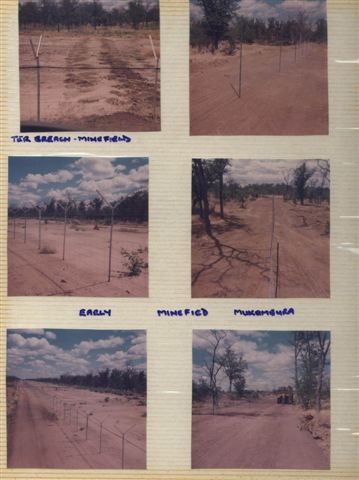
Below is a photo of the early Mukumbura minefield. Note the gook breach in one of them.
Place name: Mukumbura
Latitude: 16° 13′ 57″ S
Longitude: 31° 42′ 31″ E
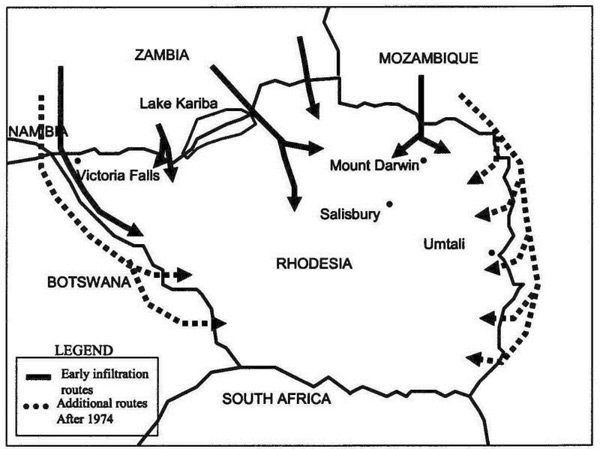
Below is a gook infiltration map. Mukumbura is in the North-East.
Operation Hurricane
The object of Cordon Sanitaire was to use minefields and patrols to channel insurgents into designated areas from which the local population had been removed. They could then be tracked and killed before they reached populated areas.
The first Operation Hurricane “no-go” area was along the Mozambique border in May 1973. Other “no-go” areas were extended along vast stretches of Rhodesian border in an attempt to establish depopulated “free-fire” zones for Security Force operations. This concept that anyone seen moving in an area is considered a terrorist and can be killed was tried in some areas of Vietnam too but was not particularly successful.
More to follow on Mukumbura in the next instalment.
1974…..Octoberish
Once we had finished our theory phase of training it was time to get out into the field and find out exactly what we had taken on board.
Our explosives training was carried out at Khodwayo Bombing Range and this had been completed earlier on. That had been extremely interesting and we had been taught a variety of demolition skills……steel cutting charges, destruction of landmines and other unexploded ordnance, cratering charges using camouflet sets which had a strange device called a “monkey” that weighed a ton, laying out of detonating cord ringmains and electrical ringmains, and most importantly explosive safety regulations.
There was no buggering about at Khodwayo. The training was presented in a professional way and there was no running or stress situations. This was serious stuff and our first exposure to things that would literally blow your head off if not treated with respect. The instructors understood this and adapted their methods of instruction accordingly. All in all one of the best phases of my training and probably the single most important subject I still use to this day in my chosen profession.
After demolition training it was back to Brady Barracks, unload the Bedfords of all the demolition kit, reload them with all sorts of other weird and wonderful Sapper stuff, most of which was bloody heavy and/or sharp, and we were off to Mzingwane Dam……and this was really going to be fun.

Mzingwane dam
Basic Training……the metamorphosis
May 16, 2010
It has been well recorded that the Rhodesian fighting man/woman were the finest counter-insurgency force in the world at the time and the training we received from day one was designed to ensure that this reputation was never sullied. It was hard and relentless, both physically and mentally. I must mention here that I have never been a small chap of politically correct weight. Those who know me will understand what I mean. I have had a lifelong battle with excess lard and this did not do me any favours during basic training. I really suffered, as did many of my fellow trainees.
However I soon discovered that I had a high level of mental stamina and an above average walking endurance with extremely heavy loads. This was to prove of great benefit to me in the future.
Walking anywhere was considered taboo during basic training and would immediately incur the wrath of our instructors, who appeared to take their greatest pleasure from grinding the less physically adept more than the rest. There were three of them in A Company……and at the time were all evil men according to me. I remember their names and faces to this day but I do not see any value to mention them here. I fully understand they had a difficult job to do but they did seem to wobble along that thin and somewhat blurry line between constructive battle competence/discipline training and sadistic bullying rather frequently. Perhaps this was all part of the grand plan to make us survivors in combat…..I don’t know….. but apparently it worked as I am still here to tell the tale so I have forgiven them a long time ago and in some ways I probably owe them my life many times over.
Basic Training doctrine in the Rhodesian Army had one purpose……to train every recruit to be an infantry fighting platform as their primary function. Even though many of us would later specialise in one of the many and diverse branches of the military machine, each and every one of us could therefore also form part of a fighting infantry section, or “stick” as we called them. With this as the objective much of our time was spent carrying out weapon drills by day and night, days and days of musketry training on the range, section battle drills, bayonet fighting, grenade throwing, map-reading, bush-craft, and a myriad of other black arts and skills that we would need to see without being seen, and kill without being killed.
So between all the boot-polishing, beret shaping, uniform starching, parade ground work, bed-packs, barrack room inspections, guard duties, PT and vehicle debussing drills we actually did some interesting stuff too.
I am not going to spend much more time on the intricacies of Rhodesian Army basic training techniques.
One thing is for sure though and that is that I was extremely happy to have had my request for transfer after Phase One Basics to the Rhodesian Corps of Engineers approved. The truth is that I did not see myself as an infantryman full-stop, and coming from an engineering background the Sappers seemed the way to go. I have never regretted it to this day and my next installment will cover the 8 or so weeks that the Rhodesian Army spent turning me into a Combat Engineer.
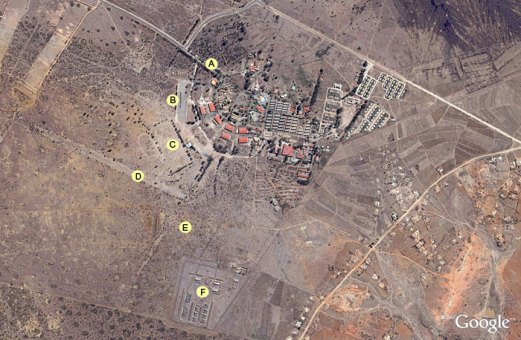
- Llewellyn Barracks (Alan Roberts)
Llewellyn Barracks from 14,000 ft:A) Main Entrance to Llewellyn
B) The parade ground: where many painful hours were spent
C) The sports ground: with rugby posts that we often had to run around during drill on the parade ground
D) The abandoned air strip: around which we had to run most mornings before breakfast
E) The rifle range: now abandoned….you can see the stop-butts just left of the “E”
F) Number Three Guard: where I also spent many painful hours
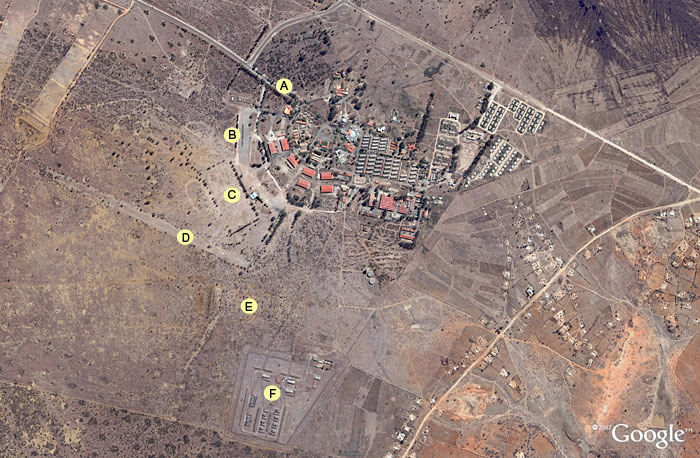

- Passing-Out Parade-Depot, The Rhodesia Regiment
Falling-In
February 7, 2010
6-6-1974
The evil smelling little Renault 4 taxi dropped me off at the main bus-stop next to the car-park behind the Bulawayo City Hall….our mustering point. There were a few sad-looking individuals there already, many of them saying their goodbyes to family and friends.
We were mostly eager to get on our way, away from the city. Wanted to get it all over with so we could go home again.
They had come to fetch us in that old stalwart of the Rhodesian Army vehicle fleet, Bedford RL’s…..the ones with the big bubble-like noses. There were also what seemed far too many grim-looking people in uniform shouting and ushering us onto the vehicles. The tailgates were down and we chucked our few belongings on board as ordered and clambered up into the wet cargo areas of the trucks like robots, heads banging on overhead frameworks, feet slipping on wet metal.
Two stone-faced and extremely well turned out Corporals accompanied each vehicle. For some reason they were in their drill kit, hobnail boots with gleaming toe-caps and putties. The creases on their twill shirts and shorts starched and ironed to razor like sharpness.
The rain had eased a little but the old tarpaulins that covered the back of the trucks were full of holes or in some cases ripped……this ensured most of us had a second shower, or in some cases probably the first for the day. There was no way to escape from the dripping …..it only made the mood more depressing.
As if on cue, the drivers and escort, who up to then had stood at the back of thier idling vehicles, now lifted up the heavy tailgates and slammed them shut, making sure the two locking latches were in place……not easy as most of them were bent out of shape and alignment. They then climbed into the doorless cabs, the driver double clutched and slipped the RL into first gear……and our convoy began to move off.
On the way the Corporals said very little. They too were obviously pissed off with the wet journey and were more than likely plotting their revenge against us civvies……seeming to look in my direction more than what I deemed necessary.
The trip out to Llewellyn was fairly uneventful except for the whipping one would get from the madly flapping canvas and loose ropes that were meant to hold the tarpaulins in place. The seats were hard cold steel, and my arse was soon numb and my feet went to sleep……the exhaust fumes from the Bedford 6 cylinder being sucked into the back of the vehicle by the vacuum caused by our forward movement……stinging our eyes and throats. The whirring of the wheels on the road and differential whine on an RL are somewhat hypnotic, and this having been well mixed with an overdose of carbon monoxide caused my head to start nodding like one of those dogs my mate had in the back his Cortina GT.
We tried to make small talk with one another to stay awake, fear of the unknown making it difficult to forge any kind of friendship for now. The best one could expect to get was someones name and a shivvery, cold, wet handshake.
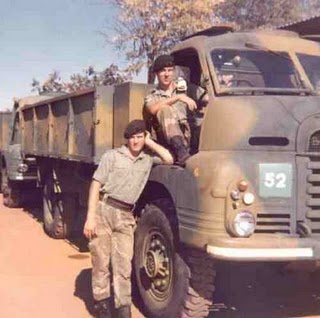
Rhodesian Army Bedford RL
D-Day Part 2: 30 Years Later
January 31, 2010
6th June 1974.
The above date and the month (6/6) are probably quite well-known to most people, especially the sad bastards like me who read military history.
The year however will not mean too much at this time…….but read on and all will be revealed.
30 years to the day a combination of the date, month and year was extremely significant to a few hundred young men who were part of Rhodesian Army Intake 139, destined for their National Service with the Rhodesia Regiment at Llewelyn Barracks near Heaney Junction outside Bulawayo.
I was part of Intake 139, and I don’t think my fear was any different to any of those brave men who were going to land on the beaches of Normandy……..the ones with the unforgettable names….Utah, Omaha, Gold, Juno, and Sword. On a different level I was just as shit scared as those brave men must have been……..and Llewelyn Barracks was also to become an unforgettable name.
There is no argument that the scale of the threat in 1944 was different, but the knowledge that certain death from an enemy bullet could be around the corner must have been very much the same.
There was the sound of a car horn from downstairs……the taxi had arrived to take me to the pick-up point. I was on my way……it was a cold and gloomy day outside. And it was raining again……”guti“…..a soft mist of refreshing happiness from the sky.
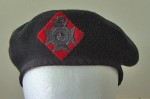
My first Cap-Badge: The Rhodesia Regiment
D-Day……Part 1
December 8, 2009
6th June 1944:
In November, 1943, Joseph Stalin, Winston Churchill and Franklin D. Roosevelt met together in Teheran, Iran, to discuss military strategy and post-war Europe. Ever since the Soviet Union had entered the war, Stalin had been demanding that the Allies open-up a second front in Europe. Churchill and Roosevelt argued that any attempt to land troops in Western Europe would result in heavy casualties. Until the Soviet’s victory at Stalingrad in January, 1943, Stalin had feared that without a second front, Germany would defeat them.
Stalin, who always favoured an offensive strategy, believed that there were political, as well as military reasons for the Allies’ failure to open up a second front in Europe. Stalin was still highly suspicious of Winston Churchill and Franklin D. Roosevelt and was worried about them signing a peace agreement with Adolf Hitler. The foreign policies of the capitalist countries since the October Revolution had convinced Stalin that their main objective was the destruction of the communist system in the Soviet Union. Stalin was fully aware that if Britain and the USA withdrew from the war, the Red Army would have great difficulty in dealing with Germany on its own.
At Teheran, Joseph Stalin reminded Churchill and Roosevelt of a previous promise of landing troops in Western Europe in 1942. Later they postponed it to the spring of 1943. Stalin complained that it was now November and there was still no sign of an allied invasion of France. After lengthy discussions it was agreed that the Allies would mount a major offensive in the spring of 1944.
General Dwight Eisenhower was put in charge of what became known as Operation Overlord. Eisenhower had the task of organizing around a million combat troops and two million men involved in providing support services.
The plan, drawn up by George Marshall, Dwight Eisenhower, Bernard Montgomery, Omar Bradley, Bertram Ramsay, Walter Bedell-Smith, Arthur Tedder and Trafford Leigh-Mallory, involved assaults on five beaches west of the Orne River near Caen (codenamed Sword, Juno, Gold, Omaha and Utah) by the British 2nd Army and the American 1st Army. Follow-up forces included the Canadian 1st Army and the American 3rd Army under Lt. General George Patton.
Juno was assigned to the Canadian Army. Canada contributed 110 ships to the invading force, 14,000 troops, including paratroopers, and 15 RCAF squadrons of fighters and fighter-bombers. It is estimated that Canada contributed about 10 percent of the D-Day invading force.
The invasion was preceded by a massive aerial bombardment of German communications. This resulted in the destruction of virtually every bridge over the Seine.
On 6th June, 1944, 2,727 ships sailed to the Normandy coast and on the first day landed 156,000 men on a front of thirty miles. It was the largest and most powerful armada that has ever sailed.
The Allied invasion was faced by 50 divisions of the German Army under General Erwin Rommel. At Omaha, steep cliffs favoured the defenders and the US Army suffered 2,500 casualties.
The Allies also sent in three airborne divisions, two American and one British, to prepare for the main assault by taking certain strategic points and by disrupting German communications. Of the 23,000 airborne troops, 15,500 were Americans and of these, 6,000 were killed or seriously wounded.
Over the next couple of days 156,215 troops were landed from sea and air in Normandy, at a cost of some 10,300 casualties.

Soldiers waiting to be parachuted in France (6th June, 1944)
And the rest is history……..listen closely to the words of “Say Goodbye To It All” by Chris de Burgh……study the photo above closely, imagine what they imagine……think their thoughts……. and it will bring a tear to your eye……if it doesn’t you are a sad, lost, and empty soul…..Fox.
On And Off The Rails (Part 4)
September 27, 2009
Location: Rhodesia Railways Mechanical Workshops, Bulawayo
Still in the Erecting Shop, 1973
I would like you to meet my Erecting Shop Journeyman.
His name was Brian Kelly and he came from Ireland. I am convinced he was an IRA hit man but this was probably my overactive imagination at work, but he did strike me as a dark horse whose passive and quite nature merely concealed his other side.
Brian was a great guy, spoke with a wonderful Irish accent (obviously) and we got on really well although I made a number of serious fuck-ups while I was with him. We will not discuss them at this time.
The ten o’clock tea-time was reserved for playing bridge in the Erecting Shop welding cubicle. We had our own little hide away where our wooden lockers were. Brian spent many frustrating months teaching me the game. He had a lot of patience with me and I think I got the hang of it in the end although I still don’t really know what “vulnerable” and “rubber”means. Anyway during tea time we used to sit around a steel table we had made and four of us would drift away into a make believe world of soft carpets, cigar smoke, and waiters dressed like penguins. We really were a quartet of grand gentlemen in our oily, sooty overalls, greasy safety boots and chipped tin mugs that burned ones lips whenever a sip of tea was taken.
Brian’s wife also made the nicest mince sandwiches which I used to readily devour, normally not having anything of my own.
One of the jobs I was taught by Brian was a boiler tube replacement. This was a bitch of a job and involved first the cutting out and then the welding back of up to 400 tubes that form the steam making heart of a steam locomotive. The idea was that once the boiler was safely on its stands, the welder, in this case me, would climb inside the firebox and cut the old tubes out using an electric arc. Quite a mission as you have to get the arc inside each tube to cut it out and the arc would flash all over the place. If you have never welded electrically you wont understand what I am talking about but try to imagine it anyway. Once they were all out the boilermakers would come and clean everything up and new tubes would be fitted which I then had to weld back in. A long and back-breaking process, done in isolation and under a strict time scale. Once all the welding was finished the boiler tubes were pumped up using water pressure so you could see any leaks in your welding. And then it was back in again to seal off any water spurts.
In have to say here that I was complimented by Jack Crilly on my ability to carry out positional welding much better than the easier and normal flat welding. This is quite strange as positional welding means upside down or vertical up/down welding and normally takes ages to master. I got it right within a year and found it quite an accomplishment. Boiler tube welding was all positional stuff and tested a welder to the limit both physically and technically.
I have never been a small lad. In fact I am what you would call over average in build…..overweight or fat actually. I was known as the little fat fucker in the workshops. Getting into the boiler was always fun and getting out even more fun as a persons body expands when hot….I jest not with you here. And it is really hot inside a boiler that is being welded. The sweat literally pisses off of you. Remember you are wearing elbow length fireproof gloves, your Jack the Ripper apron, boots, spats and your overall. Oh yes and you have a welding helmet and cap on as well. The cap was to stop any welding sparks burning the shit out of your exposed head which resulted in intense pinpoint pain, swearing, and the sickening smell of your own hair and flesh on fire.
If you do not manage to get your kit on correctly, some sparks do manage to get inside your overalls and I had one rather painful experience of a blob of molten metal coming into contact with the side of my dick….I have the scar to this day. Lucky, lucky.
Sometimes blobs of metal got inside my boots….very painful too and you just have to grin bravely, swear, jump about, and wait for the bit of metal to cool down while being in direct contact with your skin. There is no way to get your laced-up boots off.
As in the wagon shop there was also a graveyard for weary locomotives…..those fire breathing monsters that have come to the end of the line. This was also a sad place where once proud giants of the railroad found their final resting place…..out in the open and unprotected from the elements.
It was an undignified end for these truly wonderfully majestic machines, and my love of and fascination for steam locomotives remains with me to this day.
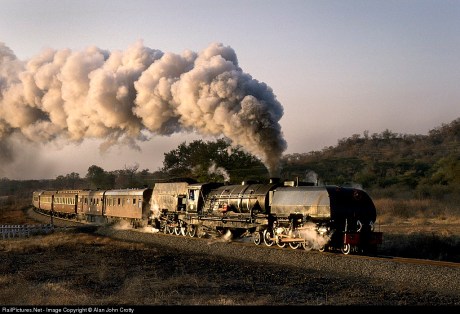
Rhodesia Railways 20th Class Garrett hauling a passenger train.....what a majestic beast! There is a more than even chance I worked on this grand old lady.

Rhodesia Railways locomotive graveyard, Bulawayo

Inside a locomotive boiler showing steam tubes
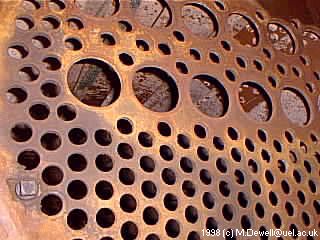
Boiler tube plate where I would cut out and weld back the tubes

Inside a boiler
On And Off The Rails (Part 3)
September 26, 2009
Towards the end of 1972 and early 1973…..still in the Rhodesia Railways Mechanical Workshops, Bulawayo
Second Mission: The Erecting Shop
I know what you are thinking. Erecting Shop. What a strange name and why would they call it that? I thought the same myself and of course this part of the workshop complex was always going to be rife for a whole lot of strange comments.
So why is it called the Erecting Shop and what debauched activities take place there? Patience dear reader…..all will soon be revealed.
Towards the end of 1972 I was told that I would be transferred away from the Wagon Shop. My destination was not made clear at that time as there was a lot of shuffling around going on. A large majority of the Journeymen and senior apprentices (3rd, 4th, and 5th years) were spending more and more time in the bush on Territorial Army (TA) call-up duty, and this was putting a severe strain on those of us who either had not yet been called up for National Service, or those that for one or other reason were unable to serve in the Rhodesian Army. I suppose that this was when I first realised that one day I would be going on call-up and others would have the pleasure of cutting up smelly meat wagons.
To be very honest I was extremely sad to be leaving Jack Crilly. He had become like a father to me and mentored me in everything I needed to know about my work and more importantly, about life itself. He treated me as his son. As an apprentice I never earned much money. In my first year I took home 77 Rhodesian Dollars per month. Out of this I had to pay for my lodging, buy clothes, and eat. I had moved into the Railway single quarters in Raylton, the railway suburb right next to the workshops and staff canteen. So I lived in the shadow of where I worked and the sulphur smell of burning coal was ever prevalent. Each month I bought my little book of meal coupons and that’s where I basically ate all my meals. Not bad food, but pretty much the same menu each day.
I got to know quite a few of the married personnel who had their houses next to the single quarters and ever so often I used to get invited round to someones house for a real supper of hot beef stews, hearty vegetables, and guavas and custard. One couple I became very attached to was Bella and Keith Harris. Keith, a giant of a man with a heart as good as gold, was a locomotive fireman…..the tough guys that shovel coal into the ever-hungry maw of a steam engines firebox. And dear Bella….what a wonderful person……she just had a way of making me realise what it must be like to have a real home. Wonderful people who never had too much of the good things in life but shared what they had.
Back to the Erecting Shop.
Erecting Shops are places where things that were previously un-erect (not flaccid as in penis, but rather dismantled) are re-erected. Normally this process involved enormous machines. In this case huge black steam locomotives. Great big Beyer-Garrett monsters that could haul thousands of tons of cargo up and down the many miles of Rhodesian rail tracks.

Beyer-Garrett 15th Class
These were massively powered beasts that prowled Rhodesia’s open spaces taking goods all over the country and over the borders as well.
Life was quite hazardous in the Erecting Shop. What you have to understand is that Rhodesia Railways locomotives could weigh between 30 and 120 tons depending on the model, and when it arrives at the workshops it is still on its bogeys, or wheel units. So it is easy to move about with little shunting engines or winches. However one of the first things that has to be is to remove the bogeys. The only way to do that is by lifting the whole locomotive into the air and pushing the bogeys away. The locomotive, suspended on huge overhead cranes was then lowered onto giant stands. It would remain there for at least 21 days, the time it took for a full strip and rebuild. Rhodesia Railways were known to be one of the most experienced organisations as far as this type of work was concerned.
I have described the removal of the bogeys as if it was a really simple activity but in fact it was an extremely precise and dangerous operation. The first thing that is done before removing the bogeys is that the sanding pipes must be cut off using oxy-acetylene cutting equipment. Sanding pipes are used to spray sand onto the rails in front of the main driving wheels of a locomotive when extra traction is needed, for example on steep inclines. This cutting of pipes was one of my jobs and again rotten meat comes into the story. You see there is a thing called a cow-catcher at the front of all locomotives and their job is to catch cows standing and minding their own business on the track…..basically a massive fast moving 100 ton meat tenderiser. The problem was that the now mushy cow normally got caught up under the locomotive after being hit and bits of pieces of processed meat and bone ended up being sprayed up the front bogey assembly that included the sanding pipes. So we are back to the 3000 degree flame burning minced up rotten beef.

Lifting a locomotive in an Erecting Shop (non-Rhodesia Railways)

A typical Erecting Shop (non-Rhodesia Railways)

Rhodesia Railways Erecting Shop where I worked as an apprentice Plater-Welder
 Fatfox9's Blog