Cordon Sanitaire: Scope Of Operations
March 1, 2014
Mukumbura………to any Rhodesian Sapper worth his/her salt the name conjures up Cordon Sanitaire operations. Indeed to most of us this was the Mother of all Rhodesian Cordon Sanitaire operations. However there were other areas where we laid mines, usually along the conventional lines of what I have described previously, but also some in more unconventional ways (will describe these in future posts).
Here is a diagram showing the extent of Cordon Sanitaire operations throughout Rhodesia. It also shows the various operational areas:
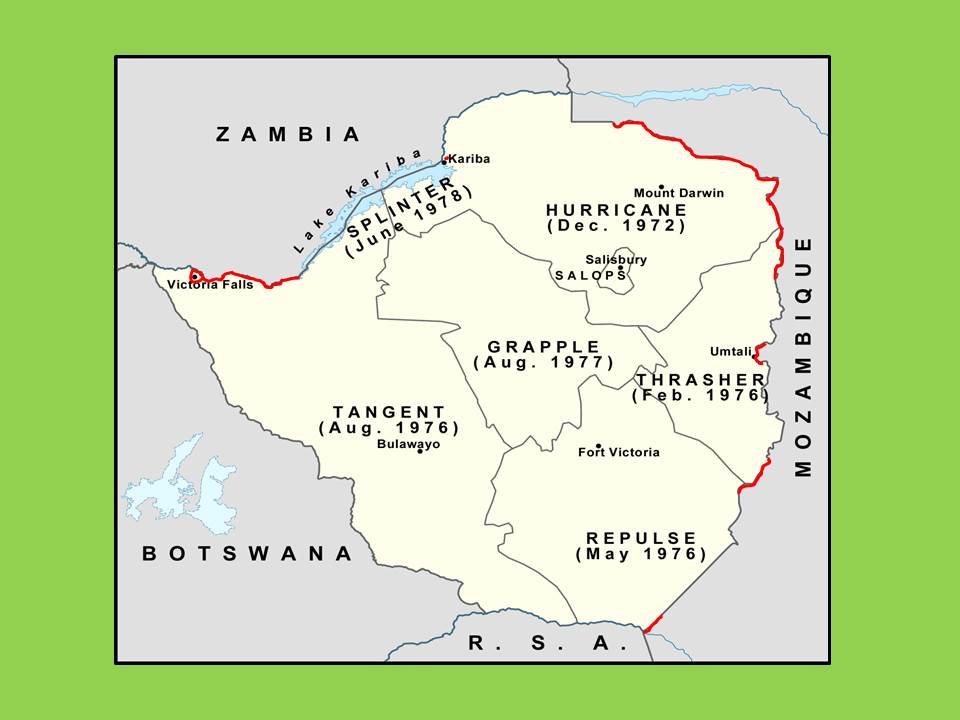
I would like to point out the following:
1. This map is not to scale
2. The information is to the best of my knowledge/memory correct (but fairly accurate and I do not suggest walking on the red bits).
3. Red bits (added by me) denote armed Cordon Sanitaire strips.
4. Base map courtesy of shelf3d.
Known mined areas:
1. 220 kilometers: Victoria Falls to Mlibizi
2. 359 kilometers: Musengetsi to Nyamapanda to Ruwenya
3. 72 kilometers: Junction Gate to Jersey Tea Estate to Muzite Mission
4. 50 kilometers: Stapleford Forest to Umtali
5. 61 kilometers: Malvernia/Villa Salazar to Crooks Corner
6. +-1 kilometer: Kariba Power Station
Not all of the areas above were laid to the same pattern. Some were standard pattern, others double-density, and some contained additional trip-wire operated fragmentation stake-mines. The double-density/trip-wire minefields were the most dangerous for us to work in, especially when carrying out minefield maintenance tasks. I will show diagrams of these variants in future posts to give you a better idea what they looked like and what we were up against.
The above information (Rupiah) is probably reasonably accurate distance wise but definitely does not account for what I will call “other” mined/booby-trapped areas. I know these “other” areas exist because I laid some of them while serving on special operations. My conclusion regarding these “other” areas is therefore that they remain unknown and uncleared.
Please also have a look at my website dedicated to Rhodesian and South African Military Engineers. Please join us on the forums by using the following link:
http://www.sasappers.net/forum/index.php
Copyright
© Mark Richard Craig and Fatfox9’s Blog, 2009-2014. Unauthorized use and/or duplication of this material without express and written permission from this blog’s author and/or owner is strictly prohibited.
Mukumbura: Learning The Ropes (Part 2)
January 14, 2014
Cordon Sanitaire Mine-laying Operations
Working with explosives is a dangerous business. Make no mistake. Having said that laying mines is not rocket-science but if you don’t keep your wits about you and exercise strict discipline and command and control, people are going to get hurt.
Sadly, there were a number of Rhodesian Sappers killed in our own minefields during laying and minefield maintenance operations. Please spare a moment to pay your respects to these brave men by visiting the Rhodesian Corps of Engineers Role Of Honour at http://www.sasappers.net.
Additionally there are quite a few accident survivors living with missing limbs, blindness and other injuries caused by our own mines. Mines do not differentiate between friend and foe. They kill and maim the layers and the enemy without distinction or warning. I have been in the unenviable position on more than one occasion where I have witnessed our Sappers killed or horribly injured during Cordon Sanitaire operations. I will not discuss the details in this post but I can assure you this type of incident remains very clear in ones mind.
To give you an idea of our mine-laying methodology please look at the following diagram:
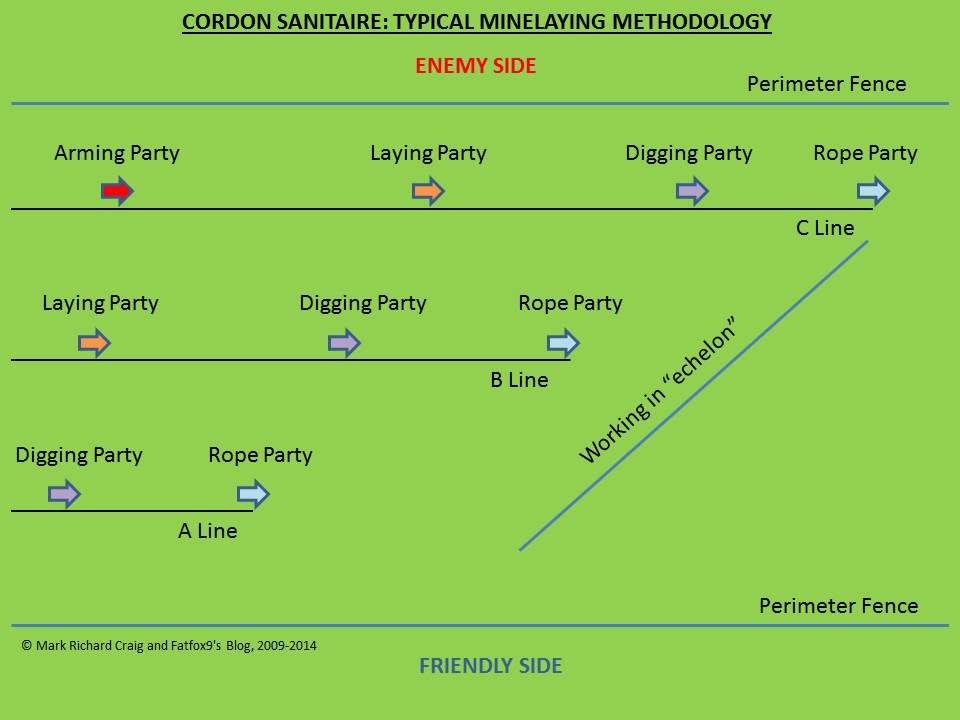
FIGURE 1
As you can see we had an Enemy and Friendly Side. In the case of Mukumbura the Enemy Side would be Mozambique, and the Friendly Side, Rhodesia. The two fences were constructed using strands of barbed wire evenly spaced and attached to steel pickets at regular intervals. The lower one meter or so of the fence was also fitted with mesh to stop smaller animals from getting through and detonating mines.
Here are some photos of Cordon Sanitaire, Mukumbura. (Terry Griffin):

Here is a photo of the mine-sign you can see on the fence in the top-left image:
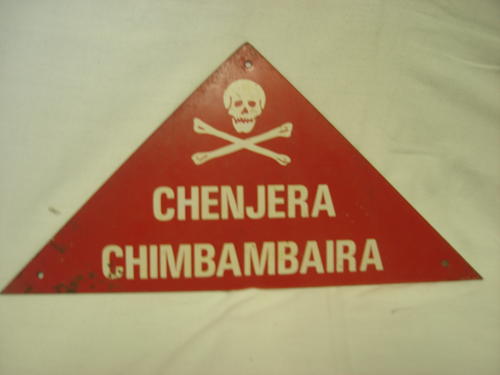
According to Vashona.com, Chenjera Chimbambaira literally translates to “Beware Grenade” in the local (Rhodesian) indigenous vernacular (Shona). Mine-signs were attached to the perimeter fence to warn the locals of the danger of crossing the fence. Unfortunately the warnings were not always heeded resulting in civilian casualties.
In the next post I will discuss the duties of the Rope Party, Digging Party, Laying Party, and Arming Party.
© Mark Richard Craig and Fatfox9’s Blog, 2009-2014. Unauthorised use and/or duplication of this material without express and written permission from this blog’s author and/or owner is strictly prohibited.
Mukumbura: Salisbury Sojourn (Part 1)
February 14, 2013
Getting to Mukumbura was a pain in the arse……literally. If you have had the opportunity to sit on the steel benches in the back of a Bedford RL for 400 clicks you will understand exactly what I mean. Your arse goes numb and so does your scrotum for some reason. I have even had pins and needles in my dick during these trips, loosing all sensation and not knowing if it was still an appendage to my body. Here is a picture of a Bedford RL:

Bedford RL
Secondly, and more irritating than numb-nuts was the fact we had to deploy through Salisbury. This involved having to accept the hospitality of either 2 or 3 Engineer Squadron (Rhodesian Corps of Engineers). These units were based at either King George the Sixth Barracks (KGVI), or Cranborne Barracks (also home of the Rhodesian Light Infantry (RLI)). It seemed to many of us from 1 Engineer Squadron (Brady Barracks, Bulawayo), that the Salisbury Squadrons had an air of superiority about them. This was probably a result of Engineer Directorate also being in Salisbury. I cannot say that I enjoyed any of my visits to these units and the sooner we had done what we had to do there and got on our way the better. Having said all of that there were some good men in the Salisbury Squadrons and I made a number of close friends from these units during my 7 years in the Rhodesian Army. Here is a picture of the entrance to Cranborne Barracks:

Our normal stop over was about 2 or three days and during this time we would do retraining, load up any logistics that needed to get to Mukumbura (including anti-personnel mines), and get pissed in the many watering holes in Salisbury. One of these pubs was La Coq D’or which the RLI considered to be their personal domain and woe betide any other Unit that encroached on their territory. There have been a number of memorable punch ups there. Here is a picture of the place (courtesy of New Rhodesian Website):

And a menu cover from way back when:

All good things come to an end however and we had to move on. We had a mission after all…..to lay mines and stop the gooks getting into Rhodesia. We climbed up into the Bedford’s, and with the stench of exhaust fumes polluting the air and stinging our eyes we were off. Wrapped up against the cold in my prickly grey army issue blanket I could still taste the bacon, eggs and coffee we had for breakfast as I settled in for another ball-numbing journey.
 Fatfox9's Blog