Cordon Sanitaire: Personal Experiences (3: Basil Preston)
November 2, 2014
The response to my request for personal experiences on Cordon Sanitaire has resulted in a number of submissions from people who clearly want to see our history recorded and celebrated. Long forgotten names are being mentioned, sparking the grey matter into life once again and there is so much to be gained by reading about other people’s experiences on the Cordon. I for one feel enriched by all of this.
The following is from Basil Preston, a Rhodesian Sapper who I am sure has many more stories to share with us and I really hope that he does. I have slightly redacted Basils submission, however it is mostly exactly the way he sent it to me.
Hi Mark,
My name is Basil Preston army number was 72860 and I became an Engineer after I did my basics at Llewellyn starting 07/06/1972, Intake 132.
I have just read your blog about the Cordon Sanitare (sp) mine-field starting at Mukumbura.
We were the first Engineers to start this field, in either February/March or April 1973, can’t remember the exact date, (but ABBA, the Swedish group had just announced that they were in support of the freedom fighters at that time, we all dropped them from our favourites after this announcement).
We were tasked with the clearing of the bush etc with bulldozers and graders. Our main chap who loved the grader work was Gordon Paterson, who was black by the end of his shift from all the dust and sweat.
We were broken up into 3 groups; clearing party, guarding the workers and the clearance party comprising 3 sappers, who did a 360 around the whole group. Tetse workers were busy with the fencing.
Corporal Gleson was in charge of us, and Corporal Charlie Mcquillan and Sergeant Hitchins/Hutchuns (sp) were there too, but did nothing special as they were imports from the UK who joined the army as regulars and were being bushed trained. These chaps were electricians by trade, but knew nothing much about our conditions or bush. We were about 20 sappers all told, and were looking forward to our demobbing in June. We were due to pass out on the 13/05/1973. Melvin Hein, Tommy Dickinson, Basil Kirby, Mike Travaglini, Gordon Paterson, Gumbie Dixon are just a few names I remember.
We were told that if we saw anyone foreign to our people, we were to first contact base camp to confirm, as they could be Tetse workers.
On our first outing, I was part of the 360 group, comprising Tommy (Dicky) Dickinson, Gumbie Dixon and myself, and we had just collected Marula fruit and were busy eating them when I noticed movement about 400 metres away from us. As I passed a huge palm leaf, the 2 images I saw went to ground. I shouted “ters” and we took cover, made contact with base camp, who told us to wait one, and they would come and assist. (contact via our radio was a laugh, as Dicky’s hand was shaking so much, the coms was interrupted going out, as the hand press-switch was also being pushed on and off as the shakes continued)
We were high on adrenalin and got impatient waiting for back-up, and started to leopard crawl through a dried out mealie field, which was cutting our knees to pieces. We then ran to where we saw the 2 images go down, all the grass was laid flat.
Back-up arrived nearly an hour late, and off we went. By this time, the Cts were back in Mocambique. But we still did a follow up. Crossing our own freshly graded mine field was hectic. Crossing by running across the open one at a time The Sergeant got stuck on the fence as the strain of wire wedged between his back-pack and his back, I ran forward to help the guy,who did not appreciate it as we were now both sitting targets.
Nevertheless, we were the first group of sappers to have a “contact” be it visual only. We were not impressed with the time it took the back-up to arrive and we voiced our views on this.
But to cut a long story short. After weeks doing the same thing, day in and day out, and nightly ambushes along the field, we started to get gut-vol.
On our return from the field one day, Charlie Mcquillan, wanted to put my group on extras as he had found a tin of jam in our bivy area, full of stinkbugs and ants eating the left-overs. One of our group had acquired the tin of jam from the kitchen. We were short on every thing by this time. We lost it and asked him why he was snooping around; and threatened him with his life. Dicky was going to see that he never left the country, as he was “customs” back in civy life, I was a banker and told him that he would never get foreign exchange when he left Rhodesia and Melvin just wanted to hit him with a pick-handle. The rest of the guys just wanted to bury him in our trench. Corporal Gleson saved Charlie that day.
I also went onto doing the Dekka mine-field, and the one at Villers. Did boats in Kariba with Ant White, at the time they were forming the Selous Scouts and served with RAR, 2RR for almost the whole of the continuous period at Malapati and various other RR Companies. Looking back, I had a tough 8 years of army life as a sapper. My son was 3 weeks old when I was called up for the “Continuous” period and was 13 months old when I saw him proper again. All told, the guys I served with were a great bunch indeed. Mick (Chum) Jones was in my intake too. He was killed with Leroy Duberly, Charles Small, Peter Fox and one other during the second Chimoi external. They were with a bunch of RLI all in a Puma which was shot down, all 17 in the chopper were killed.
Thats all for now.
Regards, Basil Preston
Photos of Basil are shown below:
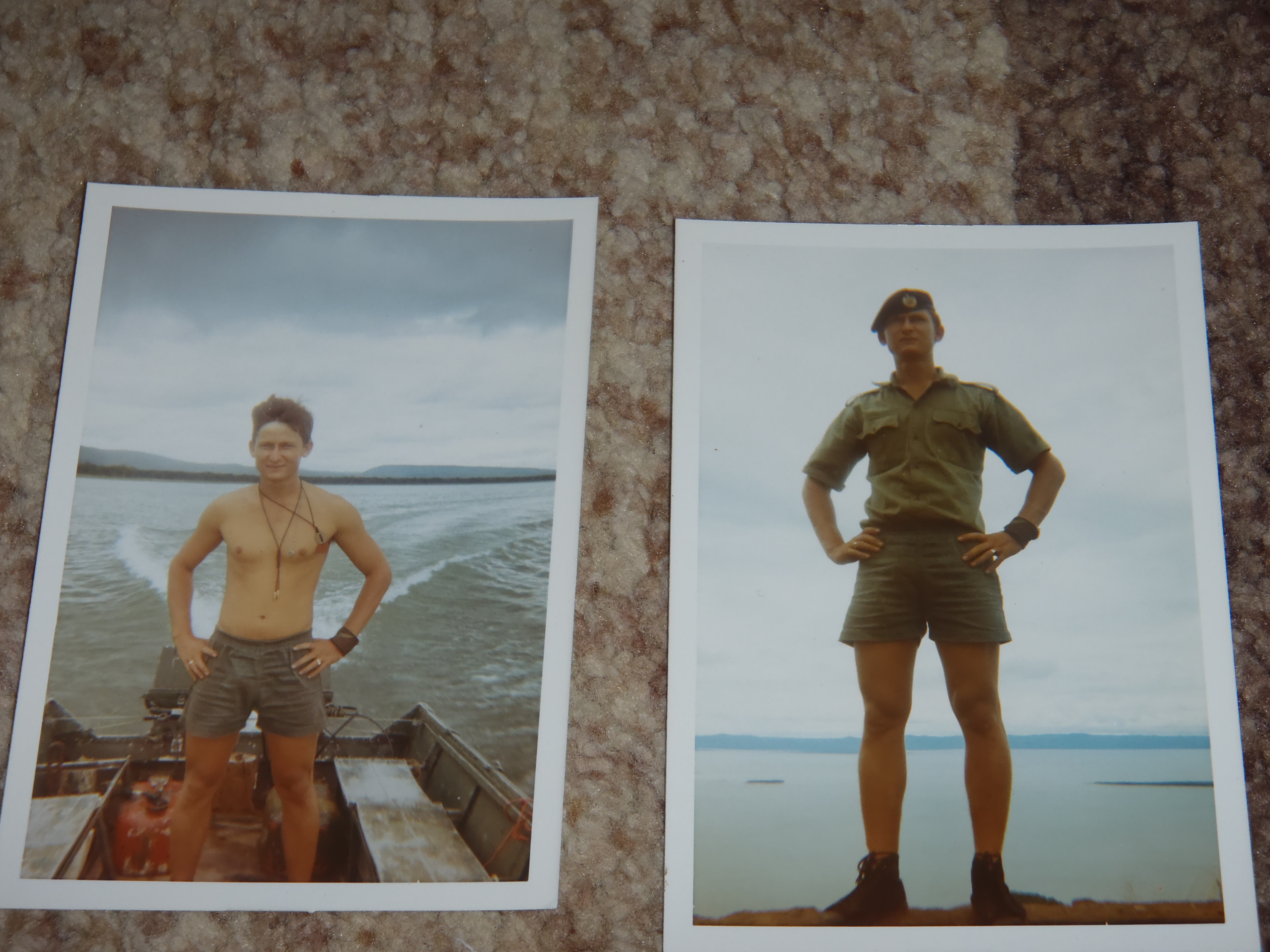
Please also have a look at my website dedicated to Rhodesian and South African Military Engineers. Please join us on the forums by using the following link:
http://www.sasappers.net/forum/index.php
Copyright
© Mark Richard Craig and Fatfox9’s Blog, 2009-2014. Unauthorised use and/or duplication of this material without express and written permission from this blog’s author and/or owner is strictly prohibited.
Cordon Sanitaire: Personal Experiences (2: Vic Thackwray)
October 19, 2014
As mentioned in my previous post we will continue with the personal recollections of some of those that worked on Cordon Sanitaire. In this post we have accounts from Vic Thackwray, another former Commanding Officer of mine. I had the pleasure to work with Vic in the Rhodesian Army (RhE), the South African Defence Force (SADF (SAEC)), and also in the private sector after we had both ended our military careers. Vic and I remain close friends and I wish to thank him here publicly for all of the help and sage advice he has given me over the years, and will probably also need to do in the future. I am bound to ask him something and he always responds rapidly and with a genuine willingness. Thanks for everything Vic…..you are one of a kind.
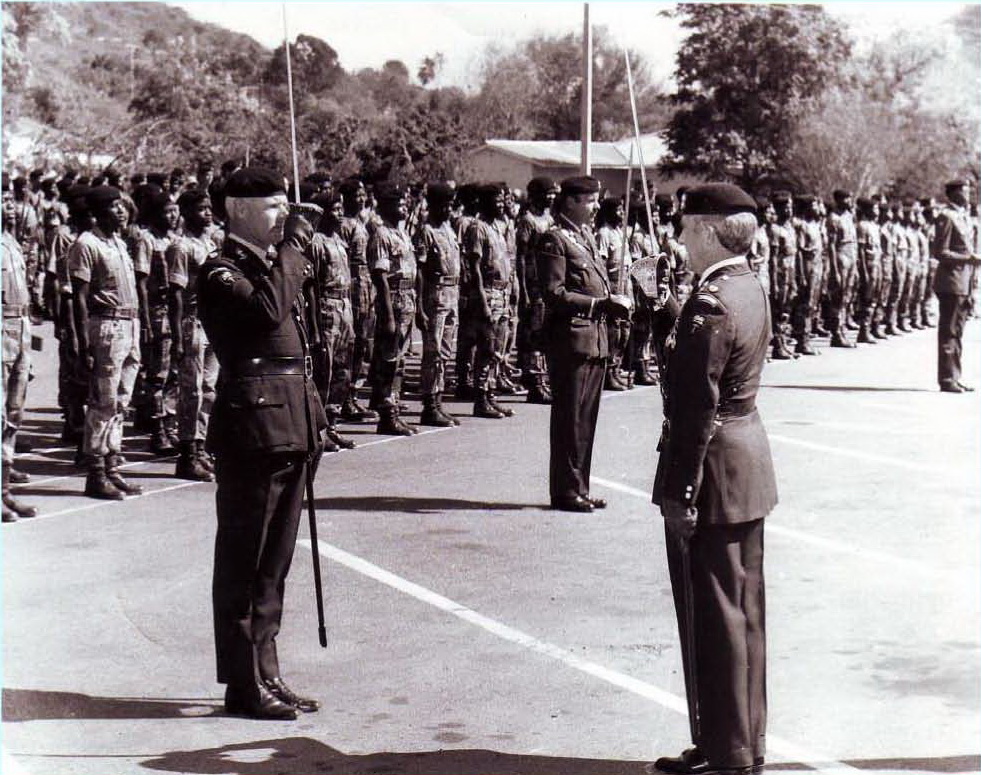
The picture below shows Vic (left, saluting with the sword) as Parade Commander at the Last Official Parade of the Rhodesia Corps of Engineers in 1979……..a sad day indeed and the end of an era but how proud he must have been!!
Vic takes up the post from here…………starting with an interesting and sobering Cordon Sanitaire Fact Sheet:
‘CORDON SANITAIRE’ FACT SHEET
The following illustrates my involvement with the Rhodesian Cordon Sanitaire.
- My initial deployment to Cordon Sanitaire was to take over from Terry Griffin (see previous post) who had trained the first mine laying teams in Mukumbura.
- My second in command was a Corporal Charlie MacQuillan who had recently attested into the Rhodesian Corps of Engineers from the British Army.
- We commenced laying the Portuguese M969 mine. This was followed by the South African R2M1 mine, the South African R2M2 mine, the Rhodesian Engineer manufactured RAP mine (commonly referred to as the ‘Carrot Mine’), and the Italian VS50 mine.
- The Cordon concept was based on the Israeli Defence Force minefield which separates Lebanon from Israel and is called the ‘Blue Line’, the electronics used in Israel were used for the first 50 km or so in Rhodesia but was soon ‘binned’ for financial reasons coupled with the constant triggering of the system by wild animals.
- The total length of the combined minefields is 696 km
- The density of mines was 3,000 mines per kilometer with 300 ploughshares per kilometer for approx 500 kilometers.
- A committee was inaugurated comprising the SADF, the Rhodesian Army, and elements of CSIR in SA and was called the ‘Geisha Committee’. It was formed to discuss, workshop and plan all mine action activities between the two countries.
- One of the senior CSIR members, (name removed) was instrumental in the design and manufacture of the R2M1 and R2M2 AP mines. I was tasked to assist on the ground in the Mukumbura area and established a ‘Seed Minefield’ within our minefield. In this area we laid many mines at predetermined depths and other technical data. On frequent occasions the Professor would travel to the field and I would be instructed to remove selected mines for observation and assessment.
- Accidents involving own troops during laying, maintenance and some clearance numbered 97, of which the majority were traumatic amputations of one leg, and 1 member both legs, (1 above and 1 below the knee) (Sgt. Willem Snyder). Several of the 96 members lost hands, fingers and eyes, 1 unfortunate member Spr Ndlovu lost both hands and blinded in both eyes during the arming of a plough share. The deaths of members numbered 30, however, this figure is not confirmed but estimated by me and several other officers of the Corps. he majority of accidents and ALL the deaths are attributable to the Maintenance phase of the Cordon. I am aware of members being killed when the point Sapper walking down a safe lane was confronted by a snake, normally a Black Mamba or Cobra and he just ran blindly into the minefield and subsequently triggered the trip wire of a plough share instantly dying and often a few of the maintenance team were injured by shrapnel. Additionally other members were killed or severely injured when replacing plough shares during which the 30 metre trip wire was hit by Doves, guinea fowl, small antelope, and turkey buzzards. In the Umtali forest areas where I spent considerable time, several members were injured or killed when the plough share was triggered by falling bark from Gum trees as the Cordon went through many Gum Tree plantations. Again in the Umtali area some 5 accidents were attributed to terrain problems, whilst maintaining the minefield the 15-20 cm. thick soggy/wet leaf mould caused the members to slip/slide and subsequently hit a mine on their rapid descent. One young Sapper lost his leg when he foolishly attempted to retrieve a set of Kudu trophy Horns in the Northern minefield.
- The Cordon, in 99% of cases employed the International Border as the Enemy fence, for obvious political reasons.
- When the terrain dictated that the Cordon could not follow the Border, the proposed route of the field was assessed and this information subjected to a high level detailed Military Appreciation. Changing the minefield routing obviously required high level Political input as it involved, Private land, farms, forestry, National parks, Police, Internal Affairs, and Tribal burial grounds, to mention a few. This appreciation and request was forwarded to Parliament via Engineer Directorate to Army Commander to COMOPS for approval. The agreed rerouting on the Rhodesian side of the border together with detailed maps of the new routing was then subsequently issued from Engineer Directorate.
- The Cordon including all maps, diagrams, drawings, mine stocks and all reports etc., was officially handed over to the New ZANU Commander of the Zimbabwe Corps of Engineers over period April 1980 to December 1980.
Vic continues with anecdotes he recalls from the time:
During the maintenance of the Cordon Sanitaire, we frequently had to deal with wounded terrorists in the field, on one occasion near the Mazoe river bridge on the Northern border with Mocambique we were informed of four terrorists injured in the field, I proceeded with my team, ably protected by “Dads Army” , (the over 50-year-old soldiers)!
On arrival I deployed the protection troops to give me covering fire, gave them strict orders on the rules of engagement and proceeded to clear into the field.
Of the four terrorists, one dead, one youth (more a porter of equipment than a combatant), and two combatants, one had lost both feet and the other, one foot. Both with AK rifles close by and lying with their injuries slightly elevated on packs to reduce pain and bleeding. I gave them the usual warning that if they moved during my clearance in to save them, the troops would not hesitate to take them out.
All prepared, focused and fully hyped, I commenced clearance, when suddenly out of the blue, one of the “old soldiers”, a bank manager, called out to me in a loud and very posh voice:
Quote
“ I say sir, there is no threat here, it appears that all these chaps have been defe(e)ated”
unquote .
That just cracked me up, I needed a few minutes to regain my composure, and focus before resuming clearance.
And another…………………….
First Version of the Ploughshare
Based with Major Henk Meyer 1st. Battalion RLI at Mukumbura,
I had been tasked by Colonel Parker (affectionately called the ‘King’) who was based at Mount Darwin to strengthen the minefield over a certain area as they were expecting a thrust from Mocambique.
I installed 30 trip wire operated devices (First version of the ploughshare, using old pull switch devices.
Major Henk Meyer instructed me to show and explain the procedure to Captain Keith Sampson RhE., and a Selous Scouts Officer Major John Murphy (ex American Military), with parting words from Major Henk, ‘be careful Thackwray’.
I was dressed in Veldskoens, no socks, camo shorts, camo shirt, chest webbing, Camo floppy hat, water bottles and rifle .
We walked about 2 km along the fence with army protection on our left hand side, crossed the minefield at my clearance lane into Mocambique and walked 400 metres along the minefield fence to the position of the devices.
At a safe distance from the devices, I instructed them to wait at the fence whilst I made the device safe, I went in, removed 2 of the 3 ‘keeper mines’ from the base of the device and removed the detonator from the trip wire device, placing the detonator below my lower legs .
I commenced describing the device when (according to the protection force members) a bird some 20 metres down, flew into the trip wire, the detonator blew and I received detonator shrapnel, mainly to face, head, arms, legs and lost an eardrum, fortunately I had my prescription glasses on.
The two very agitated visitors were trying to come through the fence to assist me, I calmed them down stating that I was OK just a little blood, Major John Murphy then said words to the effect that ‘Rhodesians had big balls’. With ringing in my ears I only remember hearing the word balls, to which I immediately and instinctively checked my 6 o’ clock position, all was found to be good and this reaction was enjoyed by my visitors.
I relaid the 2 mines around the base and we walked back the 400 metres and along the 2 km road to base, it was amusing because all the supporting troops were staring at this walking bloodied apparition.
We finally arrived back at RLI base and my shoes were swimming in blood I was an apparition to behold, Major Henk Meyer was not amused and taking off his beret swiped me with it, saying “I told you to be careful Thackwray and what am I going to tell the King (Colonel Parker)”?.
I was casevaced to salisbury two days later.
Below I have included pictures from Vics contributions showing the types of mines he mentions :
Portuguese M969

South African R2M2 (R2M1 was very similar in overall design but had a different ignitor)

Rhodesian Carrot Mine (RAP)
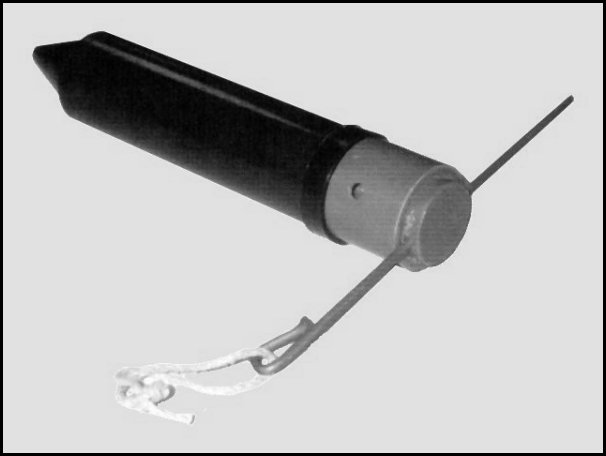
Some of the items may vary in colour from what the Cordon Sanitaire veterans remember but the general shape and design are spot on.
I would like to thank Vic once again for his input here
………..and just before I sign off this post:
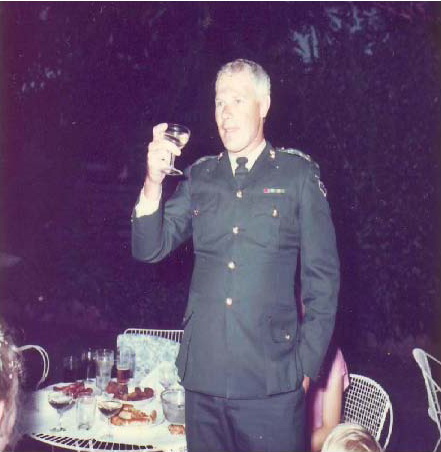
CHEERS VIC!!!!!!
Please also join me on my website dedicated to Rhodesian and South African Military Engineers. Sign up to the forums by using the following link:
http://www.sasappers.net/forum/index.php
Copyright
© Mark Richard Craig and Fatfox9’s Blog, 2009-2014. Unauthorised use and/or duplication of this material without express and written permission from this blog’s author and/or owner is strictly prohibited.
Cordon Sanitaire: Personal Experiences (1: Terry Griffin)
September 16, 2014
I have received significant help from a number of individuals with regards to various aspects of Cordon Sanitaire. It is only fair that their experiences are also shared with my readers and this seems a good time to do it.
This is my way of thanking them and acknowledging their contribution to the Rhodesian Corps of Engineers own private war within the Rhodesian Bush War.
Cordon Sanitaire was indeed our very own personal, deadly war. I am not saying that our supporting units did not contribute to this war………what I am saying is that we were the guys pulling the pins.
I would like to start off with contributions from Terry Griffin, one of my former Commanding Officers at 1 Engineer Squadron. I am posting this exactly as he sent his recollection to me…….if I done it any other way it would lose the impact of the era. I have seperated his submissions by a dotted line.
Terry takes up the post from here:
I was quite bemused, when attending an “early” mine warfare committee meeting, held at Army HQ prior to deployment of the first team to Mukkers – as previously detailed. At the meeting, were all sorts of folk who had an “interest” in what was to become the Cordon – as in Tsetse and various Army people etc. These meetings were held on a regular basis to discuss improvements , change of tactics etc, etc. However, at this “first” meeting the aspect of the Geneva Convention was discussed at length where correct signage, fenced on both sides etc, etc was laid down as pretty much a non-negotiable aspect. This was just in case we offended anyone and were then leaving ourselves open to be charged with war crimes. Can you believe it !! I recall very clearly being opposed to this “requirement” (as were a few other folk present) – for many reasons. Not least our “Coin” war aspect where camouflage and concealment etc was a “local” criteria and why should we “advertise” the minefield thereby nullifying its concealment etc and above all – who was going to arrest us and take us to court – in Geneva? We were overruled and the “first” minefield complied with the Geneva Convention – to ensure no comeback !! After completing my ERE attachment to RLI and being posted all over the country I (several years later) became involved with the Cordon again and was delighted to find that the Geneva Convention had been dispensed with. A classic example was in the Deka area where (as I am sure you recall) no North side fence was ever erected. Gooks just had to find out when they entered the minefield – more by when the first explosion went off.
Going back to the original / first field, am sure you recall, we had not developed the ploughshare (on a stake) yet so, all mines were AP’s laid as per original design. Due to the costly clearing (and stupid) of bush etc it was very difficult to camouflage all and even days later, unless rain (which did not fall often) or strong winds, concealed the placement – most laid mines positions were very/fairly visible. The open bare earth aspect (as per my pics you have) made the field look like a dirt landing strip – for light aircraft – in the middle of the bush. This is pretty much what it became as hordes of Ground Hornbills (Turkey Buzzards) descended into the field and inevitably sourced their daily food by pecking around the obvious digging areas. This resulted in many birds, either exposing the AP’s or occasionally blowing themselves up as they (obviously) pecked with sufficient force to detonate the mine. This resulted in the most hazardous aspect of the Cordon (to my mind) being re-entry to re- lay mines. We did try shooting these birds, to prevent their damage, but they arrived in their 100’s from all over the NE when the cleared bare earth, easy meal, word got out. Large animals as in Kudu, Elephant, Buffalo etc were not a problem here as there was no vegetation (between fences) for them to eat. Only the occasional one that took offence, to the fence, being in its way – as it were. This was to change in years to come as without bush clearing, the vegetation between fences had limited predation hence many of these herbivorous animals now saw the pristine vegetation growing between fences and broke through to eat from the protected larder – as it were. Again, the hazardous task of re-laying took place and I eventually (when OC 1 Sqn) banned all re-laying due to the casualties already sustained. However, the later aspect resulted in another bird being a danger. When an animal had been killed in the field, we now had hordes of vultures descending on the carcase. Empty and light, a vulture just came straight down to feed. After engorging (and now heavy / overloaded) it needed a running take off which often resulted in it activating a tripwire from the now laid ploughshares !! Many occasions I/we came round a corner either on foot or in a vehicle, next to the fence and surprised vultures on a carcase. As they started their running take off we would duck behind any available cover to avoid the inevitable shrapnel emanating for the ploughshare – as I am sure you recall ? I am aware of a dozen or so Sprs (not me thank goodness) who suffered “minor” injuries from this shrapnel as obviously we were at some distance from the detonation.
————————————————————————————————————-
Some light humour – wrt the Cordon, as opposed to all the “damage” it caused to humans and wildlife.
One of the highly intelligent Dr’s working for Tsetse, who had several degrees in Entomology etc was a rather dour individual. His name escapes me but am sure Vic will recall him if not remember his name. He was present at most Mine warfare committee meetings.
Anyway, one hot and boring day at Mukkers I had been bitten dozens of times by Tsetse flies and in desperation made my way to the cab of a 45 shutting doors and windows to complete (hopefully in some peace- from the flies) my report.
I noticed several flies were shut inside the cab so, in absolute glee commenced with my “payback” as in catching every one, and with my finger nails, removing their proboscis and then releasing in the cab – alive. I carried on (in peace) with writing my report. Sometime later this Dr who was at Mukkers and seldom ventured into the field joined me in the cab of the 45 as he was also fed up with being bitten. We discussed many things not least where / how he obtained his PhD and that it was sacrilege to refer to a Tsetse employee (especially a Dr) as just a plain entomologist. They were in fact called Glossinologist’s – as in specialist (entomologists) Tsetse fly folk. There is much on the web about this. After some minutes he let out a yell that resulted in me grabbing my rifle and commencing a one man assault on an enemy as yet unseen. Before I could de bus he insisted on the cab remaining closed and in a high pitched voice asked for help in catching the flies (in the cab) as he had just noticed non had a proboscis. They must be some sort of Tsetse “morph “ or anomaly in nature, that he would now investigate and maybe be able to breed, release into the wild and potentially eradicate the Tsetse scourge as there were obviously some flies that could exist without sucking blood.
When we had caught most and carefully placed in a container he had, he enquired as to my persistent giggling as this was an entomologist “dream” but he would assure me of a mention in his research. I then in stiches of laughter told him about my “payback” which did not amuse him. On pain of death he asked me never to divulge this incident as it would make him out to be a bit of a fool – amongst his peers etc. I have never mentioned it until now but still have a quiet chuckle whenever I think about it.
—————————————————————————————————————
Basically I was tasked with doing the defoliation on Chete Island after the gooks wacked the civvy ferry. I called up S Tp from 1 Sqn albeit I was OC Boats at the time and then we sailed plus Tsetse in the Army ferry (Ubique) from Kariba to Chete. Had strike craft as back up and positioned one at each entry to the gorge as it had been declared a frozen area for all craft during the OP. Went ashore (after anchoring on the island – invading enemy territory !! – to clear it of gooks – if any. There were none. Tsetse also provided back up (Jack Kerr plus another) with ,458 rifles in case elephants had a go at us. They did not. After positioning the guys in a defensive role we cleared the area where the gooks had fired from – onto the ferry – which still had much kit lying around from the firing point. Tsetse folk then used a defoliant called Hivar (as I recall) and by hand distributed like it was fertiliser along the entire bank facing the gorge and inland a short way. This would (as it did) clear that sector of all foliage and thereby (hopefully) deny natural cover. After the first rains it was evident all was dying off and it did clear all fairly quickly creating a rather bare scar along that section of the island. Some 10 years later it was still very visible but on my last fishing trip there + – 4 years ago all had now regrown. The gooks never did use the original firing position again.
Chete Gorge
 Africamemories.com
————————————————————————————————————-
The very first minefield laying etc (again) I was OC of that – starting at Mukambura. Lt Col Horne actually came up with the team I had trained – for a look see.
Tsetse were (as per normal) responsible for erecting fences but we also had plant tp folk with bulldozers and graders clearing all so we had bare earth in and outside the minefield to work on. This was also to prevent gooks taking cover in the bush. At that stage the minefield was approx. 25m wide. In no time I realised this method was an absolute waste of time money etc, etc as we also provided armed protection for the dozer drivers etc way ahead of laying teams. To keep a definitive 25m width etc was patently stupid so I wrote a paper and suggested fences meander to create doubt as to depth of field – albeit still 3 rows – and do NOT clear vegetation as it then aided in camouflaging all. I sent you some pics of the first gook breach and just look at the nice clear earth with fences visible at exactly 25m. Boy did we have a lot to learn – and quickly. This is the only defoliation that I am aware of??

————————————————————————————————————
The foregoing was not in any particular order and I am sure this is the very first time Terry has shared anything like this publicly. I thank him sincerely for giving us all the privelidge of sharing some of his experiences.
Amazing stuff from a true RhE veteran Officer.
I will be posting the recollections of Vic Thackwray in my next post. Look out for it as it is going to be a good one.
Please also have a look at my website dedicated to Rhodesian and South African Military Engineers. Please join us on the forums by using the following link:
http://www.sasappers.net/forum/index.php
Copyright
© Mark Richard Craig and Fatfox9’s Blog, 2009-2014. Unauthorised use and/or duplication of this material without express and written permission from this blog’s author and/or owner is strictly prohibited.
Cordon Sanitaire: Electronic Alarms and Monitoring
August 25, 2014
If I thought that getting historical background to Cordon Sanitaire defoliation efforts (see previous post) was challenging, I was wrong!
Trying to find anyone who has in-depth information on the electronic early warning systems installed on the fences was an even more daunting task. To be very honest I am not in any way convinced that what I have managed to find holds too much water and this is once again where I will be hoping that someone, somewhere reads this post, tells me I have written complete rubbish and puts things right. I can take it and no offence will be taken I assure you. We simply need to get this as factual as we can. There has to be Rhodesian Army veterans that actually installed and monitored the electronic side of things that can help here.
The following redaction comes from more than one source, the reliability of which has not been confirmed to me. From an intelligence source and reliability perspective I therefore have no option but to rate it as F/6 (Insufficient information to evaluate reliability. May or may not be reliable/The validity of the information cannot be determined) and should therefore by no means be quoted as being the way things actually were. Read on………..
For the sake of simplicity we will consider the Cordon to be 25 metres wide, fenced on both sides, and containing anti-personnel blast mines.
On the home side a system of electronic sensors divided into monitored sectors and wired to sector control boxes formed the basis of the early warning system. I have not been able to find any information as to what type of sensors (movement, vibration, broken electrical circuit, audio, etc.) were used, nor who was responsible for installing them (possibly the Rhodesian Corps of Signals (8 Signal Squadron)). According to one source these control boxes were placed in bunkers close to the home side fence and manned full-time by troops waiting for an alarm to be set off.
Logic makes me think that a combination of activation triggers may have been used. Apparently the idea was that any penetration of the Cordon would be detected by detonations or some form of electronic sensor. My information claims that reaction to these events was primarily by vehicle and took place within 10 minutes of a signal being received. In addition to the vehicular response, artillery fire was also used to put down fire on ranged, pre-selected targets. I imagine this would be from 25 pounder howitzers or possibly 120mm mortars.
It is my understanding that the only parts of Cordon Sanitaire to be fitted with an electronic early warning system were the Musengezi/Mukumbura, and Nyamapanda to Ruenya minefield. Soon after these areas were completed a significant amount of false alarms were being recorded. This resulted in finding no enemy presence at the alarm trigger point. Due to the significant cost of ammunition being expended on these false-positive events, it was decided to curtail the rapid response on these areas in 1975. An ongoing Cordon Sanitaire review shelved the whole idea of an early warning system shortly thereafter.
And so ended the Cordon Sanitaire early warning system.
I do not know how effective these measures were as I never encountered them during my time serving in the Rhodesian Corps of Engineers. Personally I do not think the electronic system was as successful as the planners initially thought it would be and with the Rhodesian economy heavily burdened by sanctions and an ever-increasing defence budget there was little chance of any project surviving unless it showed significant success indicators (body count, infiltration mitigation, etc.).
I located the following on the issafrica.org website. They seem to confirm in some ways parts of the foregoing:


I will continue to seek further sources to help unravel this interesting and little known subject.
Please also have a look at my website dedicated to Rhodesian and South African Military Engineers. Please join us on the forums by using the following link:
http://www.sasappers.net/forum/index.php
Copyright
© Mark Richard Craig and Fatfox9’s Blog, 2009-2014. Unauthorised use and/or duplication of this material without express and written permission from this blog’s author and/or owner is strictly prohibited.
Cordon Sanitaire: Defoliation Efforts
July 26, 2014
I never realised how challenging it would be to get information on Rhodesian Army defoliation efforts on Cordon Sanitaire or anywhere else for that matter. One of the main reasons for this is that these activities took place, and were more or less completed by the time I joined the army. It is disappointing that so little is known of these activities and I apologise in advance for the scant information at hand. This is definitely one of those posts where I could do with all the help I can get.
However I have managed to cobble some data together thanks to Terry Griffin and Vic Thackwray (a big thanks to both of them who incidentally were also both my Commanding Officers, at different times of course), and also a number of publications. It would however seem that very little information on this aspect is available.
As a starter to this post it is probably useful for some readers to have a better understanding of what defoliation is all about, why it is used during military operations, the main methodologies used, and historical results both positive and negative. Without question the use of defoliant by the US military during the Vietnam War (and Korea before that) is the best example of these activities and they are well documented, mainly for all the wrong reasons.
A short preamble will therefore follow and we will then look at Rhodesian Army efforts according to my understanding of things.

Chemical Defoliation
Probably the most well-known chemical defoliant used to date is Agent Orange.
Agent Orange was a powerful mixture of chemical defoliant used by U.S. military forces during the Vietnam War to eliminate forest cover for North Vietnamese and Viet Cong troops, as well as crops that might be used to feed them. The U.S. program of defoliation, codenamed Operation Ranch Hand (http://en.wikipedia.org/wiki/Operation_Ranch_Hand), sprayed more than 19 million gallons of herbicides over 4.5 million acres of land in Vietnam from 1961 to 1972. Agent Orange, which contained the chemical dioxin, was the most commonly used of the herbicide mixtures, and the most effective. It was later revealed to cause serious health issues–including tumors, birth defects, rashes, psychological symptoms and cancer–among returning U.S. servicemen and their families as well as among the Vietnamese population.

Above picture shows a four-plane defoliant run, part of Operation Ranch Hand (wikipedia)
Agent Orange was the most commonly used, and most effective, mixture of herbicides and got its name from the orange stripe painted on the 55-gallon drums in which the mixture was stored (see picture below). It was one of several “Rainbow Herbicides” used, along with Agents White, Purple, Pink, Green and Blue. U.S. planes sprayed some 11 million to 13 million gallons of Agent Orange in Vietnam between January 1965 and April 1970. According to the U.S. Department of Veterans Affairs (VA), Agent Orange contained “minute traces” of 2,3,7,8-tetrachlorodibenzo-p-dioxin (TCDD), more commonly known as dioxin. Through studies done on laboratory animals, dioxin has been shown to be highly toxic even in minute doses; human exposure to the chemical could be associated with serious health issues such as muscular dysfunction, inflammation, birth defects, nervous system disorders and even the development of various cancers.
Photo and parts of the above paragraphs in italics are from http://www.history.com/topics/vietnam-war/agent-orange.

We should also be clear here that the US were not the only ones using Agent Orange. This interesting fact is expanded on below:
The British used Agent Orange in Malaya, but for the very British reason of cutting costs…The alternative was employing local labor three times a year to cut the vegetation. British stinginess over this matter in one respect helped to avoid the controversies provoked by the use of Agent Orange in Vietnam. The original intention was to crop spray but even this was deemed too expensive by the protectorate authorities. Eventually someone struck on the idea of simply hosing the jungle from the back of bowser trucks and this is what the British did, in limited areas and to no great effect. This happily amateur effort at chemical warfare undoubtedly saved future British governments from the litigation suffered by post-Vietnam US governments (http://www.psywarrior.com/DefoliationPsyopVietnam.html).
In fact the US were largely inspired to use chemical defoliation from the good old Brits.
Mechanical Defoliation
Mechanical defoliation makes use of heavy earth moving machinery to excavate, bulldoze or scrape vegetation out of the ground. This cannot be considered as permanent a method as using chemical agents but it has the advantage of being localised to where the machinery is being used. Crucially it does not spray poisonous herbicides from here to eternity, or cause long-lasting sickness and disease.
Deduction
So from the above two methodologies we can determine that the main use of defoliation was to:
a. Deny the enemy cover to attack from
b. Deny the enemy the ability to grow crops to feed themselves with
c. For Cordon Sanitaire purposes it also had the added use of allowing us cleared areas in which to lay mines
Rhodesian Army Defoliation Efforts
The Rhodesians used a combination of mechanical and chemical defoliation methods on Cordon Sanitaire and Non-Cordon Sanitaire operations.
So Rhodesia was apparently not squeaky clean as far as using herbicides was concerned although very little is known of their use, or the extent of such use. There is also no objective evidence that shows what if any residual effect there was on the local population and indeed our own troops. Perhaps this is an aspect that no one wants to talk about or perhaps it was just one of those activities no one knows much about. Somehow I have a feeling there is someone out there who knows a lot more about this activity.
I managed to dig up the following and once again I apologise for the lack of real meat for this post:
The Rhodesian Corps of Engineers were responsible for clearing the 25 meter wide strip of land that would eventually become the minefield with bulldozers. This mechanical defoliation methodology was used primarily to make the job of laying mines easier and to make the terrain more suitable in general for manual, dismounted operations. Laying mines in vegetated areas is both dodgy and dangerous. One can very easily become disoriented with disastrous results.
The Tsetse Fly Department (the “Fly-Men”…….see previous posts) were apparently responsible for the Rhodesian chemical warfare effort. I found this very surprising when I read about this but it appears to be quite true. Apparently they used back-pack hand-operated sprayers containing HYVAR-X. (PRODUCT INFORMATION: DuPont™ HYVAR® X herbicide is a wettable powder to be mixed in water and applied as a spray for non-selective weed and brush control in non-cropland areas and for selective weed control in certain crops. HYVAR® X is an effective general herbicide that controls many annual weeds at lower rates and perennial weeds and brush at the highest rates allowed by this label. It is particularly useful for the control of perennial grasses). You can read more about HYVAR-X at http://www.afpmb.org/sites/default/files/pubs/standardlists/labels/6840-01-408-9079_label.pdf
It seems that the Cordon Sanitaire planners were not happy with only a 25 meter defoliated corridor and gave orders to chemically remove vegetation 150 meters either side of the Cordon fences (I have to wonder how this was achieved using back-pack hand-operated sprayers). In a bid to save on costs they substituted HYVAR-X with a different chemical known as TORDON 225. This would prove to be a costly mistake as this product was ineffective and resulted in Rhodesia instituting court action against the South African manufacturers of TORDON 225.
I found only one record of chemical defoliation usage. This was apparently on the Musengezi, Mukumbura, and Nyamapanda to Ruenya minefield. Nothing else is available.
The following two photos were sent to me by Vic Thackwray, a Cordon Sanitaire veteran. They show the cleared areas between the minefield perimeter fences. In the first picture the minefield is on the left of the fence. A parallel minefield maintenance road can be see on the right of the fence. This specific photo was taken at Mukumbura.


The second photo is a great shot of Vic Thackwray standing next to the Cordon fence. Note the thick vegetation inside the mined area.
I also have some interesting input from Terry Griffin which I have added below:
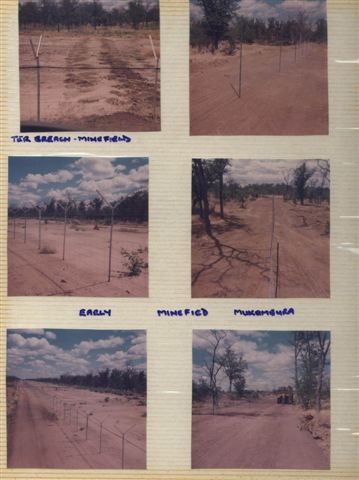
The photos above were provided by Terry. They too show the type of terrain and vegetation of the Cordon at Mukumbura. I must add the terrain was not always as good as what is shown and from my own experience this was as good as it got (so don’t think we had it easy all the time).
Terry also highlighted some non-Cordon defoliation and I felt it was appropriate to include in this post. It makes very interesting reading. Terry takes up the story:
The very first minefield laying etc (again) I was OC of that – starting at Mukambura. Lt Col Horne actually came up with the team I had trained – for a look see.
Tsetse were (as per normal) responsible for erecting fences but we also had plant tp folk with bulldozers and graders clearing all so we had bare earth in and outside the minefield to work on. This was also to prevent gooks taking cover in the bush. At that stage the minefield was approx. 25m wide. In no time I realised this method was an absolute waste of time money etc, etc as we also provided armed protection for the dozer drivers etc way ahead of laying teams. To keep a definitive 25m width etc was patently stupid so I wrote a paper and suggested fences meander to create doubt as to depth of field – albeit still 3 rows – and do NOT clear vegetation as it then aided in camouflaging all. I sent you some pics of the first gook breach and just look at the nice clear earth with fences visible at exactly 25m. Boy did we have a lot to learn – and quickly. This is the only defoliation that I am aware of??
And after I prodded him for more:
Basically I was tasked with doing the defoliation on Chete Island after the gooks wacked the civvy ferry. I called up S Tp from 1 Sqn albeit I was OC Boats at the time and then we sailed plus Tsetse in the Army ferry (Ubique) from Kariba to Chete. Had strike craft as back up and positioned one at each entry to the gorge as it had been declared a frozen area for all craft during the OP. Went ashore (after anchoring on the island – invading enemy territory !! – to clear it of gooks – if any. There were none. Tsetse also provided back up (Jack Kerr plus another) with ,458 rifles in case elephants had a go at us. They did not. After positioning the guys in a defensive role we cleared the area where the gooks had fired from – onto the ferry – which still had much kit lying around from the firing point. Tsetse folk then used a defoliant called Hivar (as I recall) and by hand distributed like it was fertiliser along the entire bank facing the gorge and inland a short way. This would (as it did) clear that sector of all foliage and thereby (hopefully) deny natural cover. After the first rains it was evident all was dying off and it did clear all fairly quickly creating a rather bare scar along that section of the island. Some 10 years later it was still very visible but on my last fishing trip there + – 4 years ago all had now regrown. The gooks never did use the original firing position again.
Looking at this post I realise that although I would have liked to give the reader more on the actual defoliation in Rhodesia, what we have here is real Rhodesian Millitary Engineering history. The accounts by Terry have probably never been recorded in this format before and the photos from Vic still give me goose-bumps, bringing back a part of my history that must be told or it will be gone forever. Thanks to both of them once again for all the help and support they provide to me.
I would like to end this post with a cruel irony:
Perhaps no two people embodied the moral complexities and the agony of Agent Orange more graphically than Adm. Elmo R. Zumwalt Jr. and his son Elmo R. Zumwalt III. Admiral Zumwalt led American naval forces in Vietnam from 1968 to 1970, before he became chief of naval operations. He ordered the spraying of Agent Orange. The son was in Vietnam at about the same time as the father, commanding a Navy patrol boat. Years later, doctors found that he had lymphoma and Hodgkin’s disease. He died in 1988 at 42. His son, Elmo IV, was born with congenital disorders.
Perhaps this post has digressed a bit from the title but it does make for interesting reading I hope.
In the next post we will look at Cordon Sanitaire with electronic alarms.
Copyright
© Mark Richard Craig and Fatfox9’s Blog, 2009-2014. Unauthorised use and/or duplication of this material without express and written permission from this blog’s author and/or owner is strictly prohibited.
Cordon Sanitaire: Scope Of Operations
March 1, 2014
Mukumbura………to any Rhodesian Sapper worth his/her salt the name conjures up Cordon Sanitaire operations. Indeed to most of us this was the Mother of all Rhodesian Cordon Sanitaire operations. However there were other areas where we laid mines, usually along the conventional lines of what I have described previously, but also some in more unconventional ways (will describe these in future posts).
Here is a diagram showing the extent of Cordon Sanitaire operations throughout Rhodesia. It also shows the various operational areas:
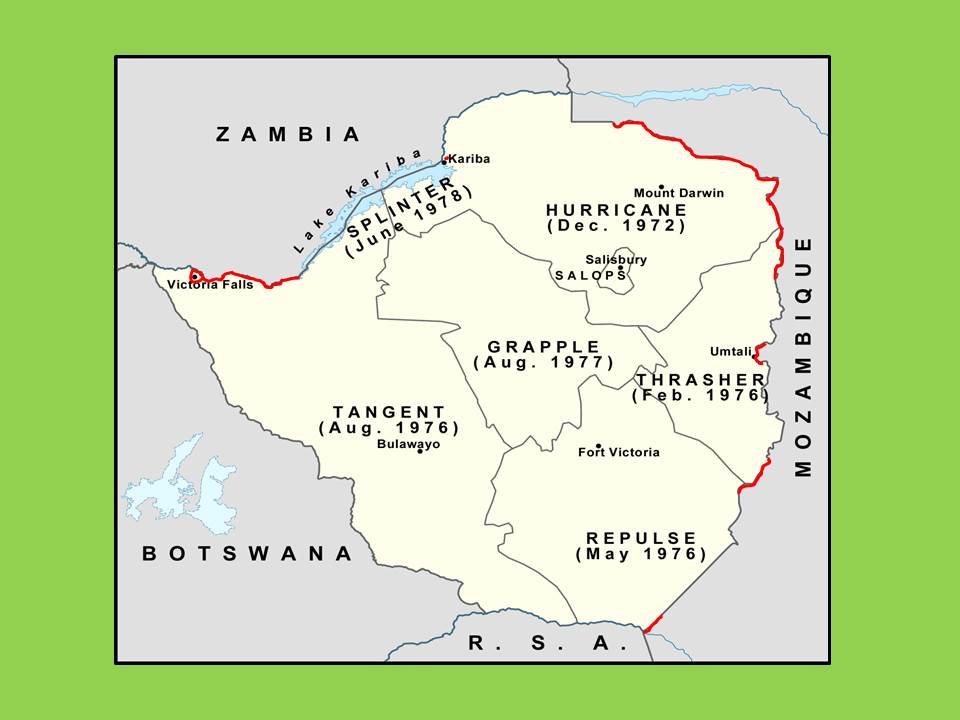
I would like to point out the following:
1. This map is not to scale
2. The information is to the best of my knowledge/memory correct (but fairly accurate and I do not suggest walking on the red bits).
3. Red bits (added by me) denote armed Cordon Sanitaire strips.
4. Base map courtesy of shelf3d.
Known mined areas:
1. 220 kilometers: Victoria Falls to Mlibizi
2. 359 kilometers: Musengetsi to Nyamapanda to Ruwenya
3. 72 kilometers: Junction Gate to Jersey Tea Estate to Muzite Mission
4. 50 kilometers: Stapleford Forest to Umtali
5. 61 kilometers: Malvernia/Villa Salazar to Crooks Corner
6. +-1 kilometer: Kariba Power Station
Not all of the areas above were laid to the same pattern. Some were standard pattern, others double-density, and some contained additional trip-wire operated fragmentation stake-mines. The double-density/trip-wire minefields were the most dangerous for us to work in, especially when carrying out minefield maintenance tasks. I will show diagrams of these variants in future posts to give you a better idea what they looked like and what we were up against.
The above information (Rupiah) is probably reasonably accurate distance wise but definitely does not account for what I will call “other” mined/booby-trapped areas. I know these “other” areas exist because I laid some of them while serving on special operations. My conclusion regarding these “other” areas is therefore that they remain unknown and uncleared.
Please also have a look at my website dedicated to Rhodesian and South African Military Engineers. Please join us on the forums by using the following link:
http://www.sasappers.net/forum/index.php
Copyright
© Mark Richard Craig and Fatfox9’s Blog, 2009-2014. Unauthorized use and/or duplication of this material without express and written permission from this blog’s author and/or owner is strictly prohibited.
Mukumbura: Learning The Ropes: (Part 6)
February 25, 2014
In this post we will discuss two of the dodgiest activities when working on Cordon Sanitaire, namely the Laying and Arming of mines. These are the phases that demand mature and flexible Command and Control, intense Sapper concentration, and a natural grip of situational awareness.
Sappers need to know exactly where they are in the minefield at all times.
A lack of any of these key requirements could and indeed did result in own forces casualties. As I have mentioned in previous posts, landmines cannot differentiate between friend and foe…….if you fucked-up you were going down, literally. Sadly, an accident may not even be the doing of the person killed or injured, and somewhere in the root-cause of these events there is without a doubt also a good dose of plain bad luck.
Group 5: The Laying Party
The Laying Party followed the Digging Party. They were responsible for carrying the mines in some form of container, often a type of back-pack, and placing three mines more or less at the mid-point of the three holes (the Mine Cluster) dug by the Digging Party, but not in the holes. They do not arm the mines. Common sense and safety dictates that the Laying Party were never allowed to overtake the Digging Party. Remember that these mines were already in an advanced state of preparedness (we started the process the previous afternoon if you recall from previous posts) and all that was required to arm them fully would be to remove the safety device which could be a pin removal or perhaps a spin-off plate action, and was dependent on the type of mines we were using at the time.
Once the Laying Party commences placing the mines, WORKING IN ECHELON becomes mandatory for all in the minefield (this is Laying Party and Arming Party specific). No one in Bravo Line will ever overtake anyone in the Charlie Line, and no one in the Alpha Line will ever overtake anyone in the Bravo or Charlie Line. That was the Golden Rule although it was broken on quite a few occasions.
The Rope and Digging Party were way ahead of everyone else and therefore would not be affected by the activities of the Laying and Arming Parties. Indeed, in most cases once the Rope Party and Digging Party were finished for the day they came back and integrated into the Laying or Arming Party, whichever needed them. So we all ended up arming mines every day.
Group 6: The Arming Party
The Arming Party arm the mines. They have one of the most dangerous tasks during mine-laying operations. Movement of the Arming Party is strictly controlled by an NCO or switched-on Sapper. Lets assume the primary safety device on the mines is a removable safety clip, and that operations are moving from left to right. This was the sequence of events when arming mines:
1. Arming Party (+-8 Sappers) dress up to the line of clusters. Remember the rope is gone so all you have are the holes to guide your positioning.
2. Arming Party ensures that there are no large clumps of soil present. If there are these are carefully broken up prior to arming commencing.
Note: At this time the Arming Party will also straighten any bent safety pins to ensure they are easy to remove when arming takes place. Depending on the type of mine being used this may also be the time that booster charges are inserted. Booster charges are used to increase the shock-wave that propagates the main charge detonation.
3. Person in control instructs Arming Party to place mines in holes but not to arm them.
4. Person in control authorises mine in 9 o’clock position hole to be armed and covered. Arming Party move to correct mine position, crouch or kneel, remove safety device and carefully cover the mine. Arming Party dress back to original position and await further instructions. Crouching is to be discouraged as if one loses ones balance, Murphy’s Law says you will probably land on an armed mine.
5. Person in control authorises mine in 12 o’clock position hole to be armed and covered. Mine armed and covered as in paragraph 4.
6. Person in control authorises mine in 3 o’clock position hole to be armed and covered. Mine armed and covered as in paragraph 4.
7. Arming Party dresses back from the clusters and awaits further instructions.
8. Person in control authorises movement to next mine clusters. The person furthest to the left steps back and walks behind all the arming personnel on his right and dresses onto the next available mine cluster. He waits there until the Arming Party has dressed onto new mine clusters.
9. Person in control commences arming sequence. This continues until all clusters are completed for the day. Bravo and Alpha Lines, working in echelon carry out the same process.
Here is a diagram of the personnel movement. This is very important and I know of at least one Sapper who lost his leg by moving in front of and not behind Arming Party Sappers to his right.
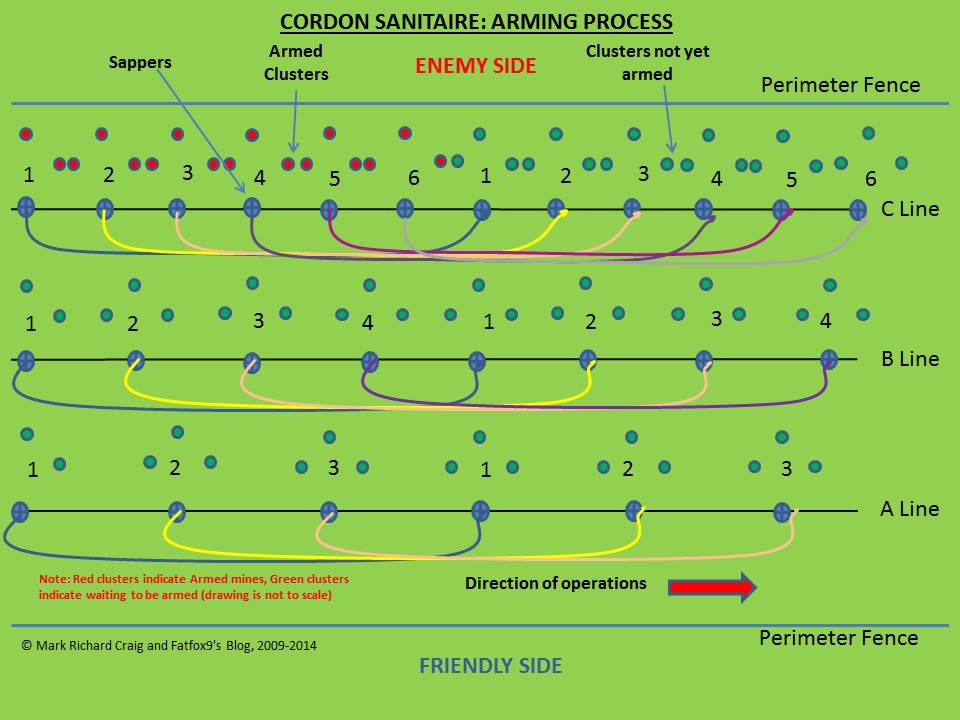
I hope the above diagram makes sense. Just to clarify:
Sapper 1 moves to the next number 1 position, Sapper 2 to the next number 2 position and so on for the rest of the Sappers. Movement is always routed behind the person to your right. No one moves until the Sapper on his left has moved to his new cluster. All lines must work in Echelon. This diagram makes it easy to understand why. There must always be safe ground behind the Bravo and Charlie Line Arming Party so personnel can escape in the case of an attack. As mentioned previously in the event of an attack from the friendly side we were in the crap as we would probably need to escape over armed clusters.
As all of these activities from pulling out the ropes to arming the mines were all taking place concurrently it then becomes clear that this was a very dangerous piece of real estate if you did not know what you were doing. I do not need to convince anyone that this was a hazardous activity.
Sadly, the statistics have already proved this.
This post will be the final part of the Mukumbura: (Learning The Ropes) series. It has been an interesting and nostalgic journey for me to relive those early days of my military career and I hope that it has not become too monotonous. From here on I will be posting my memories of different events as they come to mind and these will be in no particular order although I will continue to keep my Rhodesian and South African campaigns separate. I hope you continue to enjoy my ramblings.
Again, I ask anyone who reads my posts to flag-up any incident they were also part of and if I have erred in my recollections in some way please do not hesitate to help me put the record straight. It is not easy to do something like this on your own and especially when you have no written record of events, nor access to official documents.
Copyright
© Mark Richard Craig and Fatfox9’s Blog, 2009-2014. Unauthorised use and/or duplication of this material without express and written permission from this blog’s author and/or owner is strictly prohibited.
Mukumbura: Learning The Ropes (Part 5)
February 18, 2014
Group 3: Rope Party
The Rope Party were the next group to start work in the morning and followed the Protection Party. They carried spools of nylon cord which were more or less 50 meters long. We had three of these spools, one for each of the three lines to be worked (A, B, C) or Alpha, Bravo, and Charlie Lines. If you read previous posts you will understand this better.
Each rope had a different number of knots tied into them as follows:
Alpha Line Rope: 1 knot every 3 meters
Bravo Line Rope: 1 knot every 2 meters
Charlie Line Rope: 1 knot ever 1 meters
From this you can do the rough maths for 1,000 meters if you work on 3 mines per knot. Works out to about 5,500 mines. We normally laid about 3,000 mines per day. Of course if you were a badly resourced crew you would find extra knots in the rope as a result of breaks and joins and this could make things dodgy and confusing on the ground.
Some minefields worked on double-density cluster layouts plus other nasty devices but they are completely other animals and I will discuss these at a later time. These types of minefield hurt many of our boys and were treacherous, sinister places to work.
For the purpose of this blog I have made the line nearest the enemy Line C and work always started on this line first in the morning so if you were an idle wanker you made sure you got into the A Line. This meant you had about 20 additional minutes to smoke and talk crap to your mates before you started work. The fact that you would have to work that time in at the end of the day after the B and C Lines were finished did not make an iota of difference to the devious Sapper brain. In all honesty the Echelon Method of working did not begin to really matter until the laying party started to work in the Charlie Line, and the Rope Parties could quite safely work on all three Lines at the same time without any danger to personnel.
After the dannert coil had been removed from the minefield, the Rope Party hooked up their rope to the metal picket left in the ground the day before as the start point, and began walking the line off the spool for the next 50 metres. They would then put a small metal pin in the ground, hook the line onto it and continue for another 50 metres. This they continued doing until they had pulled the line out enough times to achieve the days laying objective. All three lines carried out this action.
At this point it is extremely important to note that there will be live mines adjacent to the initial start point of the day (the last clusters from the previous days work), and there would always be an NCO or switched on Sapper controlling these start-up activities. A foot out of place here or a moments inattention could be very tragic indeed and fuck everyones whole day up. And yes, it did happen.
Group 4: Digging Party
From the number of knots shown above you can see the 3 Lines had 3 different densities of mines. At each knot a mine “cluster” was dug. A “cluster” consisted of 3 holes dug with a badza (a type of hoe), one at 12 o’clock, one at 3 o’clock, and one at 9 o’clock. I do not want to go deeply into the science of number of “mines per meter front” at this stage but you can see that by adjusting the number of knots on each Line, the probabability of standing on a mine within any given meter of the minefield frontage can increase or decrease. Simple Sapper Stuff.
It therefore goes without saying that the next group into the minefield was the Digging Party.
Here is a badza. They caused bad blisters to hands not wearing gloves. I know, I dug, I had blisters. Many of them. Our medics took much glee in injecting merthiolate into them. Ours were a bit more modern but you get the idea (theswift.org):

Here is a bottle of Merthiolate……it burns like shit when injected into a blister caused by a badza. This bottle looks like it just came out of a medics bag (flickr):

Here is a diagram showing mine clusters and the Rope and Digging Parties:

If this looks confusing to you just remember we had to work in here and at this time there are not even any live mines on the diagram!
The Digging Party had to start immediately after the Rope Party and actually chased them. The Rope Party could not move on to the next 50 meter run before the Digging Party had dug the last cluster of the current run or they would not know where to dig. Again digging parties could work on all three Lines at once but very soon the importance of the Echelon Method will be seen very clearly. The Digging Party were also responsible for breaking-up any clumps of soil excavated as well as remove any rocks. Clumps of soils and rocks/stones were not very useful when covering armed mines. A very good friend of mine, Charlie McQuillan, was badly injured when a large clump of soild soil contacted the ignitor of a mine he had just armed. A sad day indeed but thankfully he lived to tell the tale.
Thats it for today. In the next post we will talk about the Laying and Arming Parties. Many people think they are one and the same but they are not.
Copyright
© Mark Richard Craig and Fatfox9’s Blog, 2009-2014. Unauthorized use and/or duplication of this material without express and written permission from this blog’s author and/or owner is strictly prohibited.
Mukumbura: Learning The Ropes (Part 4)
February 4, 2014
In this post we will start to have a look at how the Cordon Sanitaire teams operated within (and outside) the minefield boundary. With the amount of mines being laid each day (+-3,000), the loss of concentration due to fatigue, and poor discipline or procedures could be disastrous and indeed fatal. Sadly we have ample evidence of this in our Roll Of Honour and also by the number of our colleagues that lost limbs and their eyesight, although there are other reasons for accidents such as dodgy mines/mchanisms and equipment.
Cordon Sanitaire Work Groups
Group 1: Protection Party
The Protection Party normally consisted of Rhodesian Defence Regiment (RDR) personnel. This unit was, in the majority, manned by Coloured and Asian troops. It was formed with the intention of using their personnel to protect bridges, camps and other infrastructure. They deployed with us on many occasions as our perimeter force protection component. These were interesting individuals, had their own slang (which many of us picked up), and often had a good supply of contraband items, especially exotic tobaccos, the aroma of which could often be smelt wafting through our camp lines. Please see the previous post for more information on this unit.
After we had checked the area for booby-traps the Protection Party would deploy across the safe area of the Cordon, jump over the enemy side fence and melt away into the bush. There they would lurk, looking for gooks who might try and attack us while we were laying mines. Coming under enemy fire is bad enough under “normal” circumstances but inside a live minefield it is disastrous. There is nowhere to take cover as the vegetation is sparse and there would be mass casualties without a doubt. We had no defence as we never carried our weapons while laying mines in case they fell and detonated a mine. Additionally it would not be comfortable working with a rifle slung over your shoulder and would have been a recipe for accidents. Having said that the command and control personnel working inside the minefield with us were armed and would do their best to direct and cover us in the case of an attack.
The Protection Party were also deployed on the friendly side in case of an attack from behind. If this happened we were in deep shit.
Group 2: Echelon Support Vehicles
Our Echelon Support Vehicles normally consisted of Bedford RL’s, Rodef 25, 45, and 75 Mercedes Benz clones. The Rodef 25 was actually a Unimog with a dodgy sanctions-busting name. No one was fooled though. Here is a Rodef 25 (newrhodesianforum):

And a Bedford RL in rather smart condition:

Later vehicles were like these MAP’s but I never saw them at Mukumbura:


These vehicles would follow us down the access road as we progressed and carried our mines, water, food, tools and other bits and pieces we needed to do our job. Our medic was also part of this echelon and excellent blokes they were too. Some legends amongst them and they will get a mention in future posts. Needless to say they were highly trained and knew the business. Radio communications for casevac purposes were also checked before work commenced and maintained by the echelon during laying operations.
The Tsetse Fly Officer (see previous posts) and his crew normally formed part of our support echelon personnel too.
Here is a typical Cordon Sanitaire access road running next to the perimeter fence (Terry Griffin):

I would like to talk about “working in echelon” at this point. Working in echelon was a very important principle which we applied when working in the minefield. This principle ensured that at no time was anyone working ahead of fully armed mines. This is why we always started activities on the Charlie Line, second to start would be Bravo Line, and lastly the Alpha Line. No activity ever overtook a similar activity on a line that was to your front. The diagram below demonstrates the principle:
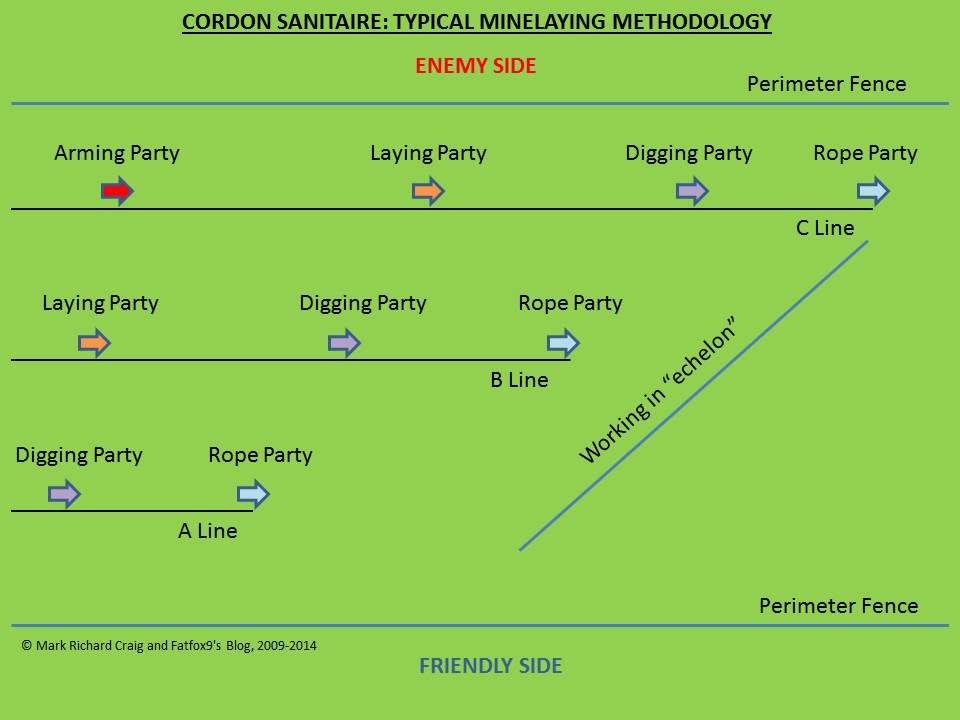
As you can see the Charlie Line is ahead of the Bravo Line and the Alpha Line behind the Bravo Line and Charlie Line. Crucially an Arming Party shall NEVER overtake personnel to their front. In the event of an attack from the Enemy side, our personnel could safely exfiltrate the minefield by moving directly and straight back toward the friendly fence.
We will discuss the remaining minefield parties in the next post.
© Mark Richard Craig and Fatfox9’s Blog, 2009-2014. Unauthorized use and/or duplication of this material without express and written permission from this blog’s author and/or owner is strictly prohibited.
Mukumbura: Learning The Ropes (Part 3)
January 30, 2014
Figure 1 in the previous post clearly shows we had three distinct working Rows, namely Row A, Row B and Row C. Row C was always on the enemy side and Row A on the friendly (or home) side. Row B by default was the neutral (middle) line and located more or less equidistant from Row A and Row C
Working Row Methodology (I need to start at the end of the working day to make this easier):
At the end of each working day Dannert Coils (also known as concertina wire) were pulled across the entire width of the minefield, just outside the mined area. In addition to this a small steel pin was driven into the ground at the point where the pulling parties would attach their ropes the next day as their start points. There would be three of these, one for each Row. This more than anything else was to let us know where the boundary between safe (no mines laid) and dangerous ground (mines laid and armed) was. A very simple procedure that made things very clear on the ground. Remember that we had no GPS units in those days so a physical feature on the ground was very useful when using traditional navigation methods.
Here is a picture of Dannert Coils being emplaced (not on the Cordon and for clarification purposes only). A really unpleasant job when they get old and lose their shape. We used a single layer of Dannert Coils. Shown below is a triple concertina fence that will be used as a Field Obstacle.

In Figure 2 below you can see where the Dannert Coil was placed at the end of the working day. I know this does not look very neat but you get the idea and in fact some of our Dannert Coils were in such poor shape they actually looked very similar:
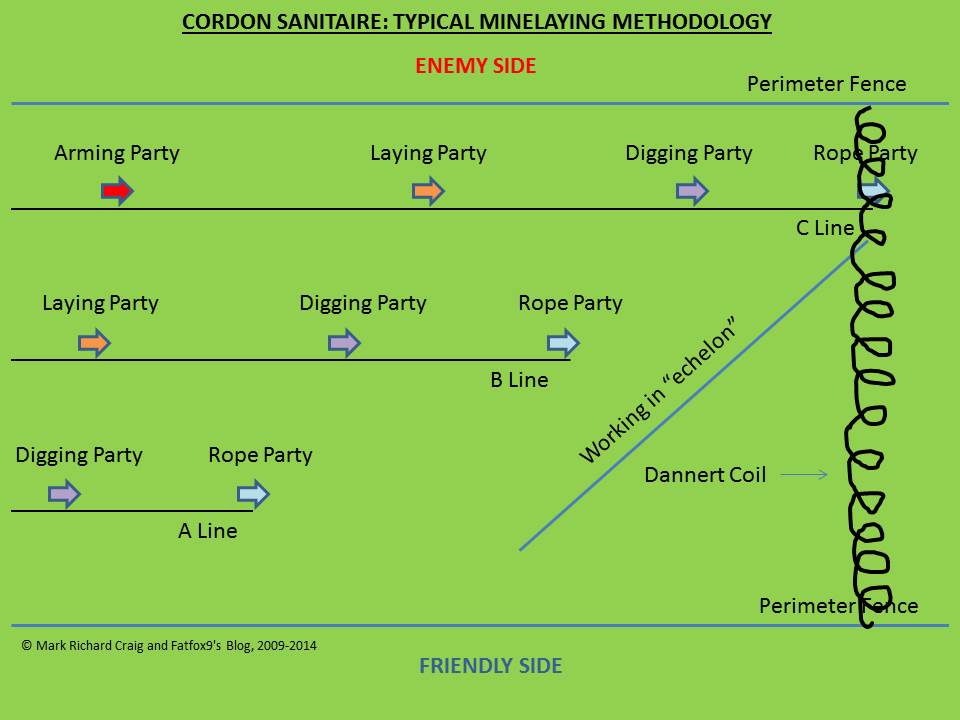
FIGURE 2
Morning Routine:
On arrival at the minefield the first thing to be done was to identify the safe working area and ensure nothing had been tampered with overnight. I always wondered why the gooks never booby-trapped our Dannert Coils or planted mines where they must have known we would be starting work. Perhaps they did in some other areas but I never heard of it. I know if I was a gook I would have had a go at that. In any case we had to be vigilant each morning.
Other things we needed to be switched on for each morning were the following:
- Our access roads were a prime target for the gooks and I do know that some of our convoys were hit by vehicle mines on a number of occasions whilst en-route to the Cordon.
- Wash-Outs: These were mines laid by us in the cordon that wash-out of the minefield boundary fence during heavy rain or flash-flooding. They would then often end up on the road we would be driving down and by default debussing on. This was a particularly dangerous issue for us and a number of our men were seriously injured as a result of wash-outs.
- Booby-traps on the perimeter fences or mines laid in areas where we would access the minefield. Unfortunately we once again had people seriously injured by these cunning gook contrivances.
Activities Inside The Minefield
In the next post we will look at how the mines were positioned and armed, and some of the different mine types we used.
 Fatfox9's Blog