Piss Poor Planning: The Debacle of Nyahuku (Part 2)
March 7, 2026
The journey to Salisbury was fairly uneventful, and except for the occasional stop for the customary pee, smoke and leg stretch, we arrived in good time and still in daylight.
Reporting to the 2 Squadron HQ, where we were expecting a hero’s welcome and friendly smiles turned out to be a pretty poor assumption and was far from reality. No one seemed to have a clue why we were there and evidently we should have pushed all the way through to Mtoko without a stop in Salisbury. This was light years from the instructions given to us in Bulawayo, and it was pretty clear it was another of those military blunders – sadly this was just the first example of many to come on this mission.
We were not keen to travel through to Mtoko immediately, and in any case we would not be allowed to as it would be breaking the curfew if we did, so it would be a night stop sleeping under our vehicles and the stars as there was no accommodation arranged either. This by default also meant no catering arrangements either. I asked that a message be sent to 1 Squadron, informing them of the situation and apparent miscommunication. This of course to cover my arse.
We were given permission to park our trucks on a piece of open ground for the night. After collecting money from the crew we sent a couple of lads with the Unimog to buy beers at the canteen, and cokes for the teetotalers. It was going to be ratpack stew for supper. At least we could have a few drinks and shoot the shit before climbing into our sleeping bags – life was as good as we could make it within our cohort. I fell asleep looking at the stars.
Early the next morning we cleaned up the area, washed and shaved using the taps on our water bowser. I then sent the drivers to fill our vehicles at the Petrol, Oil and Lubricants (POL) point, while one of the sergeants and I paid a visit to the Squadron HQ once again. I recognised one of the junior officers and asked if we could have a word. According to him, he knew we were on the move to Mtoko, but there was never a plan for us to night stop in Salisbury, which I found very strange indeed, considering we would not have enough daylight to get from Bulawayo to Mtoko in a single day without breaking curfew. I considered this and as it was a lovely sunny day, decided that it was just one of those things. He added that the 2 Squadron contingent had left for Mtoko at the same time we left Bulawayo – so they were already there waiting for us, and had already been informed by radio of the change in plan, and that we would be arriving later today.
Our next dilemma was rations. We had only drawn 2 ratpacks each at Brady Barracks and therefore already breaking into our second and last one. Should we encounter any further delays on the way to Mtoko, we would be in a bit of a fix, food-wise. I asked the officer if we could be issued a further 2 packs per man and to my surprise he told me all of our rations were with the 2 Squadron contingent and there was nothing available for us in Salisbury. No use arguing, but the plan was continuing to unravel. If you want to mess with troop moral, take away a soldiers food and pay.
By now our vehicles had refueled and were parked-up close to the Squadron HQ, waiting for the sergeant and I to join them. As we were leaving the HQ, the Squadron Sergeant Major, who I also knew approached me and asked what those waster 1 Squadron vehicles and troops were doing in his lines. I explained the situation we were in and he immediately got very pissed off, not with me but rather the 2 Squadron HQ in general. He berated them for not providing us decent accommodation and a warm meal on arrival and insisted that rations be issued to us for our journey to Mtoko. Whoever his ire was aimed at I do not know, but there was much activity while arrangements were made for us to collect additional rations for the journey. At least there was someone who understood where the fault lay and done his best to make things right. He directed us to the QM store where we were issued what was known as tinned equivalent, not rat packs per se, but rather bulk rations in big cardboard boxes containing larger tins and other bits and pieces that we could share between us when the time came.
Everyone loves a Sergeant Major – and normally avoids pissing them off.
After thanking him for bringing some inter-squadron cooperation to an otherwise hard start to the day, we mounted the trucks and got on our way to Mtoko.
The 140-odd kilometer journey would take around 3 hours – but this was a dangerous route where high vigilance was required. To add context, attacks on this road were frequent, characterised by gook ambushes, minelaying, and infiltration attempts, crucially as the enemy had established so called “liberated zones” in the Mtoko area.
The gooks knew that if they could dominate this road, they would be successful in disrupting Rhodesian Security Force logistics.
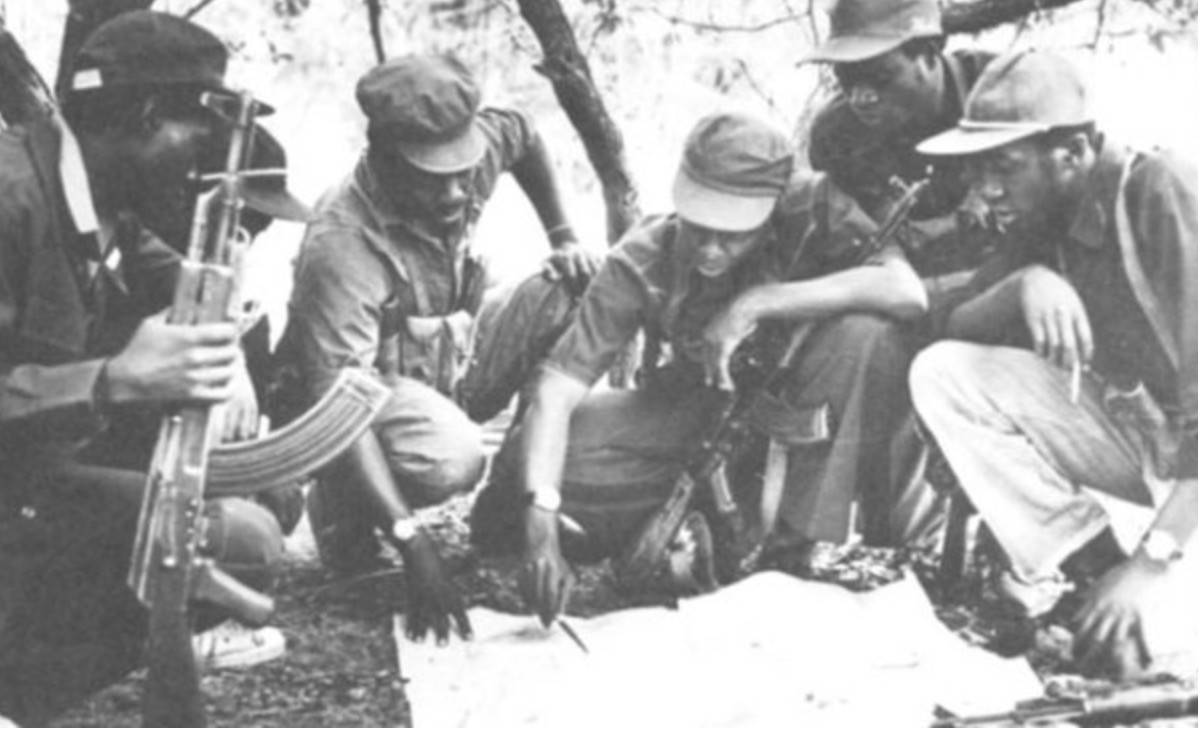
Above: ZANLA CTs making a plan – Owner unknown but I do acknowledge that this is not my media
And we were going to be travelling right through the Zimbabwe African National Liberation Army (ZANLA) hunting grounds.
Would we make it through unscathed? Part 3 will tell.
Copyright
© Mark Richard Craig and Fatfox9’s Blog, 2009-2026. Unauthorised use and/or duplication of this material without express and written permission from this blog’s author and/or owner is strictly prohibited.
Piss Poor Planning: The Debacle of Nyahuku (Part 1)
February 28, 2026
As a member of the Regular army within the Rhodesian Corps of Engineers, it was not unusual to be redeployed to different operational areas to assist where additional manpower or specialist military engineering expertise was required. If you were in-between missions, and idling around at Squadron HQ in Bulawayo (Brady Barracks), you were a prime target for any dodgy task that might be dreamt up by the upper echelons.
The following posts recount one of those occasions.
I was in the Squadron admin office doing my best to look busy, operating the Gestetner machine, rolling off precis for the next intake of recruits from Llewellin Barracks – they would have just finished their basic training, and been selected for Engineers.
There was much to prepare for their arrival, and to be honest I was not into this arranging barracks rooms, stapling A4 sheets together and arranging bed-linen lark – luckily I was about to snivel out of it – although I would have been much better off staying and helping with the incoming Gobbies1.
Someone shouted my name from one of the offices in the HQ. I recognised the voice – it was Staff Sergeant Vic Hydes and he was someone you never kept waiting and I quickly doubled-away to see what he wanted. Vic was often referred to as “Little Hitler”, and it was for a good reason – he was the bloke that had made me swim from one end of Umzingwane Dam, to the other – at night. For more on these aquatic activities please follow this link: https://fatfox9.net/2010/05/22/mzingwane-dam-part-1-combat-engineer-practical-training-phase/.
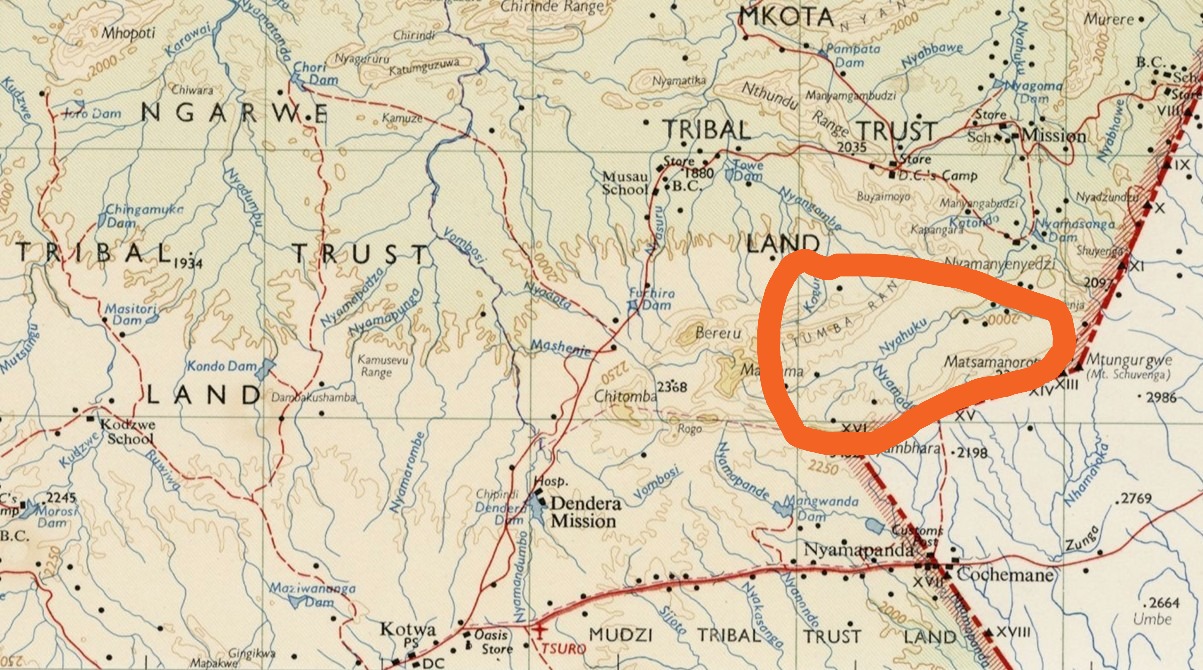
Vic briefed me, although with the little he knew himself, I was only marginally wiser after leaving his office. The short of it was that hot intelligence (laughing my head off) had been received (laughing again) that a large group of gooks2 were planning to cross into Rhodesia somewhere along a 30 kilometer stretch of the border with Mozambique in an area of East Mashonaland within the next two to three weeks. The general location of the suspected crossing point was within an area known as Nyahuku, and is shown below in the orange circle:
During the day more information came to light and I learnt that we had been tasked, together with elements of 2 Engineer Squadron from Salisbury, to lay a rapid barrier minefield (Cordon Sanitaire pattern – see https://fatfox9.wordpress.com/wp-admin/post.php?post=491&action=edit) to block the suspected enemy line of advance where it would cross the Mozambique/Rhodesian border, and kill them.
Due to the geographic location of the target area, 2 Engineer Squadron would be calling the shots on this one, with overall command, control, administrative and logistic responsibility. 1 Engineer Squadron was only providing personnel.
1 Engineer Squadron would mobilise approximately 30 Territorial Force and National Service Field Troop (NSFT) personnel for this mission and they were due to arrive at Brady Barracks in drips and drabs over the next 48 hours. In the meantime I would be working to get 3 troop carrying vehicles prepped for the 650 kilometer journey that lay ahead of us. Nyahuku was a world away from Bulawayo and it was going to be a monster of a drive of 10 to 15 hours, not including stops. Our route would take us through Salisbury where we would night stop and join the 2 Squadron personnel, and then on to Mtoko the next day. Joint Operations Center (JOC) Mtoko, was a key fire-force and intelligence hub within the Operation Hurricane area, and we would take our last stop there before making the final leg to Nyahuku via Kotwa.
Over the next few days I cobbled together 1 x Unimog 25, and 2 x Rodef 45s for the force that would deploy with me. These were reliable Mercedes-based vehicles and I was pleased that we had these three available for us to use, as we would also be towing a full water bowser and fuel bowser.
On the night before we were due to depart we had a good session in the pub, the usual banter between Regulars, Territorials and National Servicemen continued well into the night. Most of us knew one another – we were a small band of brothers, highly experienced in our craft and more than capable of carrying out the task ahead.
The last thing to be done on the morning we left was to test our TR48 radio for comms with 1 Engineer Squadron ops room, plus inter vehicle comms with A76’s, draw our weapons,/ammunition, and 48 hours of rations per man – 2 rat-packs each.
With vehicles full of fuel and final trips made to empty bladders, we fired the Mercedes engines up, and were on our way before noon, most of the passengers dozing-off before we hit the road to Salisbury.
Salisbury would prove to be where things started going wrong at pace.
More to follow in Part 2
Sleeping Snakes and the Whistling Sapper
September 22, 2025
I mentioned in previous posts that the Engineers were often utilised in the Infantry role, or at the very least expected to carry out what are customarily Infantry tasks. There was no operational or tactical issue with this concept as all Rhodesian soldiers, regardless of any additional Corps affiliation, were also Infantiers – the fundamentals of these skills being taught during basic training. The Rhodesian Corps of Engineers were Combat Engineers in the true sense of the word, trained to take on the enemy in face-to-face combat, and also carry out a wide variety of Military Engineering tasks. The account that follows is one of these times and is vividly burnt into my brain……despite an ever-fading memory of an event that took place over 50 years ago.
Early that morning I had just finished a sickly sweet condensed milk coffee and going through the guard commanders evening occurrence book in the ops room when I heard a vehicle pull up. I stepped outside to see who our visitors were, recognising the doorless dark green Land Rover straight away as a British South Africa Police (BSAP) vehicle from Wankie. The two occupants were already standing next to the vehicle, both in civilian dress. I knew both of them – one was a BSAP Special Branch (SB) officer, the other was my Engineer OC from our Wankie (4 Indep Coy) office. After the usual greetings and inter-service banter I invited the two of them over to my office, ordering a jug of more sickly sweet coffee and mugs as we went.
The SB officer got straight into explaining the reason for their early and unannounced visit, informing me that I had been allocated a special task that was time-sensitive. My boss-man was there to add context to the briefing during which he confirmed that the operation had been authorised by 1 Squadron HQ in Bulawayo.
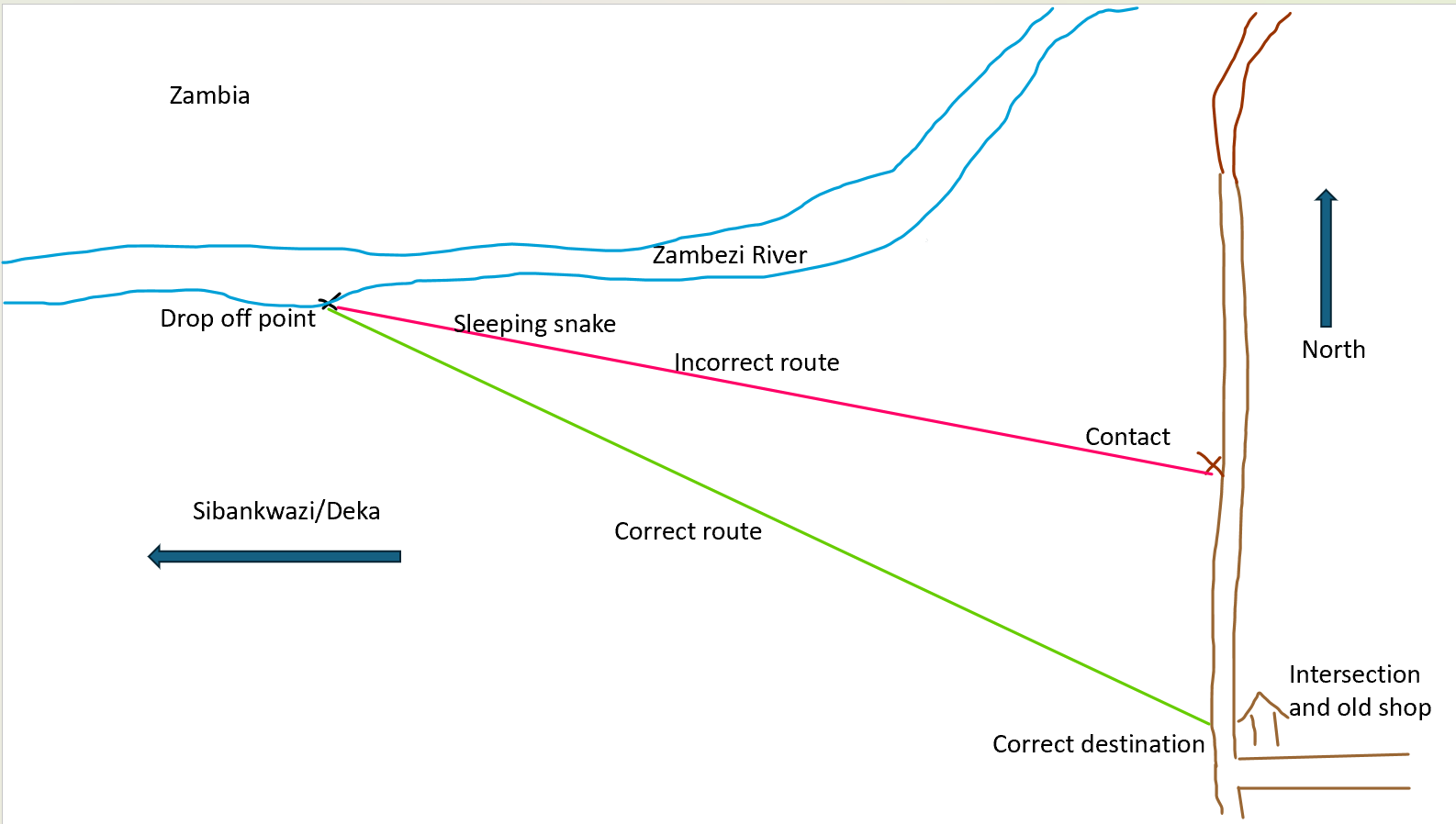
The mission was straightforward enough. “Hot”1 intelligence (I had to resist rolling my eyes – as I had been down that road before) had been received that a group of terrorists were going to be using a certain road intersection as a navigation point – a well-known terrorist method of moving from point A to B without getting lost or disoriented. They were expected to be at this point within a fairly short space of time – from what was known, within the next 24 hours. I was to lead a reinforced “stick”2 of 8 Combat Engineers to set up an ambush position adjacent to the said road intersection, and hopefully make contact with the enemy. The road that we would initiate the ambush on ran along a fence line from north to south, the intersecting road running east to west off of this at a very neat 90 degrees. There used to be a small general store at the intersection, but this was now derelict and in ruins. This feature should make it easy to confirm that we were in the right place.
Lastly I was ordered not to cross the fence under any circumstances – we were to stay on the western side of the road. No reason was given but I assumed this to mean we may have pseudo units in the area.
The tricky part was going to be getting there in time. We were going to be deployed by a BSAP patrol boat as the planners figured that this would be the quickest way, seeing that there were no Cyclone 7’s (Alouettes) to troop us in – they had other commitments. There would however be one Gunship on stand-by at Wankie Forward Air Field 1 (FAF 1) in case of a Casevac requirement.
Once we had confirmed callsigns, map numbers, grid references and the proposed route to the target area, our two visitors left, travelling the short distance down to the BSAP post at Sibankwazi to arrange the boats that would deploy us to our drop-off point along the river.
We had an hour or so to prepare before we too would travel down to Sibankwazi, and wasting no time I summoned the two Corporals whose sections would take part in the mission, and after briefing them, ordered them to ensure their men would be ready to move within the hour. Rations, water, weapons and ammunition needed to be inspected – radios checked and extra batteries drawn from the signaler. The chef was given instructions to make an early lunch for the troops going out with me – this would ensure we would all have full tummies before we moved out and sustain us until late afternoon.
With all preparations complete, I issued last orders to my second in command and we embussed onto an idling Rodef 45 Troop Carrying Vehicle (TCV). Handing my weapon and kit up to one of my troops, I hauled myself over the side of the vehicle and settled into one of the seats. My second in-command was standing next to the vehicle and I looked down at him – he was a good lad and would look after the camp while I was away – he was destined to become one of the first Black officers in the Rhodesian Corps of Engineers, and decorated with the Bronze Cross of Rhodesia.
The journey to Sibankwazi took no more than 30 minutes and we travelled down in silence, each of us thinking of the task ahead. We debussed on arrival and the troops moved the kit down to the jetty where the police launches were moored – the vehicle that dropped us off doing a three-point turn and returning to Deka camp. I asked one of the Corporals to carry out a radio check with our TR48 HF radio and confirm comms with both Deka camp and our Wankie HQ.
There was time for a quick brief with the Sibankwazi Member in Charge, a great friend of mine to this day, and we walked down to the boats together – he would skipper one of the boats out. I remember her callsign was Papa 5, she was a beautiful cruciform-hulled craft, painted white and light blue. We split my team between the two boats – the two skippers setting the trim, and we shoved off, travelling east down the Zambezi River.
Having made a time and distance appreciation while still at Deka camp, I had decided that we would be dropped off at a suitable point along Devils Gorge, approximately 20-30 kilometers east of Sibankwazi. The trip out was pleasant and the river calm and peaceful. By stretching the imagination, one could even believe that we were on a pleasure cruise, except we knew where we were. And always we had to remember that Zambia, home to our ZIPRA enemies was just a stones throw away off our port side – we had probably been observed through a pair of high-quality Russian binoculars or a Dragunov3 telescopic sight from the moment we had shoved off the jetty.
I was looking for a good place to be dropped off, the Devils Gorge towering high above us. It would be a hard climb to the top and I wanted to find the easiest access route up for us. I found what I hoped was the best place, a disused (hopefully) elephant trail that led from the river up to the top of the gorge. Elephants are pretty good at crushing everything that got in their way and they made wide super- highways down to the edge of the river from the top of the gorge – these for them to quench their thirst in the sweltering Zambezi Valley . In theory this should make our haul up the gorge much easier than hacking our way through virgin bush. The boats moved into the cleared space sideways on and we jumped onto the river bank, one by one. Before the boats departed I double checked my location on the map with our skipper and we both agreed on my current position. He would send the coordinates of our drop-off point back to Wankie HQ when he got back to Sibankwazi.
As the two boats disappeared from view we began the climb up and out of the gorge. Elephant are intelligent creatures and therefore clever enough to choose the shortest route up and down, meaning it didn’t take all that long to get to the top. Initially our progress was hindered by lack of grip as our boots slid and slipped on the crushed and slippery, elephant-crushed reeds close to the river but as we got higher it became easier and the super-highway was kinder to us. We eventually all made it out of the gorge safely in what I felt was reasonable time. Just off the crest, we went into all-round defence and I gave the stick a 15 minute rest. I would use this time to do some map work – check the grid bearing to the target on the map, and set my compass, making the necessary adjustments for magnetic declination.
Before leaving our rest area we all checked our kit for for rattles and loose items. We needed to sort these details out now as one thing that was a dead giveaway to the enemy was the sound of a stick moving through the bush like a bunch of church bell-ringers on a Sunday. With one look back towards the mighty Zambezi, I stepped the men off, heading south-east. I had calculated we would need to travel roughly 12 kilometers to the target area – and keeping a steady patrol speed of around 3 kilometers per hour we could be close to our destination in 4 or so hours, including stops. This would bring us to where we wanted to be just before last light – our chosen killing ground.
If climbing out of the gorge was reasonably easy, descending the other side was even easier as we still had the benefit of the jumbo super-highway and now we were going downhill……..some slips and slides along the way but we all arrived on the escarpment floor unscathed. I was happy to note that the men’s kit was nice and quiet, even when making sudden movements – the MAG gunner had done his very best to keep his ammo belts behaving themselves as well. As we reached flat ground, I got the men into extended line, and double checking the direction we were heading, gave the signal to move out.
We had been on the move for about 30 minutes when I noticed a rather large fallen log on the ground that I needed to step over. As I placed one foot on the other side of the log I looked down more closely to ensure I didn’t stumble and almost pissed in my pants. The “log” was actually one of the biggest pythons that I have ever seen – just lying there in the sun and minding its own business, its silvery-grey and black scales shining in the sun. I got my other foot over the sleeping snake, making sure not to touch this magnificent creature, and moved off quickly, leaving it to continue snoozing. I assumed the snake had recently had a big meal as it had no interest in me at all, and its quite true that if you avoid annoying them they will leave you alone. Fortunately my troops were blissfully unaware of the python, as had they seen it there would have been much shouting and running about – possibly bringing an unwelcome reaction from our sleepy friend.
Having walked for an hour we took a short break and carried out a radio check with the TR48 – all good and we marched on. I wanted to pace our advance to allow us to be within 1 kilometer of the road intersection just before last light – moving in only after we had had something to eat and a warm drink some distance beforehand. We also had to assume that the bad guys may have already crossed the road and were on our side of the road – alert levels were high, as with any patrol and we needed to keep our eyes and ears well tuned, or we could be going home in body bags.
I managed to get the timing just the way I wanted it – last light about 30 minutes away and we could see the north-south road just up ahead. If my map-reading was accurate the intersection and ruined shop should be just south of us. I got the troops into the prone position and I moved slowly forward on my own to confirm our position was correct. Leopard crawling through the long grass I edged towards the road until I was on the verge. I needed to be able to look both ways up and down the road which I managed to do – but there was no intersection and there was no old shop. I quickly checked my map after moving back from the road – I couldn’t make out where I had gone wrong. My problem now was working out which side of the intersection we were. Should we move south or north to locate it? With the sun now disappearing fast there was no time to waste and I decided to move a little more to the south. Getting the troops moving again we proceed until it would be not be in our interest to continue any further. I checked for the intersection and old shop again but there was nothing. It would appear my map reading skills were rubbish. I made the decision to set our ambush where we were and bite the bullet if we missed the gooks – the only consolation I had was maybe the intelligence was wrong in any case.
It was almost dark before we had finished our preparations and I was happy with our position. I had decided on a spot about 30 meters from the road with good visibility – we settled down for the long wait, the MAG gunner next to me – he would initiate the ambush on my command.
It was indeed a long night, taking turns to catch some much needed sleep we waited, and waited. My concern was that we we were nowhere near our intended position and we were simply wasting our time. Ones mind plays games in the bush at night – rustling in the undergrowth, owls calling and a myriad of animal sounds all around. Someone snored and was quickly silenced with a whispered curse – and the hours ticked by, seeming like days.
We were all awake before first light and this was a critical time – nothing had happened overnight and we could easily be drawn into a false sense of security. It was deathly quiet – nothing moved.
We all heard it at the same time – someone talking in African dialect, accompanied by the sound of people moving. I strained my eyes in the dim light, squinting through the wet grass- all of us now on full alert, adrenalin pumping. And then, incredulously, there was man standing on the opposite side of the fence that ran alongside the road – right in front of us. I couldn’t quite make out who he was as he started to climb over the fence. More of them followed – my brain began making a million calculations as doubt set in. We were out of position and what were the chances that the terrorists had made the same miscalculation and were now right in front of us? For some unknown reason I whistled at them and it was then that I saw the tell-tale AK magazine and gave my gunner the order to open fire.
All hell broke loose as my stick began firing towards the enemy……..screaming coming from their direction but no return fire as they scrambled back over the fence and started running – discarding equipment on the way. We started to move forward to the road, but the gooks had disappeared into thick bush and we took up the chase, cautious in case they laid an ambush on their tracks. There was blood on the ground and in the grass, enemy kit strewn about. We would collect it later – no kills for now, but at least we knew we had caused these guys some pain and seriously fucked-up their day.
I decided to get the stick into a defensive position while we radioed the contact into Wankie HQ – in reality this probably only a few minutes after we first opened fire. By chance, there was a Copper (Police Reserve Air Wing – PRAW) callsign flying close-by to us and the pilot had monitored our radio communication. He contacted us and asked for our location, which I passed onto him as well as the terrorist line-of-flight. He immediately flew to our position and established overhead cover and observation, at the same time making a plan to get stop groups placed ahead of the gooks. He was a very welcome addition to our little force as he was able to arrange Fire-Force from another location, together with Alouette gunships to join in. Until they arrived we would continue to follow the spoor until qualified trackers were flown in with more troops to continue the follow-up.
Once relieved we were instructed to collect all of the kit we could and await uplift from where the contact had originally taken place. We would be flown to Deka base by two Alouettes -at least we weren’t walking home this time.
While waiting for our lift I had time to reflect on the days work. My troops were magnificent and done exactly what they had to do – of this there was no doubt. I wasn’t so sure about my own performance though. I had made some fundamental errors and to this day I question a number of my actions. Firstly, I had made a navigation error, or perhaps we were dropped off further east than I thought we had been, making my approach route inaccurate. Either way, by a quirk of fate, we still made contact with the enemy – possibly due to them also not being where they wanted to be. Secondly, I wasted precious milliseconds by being indecisive as far as giving the order to open fire. It is very easy to criticise myself for this as I was there to kill the enemy that was expected to be coming my way – I knew they were meant to be coming but I hesitated. I have tried to justify this by the fact that a) we were not in the correct position to make contact, and b) the order not to cross the fence to the east made me think that there were pseudo teams in that area.
I would like to end this post by asking my readers – if you were in my position what would you have done? All I know is that when you have the power to end someone’s life just because they are there, but you are not entirely sure that they are indeed the bad guys, then perhaps it is prudent to proceed with caution. You decide.
- Hot intelligence was often just the opposite – a waste of time and effort, with sources often providing misleading information. ↩︎
- A section of soldiers on patrol – in Rhodesia this usually consisted of 4 troops ↩︎
- The Dragunov, officially the SVD (Snayperskaya Vintovka Dragunova), is a Soviet-designed, semi-automatic designated marksman rifle that was adopted by the Red Army in 1963. Developed by Yevgeny Dragunov, it is chambered in 7.62x54mmR, uses a detachable 10-round box magazine, and is characterized by its skeletal stock and long, narrow profile. ↩︎
Jitter Patrols With The Selous Scouts
July 1, 2025
Those of you that have read previous posts within this blog will recall the S Troop escapades. Although we often operated alone, on a number of occasions we were seconded to Special Forces. This post recalls an interesting little mission that I took part in with the Selous Scouts. It is important to note right at the beginning of this post that nothing within it should be construed as implying that I was a Selous Scout…….I was not. We were adding boots on the ground when these supreme warriors needed some extra fire-power or close Combat Engineer support.
At the time that this operation took place, I was based with Greys Scouts at Tswiza, together with a couple of other S Troop guys. Our primary task was a daily vehicle patrol along a dirt road (drag-road) South of Tswiza that ran in a North-East direction from Nyala, and parallel to the Mozambique border. During these patrols we would drag tyres attached to a sturdy triangular metal framework behind our vehicle. The purpose of this activity was twofold. Firstly to check for any ground-sign (soil disturbance) indicating that the enemy had crossed over the road within the previous 24 hours, and secondly to “drag” the road with the abovementioned metal framework on the return journey to smooth the road surface, making it easier to see any tracks on our next patrol. It was a simple but effective bit of improvisation.
One afternoon I was called to the Greys CO’s office and told to get my Sappers ready for a special mission the next day. There would be no drag-road task in the morning, and we were to wait for further instructions.
Around mid-morning of the next day, a small column of 5 or so Selous Scout vehicles pulled up next to our camp in a cloud of dust and diesel fumes. There was an assortment of vehicles including a “Pig” which was an armoured-up Unimog with a variety of weaponry onboard, most noticeably a 20mm cannon. There was also a couple of plain Unimog’s with mounted 12,7 and 7,62 MAG’s. They were hard men manning these vehicles, dressed in a variety of uniform combinations, longer than regulation hair and thick bushy beards. They looked the business and it was little wonder that the gooks were terrified when they came across them.
Another quick conversation with the Greys and Selous Scout boss men and I was off to places unknown with my 2 mates – being told to ride on the front vehicle. A few kilometers down the road toward Vila Salazar the vehicle commander, who I took to be the mission commander ordered a halt, and the vehicles found suitable rest-up positions and engines were switched off……again the pinging of cooling metal, the sudden silence.
The leader of the Selous Scouts called the three of under a tree and told us to sit down – he wanted to brief us on what was going on. The guys at Vila Salazar were getting pissed-off with the Freddies (Frelimo) stonking them with mortars – in fact we had had a number of KIA in the past. Our mission was to see if we could terminate the Frelimo guy who was doing their fire-control. It was believed that this guy climbed high up into a blue gum tree that was located in a plantation south west of Vila Salazar base – just inside Mozambique. Having been briefed we remounted and were told to each choose a MAG from the weapons lying on the floor of the vehicle and we were off.
Just short of Vila Salazar we turned left and travelled about 150 meters along the base perimeter fence and stopped. We were shown the gum trees and told to dismount and take up prone positions with our MAGs and ammo belts (with spares) along the fence. Our task was to spray the blue gum trees with as many rounds as possible until we ran out of ammo. One of the Scouts would initiate the firing with a 12,7mm.
Being close up to so many weapons firing at close range was damn noisy. Every one firing at the blue gum trees. Branches and leaves fell to the ground as our weapons pumped round after round into them. AKs, PKMS and all manner of weapons hammered away for about 10 minutes until we either ran out of ammo or the Scout leader gave the command to cease firing.
I never saw anyone fall out of a blue gum tree screaming on the way down unfortunately. I do remember seeing that where I had been firing through the diamond mesh fence, a number of strands had been shot through, forming an oval shape gap in the wire.
With no further ado we remounted the vehicles and they drove us back to Tswiza.
I never heard another thing about this mission which were known as Jitter Patrols……..and I could imagine why.
The stonking of Vila Salazar continued though. So it would appear that we had not been successful on terminating that damned Freddy.
Mystery at the Morgue
September 11, 2024
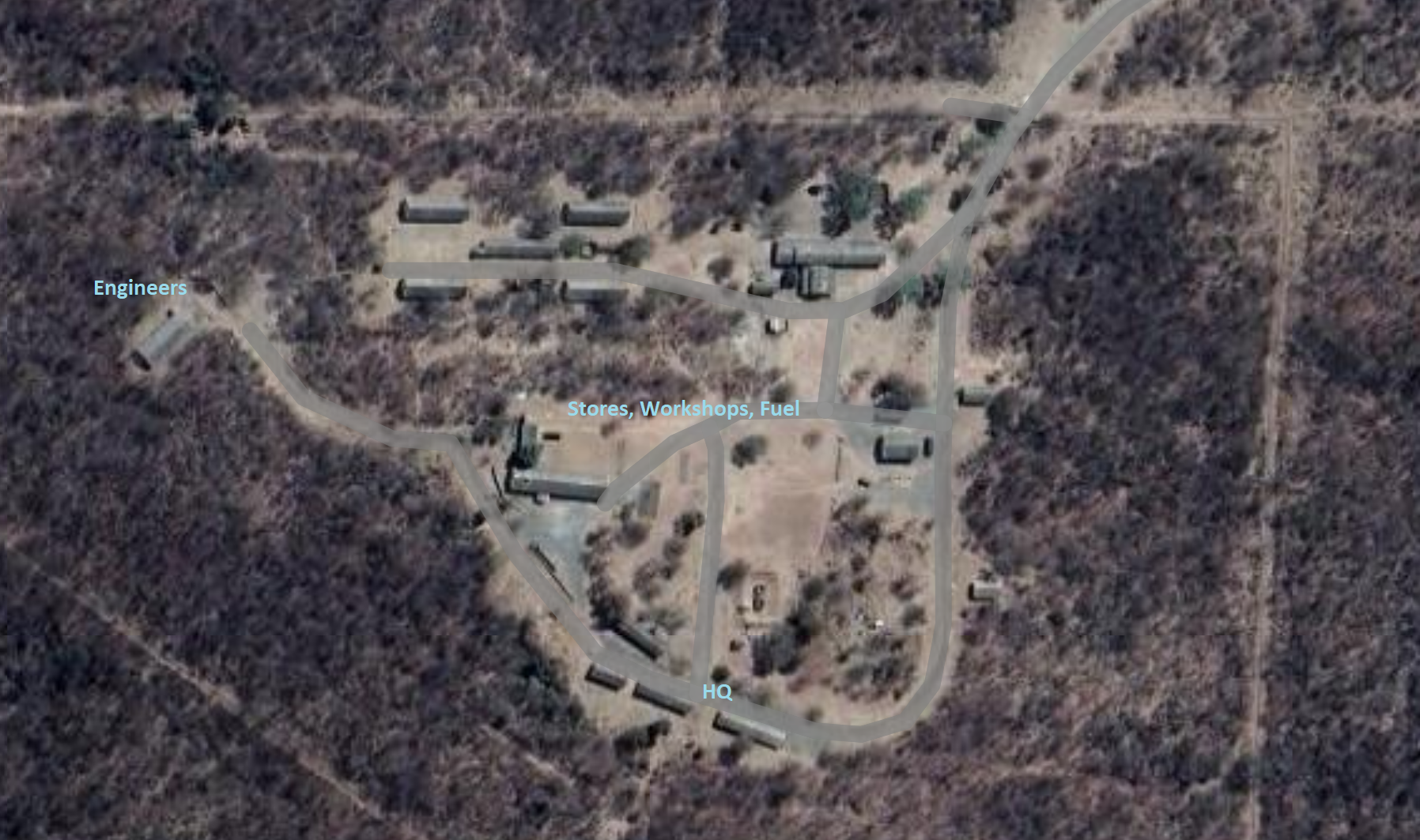
For a time I was based with 4 Independent Company (4 Indep) at Wankie, and those familiar with this unit will remember that it was on top of a hill and on the left, as you came into Wankie from Bulawayo. 1 Engineer Squadron (1 RhE Bulawayo) maintained a small Forward HQ within this base with the task of providing Engineer logistic and operational support to our two sub-callsigns at Deka and Victoria Falls. We also supported the British South Africa Police (BSAP) and 4 Indep throughout the Operation Tangent theatre of operations, as and when required. Captain George Jenkinson was the commander (Sunray) of our little team, with me as his second in command (Sunray Minor). We also had a number of Sappers with us to do the heavy-lifting and man the radios (which were active 24/7). All-in-all we were a happy bunch who just got on with doing Sapper things.
The picture below shows the 4 Indep camp layout.
This particular morning (probably mid to late 1979) I was going through the radio messages to see if there was anything for immediate action when the telephone rang. Captain Jenkinson was away at the time on another mission so it was just me and the lads on deck. The caller was a Special Branch (SB) Inspector from Wankie BSAP. I had got to know him quite well and after exchanging the usual pleasantries he asked me to come down to his office as he had a job for me. Knowing SB it was probably going to be something dodgy, dangerous, or both. Little did I know that this would be one of the strangest tasks I would ever be asked to take part in.
Leaving one of the Sappers to hold the fort, I jumped into our Unimog and drove down to the police station, a short 10 minute drive. Entering the charge office I winked at one of the Woman Patrol Officers – they were all great girls and often played darts with us at No1 Club in Wankie. They definitely were not prudes. She waved me though to a side door that led to the back of the police station – this was where the SB offices were. A pair of dark green Series 3, 6-cylinder Land Rovers stood silently in their parking bays – both of them fitted with 2 x AK 47s – mounted transversely in the back, directly behind the cab. These could be fired from inside the cab by means of a solenoid in case of an ambush – spitting death left and right within the killing ground. Some vehicles had a third forward-firing AK mounted at the front in the engine bay. Very useful set-ups indeed. Whilst marveling at these instruments of death I heard a shout and someone cry out, obviously in pain. Not my business and I continued on my way towards a locked steel gate and rang the bell.
The SB Inspector took a long pull on his Madison cigarette, held out his hand for the regulatory handshake and offered me a seat opposite his desk. A large map covered with plastic was attached to the wall behind him – different color chino graph lines and secret symbols dotted its surface. I looked at him – these were hard men doing a hard job – never easy and always laced with danger and sudden death. Our conversation did not last very long and the gist of it was that I was to assist in identifying ammunition that had somehow ended up at the Wankie Hospital – a strange place for it to be I thought, but anything was possible. He never gave me any further details except the name of a contact person at the hospital and a warning that the task may take some time, and I needed to go there directly. I used his phone to let my people know not to expect me back until late, and after a few minutes of arranging to catch-up again soon I went on my way.
The Wankie Hospital was run by Anglo American. It was not big, but it was modern, clean and efficient. I had spent a few days there previously with malaria and found the treatment and staff excellent – the only downside being the constant moans of a Portuguese guy who had caught his arm in some kind of machine at the colliery, mangling it badly. He was in the same ward as me and I felt his pain – which must have been considerable- the nurses done their best for him but a person can only have so much morphine.
Having found my contact person and identifying myself, I was directed to the mortuary where I was told I would be met by one of the pathologists. This was becoming more and more bizarre, but I done as asked.
See below for location of mortuary at Wankie Hospital.

Before I was anywhere near the mortuary, I was struck by the sound of crying and wailing – lots of it and clearly there was something going on here. People do cry at a mortuary though so not too unexpected. What was unexpected was the amount of people milling around outside the mortuary, police officers doing their best to contain those trying to get into the building. Much shouting was taking place, finger-pointing at the police and then at me as I came into view. The police must have been warned that I was on my way as they ensured I got to the mortuary entrance without being mugged. On pressing the bell an African gentleman dressed in a surgical gown and plastic apron opened up and ushered me inside.
The site that greeted me is something that will be forever burned into my slowly fading memory. There were bodies everywhere. On the autopsy table, on the floor, on trolleys and in the fridges. I estimate that there must have been in the region of 20 bodies all-in-all. The smell of decomposition, blood, urine and faeces permeated the air – this was the smell of death. Some were wrapped in clear plastic, some in unzipped body-bags, and some simply lying on the floor.
There was hardly any space to move, but the man who looked to be in charge ushered me into a small office, and after thanking me for coming down explained what he needed from me. He turned out to be the only pathologist available in Wankie at the time and he sure seemed to have his hands full. He proceeded to brief me up. Apparently an African bus had been attacked the previous evening by persons unknown on one of the many bush roads within our operational area. The bus driver had been injured but managed to bring the bus to a safe stop on the road, whereby the attackers boarded and began firing at the passengers indiscriminately with automatic weapons. Dozens were injured and those I had just seen lying dead next door, were killed.
My readers should understand that during this period of the war, there were many actors vying for popularity with the local population, and I had learnt a long time ago that nothing was ever at it seemed – there was lot of smoke and mirrors and in fact sometimes you couldn’t see the mirrors. We had ZIPRA (Joshua Nkomo), ZANLA (Robert Mugabe), Bishop Abel Muzorewa and his crew, The Rhodesian Security Forces, the Monitoring Force, various intelligence services and probably other organisations I more than likely had never heard of. So it became an evil, cruel game, played between the actors with the aim of seeing who could look like the good guys. If that meant killing innocent bus passengers and getting the blame pinned on someone else, then that would do just fine. According to them, the means justified the end.
My mission was to assist in identifying who had carried out this attack – I’m not a pathologist so cannot make medical conclusions, but I can tell the difference between AK and FN ammunition. My job was therefore the following:
- Attend the post-mortem of each of the deceased
- Witness the removal of bullets and bullet-fragments from each body
- Where possible identify non-fragmented bullets as either AK or FN (wishful thinking)
- Ensure that each bullet or bullet-fragment was placed in its own sealed container for further analysis at a specialist facility (chain of custody was not my responsibility to maintain – this was a police responsibility as the investigating authority).
Each body had a brown tag on the big toe. Amazingly most of the victims had been identified by the teams that recovered them from the bus – the same team now carrying out a forensic investigation of the vehicle. I imagined what the interior looked like. Blood, bits of brain tissue, vomit and skull fragments – and the pitiful belongings of the deceased. Handbags, shopping bags, multi-coloured blankets, groceries and shoes. Shoes always seem to come off during a violent death. And of course, the cartridge cases.
And so we began the unpleasant task of examining each cadaver. Some were straightforward, with the bullet still in one piece within the body, some not so easy, especially where they had fragmented on bones, sending bits of bullet in all directions throughout the fleshy mass. It was then a matter of literally digging around in the flesh until the pieces were found. In other cases the bullets had exited the body cleanly and there was nothing to find. Each piece was put into a stainless steel tray for me to examine. There was very little blood considering the number of bodies and type of injury – all of the bleeding would have taken place on the bus.
There was no dignity for these poor souls – time was of the essence and the pathologist and his assistants stripped the victims until completely naked and hurriedly poked about inside the pink and red cavities of damaged flesh until they were satisfied they they had found everything they could. And then it was onto the next one. As most of the victims had been shot in the torso or chest, all of the bodies were cut open from neck to groin, and the chest cavities pulled open for examination. This was a brutal process beginning with a large scalpel incision from neck to pubis followed by the cutting of the sternum and ribs with what can only be described as bolt-cutters, allowing the the chest to be completely opened up. Others with head wounds and half a skull missing, brains left behind in the bus, staring, lifeless eyes hanging out, were quicker to process. It was grisly work and although I had seen my fair share of death and traumatic injuries over the years I was still shocked at what I was seeing. The small children were the hardest for all of us – probably going home with a new toy or clothes after a day out with mum and dad in the city. Now there was no tomorrow for them. No playing with their friends around the kraal, or helping to tend the goats and chickens – there was nothing for them. It was just so bloody sad.
As each body was completed the chest cavity was forced back into place, and sewn up by one of the assistants while the pathologist wrote up his report. The needle was thick as a finger and unlike anything else I had seen from a medical perspective – the gut used to make the stitches similar to brown string. The stitches were spaced widely apart and pulled tight to force the two sides of the chest together. There was no need for cosmetic considerations here. Once complete the body was taken to another area of the morgue, and I assume handed to the relatives waiting outside, as the volume of wailing and crying increased from time to time.
I guess some of the victims were terrorist sympathisers, either by choice or intimidation, but here and now they were human beings who had been in the wrong place at the wrong time, the majority going about their business and hoping for a better future. That was all gone now – all that was left was for the pathologist and his team to cut them up, looking for little bits of metal which I tried my best to identify. It was, no matter how shocking, the right thing to do for them.
We continued well into the night and until all of the victims had been examined. No one was hungry. We had all opted to work until we had handed all of the remains back to the relatives. There were a few that no one claimed immediately, hopefully they would come tomorrow after the word spread.
It was past midnight when I finally left. All of the relatives had departed. A policeman stood guard at the door and I stood in the cool African night, breathing in deeply, the fresh air not helping to dissipate the the smell of death clinging to my clothes and deep in my nostrils. Walking to my Unimog I wondered what would become of the work we had done today. Would the effort prove useful or was it just a deceitful game of which I had now become part of?
Either way, I hoped that in some small way I would have helped these poor people obtain some form of justice, and closure for their loved ones.
Sadly, I would never find out.
Twin Browning’s On The Bridge (Part 1)
August 12, 2023
Some time back I had a rather spirited conversation with an individual over the idea of mounting twin 7,62 mm x 51 mm Browning machine guns atop the cab of a Hippo (converted Bedford RL), with the trigger mechanisms activated by push-bike (bicycle) handle-bar brake levers. The handle-bars were located in a convenient position for the co-driver of the Hippo to be able to fire the guns without sticking his head outside of the vehicle – thus avoiding a third-eye. All he had to do was pull the brake levers from inside the cab and the cables that led to the gun triggers, fired the weapons.
The Rhodesians thought that this was a brilliant idea, and in theory it probably was considering we were forced into using all kinds of solutions to problems that we had to overcome due to international sanctions and the arms embargo. Rhodesia used South African (Armscor) built Hippos. To the best of my knowledge Rhodesia never produced any of their own. Those that we used were former South African Police vehicles, donated to Rhodesia after their withdrawal.
In this episode I am going to relate my own personal experience firing these guns from a Hippo in a live contact with the enemy.
Firstly it would be remiss of me not to first give a bit of background to the two main actors of this episode – the Browning Machine Gun, or to use its correct nomenclature, the M1919A4 Browning Medium Machine Gun, and the Hippo personnel carrier (Bedford RL variant designed to protect against landmines and small arms fire).
M1919 Browning Medium Machine Gun
Lets start with a quick look at the weapon specifications:
- Weight: 14 kg
- Caliber: 7,62 mm x 51 mm (Springfield .30-06)
- Length: 964 mm (includes barrel of 610 mm)
- Action: Recoil operated
- Rate of fire: 400-600 rounds per minute
- Muzzle velocity: 853 meters/second
- Maximum firing range: 1,500 meters
- Ammunition feed: Belt-fed
The M1919 Browning is a .30 caliber medium machine gun which saw widespread service during WW2, The Korean war, and The Vietnam war. It was used by most NATO countries until the 1990s and is still in use today in some theatres.
Similar in design to the larger Browning .50 caliber M2, it is a recoil operated machine gun, highly versatile and was used widely as a light infantry weapon or mounted in some way on armoured vehicles. It was fitted to aircraft and also used in an anti-aircraft role, making it truly a weapon for all theatres of war.

Above – The air-cooled, belt-fed M1919A4 machine gun with its M2 tripod weighed only about 48 lbs., compared to more than 100 lbs. for the water-cooled M1917A1 machine gun. (National Rifle Association of America).

Above – In this original color photo from 1944, U.S. Army paratroopers train with the M1919A4 machine gun. (National Rifle Association of America).

Above – The Browning .30-cal. M1919A4 light machine gun was used to great effect in all theaters during World War II. A U.S. Army soldier (above) crews an M1919A4 during operations on Jan. 16, 1945, in northwest Europe. (National Rifle Association of America).
When used in the Infantry role the gun required at least a two man team but more usually four men were used; the gunner, the assistant gunner and two ammunition carriers. We never used them like this in the Rhodesian Corps of Engineers – and I definitely never saw them being lugged about by Infantry patrols.
Originally introduced as the M1919A1 the concept was of a light and easy to transport weapon featuring a bipod and light barrel. However, it soon became apparent that it was too heavy to be carried and also too light to withstand sustained rates of fire (the barrel would overheat causing a runaway gun), and so with the addition of a tripod and a heavier barrel, the M1919A4 had, at least addressed the sustained fire problem. It just needed more men to get it to where it was needed.
Usually mounted on a lightweight, low-slung tripod for use by the infantry the M1919A4 weighed in at 14 kg’s. Using fixed vehicle mounts it could be mounted on a variety of vehicles including Jeeps, tanks, Armoured Personnel Carriers, and of course – our Hippo’s.
The Hippo Armoured Personnel Carrier
Again, lets first have a look at the specifications of this beast:
- Weight: 8.8 tonnes
- Length: 6.53 meters
- Width: 2.46 meters
- Height: 3.3 meters
- Crew: 2
- Passengers: 10
- Main Armament: 2 x 7,62 mm Browning manchine guns, front mounted
- Chassis: Bedford RL
- Engine: 2.5 liter in-line 6 cylinder water-cooled, petrol
- Transmission: 4-speed manual synchromesh
- Ground clearance: 32 cm
- Fuel capacity: 240 liters
- Maximum operational range: 640 kilometers
- Maximum speed: 73 km/h
The Hippo is a South African designed Armoured Personnel Carrier (APC). Specially designed to be mine-resistant, it can carry ten infantrymen and a crew of two. The vehicle’s remote-operated turret mounts dual 7.62mm Browning machine guns, but like other improvised fighting vehicles, it is only lightly protected. An interim solution adopted to deal with the threat of landmines deployed by the South West African People’s Organization (SWAPO) in northern Ovamboland, the Hippo was simply a blast-proof hull fitted to a Bedford RL chassis. Similar to the BTR-152, it offered a staggered troop compartment with seating facing inwards. Vision was restricted to narrow plate glass windows. This layout was universally unpopular and later corrected with subsequent vehicle development. There were firing ports for the occupants and a powered machine gun turret could be braced on the open top, though these were seldom fitted. Passengers and crew debussed from the rear. The Hippo Mk1R was based on a M1961 Bedford truck chassis, which was being phased from South African service in 1974. Some 150 were shipped to the South African Police that year, another 5 being donated to the South-West African authorities. South African Police units left several behind when they withdrew from Rhodesia in 1976, and these were retained by Rhodesian Security Forces.
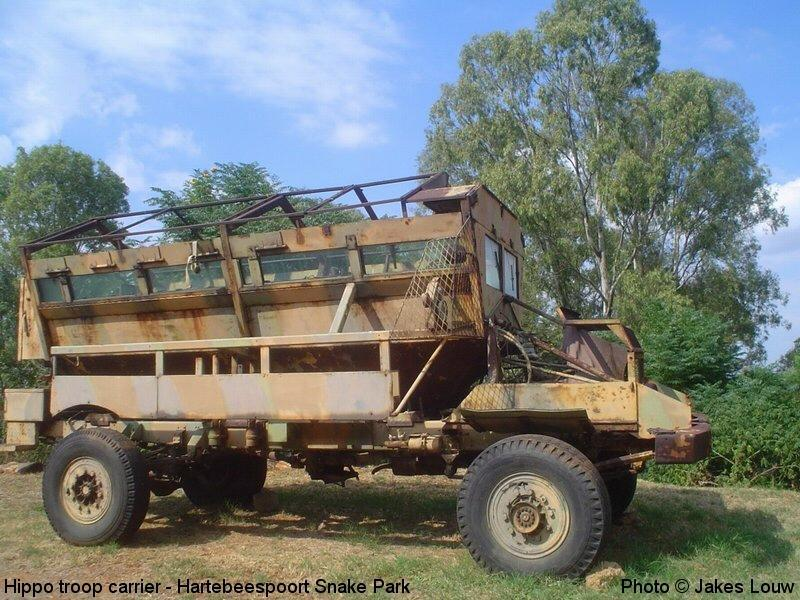


Sadly most, if not all of these grand old ladies of the bush, that probably saved countless lives, have now ended up as rusted hulks, waiting to be cut up and sold for scrap. The photographs above, whilst giving the reader excellent examples of what the Hippo was, are at the same time bringing me a personal sense of nostalgia and sadness – I have travelled in them, driven them and fought the enemy with them- they are therefore part of me, and I a part of them. We are inseparable in this sense.
In Part 2 of Browning’s on the Bridge, I will describe how one of these beautiful (to me at least) vehicles and my crew done what we were paid to do – make contact with the enemy.
And it was in such an unusual way – sort of a meant-to-be-moment.
More Cunning Contrivances
April 17, 2023
As a follow-on to my previous post I would like to share another booby-trap mission I took part in with you.
All armies and that includes the Rhodesian Army, have ammunition stores. Here they can keep anything from small arms ammunition, artillery shells, mortar bombs and hand-grenades. The number of ways that we can kill one another on the battlefield is endless and only restricted by the imagination of those that manufacture the means for us to do so. The interesting thing about ammunition and explosives is that it does not last forever, even if stored in ideal conditions – it is either used as intended, or much like the food in your pantry or fridge, it will reach a use-by date, after which it needs to be disposed of. Food is easy to deal with – but what do you do with hundreds of items of possibly dodgy out-of-date ordnance when they come to the end of their safe storage life?
Well, the EASY way is to take it to a demolition range, lay it all out nice and neatly, and destroy it in a safe and controlled manner, normally with plastic explosive donor charges, although I have also used TNT which was the only thing we had available at the time. We call this Sympathetic Detonation. Simply put, if we correctly place and detonate a donor charge next to a mortar bomb, the donor charge and mortar bomb will be destroyed – that’s the plan anyway. The theory of explosives is an interesting subject but I do not intend to discuss that at this time – possibly in another blog in the future.
Problem solved and everyone goes home happy and with all body parts in the right place.
The HARD way to do it is to let someone with an extremely vivid imagination and apparent lack of technical expertise have a think about it in the shower, and come up with a hairbrained and dangerous idea that actually added no value whatsoever to the Rhodesian war effort.
This post is about one of those hairbrained ideas that I reluctantly got dragged into executing on the ground. I was oblivious as to what had triggered the mission (probably “hot” int again) or what the result was.
I was running the Cordon Sanitaire Maintenance Teams out of Deka base at the time these events took place. I had been tasked to report to Wankie Ops Room (4 Indep Coy) for a special mission, leaving my second-in-command (also a sergeant) to run things at Deka base. He was highly competent and I had no qualms in leaving things in his hands. I was also ordered to bring 4 of my Sappers with me. One of them was my regular driver and I sat in the Unimog 25 right-hand passenger seat and enjoyed the scenery on the trip to Wankie, which usually took a couple of hours. I was not in a particular hurry and glad to be out of the camp with some my troops.
On arrival at the Wankie Ops Room for a briefing I was surprised to see one of our Staff Sergeants from 1 Engineer Squadron HQ (Bulawayo, Brady Barracks) there – I had no idea he was even in the area of operations so this was interesting. He was a good bloke though and I have good memories of working with him. Also present was an Infantry officer and one or two others who I cannot remember. A map of Ops Tangent was up on the wall – it had been overlaid with plastic so chinagraph pens of different colours could be used to emphasise different aspects. The briefing began and by the time it was finished I just could not believe that someone had thought this one up.
Apparently the idea was for me to return to my base at Deka and await the arrival of a convoy of vehicles carrying a number of boxes. Inside the boxes were dozens, possibly hundreds of obsolete or out-of-date rounds of ammunition including 3-inch, 60mm and 81mm mortar bombs, 25-pounder artillery shells, aircraft bombs and various hand-grenades. These items would be used as improvised booby-traps – not just any old kind of booby-trap though – these were going to be hung in trees and all connected up with detonating cord and connected to an electrical initiation ringmain – ready for command detonation. My job was to lead the convoy from my Deka base, up a back road to Victoria Falls. I will talk more about this back road to Victoria Falls in an upcoming post. As this was a supposedly secret mission we had to travel in darkness and I would meet up with more personnel from 1 Engineer Squadron at a secluded area near the Victoria Falls shooting range. All very cloak-and-dagger stuff which at times seemed to be over the top.
After doing some shopping in Wankie, we made our merry way back to Deka. Apparently the convoy carrying all of the ordnance would arrive during the following day and we would deploy to Victoria Falls in the evening after last light. Sure enough they arrived as planned and just after the sun dipped below the horizon, I led the convoy out of Deka Base and we were on our way. The trip up the back road could be a little dodgy, especially at night, however we travelled well and arrived at the junction where the back-road met the main Victoria Falls road in good time. Here we would turn right but I halted the convoy at this point to let the guys stretch their legs and make themselves something hot to drink.
The approximate location of this rest-stop is shown below as Point A, with Point B being the location of the mission forward base.

After a short break we moved the convoy the few kilometers to Point B where we met up with other elements as planned – including more personnel from Bulawayo and a protection group. The final tasking was now discussed in more detail and the plan now took quite a turn as it had been decided that laying these booby-traps at night was far too dangerous and we would proceed at first light to a position that is shown below as Point C below. This picture also shows the approximate back road route.
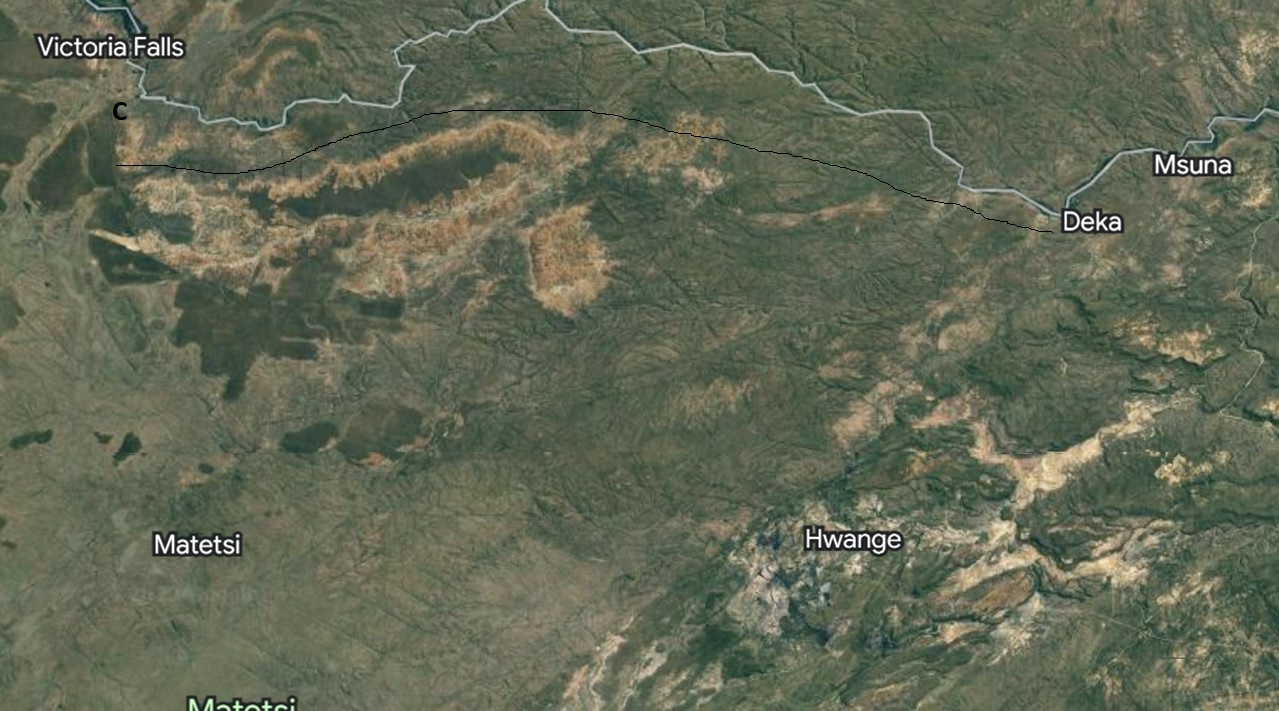
At first light we moved to a position close to Point C and began unloading the ordnance and other bits we would need to lay, or rather hang the traps. This included rolls of detonating cord and electrical initiation ringmain stores. The job itself was hard going as we needed to go down into the gorge to complete the work and it was hot and humid, with steep terrain. Dangerous if you lost your footing and I had to wonder who would want to infiltrate into Rhodesia using this route – but there we were hanging bombs in trees like Christmas decorations. The more we worked, the more this idea seemed to be a waste of time. Just try to imagine a bunch of guys tripping and cursing, sweating and swatting mopani flies from their eyes and ears while hanging bombs in trees. You couldn’t make it up but sadly this is what we were tasked to do. I don’t know how long it took but we never used everything we had and by late afternoon we had set the electrical ringmain and it was time for me to take my guys back to Deka. It seems that there was going to be a stay-behind team and these individuals would lie in wait for goodness knows how long and set off the bombs when the bad guys came across the border via the Zambezi River, and hopefully spoil there plans. I had no intention of asking any further questions or getting involved further, and after a quick meal we set of to Deka Base. Again, I have no idea what the result of this operation was as there were no reports of any crossings or enemy contact that came across my desk and I never heard anything about this mission ever again. My personal opinion is that the plan was abandoned quite quickly after we left as common sense should surely have eventually prevailed and the personnel in the ambush party redeployed to more useful activities. There is no glamour in this account and my intent is only to share some of the more bizarre activities that I got dragged into. An outlandish idea which came to nothing – all it really achieved was to put good men’s lives in danger once again.
Cunning Contrivances: Booby Traps (Part 2)
February 25, 2023
We were often required to carry out some pretty strange missions during the war and the one I am going to describe to you now is just one of them.
At the time I was posted to 4 Independent Company, an Infantry unit, located in a town called Wankie. I was responsible for running the 1 Engineer Squadron operations room. Those of you who are familiar with this base will remember that it was on top of a hill and one should not confuse the location with the old 1 Independent Company base on the left hand side of the main road as you left Wankie, travelling towards Victoria Falls.
We had a good set-up in Wankie that comprised of four offices, one of which was my sleeping quarters, another the operations room itself, one for my Sappers to live in, and one for Engineer stores. I had three Sappers under command who manned the radios and carried out other duties to support our little HQ and we were a rather happy bunch.
Our primary task was to maintain and support our Engineer callsigns in the Operation Tangent area and these consisted of Troop strength sub-units based at Deka and Victoria Falls. In addition to this we also had a responsibility to provide Engineer support to the operational efforts of the Officer Commanding 4 Independent Company whenever required.
The map below shows the area of our responsibility, including Wankie (now renamed Hwange), Deka and Victoria Falls:

This map below shows what is left of the 4 Independent Company base today – indicating where the Engineers were located (if my memory serves me correctly):

On this specific day I was called to the radio by our duty operator, who informed me that it was I Engineer Squadron Headquarters (Callsign 1) looking for me (Callsign 11). I picked-up the hand-set and called them up and was surprised that the Commanding Officer (Sunray) was on the other end. I had therefore either committed some high-level violation, or he had some dodgy mission for me. Luckily it was the latter, but if I had known what the mission was I would not have been so relieved as it turned into a badly resourced and dangerous task that to this day I cannot fathom the logic of. Anyway you can judge for yourself – read on.
Intelligence collected over the years by our spooks had led to the assumption that the gooks did not always navigate with traditional methods, meaning map and compass with time and distance (no GPS in those days). The reasons for this ranged from lack of navigation training to possibly a lack of equipment. To improvise they would instead use a number of known prominent landmarks that they used for navigating from point A to point B. Ingenious, simple, and it worked. These landmarks could be buildings, large trees, fence-lines, river junctions, cross-roads and so forth – anything that could be easily identified and confirmed. They also used T-junctions in roads – and it was one of these features that I was tasked to make uncomfortable for them. Working on “hot” intelligence my mission was to take a number of R2M1/2 anti-personnel mines and a single TM46 anti-vehicle mine to booby trap a certain T-junction in our area of operations (I cannot remember the exact location but there was also a trading store right at the junction). We would also take 2 rolls of detonating cord, plastic explosives and a pressure release switch (number 6) – and lots of black insulation tape.
“Hot” intelligence normally meant that there was credible evidence from sources that imminently, there would either be an attack, gooks crossing into Rhodesia, or movement of gooks within a known area. It therefore also meant that the mission would need to be carried out covertly and at pace. This was going to be challenging as we had been given little pre-warning and all I had was 24 hours to complete the mission or the opportunity would be gone. The only information that I was given regarding this mission was that a group of terrorists was going to be using a certain T-junction as a navigation point on their route to other parts of the operational area. Our job was to stop them at the T-junction by either eliminating them or disrupting their plans.
With the benefit of hindsight, laying a booby-trap was not a very clever idea from the start – for one it would take time to mobilise to the area and to set the trap, and secondly, a well placed ambush would have been a far better (and quicker) option to my way of thinking. At the time though, I got behind the plan and proceeded as instructed.
Due to the fact that we were supporting minefield maintenance teams at Deka and Victoria Falls, we had personnel mines in the 4 Independent Company magazine as well as plastic explosives and detonating cord. The pressure release switch and insulating tape we had in our Engineer store – so we were at least prepared equipment-wise. I was to be driven to an area close to the T-junction and accompanied by an infantry call-sign and one of my Sappers during the actual laying phase. This meant it was just me and a single Sapper (lets call him Moyo) laying the traps while the infantry stick would keep their eyes open for bad-guys. We had packed everything into back-packs to make carrying all of the kit easier – all except the vehicle mine which I carried by hand after collecting it from Wankie Special Branch.
On the way to our drop-off point I wondered how were we to lay this booby-trap without being seen or heard. Considering that there was a trading store right in the middle of the target area that was sure to be quite busy in the daytime, with surely some of the customers being gook sympathisers, or Mujibas (informers, usually youths who supported the gooks). We were being forced to do this at night – not a very clever idea as laying mines in the daytime is dangerous enough as it is – at night its just plain silly and not recommended.
We had stopped some way from the target and done our best to camouflage our vehicles and settled down in an all-round defence until darkness fell. Some of us slept……I’m sure that I did anyway.
I awoke in pitch darkness and there was movement all around me. I checked my watch and it was probably around 2100 or 2200 – something like that anyway. We had already planned to walk into the target area and we hoisted our packs and fell into a single file formation with the infantry who would be navigating us in. We were going to approach the target from the north and this would bring us in at the top of the long leg of the T-junction and on high ground – the road sloped downwards quite steeply to the actual junction itself, and the trading store. Please see my drawing below for a better idea of what the ground was like and what we were going to be doing booby-trap wise.

The mines that we used looked like these:

R2M2

TM46 anti-vehicle mine – (unknown copyright holders and apologies in advance)
Once we had arrived at the top of the hill and neared the road we took up positions from where we could observe the store and road for any movement or other activity. It was actually very quiet and strangely peaceful, and after giving it another 15 minutes or so I let the infantry stick leader know that we would commence laying the trap – he nodded and put his troops in as good a position as possible to offer covering fire for us to withdraw from the road if necessary.
Moyo, as a trained Combat Engineer would lay the mines on one side of the road and I would do the other. I would also lay the TM46 at the T-junction and fit the pressure-release switch as an anti-handling device. The plan was to ensure that if anyone tried to lift the mine it would detonate.
Laying the TM46 was hard work as besides the actual excavating of the hole and setting the pressure-release switch, I also needed to run a detonating cord line to the where the first anti-personnel mines would be laid on the verges. It was a complicated and tricky set-up but the best we could do under the circumstances and time given to us. Laying the anti-personnel mines was just as difficult as the verges of the road were hard packed and covered in small pebbles that made digging and covering the mines extremely dangerous. One pebble or clump of soil landing on a mine would set the whole lot off. Please bear in mind that every mine was connected to the next mine with detonating cord. The idea being that if any of the anti-personnel were activated there would be a mighty big bang and hopefully the gooks would take some pain.
I’m not sure how long the entire laying operation took but it was still dark by the time we finished. I will say it again that this was a very dangerous task that we had been given. Laying mines in the darkness is scary stuff, and the terrain made things more uncomfortable than ever – the soil was unforgiving and hard as hell – I know we were making enough noise to wake the dead and I am pretty sure that we had compromised ourselves over and over. The whole thing was pointless the more I looked at it and by the time we were finished it would have been a foolish move to double check everything, as I should have.
Imagine this:
- each anti-personnel mine had to have a two turns of detonating cord wrapped around it, armed and then covered
- a small channel needed to be dug between each mine to connect them to a common ringmain – each time we done this we were tampering with a number of fully armed mines
- working amongst the rocks and pebbles made covering mines difficult, especially in the dark
- ensuring everything was covered and concealed to avoid discovery was practically impossible in the dark
- working around fully armed mines, slipping and taking mis-steps is an accident waiting to happen
At the end of the day we done the best that we could and left the area by a different route with the infantry leading once again. Arriving at our vehicles it was time for a quick cup of coffee and then we were out of there by first light. I was looking forward to putting this one behind me and today I really consider this to have been one of the most pointless, unproductive and dangerous tasks I have ever had to carry out, not only from a personal perspective but also for the troops I was responsible for.
I never ever found out if the trap was sprung, and if it was by what or who? Terrorists, or an innocent civilian – or livestock? This is the danger with these devices – they know not friend or foe, killing or maiming anyone or anything that sets them off. The idea was for an aircraft to fly over the target now and again and check for a crater from the TM46 at the T-junction that would confirm detonation……..I’m not sure if these flights took place at all to be honest. Aircraft were needed elsewhere and certainly not to go and check a T-junction, so the result remains a mystery to me till this day.
To finish this one off let me just say this; booby-traps have their place in warfare, however they should be planned correctly, deployed with sufficient time to ensure the safety of the layer, and never used as a stand-alone substitute for a well-laid ambush. The way we were told to do this one could easily have cost own forces casualties and the planners should be ashamed of themselves – knee-jerking desk-jockeys with little insight into how things actually work on the ground are very, very dangerous indeed.
Thank goodness that the Rhodesian Corps of Engineers were some of the best trained Sappers in the world. Its the reason I am still here and able to write this blog.
Cunning Contrivances: Booby Traps (Part 1)
January 2, 2023
The definition of a Booby-Trap according to the Rhodesian Corps of Engineers (RhE) training pamphlet was as follows:
“A booby trap is a cunning contrivance, usually of an explosive and lethal nature, designed to catch the unwary enemy; a savage practical joke. It is aimed directly at the reduction of morale and mobility, both of which are vitally important to success in war.“.
In this post I would like to recall two occasions where I was tasked by my higher HQ to lay Booby-Traps. These operations were to take place in the Operation Tangent area and were to be sighted in such a way that terrorists would be well into the kill-zone before the traps were initiated, meaning that we were going for maximum gook casualties. Concealment of the entire set-up was therefore of critical importance, and this includes clandestine insertion of the Booby-Trap team, as we knew that there were eyes and ears everywhere in the bush. We therefore had to apply counter surveillance techniques from insertion to extraction as it is pointless to lay a Booby-Trap that can be seen, or the laying team are observed moving into the target area.
Without going into too much detail, Booby-Traps can be initiated (set-off) by a number of actions, the most popular at the time being the application of pressure, the release of pressure, pull, pull (or tension) release, or the application of some form of Delay. There are many other ways that Booby-Traps can be initiated but I am not going to cover these here. We had specially manufactured devices known as switches, available to us, however for the specific tasks that I was to lead on we would be using Pressure switches only. In other words the required action for success was for someone or something to stand on the pressure switch for the Booby-Trap to detonate. Please note that I used the term “someone or something” as these devices cannot tell friend from foe and would therefore activate the trap regardless of who or what applied the pressure. Sadly animals and friendly forces have been collateral damage to these devices on a number of occasions causing death or injury. The following illustrations show the abovementioned methods in simple to understand detail:
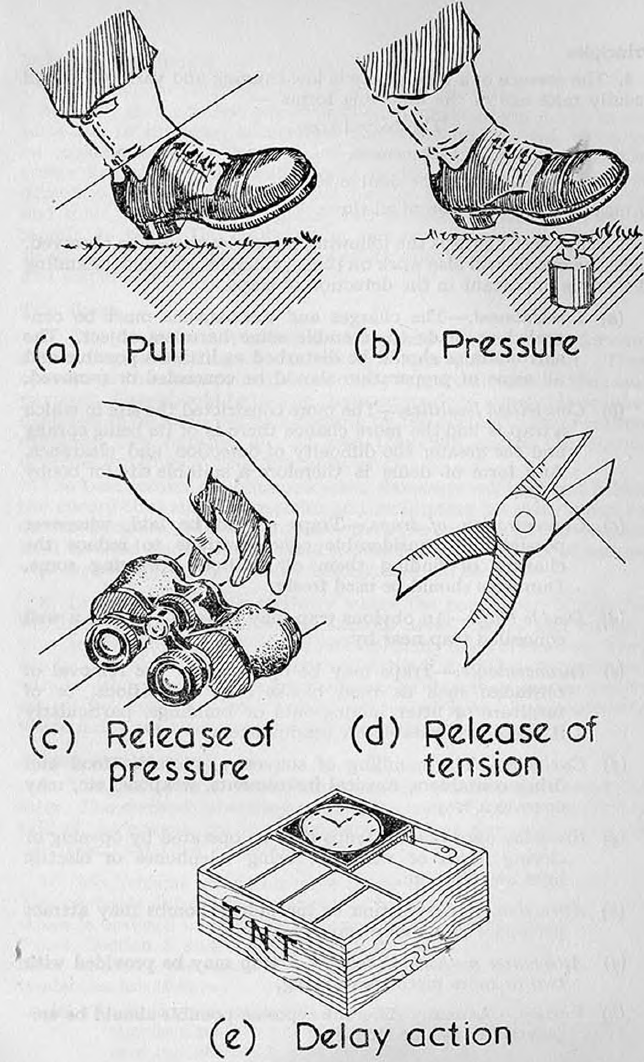
Looking at the previous paragraphs, my readers will appreciate that there are a number of fundamental pre-requisites for a successful Booby-Trap result. One does not simply pick a spot on a map and Booby-Trap it and there are a number of basic principles that we observed when sighting and laying Booby-Traps, and these are as follows:
- Concealment: The charges and mechanisms must be concealed or made to resemble some harmless object. The surroundings should be disturbed as little as possible and all signs of preparation should be concealed or removed.
- Constricted Localities: The more constricted the site in which a trap is laid the more chance there is of its being sprung and the greater the difficulty of detection and clearance. Any form of defile is therefore a suitable site for boobytraps.
- Concentration of Traps: Traps should be laid, whenever possible, in considerable concentrations to reduce the chances of finding them all without springing some. Dummies should be used freely.
- Double bluff: An obvious trap may be used to mask a well concealed trap near by.
- Inconvenience: Traps may be operated by the removal of obstacles such as road blocks and demolitions, or of furniture or litter in dug-outs or buildings, particularly if these are suitable for headquarters.
- Curiosity: The handling of souvenirs, pictures, food and drink containers, musical instruments, weapons, etc, may operate a trap.
- Everyday operations: Traps may be operated by opening or closing doors or windows, using telephones or electric light switches etc.
- Attraction: Delay-action or incendiary bombs may attract personnel to a booby trapped site.
- Alternative methods of firing: A trap may be provided with two or more methods of firing.
- Variety: As many different types as possible should be employed in any one locality.
Before continuing I would like to be clear on what I was expected to achieve on both missions and you will note that this ties in closely with the foregoing paragraphs:
- Inflict maximum casualties on the enemy.
- Use Pressure as the initiating action.
- Use of the following Principles – Concealment, Constricted Localities, Concentration of Traps, Alternative methods of firing and Variety.
- Covert infiltration to laying site
- Operational Security (Opsec)
A brief description of the two missions are as follows:
Mission 1
- Operational Area: Tangent
- Environment: Forest
- Type of Booby-Trap: Multi-device, pressure operated
- Concealment method: Existing vegetation
- Explosives to be used: Date expired Air Force and Army ordnance
- Insertion: Vehicle and night-march
Mission 2
- Operational Area: Tangent
- Environment: Existing dirt road
- Type of Booby-Trap: Multi-device, pressure operated
- Concealment method: Existing soil on dirt road
- Explosives to be used: Anti-personnel and anti-vehicle mines
- Insertion: Boat and night-march
In the next post I will describe in detail Mission 1 and Mission 2.
Ambush!
July 18, 2017
Ambush!
It all started with manpower, or rather the lack of it.
In the mid-seventies Rhodesia found herself not out-gunned, but rather out-manned in the bush, specifically Infantry-wise. The quick solution to this was to deploy specialist units (like the Rhodesian Corps of Engineers (RhE)), in the Infantry role. Those of you who have been following my Blog will remember that all Rhodesian troops were primarily Infantiers and secondly specialists.
The RhE seemed particularly well-adapted to the pseudo-Infantry role and we often deployed into the hottest areas, at times taking over from “pure” infantry units including the Rhodesian African Rifles (RAR), Rhodesia Regiment (RR) and Rhodesian Light Infantry (RLI).
In some instances we had more success in these areas than our Infantry Brothers.
We were carrying out advance-to-contact foot patrols from of a place called Tshiturapadsi, an unused District Commissioners camp that served us well as it had buildings, water and shelter. There was also an airstrip nearby (See Figure 1 below). It also happened to be located in one of the most gook-infested Tribal Trust Lands, the Matibi TTL, notorious for terrorist gangs. We had been sent there to relieve a RLI call-sign that had been in the area for weeks and who had not even seen a track let alone a gook.
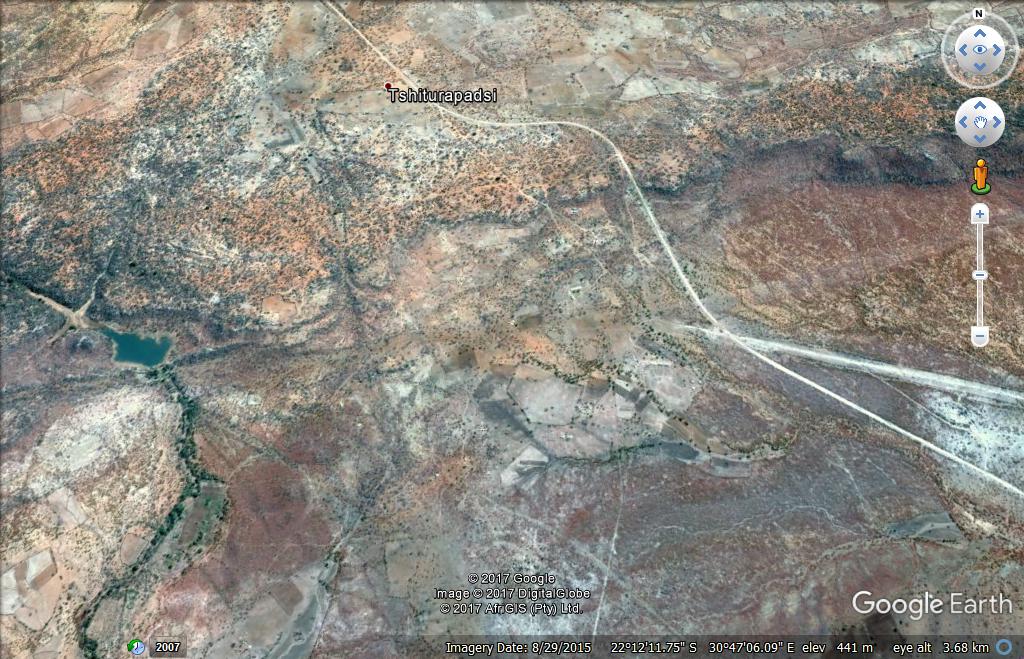
Figure 1
It had been a long day and an even longer patrol. The sun was beginning to dip over the horizon, heralding the start of one of those wonderful picture-postcard African sunsets. A cool breeze brushed my face, refreshing, and surprisingly, despite the heat, sending small shivers down my spine. There was invigoration with coolness also. We paced briskly now, still a little tired but no longer exhausted, rejuvenated with the thought that we would go into a temporary base as soon as it got semi-dark. I was on the far left flank of our ten-man extended line and felt vulnerable with no one out on the left of me…….tall grass blowing in the wind played games with my imagination….I was seeing gooks where none existed. I glanced across to my right, comforted by the presence of one of my mates in the dim light, a safe distance from me, ready to give mutual support if I needed it. As the day turned slowly into night the patrol commander, a young RhE officer passed the signal down the line to move into our temporary base for the night. We changed into single file formation (with me at the back), and took a wide dog-leg route into where the patrol commander had decided we would stay for the night. I was never a great supporter of eating and sleeping in the same place at night and in fact this practice was against our training doctrine. The gooks had Mujibas[i] everywhere and they would report our presence…..and then the gooks could come and fuck-up a pleasant evening. A patrol should eat, carry out personal admin, and then move to a new location, moving into their night location after dark and then there should be absolute silence…..no tins being opened, food warmed, farting or talking. We broke rules that night and within 12 hours we would break another one that would seem to bring hell itself upon us.
First light……always a magic time in the bush. Wet grass, dripping trees, cattle bells and screaming children. The smell of wood fires and fresh cow dung. And all of these things also meant there were people close by. The last guard had roused us all and we grudgingly extracted ourselves from our fart-sacks (sleeping bags). Dog-biscuits soaked in tea or coffee would come later in the morning, but for now we needed to move from this place quickly as this was also a dangerous time when gooks liked to attack. As it was the resident gook gang in the area had bigger plans for us on this specific day.
Still wiping the sleep out of our eyes we prepared to vacate the temporary base, taking care to cover our presence as best we could. We were surrounded by thick bush, the site being chosen for this exact characteristic as it was ideal for a temporary base. It was not however suitable for an extended line formation and so we exited in single file with me more or less in the middle of the patrol. As if by magic we were walking on a well-used path and I soon realised the patrol commander was using the path purposely, leading us to a nearby kraal. We had just broken another rule…..never walk on a well-used path……straddle it yes, but never have your entire patrol on it.
We entered the kraal and went into a well-rehearsed all-round-defence. The entire kraal had one of us on its perimeter looking out for signs of the enemy. The patrol commander and one of our Black Sappers found the Head Man and questioned him on gook presence in the area. In the Matibi TTL there was little chance of the Local Population helping the Security Forces and we decided not to waste time on this place. After searching all the huts for signs of gooks we got the signal to prepare to move on. To my utter amazement the patrol commander put us back on a well-used track leading out of the kraal and once again we were in single file. What was this guy thinking and no one challenged his judgement?
We had walked for about 500 meters when I noticed a single upturned munyatella[ii] next to the path. This in itself was not really out-of-place but it struck a chord somewhere in my survival instincts and I became uneasy. From my position in the patrol I could see we were about to take a right turn on the path. To the right of us the ground rose sharply and soon we were walking parallel to a fairly high, boulder strewn, steep kopje.
There was no warning…..these gooks were good and had chosen their killing ground well…and we had walked right into it.
The gooks initiated with what I now know was a PKM[iii] light machine gun (see Figure 2), capable of firing 650 rounds per minute. This was followed by a fair mix of AK47, SKS and RPD fire……initially. We all instinctively hit the deck not quite sure where the fire was coming from. These kind of events are pretty confusing at first and don’t believe what you see in the movies…..that’s all bullshit. My most vivid memory of this attack was and still is the crack of high velocity rounds going over my head and dirt spraying up all around me and into my eyes. We had all somehow remained in that rather silly single-file formation on the ground even though it was now pretty ragged and we were all horizontal, amazingly unscathed and all facing the kopje, the direction of the attack. We were badly exposed but because we were flat on the ground the gooks could not bring really effective fire onto us although we were all getting near misses. I began to think I was the sole target of a hundred gooks, and perhaps I was as I am quite a big bloke.
Figure 2
And then two things happened simultaneously…….firstly a new sound came from the kopje, a sound so specific that one ever forgets it….the sound of a mortar leaving a tube………and secondly the shouted order from our line to advance on the enemy using fire and movement. The mortar bombs rained down one after the other, precisely straddling the path we were lying on……encouraging us to advance more rapidly. It was clear to me the gooks had sufficient time to plan this ambush and had accurately estimated the distance from their base-plate position to the path. There was now so much noise, smoke and dust in the air that it was difficult to see. I remember clearly advancing a few yards up the kopje and taking cover, the second section following us while we pumped rounds into the gook positions. Sweat running down my face, the saltiness burning my eyes…adrenaline pumping through my veins…..all fear gone now…….just the job of surviving at the forefront of my mind. My hands were cut from the jagged rocks, the pistol grip on my FN sticky with blood. We were moving higher up the hill, almost half way and we still couldn’t see any gooks……all we could hear was the firing of their weapons. The whiplash of rounds hurting our ears. The mortar was no longer a danger as we were too close to them for them to use it safely as we systematically moved up the kopje………and then there was a relative silence as if nothing had disturbed that cool African morning. All we could hear was the tell-tale clinking of gooks running at high speed with loose kit jumping about in packs and pockets, shouting to one another. We moved up the kopje faster, ignoring the threat of an in-depth ambush……over-running now empty enemy firing positions…the only occupants expended cartridge cases, discarded AK and RPD magazines, and empty cardboard ammunition boxes. We worked through the position, wary now for booby-traps or mines but keeping our wits together. Things were slowing down but the adrenaline was still hot in our veins as we reached the top of the kopje. The gooks were gone and we had them running scared by using tried and tested infantry tactics. I silently thanked those bastard Llewellin Barracks instructors for all the blood, sweat and tears they took from me.
While some of us collected any booty we could find the patrol commander finally found space to get a message off and give the direction of flight of the gooks…….there was hopefully a Fire-Force element with gun-ships somewhere around but I had my doubts. Perhaps they could get an armed fixed-wing up to deal with the gooks but that was also doubtful. These assets were just too thin on the ground and because there had been no recent sightings of gooks in the area, there was nothing positioned close-by. Fair enough.
We gathered at the bottom of the kopje where it all began, carefully avoiding the track but recording the mortar strikes, easily found by the craters they made. They were close to where a number of us were lying and I consider myself lucky not to have been seriously injured or worse. As it was none of us sustained injuries serious enough to call a casevac. We were lucky…..this time.
Still alert and in a form of all-round-defence we found shady spots to sit and reflect on what just happened……..the entire contact not lasting more than 5 or so minutes perhaps but seeming to take an eternity to end. And now that sense of euphoria that only men just out of combat will know…….a great weight seeming to leave your shoulders as you sit back, shaking hands lighting-up a Madison, and let the calmness flow through you as the adrenaline wears off…….the calmness of knowing you survived a situation of grave danger where someone wanted to kill you and failed. There is no feeling in the world like it…….and little did I know that within a very short space of time I would go through the whole process once again…….only this time we would not be so lucky.
[i] Teenage spies, normally unarmed who observed Rhodesian Security Force patrols and informed the gooks on our whereabouts
[ii] Munyatellas were African sandals made out of car tyres and widely used out in the bush as they lasted for ever.
[iii] https://en.wikipedia.org/wiki/PK_machine_gun
Please also vist my website dedicated to Rhodesian and South African Military Engineers. Please join us on the forums by using the following link:
http://www.sasappers.net/forum/index.php
Copyright
© Mark Richard Craig and Fatfox9’s Blog, 2009-2017. Unauthorised use and/or duplication of this material without express and written permission from this blog’s author and/or owner is strictly prohibited.
 Fatfox9's Blog