Mystery at the Morgue
September 11, 2024
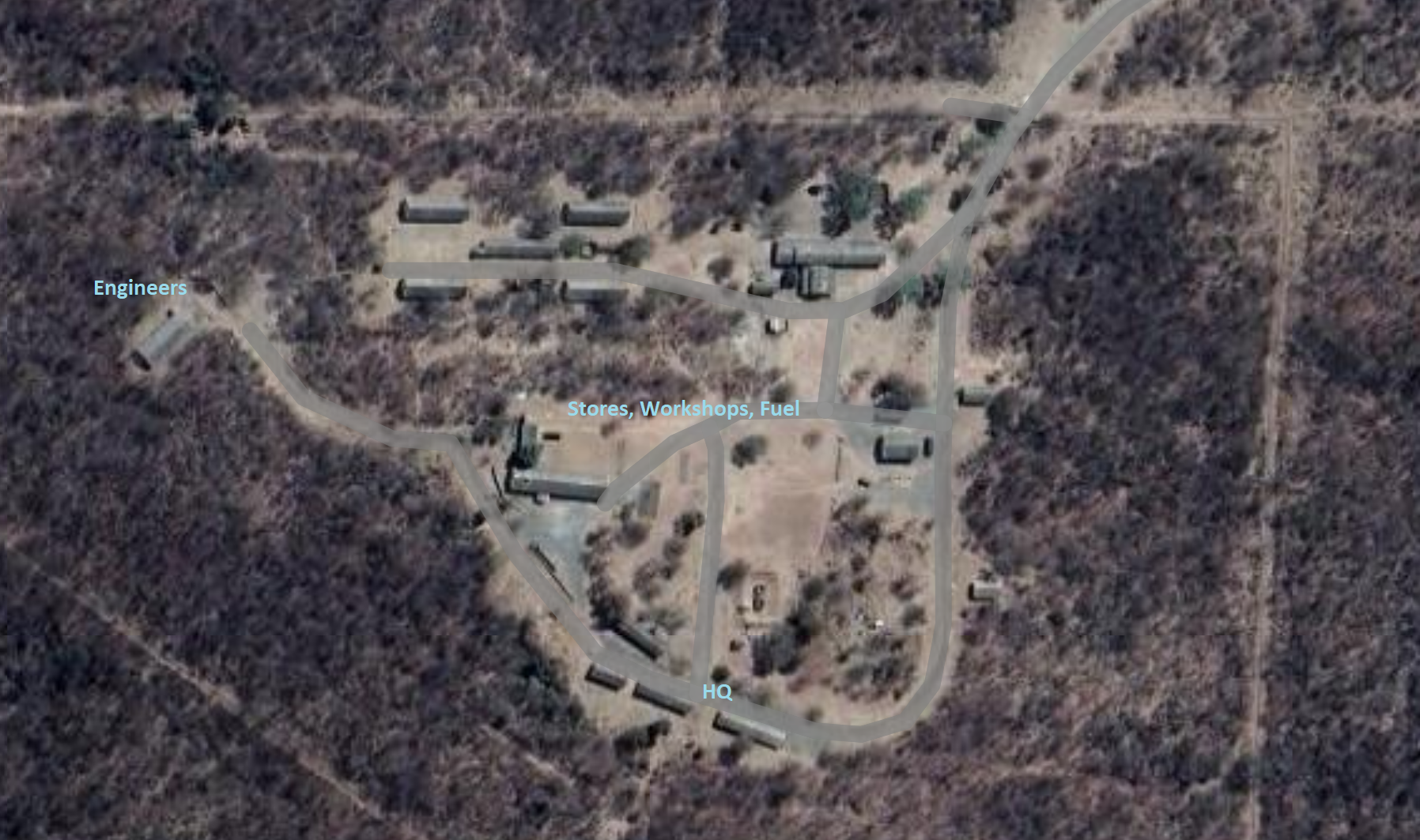
For a time I was based with 4 Independent Company (4 Indep) at Wankie, and those familiar with this unit will remember that it was on top of a hill and on the left, as you came into Wankie from Bulawayo. 1 Engineer Squadron (1 RhE Bulawayo) maintained a small Forward HQ within this base with the task of providing Engineer logistic and operational support to our two sub-callsigns at Deka and Victoria Falls. We also supported the British South Africa Police (BSAP) and 4 Indep throughout the Operation Tangent theatre of operations, as and when required. Captain George Jenkinson was the commander (Sunray) of our little team, with me as his second in command (Sunray Minor). We also had a number of Sappers with us to do the heavy-lifting and man the radios (which were active 24/7). All-in-all we were a happy bunch who just got on with doing Sapper things.
The picture below shows the 4 Indep camp layout.
This particular morning (probably mid to late 1979) I was going through the radio messages to see if there was anything for immediate action when the telephone rang. Captain Jenkinson was away at the time on another mission so it was just me and the lads on deck. The caller was a Special Branch (SB) Inspector from Wankie BSAP. I had got to know him quite well and after exchanging the usual pleasantries he asked me to come down to his office as he had a job for me. Knowing SB it was probably going to be something dodgy, dangerous, or both. Little did I know that this would be one of the strangest tasks I would ever be asked to take part in.
Leaving one of the Sappers to hold the fort, I jumped into our Unimog and drove down to the police station, a short 10 minute drive. Entering the charge office I winked at one of the Woman Patrol Officers – they were all great girls and often played darts with us at No1 Club in Wankie. They definitely were not prudes. She waved me though to a side door that led to the back of the police station – this was where the SB offices were. A pair of dark green Series 3, 6-cylinder Land Rovers stood silently in their parking bays – both of them fitted with 2 x AK 47s – mounted transversely in the back, directly behind the cab. These could be fired from inside the cab by means of a solenoid in case of an ambush – spitting death left and right within the killing ground. Some vehicles had a third forward-firing AK mounted at the front in the engine bay. Very useful set-ups indeed. Whilst marveling at these instruments of death I heard a shout and someone cry out, obviously in pain. Not my business and I continued on my way towards a locked steel gate and rang the bell.
The SB Inspector took a long pull on his Madison cigarette, held out his hand for the regulatory handshake and offered me a seat opposite his desk. A large map covered with plastic was attached to the wall behind him – different color chino graph lines and secret symbols dotted its surface. I looked at him – these were hard men doing a hard job – never easy and always laced with danger and sudden death. Our conversation did not last very long and the gist of it was that I was to assist in identifying ammunition that had somehow ended up at the Wankie Hospital – a strange place for it to be I thought, but anything was possible. He never gave me any further details except the name of a contact person at the hospital and a warning that the task may take some time, and I needed to go there directly. I used his phone to let my people know not to expect me back until late, and after a few minutes of arranging to catch-up again soon I went on my way.
The Wankie Hospital was run by Anglo American. It was not big, but it was modern, clean and efficient. I had spent a few days there previously with malaria and found the treatment and staff excellent – the only downside being the constant moans of a Portuguese guy who had caught his arm in some kind of machine at the colliery, mangling it badly. He was in the same ward as me and I felt his pain – which must have been considerable- the nurses done their best for him but a person can only have so much morphine.
Having found my contact person and identifying myself, I was directed to the mortuary where I was told I would be met by one of the pathologists. This was becoming more and more bizarre, but I done as asked.
See below for location of mortuary at Wankie Hospital.

Before I was anywhere near the mortuary, I was struck by the sound of crying and wailing – lots of it and clearly there was something going on here. People do cry at a mortuary though so not too unexpected. What was unexpected was the amount of people milling around outside the mortuary, police officers doing their best to contain those trying to get into the building. Much shouting was taking place, finger-pointing at the police and then at me as I came into view. The police must have been warned that I was on my way as they ensured I got to the mortuary entrance without being mugged. On pressing the bell an African gentleman dressed in a surgical gown and plastic apron opened up and ushered me inside.
The site that greeted me is something that will be forever burned into my slowly fading memory. There were bodies everywhere. On the autopsy table, on the floor, on trolleys and in the fridges. I estimate that there must have been in the region of 20 bodies all-in-all. The smell of decomposition, blood, urine and faeces permeated the air – this was the smell of death. Some were wrapped in clear plastic, some in unzipped body-bags, and some simply lying on the floor.
There was hardly any space to move, but the man who looked to be in charge ushered me into a small office, and after thanking me for coming down explained what he needed from me. He turned out to be the only pathologist available in Wankie at the time and he sure seemed to have his hands full. He proceeded to brief me up. Apparently an African bus had been attacked the previous evening by persons unknown on one of the many bush roads within our operational area. The bus driver had been injured but managed to bring the bus to a safe stop on the road, whereby the attackers boarded and began firing at the passengers indiscriminately with automatic weapons. Dozens were injured and those I had just seen lying dead next door, were killed.
My readers should understand that during this period of the war, there were many actors vying for popularity with the local population, and I had learnt a long time ago that nothing was ever at it seemed – there was lot of smoke and mirrors and in fact sometimes you couldn’t see the mirrors. We had ZIPRA (Joshua Nkomo), ZANLA (Robert Mugabe), Bishop Abel Muzorewa and his crew, The Rhodesian Security Forces, the Monitoring Force, various intelligence services and probably other organisations I more than likely had never heard of. So it became an evil, cruel game, played between the actors with the aim of seeing who could look like the good guys. If that meant killing innocent bus passengers and getting the blame pinned on someone else, then that would do just fine. According to them, the means justified the end.
My mission was to assist in identifying who had carried out this attack – I’m not a pathologist so cannot make medical conclusions, but I can tell the difference between AK and FN ammunition. My job was therefore the following:
- Attend the post-mortem of each of the deceased
- Witness the removal of bullets and bullet-fragments from each body
- Where possible identify non-fragmented bullets as either AK or FN (wishful thinking)
- Ensure that each bullet or bullet-fragment was placed in its own sealed container for further analysis at a specialist facility (chain of custody was not my responsibility to maintain – this was a police responsibility as the investigating authority).
Each body had a brown tag on the big toe. Amazingly most of the victims had been identified by the teams that recovered them from the bus – the same team now carrying out a forensic investigation of the vehicle. I imagined what the interior looked like. Blood, bits of brain tissue, vomit and skull fragments – and the pitiful belongings of the deceased. Handbags, shopping bags, multi-coloured blankets, groceries and shoes. Shoes always seem to come off during a violent death. And of course, the cartridge cases.
And so we began the unpleasant task of examining each cadaver. Some were straightforward, with the bullet still in one piece within the body, some not so easy, especially where they had fragmented on bones, sending bits of bullet in all directions throughout the fleshy mass. It was then a matter of literally digging around in the flesh until the pieces were found. In other cases the bullets had exited the body cleanly and there was nothing to find. Each piece was put into a stainless steel tray for me to examine. There was very little blood considering the number of bodies and type of injury – all of the bleeding would have taken place on the bus.
There was no dignity for these poor souls – time was of the essence and the pathologist and his assistants stripped the victims until completely naked and hurriedly poked about inside the pink and red cavities of damaged flesh until they were satisfied they they had found everything they could. And then it was onto the next one. As most of the victims had been shot in the torso or chest, all of the bodies were cut open from neck to groin, and the chest cavities pulled open for examination. This was a brutal process beginning with a large scalpel incision from neck to pubis followed by the cutting of the sternum and ribs with what can only be described as bolt-cutters, allowing the the chest to be completely opened up. Others with head wounds and half a skull missing, brains left behind in the bus, staring, lifeless eyes hanging out, were quicker to process. It was grisly work and although I had seen my fair share of death and traumatic injuries over the years I was still shocked at what I was seeing. The small children were the hardest for all of us – probably going home with a new toy or clothes after a day out with mum and dad in the city. Now there was no tomorrow for them. No playing with their friends around the kraal, or helping to tend the goats and chickens – there was nothing for them. It was just so bloody sad.
As each body was completed the chest cavity was forced back into place, and sewn up by one of the assistants while the pathologist wrote up his report. The needle was thick as a finger and unlike anything else I had seen from a medical perspective – the gut used to make the stitches similar to brown string. The stitches were spaced widely apart and pulled tight to force the two sides of the chest together. There was no need for cosmetic considerations here. Once complete the body was taken to another area of the morgue, and I assume handed to the relatives waiting outside, as the volume of wailing and crying increased from time to time.
I guess some of the victims were terrorist sympathisers, either by choice or intimidation, but here and now they were human beings who had been in the wrong place at the wrong time, the majority going about their business and hoping for a better future. That was all gone now – all that was left was for the pathologist and his team to cut them up, looking for little bits of metal which I tried my best to identify. It was, no matter how shocking, the right thing to do for them.
We continued well into the night and until all of the victims had been examined. No one was hungry. We had all opted to work until we had handed all of the remains back to the relatives. There were a few that no one claimed immediately, hopefully they would come tomorrow after the word spread.
It was past midnight when I finally left. All of the relatives had departed. A policeman stood guard at the door and I stood in the cool African night, breathing in deeply, the fresh air not helping to dissipate the the smell of death clinging to my clothes and deep in my nostrils. Walking to my Unimog I wondered what would become of the work we had done today. Would the effort prove useful or was it just a deceitful game of which I had now become part of?
Either way, I hoped that in some small way I would have helped these poor people obtain some form of justice, and closure for their loved ones.
Sadly, I would never find out.
On The Boats And Sundry Combat Engineer Duty: A Personal Account Of Rhodesian Sapper Life (Part 2)
June 17, 2015
Basil Preston continues with his brilliant recollections…….a fantastic addition to a blog that is slowly becoming a definitive part of the Rhodesian Corps of Engineers history.
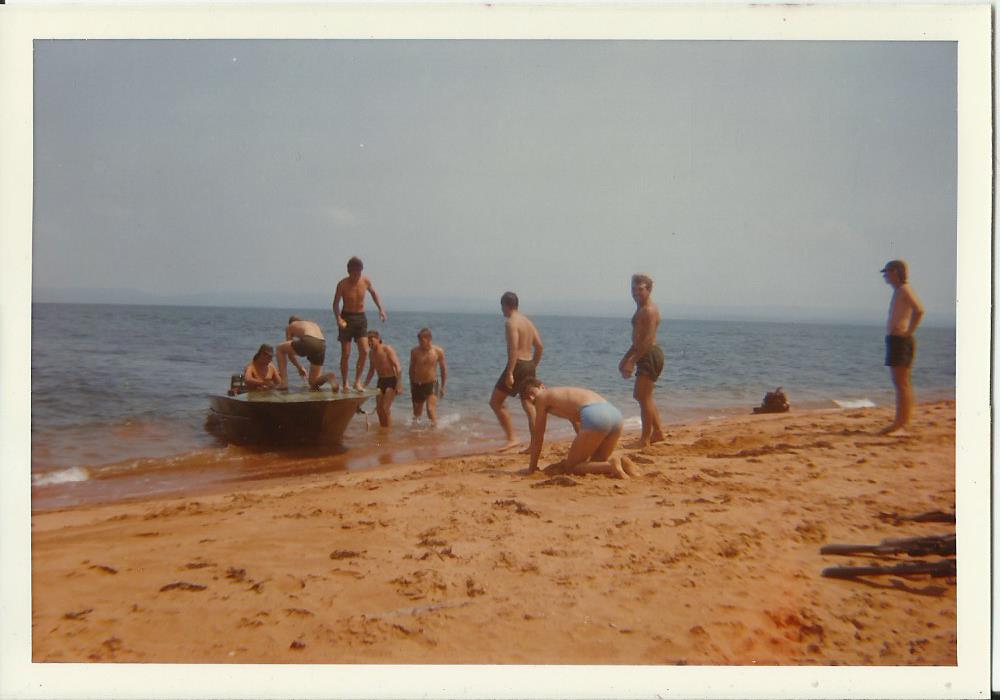
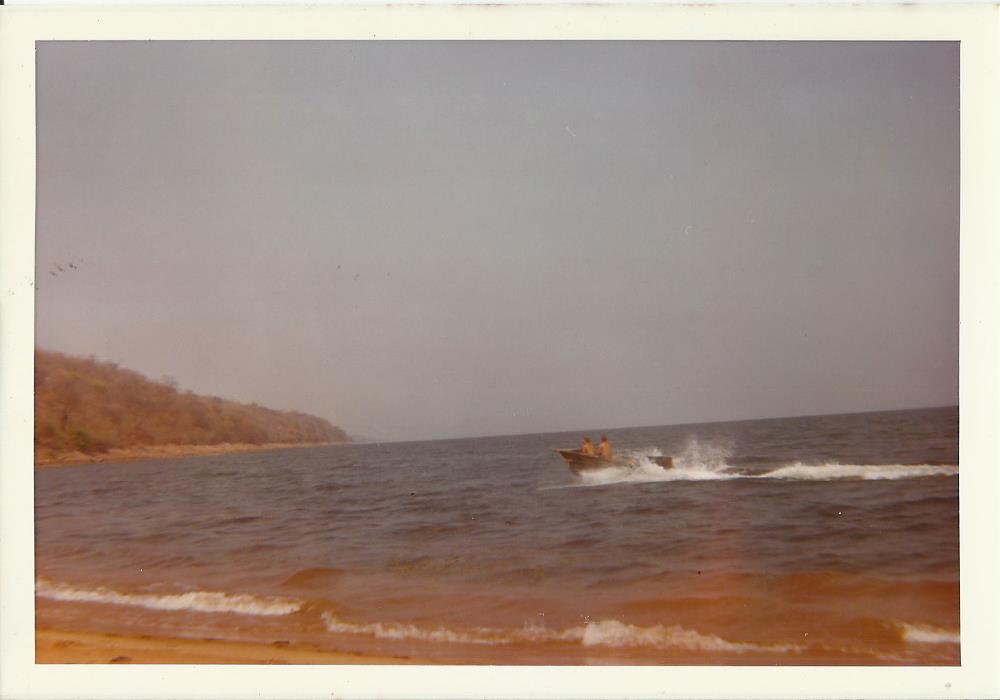
Rhodesian Navy: Boats on Kariba Binga stint (Oct 1973)
Intake 132 did their boat-training at Binga. We made camp at the back harbour. Corporal Hydes was our instructor at the time. We trained in the 1945 Hercules and a South African Sail Fish boat. See pics below: 


 Kariba stint (Oct 1973-Feb 1974)
Doug ******* and I were attached to the Selous Scouts based at Kariba Heights. Sergeant Ant White was in charge of us. I was a banker by profession and Doug was; I don’t really know, as he was a jack of all trades, but master of none, except womanizing. He was engaged to two women at the same time, one was a Wankie mine disaster widow and the other was a sweet young lady he met in Salisbury. At Kariba, he picked up another potential fiancé, I suppose this was his strategy of getting laid… Our first job was to retrieve our Hercules boat from below the Kariba Dam wall, where it was used by the previous operators, don’t know who they were. Apparently, at full throttle, both Johnsons kept the boat at a standstill. And this was against the water current from the dam turbines’ out-let only. Also, apparently, when the Sappers who operated this boat originally, went down to the boat, the Zambians would come down and try to intimidate them, by pointing their weapons at them and shouting abuse. The Sappers responded by giving them a full bare-butt salute. See pics below: 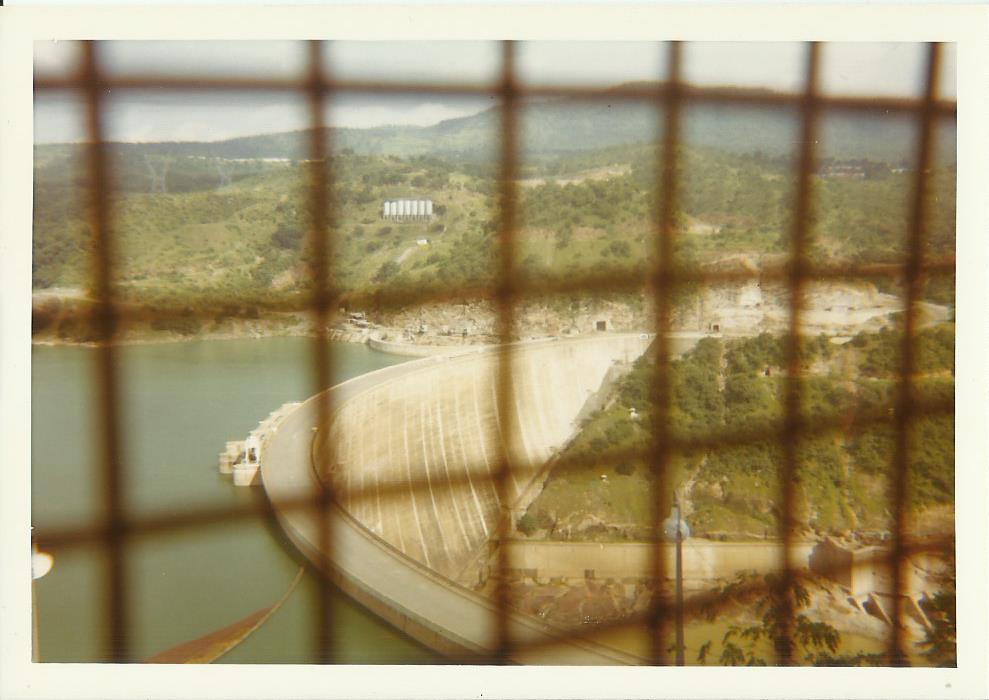
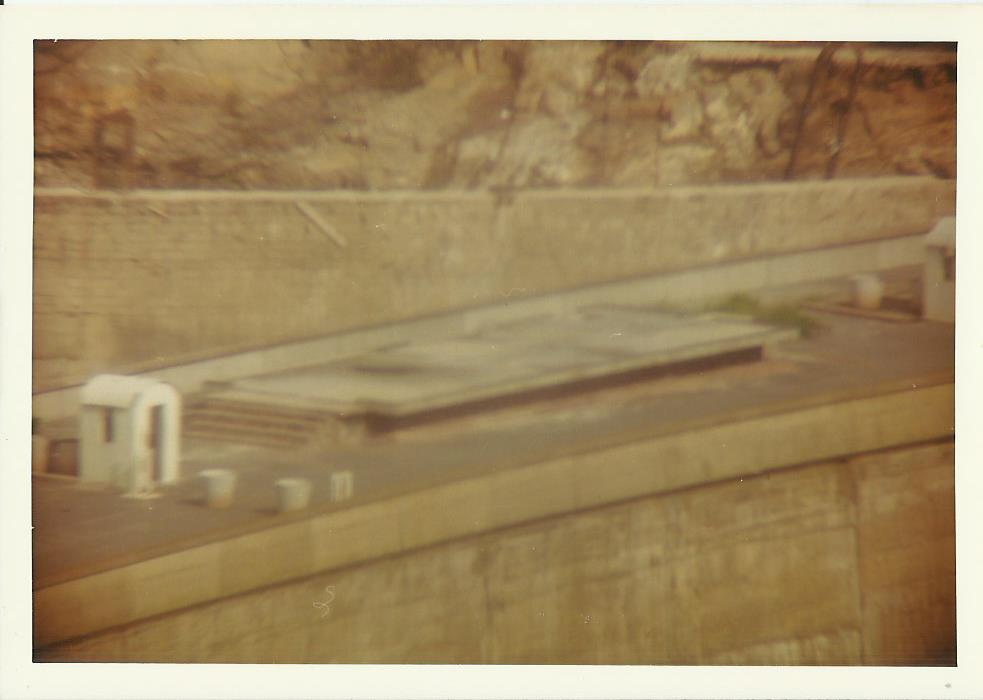


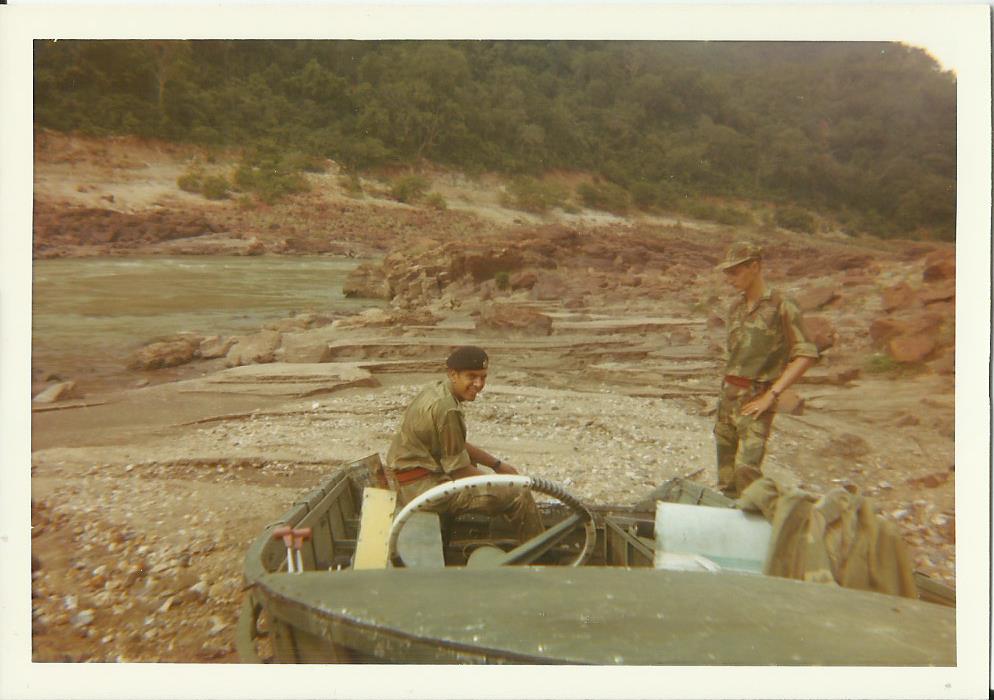 Our second job on the boat was basically to service our 2 x 40hp Johnsons, which Doug did exceptionally well. During our training, no one told us that whilst in a harbour, we were not allowed to do speed-tests, which was just messing around really. But when we were called in front of Col Ron Reid-Daly, we realized that we had caused major upsets with the other civilian boat people, as their tools etc could have been donated to Andora harbour’s murky waters. We both were made to feel like “you know what” and we both were taught a valuable life-lesson that day.
Early January 1974, during our service with Ant White, we (Ant, myself and Doug) were choppered out to a land-mine blast at “D” Camp, at Chirundu. These camps were hunting lodges alongside the Zambezi. A South African Police team were returning to their base camp when they bummed a lift from the National Parks guys; they were using two Rhino vehicles and both were over flowing with SAP and National Parks rangers, Kevin Woods, who was with the National Parks and travelling in the second vehicle, was sitting over the step-up of the Rhino vehicle. As they were leaving “D” camp, the second Rhino hit a land-mine. Kevin’s feet were badly injured, he lost one foot. And the SAP in the vehicle were all injured, one having a broken back. As our chopper dropped us, so it took the first bunch of casualties to Wankie hospital and had to return for more. We started our mine clearance immediately and the three of us were off. I noticed elephant footprints and they were fresh, so I prodded them too, and was rewarded with my first land-mine discovery. The terrs had laid one and disguised it in a footprint. Shit, I started to shake and then we realised that the laying had been done very recently, as when the Rhino vehicles had gone into “D” camp, they would have popped one as the vehicle tracks went right over the mine. So the terrs were close by. We disarmed the mine and then were told that we had to sleep over as the chopper could not return to collect us as it was too dark. I don’t think the three of us got any sleep that night. As when we were choppered in, we just had our webbing and prodders with us, no food etc. Again I had visions of the Kariba spider doing its worst to me. Another lesson was learnt here; be prepared for the unknown, as your lift back may be delayed.
On another mission we attempted to take one stick of (1 x 4) Selous Scouts to Fothergill Island in our Hercules boat, but right from the start into the trip we started to take on water as the waves got progressively bigger as the day grew older, and we set off late in the morning; rushed idea by someone at the top. Luckily we were assisted by the “Janet” launch, (sister ship to the Armenal; Janet, was Ian Smith’s wife’s name, and the Armanel was President Du Pont’s wife’s name, the wives were sisters too if I recall correctly). We were thankful for this as we were following instruction only and still had a lot to learn about actual mission work. For example the thumb tip of an open hand to the tip of the “bird” finger equaled 2 x full tanks of juice. And our boats could only take 4 x passengers and two Sappers only, and 2 x fuel tanks only, so our mission was aborted. We could have been the first boat crew to go down (not only been sunk) in history but with the Selous Scouts not being too happy either.
Ops from here on were better planned and were not so ambitious. Another op was very secretive, in that no one, not even Doug was allowed to know of. I had to take two Selous Scouts to a destination beyond Chirara, and help set up a terr base camp. This included everything one would expect to find in a base camp, even dirty woman’s clothing, cooking pots, food, fire places, uniforms etc. We even had to build make-shift lean-to’s. Plus dig shell-scrapes and some trenches. This was for training purposes. Ant White’s trainees were to find this base and then, who knows what? Interesting out-door work to say the least.
At about the same time, Ant was training up the first Territorial tracker unit, which also had to undergo a form of Selous Scout training. One such op related to survival training. After an intensive 6 weeks of training, these chaps were then told that they are off to go see the snake park, and they were to come as they were dressed; PT shorts, camo shirt and takkies only. They were taken to the harbour, and before boarding “The Janet”, they were searched. The search was to find anything that these guys could use to help survive. As they had to survive by using what skills they had been taught during their training. Sometime during their training, someone lets a few tricks of the trade out of the bag, and these trainees were told to expect the unknown and to hide things like match-heads, short pieces of wire, in the seam of the shirt-pockets and PT shorts. But Ant White was wise to this. Each guy was thoroughly searched and I doubt anything got passed him. We dropped a group off on each Island. One island was called “189”, it’s the biggest island you can see from Kariba Heights, and then there are two smaller islands to its right. (The very small island on the extreme right, I was told, is where Andre Rabe, the first Selous Scout killed is buried.) See pics of the two teams, one guy is holding the shell of a tortoise he found and ate: 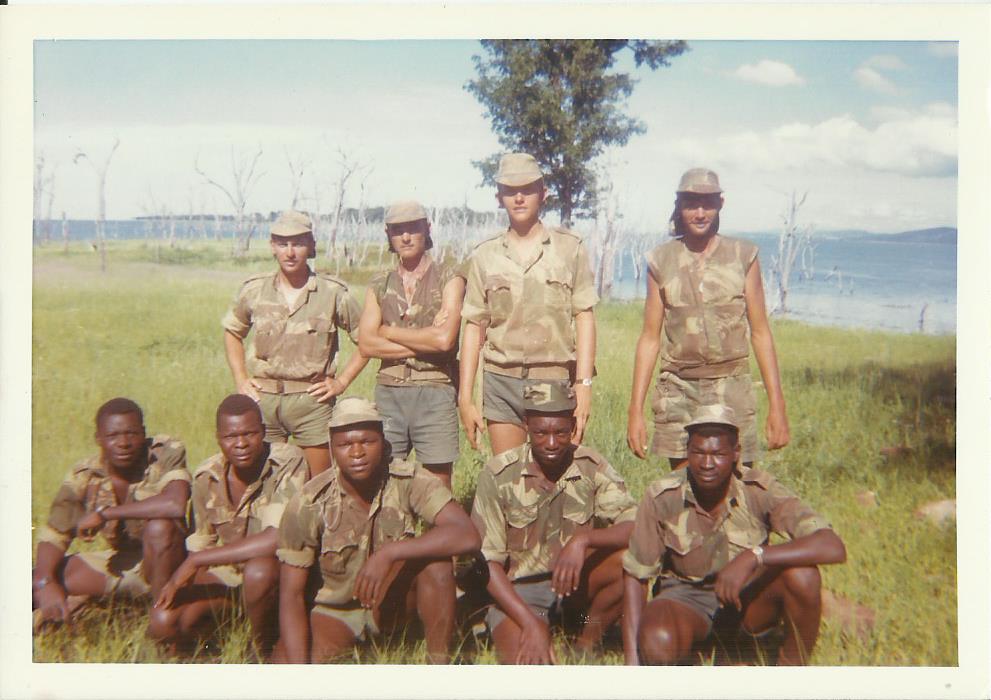

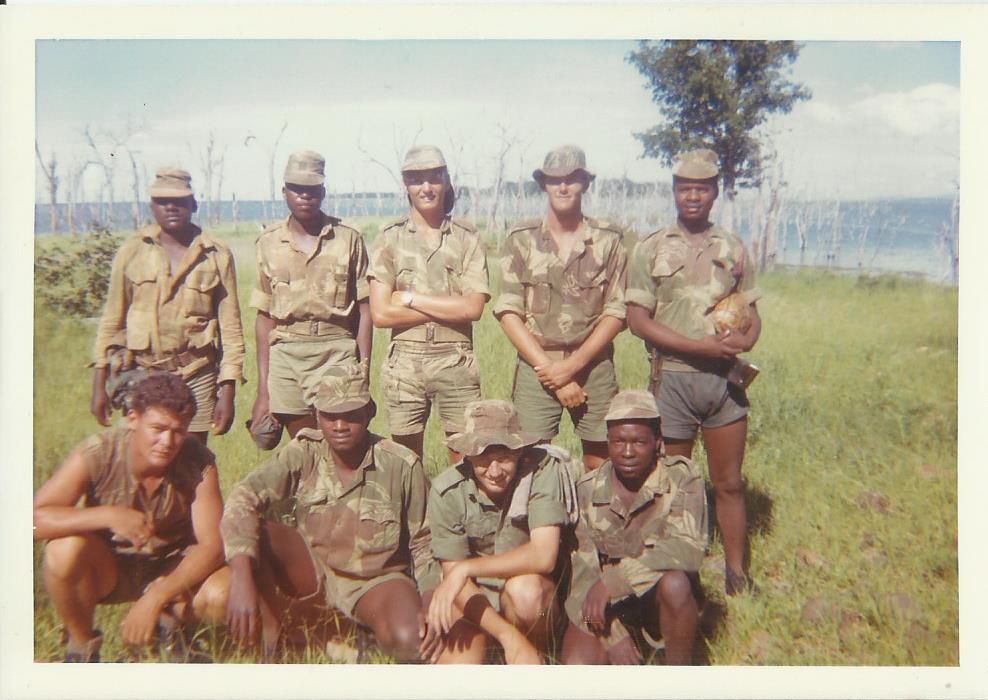 Our function as the boat crew was to be on stand-by during the week these trainee trackers spent on the islands. We speared fished daily and generally had a good time. We smoked the fish over a fire etc. The only problem we had was with mother-natures hippo, as we set up our camp right on a hippo path, because it was clear of vegetation and the dreaded Kariba Spider, these spiders caught birds in their webs etc, and innocent Sappers too. However we made sure our fire was kept burning, especially at night. Not my idea of an ideal camp site…..see pics:


 If anything was wrong with the trainees, they were to build a fire and we would come boating. Yes, we had a couple of night fires that we had to attend to. One was a snake bite, and another was a scorpion bite. Also one guy’s venereal disease played a role of him being boated off the island and off the course. Good thing that the trainees knew how to make fire. Our biggest problem on Kariba, especially at night is navigating the boat through the dead forest of Mopani trees. We destroyed a few share-pins, and changing these at night was a nightmare (also see https://fatfox9.wordpress.com/2015/04/02/on-the-boatsup-the-creek-with-the-sas-part-5-also-known-as-eight-men-in-a-leaky-boat/). When it was my turn to change one, I could always see a dam crock in my mind, so I did this job very quickly while Doug watched with his FN at the ready. Perhaps if a crock did show, would Doug know what to do? I am still here, so no crock fancied me. I also had the pleasure of spear-fishing with Sergeant Stretch Franklin, of the Pioneer experimental pseudo group. We and some others took the boat out for a fun day, i.e. spear-fishing.
2nd Binga stint (1975)
(The Binga stint was during the period we were building Causeways through out the roads off the main Binga road, towards the dam area between Mlibizi and Binga. Keith Bing was with us and what a character he was; he was the grader operator. It was our luck that the RAR needed boat operators, and they were camped at Binga), Dave Stewart, he was from Fort Victoria, was my partner on the boat when we were attached to Major Drake of 1RAR at Binga. We also undertook combat engineer duties too. We operated from the front harbour of Binga, left to Mlibizi, and right to Sinamawenda, (sp) the research station past Chete gorge and all the little islands between these two points. RAR soldiers on a boat is a nightmare, as they have a fear of the water. By this time, we had learnt that being on the lake, ones mission had to start at 04h00, this was when the lake was at its calmest. Kariba’s progressive waves can get as big as 3 metres or more, this is the radius height, so in actual fact, the progressive wave’s diametre is 3 metres in size. I.e. imagine an “S”, from the top of the S to its middle, is what is above the water, this will be 1.5 metres and the bottom is under the water, another 1.5 metres, and is moving in whichever direction the wind was blowing. And popping these waves head-on, sends shudders through the whole body. It was a wonder that our little boat survived the thrashing. The RAR guys turn white/grey and just hang onto their dog chains and pray to their ancestors, all their weapons and kit is also secured to the chain. We also had a Machine gun mounted on the front deck, which also took a beating. We were a Mercedes crew travelling in a Mini. I have often had a stand-up shouting match with Sergeant Majors who want to move around on the boat. As before we start our mission, we balance out the weight, and any movement upsets the plane etc. We explain all this shit to them, but having a fear of water is very strong. Major Drake would tell these guys that we are in charge, no matter what, but we still had plenty of verbal punch-ups. We took sticks of RAR soldiers to the islands, dropped them off on one side, and then tiger-fished all the way round to the meet-up point. Great fun, but nothing went to waste. The RAR cooks got most of the tiger we caught. And we also threw some tigers to the beloved fish-eagle, the one with the white head and brown body. A true african beauty, especially its cry. I have a 5kg Tiger from my RAR stint on my wall to-day (1975). Plus one from Mtetsi Mouth caught whilst doing the Deka mine-field in 1978.
Dave and I had to go to Sinamawenda (sp) Research station as the terrs had crossed over and took some of the staff hostage. This trip with a stick of RAR soldiers was worth a medal in itself as it was a fairly far trip with non swimmers. The terrs also ransacked the place. However, months later it came out that a certain RR company were there and had also ransacked the place as well as Sijarera Fishing camp (sp), which is on the same route. This came about when an Engineer Lieutenant ******* acquired a pistol and tried to license it. During the license process it was discovered that this weapon was reported stolen from Sinamawenda (sp) Research station. This discovery was bad news for Senior Military personnel as a few officers were “cashiered” from the army. A sad day indeed.
Van der Riet’s hunting camp 1975
During Dave’s and my camp with the RAR, the District Commissioner of Kariba was flying to Wankie, and was overhead Van der Riet’s hunting camp when he spotted a Land Cruiser which had detonated a land-mine. A chopper was dispatched to collect the injured, and Dave and I spent nearly 12 hours in a 4.5 getting there to look for more mines. Peter Parnell had started the up-grade of this escarpment road, but was ambushed a couple of months earlier and killed at Crocroft Bridge (sp). We arrived late at night and started to clear the area. But being so dark etc we were not doing justice. So we slept a crap night and resumed our search in the morning. The road had a “Y” intersection, and the mine was placed on the hunting camps road. We did a 2 kilometre length search on the other section of the “Y” to no avail. It was the norm for the terrs to lay 2 mines in tandem, so after doing 2 kilometres we decided that it was clear and also no antii-personal mines were planted on the verges. We were thorough Combat Engineers back then. We then were treated to a breakfast at the hunting lodge, where a group of Americans were visiting. They wanted to take pictures of all of us. But Dave and I refused. We had one RAR machine gunner with us, and when the yanks wanted to take pictures, the other RAR guys nearly killed themselves, all diving for the machine-gun. This is a prestigious weapon to be photographed with. Dave and I lost respect with the Yanks, they showed us their bragging photo albums. There were pictures of taxidermied squirrels holding ashtrays, etc , and when David saw the Yanks posing with a Sable bull which they had shot, he lost it. He was very vociferous about this. Van der Riet took us aside and tried to calm us down. He said that Rhodesia needed the foreign currency etc, and each guy was paying $1,000.00 USA a day, (1975) plus each animal shot had its own price tag above the daily rate, and they had already over-stayed by a week and were threatening to leave soon if they had not got their quota elephant. Van der Riet went on to explain, that his trackers would strategically place elephant dung in the opposite direction of where the elephant was, just to get more days out of the yanks. But at the end of it, the elephant had to be sacrificed for the good of the Rhodesian economy. The people injured by the mine blast had shit for luck. As on their way to Wankie, their chopper developed mechanical problems, and Kariba having the forest of dead Mopani trees and Kariba weed etc the pilot wanted to crash-land his chopper without damaging the rotors, as we were told that SA was selling them to us at a hugely inflated price. Being dusk, he took the Kariba weed as being solid ground and seemed to be clear of dead wood, he was able to put his chopper down, but it sank, and the rotors were also damaged. So, instead of us heading back to Binga from the hunting camp, we were directed to go and assist with the recovery of the sunken chopper, just short of Mlibizi Also, on a follow-up call-up to Binga, Peter Parnell’s team were still busy with the road to the hunting camp, when his grader operator unearthed the tandem mine. This time we were choppered there, and were thankful that the mine was not found in the section of road we had cleared, we were about 500 metres short of finding it the first time. So we learnt that a tandem mine has no set distance.
What a camp?
Basil Preston.
Please also have a look at my website dedicated to Rhodesian and South African Military Engineers. Please join us on the forums by using the following link:
http://www.sasappers.net/forum/index.php
Copyright
© Mark Richard Craig and Fatfox9’s Blog, 2009-2015. Unauthorised use and/or duplication of this material without express and written permission from this blog’s author and/or owner is strictly prohibited.
On The Boats……Up The River With The SAS (Part 1)
February 7, 2015
DEKA ARMY BASE: LATE AFTERNOON
Conversation between Camp OC and ourselves:
“I want you two wasters to get your boat ready for a night operation. You are to take your boat to this grid reference (him indicating on the map) and wait there for someone to make contact with you. You will need spare fuel tanks, 24 hours rations and full ammo. I cannot tell you anything else but make sure you get there just as last light falls and don’t fuck up on the position I just gave you”
That was it. Short and to the point.
It quickly became time to go. As Tony and I climbed into the back of the Mercedes 25 Troop Carrying Vehicle (TCV) we looked at each other and wondered what the hell this was all about. We didn’t even know who we were supposed to meet and more importantly, what for. The driver fired the Unimog up and with a characteristic torque-induced jerk we were off, easing through the camp entrance, and then turning sharp left onto the road to Sibankwazi. To our boat……..and the Zambezi River.
I had looked at the Ops Room map as the Captain briefed us and taken down the grid reference we were headed for. As far as my memory serves me it was at the position marked SAS pick-up position on the map shown below, near to Mapeta Island:

Tony and I had worked the time and distance calculation to get us to the Rendezvous Point (RV) just as last light was coming on. We were both edgy and rather subdued on the journey down to the boat, each of us respecting one another’s silence. Travelling the Zambezi River during the day was a challenge at the best of times, always having to ensure that we never strayed across the international boundary (Rhodesia/Zambia), which was an invisible line running up and down the river, but not necessarily in the middle. We were now going to be travelling on the water towards dusk and more than likely in darkness if our suspicions were right. Logic told us that no one would want us to meet them with a boat if they were not going to use it. We were spot on!
We had trained to work on the Zambezi River at night and knew that the landmarks that we used for daytime navigation, could also be used at night. We always chose high features that would silhouette easily against the sky or stars for navigation. Simply put we would know what feature to point our bows at and which feature our stern should be pointing at to stay safe. Quite an easy task in daylight but in darkness a mans eyes play games, confusing the mind as to what feature is what, what is true and what is false. Making you doubt your own judgement, possibly leading you into a bad place. No GPS in those days…….maps, compass, eyes and dead reckoning. I loved that kind of navigating though. Seat of the pants stuff and a small victory when you arrived at the right location.
We debussed at Sibankwazi, close to our boat. First on the agenda was to check in with the British South African Police (BSAP) personnel at the camp and let them know we were going out on the water. There was nothing to tell really, just that we were going up river and would stay in comms with them. We took comfort in knowing they would come out and help us if the shit hit the fan. They were good lads and always watched our backs. And they had nice, shiny fast boats with big guns on.
Tony and I finished our preparations, cleaning the inside of the boat, filling fuel tanks (2 per engine), checking our small supply of boat spares, running up the engines (which had no covers), checking radio comms with the police and Deka Base, and checking our personal weapons and kit. I would take us on the outward leg and Tony would bring us back. What happened in between we would share.
The picture below shows Sappers carrying out typical boat preparation activities. This is the exact same type of boat we were using on this mission (Basil Preston):

It was time to move out. I moved the throttles to the start position and made sure the engines were in neutral. Tony pumped the primer balls to get juice into the carbs, wound the starting rope around the first engine and pulled it. The engine fired and I adjusted the throttle to a gentle idle. He started the second engine and we were ready. I let the two engines idle for a minute or two while Tony made sure water was being expelled from the cooling system outlets.
I gave Tony a thumbs up and he slipped the mooring line. I moved both engines to reverse and we began gently edging astern and away from land. Once far enough out I put the engines in forward gear, pushed up the revs and pointed our bows north-west…..into the gathering gloom……we were on our way.
The picture below gives an idea of the Zambezi River at night……..a very dodgy place to be, especially if there was no moon:

Please also have a look at my website dedicated to Rhodesian and South African Military Engineers. Please join us on the forums by using the following link:
http://www.sasappers.net/forum/index.php
Copyright
© Mark Richard Craig and Fatfox9’s Blog, 2009-2015. Unauthorised use and/or duplication of this material without express and written permission from this blog’s author and/or owner is strictly prohibited.
On The Boats……Spinning Flywheels and Dodgy Sergeants
December 17, 2014
I received this personal account from Neil Potter…….another veteran of the Rhodesian Engineer Boats!
Neil takes up the post from here:
I had the dubious honour of falling over and between a pair of those Evinrudes, running without the covers on, after just pull starting both. The idiot at the controls, a 2 Indep. NS Sargeant fresh out of Hooters, decided that it would be funny if he gave both motors full throttle when I asked him to give the port motor more revs (via the warm up lever as I had instructed him beforehand as that motor always stalled). I had both legs badly cut up by the flywheels, a hundred plus stitches later, and friction burns around the wounds. What really irked me was a few years later I pulled my file in the orderly room in Kariba and read his statement to the effect that I had caused the accident by pull starting the motors in gear! He even had one of his troopies verify that by making another statement to that effect, even though that individual was not even on the boat with the others going out on patrol.
One of the drawbacks of not having a crew member with you I guess, but I’d enjoy a conversation with that idiot if I could only remember his name.
Now that’s just the sort of thing that can happen when you have idiots at the controls. Good to know Neil got out of it in one piece though and a big thanks to him for the recollection.
For those of you that don’t know what an outboard motor flywheel look like, here is a picture for illustration:
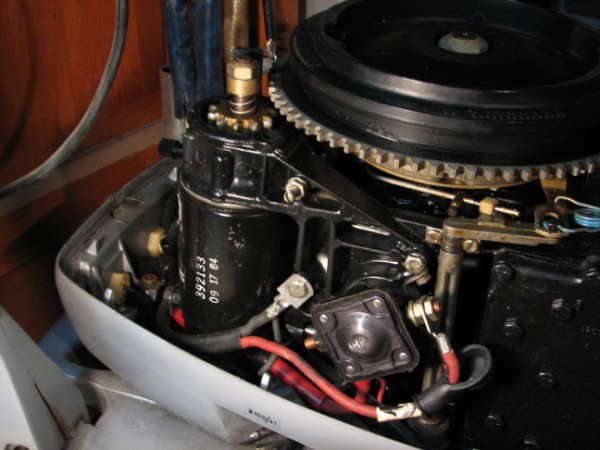
The flywheel is the big round black thing on top and when the engine is running it spins at very high revolutions. Imagine two of those spinning side by side and like Neil, falling onto them because some asshole opened the throttles………..and our flywheels were a lot less smooth than this one. We had all sorts of jagged bits sticking out to bite us.
More on outboard motors, flywheels, shear-pins and other animals in the next post.
Please also have a look at my website dedicated to Rhodesian and South African Military Engineers. Join us on the forums by using the following link:
http://www.sasappers.net/forum/index.php
Copyright
© Mark Richard Craig and Fatfox9’s Blog, 2009-2014. Unauthorised use and/or duplication of this material without express and written permission from this blog’s author and/or owner is strictly prohibited.
On The Boats…………(Part 1)
December 6, 2014
I watched the snake slither along the wooden rafter of the hut, its black tongue flicking ahead, feeling the way. Lying on my bed and looking up at the bright green reptile I wondered what my escape plan was. It was the first time a mamba had come into our billet but I always knew our luck would run out one day. We were after all in the middle of the bush, working out of Deka Army Base and snakes were quite commonplace. I didn’t like snakes then and I don’t like snakes now. Just one of those things. Anything else I can handle.
Here is a picture of a Green Mamba (greenmambasnake.com)…..a very dodgy visitor indeed:

There were two of us. Both Sappers from 1 Engineer Squadron and attached to the infantry unit at the camp. I think it was 1 Independent Company from Wankie based there most of the time on Border Control operations. Tony Carinus and I were tasked with operating a Hercules Assault Boat within our area of responsibility on the Zambezi River, and our boat was moored with the British South Africa Police (BSAP) boats at the Sibankwazi Police post. We had approximately 60 kilometres of river to patrol which was quite a stretch and we tried to cover this as often as we could.
Our boats were shite-looking and the police boats were all shiny and painted in cute pastel colours with lots of aerials on them so they could listen to Sally Donaldson and Forces Requests on Sundays. Papa5 was a particularly nice police boat that I would have given my left testicle to take onto the river but big John Arkley, the Member-In-Charge of the Sibankwazi BSAP would not allow it. We never had any aerials as we had no one in particular to talk to and the boats were painted a matt dark green, or at least they were green when they were new which must have been in 1945 or earlier.
Here is a picture of one of our boats (Basil Preston):
Please note the warped wooden seats made for extreme anal comfort, and the generally dodgy state of seaworthiness. I must say that this boat at least has engine covers on the twin 40 ponypower Evinrude outboards so is probably a VIP version. A close look at the red fuel tank also indicates it was probably “borrowed” from a civvy fisherman on a long-term basis as ours were a dull drab brown colour. Either that or the QM ran out of camo paint or brushes, or both.
Here is a picture of the area of the Sibankwazi Police Post (www.bsap.org) where we moored up.

Our boat was not allowed under the shelter because there were too many shiny police boats in there. We normally tied up to the left of the shelter near the launching area (see above). Having said that the bobbies were always very good to Tony and I and we had many good piss-ups and braais with them. They were also destined to get me out of some fairly serious shit in the years to come.
Tony and I normally planned our own activities and it seemed in retrospect that the infantry Sunray (OC) at the camp never had much interest in what we got up to all day. Only occasionally would we drop-off or pick-up infantry sticks along the Rhodesian side of the river. This resulted in a lot of tiger fishing, game viewing, stopping off at Msuna Mouth or Deka Drum resorts for beers and a meal, or simply patrolling up and down the river looking for gook crossing points or even better still, some gooks.
This is the Deka Drum area of the Zambezi (Craig Haskins)………

A pretty enjoyable time for me and Tony in general and I have fond memories of my days on the boats. We did however have some dodgy experiences and these will part of the next few posts.
Please also have a look at my website dedicated to Rhodesian and South African Military Engineers. Please join us on the forums by using the following link:
http://www.sasappers.net/forum/index.php
Copyright
© Mark Richard Craig and Fatfox9’s Blog, 2009-2014. Unauthorised use and/or duplication of this material without express and written permission from this blog’s author and/or owner is strictly prohibited.
 Fatfox9's Blog