Sleeping Snakes and the Whistling Sapper
September 22, 2025
I mentioned in previous posts that the Engineers were often utilised in the Infantry role, or at the very least expected to carry out what are customarily Infantry tasks. There was no operational or tactical issue with this concept as all Rhodesian soldiers, regardless of any additional Corps affiliation, were also Infantiers – the fundamentals of these skills being taught during basic training. The Rhodesian Corps of Engineers were Combat Engineers in the true sense of the word, trained to take on the enemy in face-to-face combat, and also carry out a wide variety of Military Engineering tasks. The account that follows is one of these times and is vividly burnt into my brain……despite an ever-fading memory of an event that took place over 50 years ago.
Early that morning I had just finished a sickly sweet condensed milk coffee and going through the guard commanders evening occurrence book in the ops room when I heard a vehicle pull up. I stepped outside to see who our visitors were, recognising the doorless dark green Land Rover straight away as a British South Africa Police (BSAP) vehicle from Wankie. The two occupants were already standing next to the vehicle, both in civilian dress. I knew both of them – one was a BSAP Special Branch (SB) officer, the other was my Engineer OC from our Wankie (4 Indep Coy) office. After the usual greetings and inter-service banter I invited the two of them over to my office, ordering a jug of more sickly sweet coffee and mugs as we went.
The SB officer got straight into explaining the reason for their early and unannounced visit, informing me that I had been allocated a special task that was time-sensitive. My boss-man was there to add context to the briefing during which he confirmed that the operation had been authorised by 1 Squadron HQ in Bulawayo.
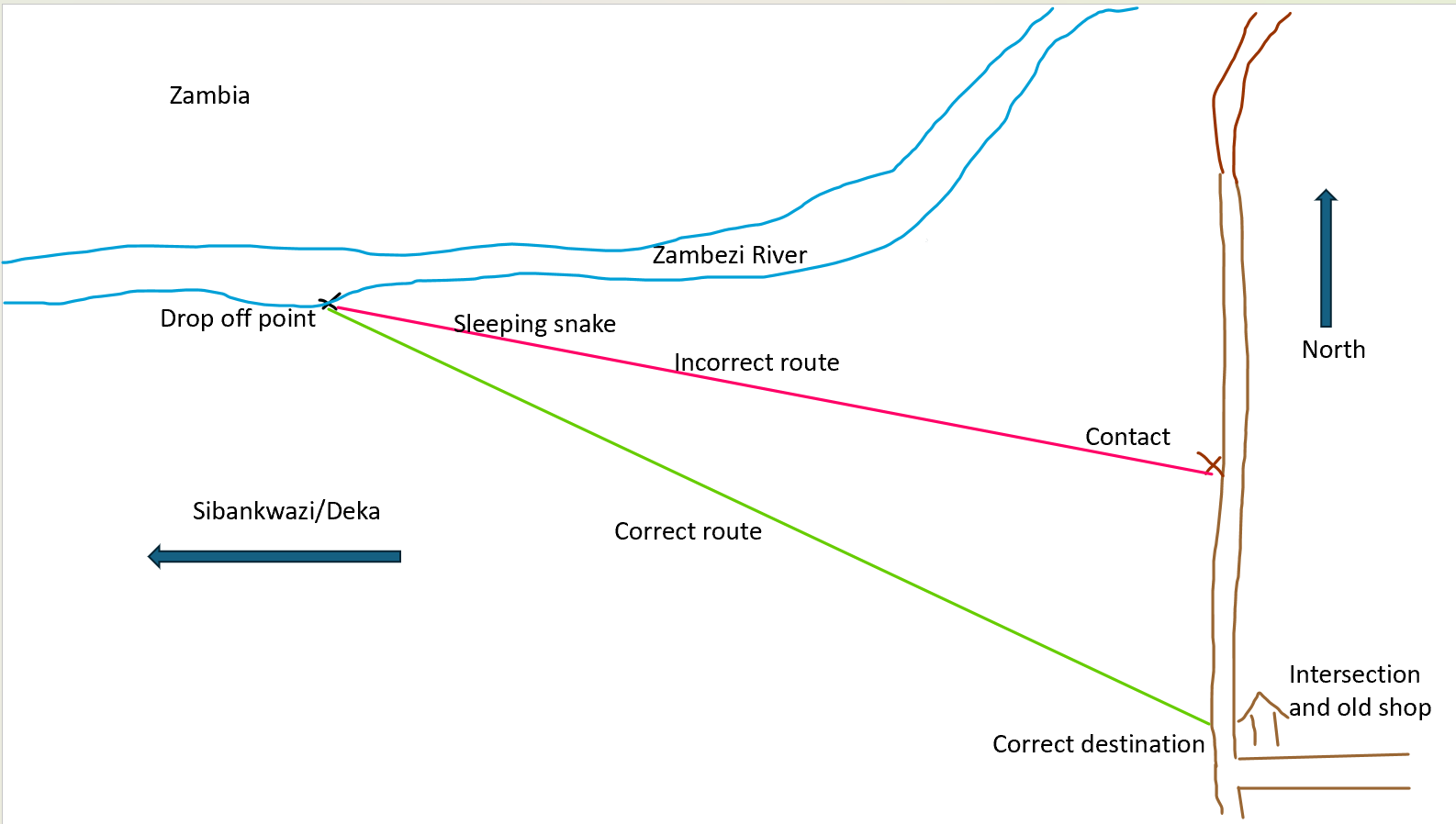
The mission was straightforward enough. “Hot”1 intelligence (I had to resist rolling my eyes – as I had been down that road before) had been received that a group of terrorists were going to be using a certain road intersection as a navigation point – a well-known terrorist method of moving from point A to B without getting lost or disoriented. They were expected to be at this point within a fairly short space of time – from what was known, within the next 24 hours. I was to lead a reinforced “stick”2 of 8 Combat Engineers to set up an ambush position adjacent to the said road intersection, and hopefully make contact with the enemy. The road that we would initiate the ambush on ran along a fence line from north to south, the intersecting road running east to west off of this at a very neat 90 degrees. There used to be a small general store at the intersection, but this was now derelict and in ruins. This feature should make it easy to confirm that we were in the right place.
Lastly I was ordered not to cross the fence under any circumstances – we were to stay on the western side of the road. No reason was given but I assumed this to mean we may have pseudo units in the area.
The tricky part was going to be getting there in time. We were going to be deployed by a BSAP patrol boat as the planners figured that this would be the quickest way, seeing that there were no Cyclone 7’s (Alouettes) to troop us in – they had other commitments. There would however be one Gunship on stand-by at Wankie Forward Air Field 1 (FAF 1) in case of a Casevac requirement.
Once we had confirmed callsigns, map numbers, grid references and the proposed route to the target area, our two visitors left, travelling the short distance down to the BSAP post at Sibankwazi to arrange the boats that would deploy us to our drop-off point along the river.
We had an hour or so to prepare before we too would travel down to Sibankwazi, and wasting no time I summoned the two Corporals whose sections would take part in the mission, and after briefing them, ordered them to ensure their men would be ready to move within the hour. Rations, water, weapons and ammunition needed to be inspected – radios checked and extra batteries drawn from the signaler. The chef was given instructions to make an early lunch for the troops going out with me – this would ensure we would all have full tummies before we moved out and sustain us until late afternoon.
With all preparations complete, I issued last orders to my second in command and we embussed onto an idling Rodef 45 Troop Carrying Vehicle (TCV). Handing my weapon and kit up to one of my troops, I hauled myself over the side of the vehicle and settled into one of the seats. My second in-command was standing next to the vehicle and I looked down at him – he was a good lad and would look after the camp while I was away – he was destined to become one of the first Black officers in the Rhodesian Corps of Engineers, and decorated with the Bronze Cross of Rhodesia.
The journey to Sibankwazi took no more than 30 minutes and we travelled down in silence, each of us thinking of the task ahead. We debussed on arrival and the troops moved the kit down to the jetty where the police launches were moored – the vehicle that dropped us off doing a three-point turn and returning to Deka camp. I asked one of the Corporals to carry out a radio check with our TR48 HF radio and confirm comms with both Deka camp and our Wankie HQ.
There was time for a quick brief with the Sibankwazi Member in Charge, a great friend of mine to this day, and we walked down to the boats together – he would skipper one of the boats out. I remember her callsign was Papa 5, she was a beautiful cruciform-hulled craft, painted white and light blue. We split my team between the two boats – the two skippers setting the trim, and we shoved off, travelling east down the Zambezi River.
Having made a time and distance appreciation while still at Deka camp, I had decided that we would be dropped off at a suitable point along Devils Gorge, approximately 20-30 kilometers east of Sibankwazi. The trip out was pleasant and the river calm and peaceful. By stretching the imagination, one could even believe that we were on a pleasure cruise, except we knew where we were. And always we had to remember that Zambia, home to our ZIPRA enemies was just a stones throw away off our port side – we had probably been observed through a pair of high-quality Russian binoculars or a Dragunov3 telescopic sight from the moment we had shoved off the jetty.
I was looking for a good place to be dropped off, the Devils Gorge towering high above us. It would be a hard climb to the top and I wanted to find the easiest access route up for us. I found what I hoped was the best place, a disused (hopefully) elephant trail that led from the river up to the top of the gorge. Elephants are pretty good at crushing everything that got in their way and they made wide super- highways down to the edge of the river from the top of the gorge – these for them to quench their thirst in the sweltering Zambezi Valley . In theory this should make our haul up the gorge much easier than hacking our way through virgin bush. The boats moved into the cleared space sideways on and we jumped onto the river bank, one by one. Before the boats departed I double checked my location on the map with our skipper and we both agreed on my current position. He would send the coordinates of our drop-off point back to Wankie HQ when he got back to Sibankwazi.
As the two boats disappeared from view we began the climb up and out of the gorge. Elephant are intelligent creatures and therefore clever enough to choose the shortest route up and down, meaning it didn’t take all that long to get to the top. Initially our progress was hindered by lack of grip as our boots slid and slipped on the crushed and slippery, elephant-crushed reeds close to the river but as we got higher it became easier and the super-highway was kinder to us. We eventually all made it out of the gorge safely in what I felt was reasonable time. Just off the crest, we went into all-round defence and I gave the stick a 15 minute rest. I would use this time to do some map work – check the grid bearing to the target on the map, and set my compass, making the necessary adjustments for magnetic declination.
Before leaving our rest area we all checked our kit for for rattles and loose items. We needed to sort these details out now as one thing that was a dead giveaway to the enemy was the sound of a stick moving through the bush like a bunch of church bell-ringers on a Sunday. With one look back towards the mighty Zambezi, I stepped the men off, heading south-east. I had calculated we would need to travel roughly 12 kilometers to the target area – and keeping a steady patrol speed of around 3 kilometers per hour we could be close to our destination in 4 or so hours, including stops. This would bring us to where we wanted to be just before last light – our chosen killing ground.
If climbing out of the gorge was reasonably easy, descending the other side was even easier as we still had the benefit of the jumbo super-highway and now we were going downhill……..some slips and slides along the way but we all arrived on the escarpment floor unscathed. I was happy to note that the men’s kit was nice and quiet, even when making sudden movements – the MAG gunner had done his very best to keep his ammo belts behaving themselves as well. As we reached flat ground, I got the men into extended line, and double checking the direction we were heading, gave the signal to move out.
We had been on the move for about 30 minutes when I noticed a rather large fallen log on the ground that I needed to step over. As I placed one foot on the other side of the log I looked down more closely to ensure I didn’t stumble and almost pissed in my pants. The “log” was actually one of the biggest pythons that I have ever seen – just lying there in the sun and minding its own business, its silvery-grey and black scales shining in the sun. I got my other foot over the sleeping snake, making sure not to touch this magnificent creature, and moved off quickly, leaving it to continue snoozing. I assumed the snake had recently had a big meal as it had no interest in me at all, and its quite true that if you avoid annoying them they will leave you alone. Fortunately my troops were blissfully unaware of the python, as had they seen it there would have been much shouting and running about – possibly bringing an unwelcome reaction from our sleepy friend.
Having walked for an hour we took a short break and carried out a radio check with the TR48 – all good and we marched on. I wanted to pace our advance to allow us to be within 1 kilometer of the road intersection just before last light – moving in only after we had had something to eat and a warm drink some distance beforehand. We also had to assume that the bad guys may have already crossed the road and were on our side of the road – alert levels were high, as with any patrol and we needed to keep our eyes and ears well tuned, or we could be going home in body bags.
I managed to get the timing just the way I wanted it – last light about 30 minutes away and we could see the north-south road just up ahead. If my map-reading was accurate the intersection and ruined shop should be just south of us. I got the troops into the prone position and I moved slowly forward on my own to confirm our position was correct. Leopard crawling through the long grass I edged towards the road until I was on the verge. I needed to be able to look both ways up and down the road which I managed to do – but there was no intersection and there was no old shop. I quickly checked my map after moving back from the road – I couldn’t make out where I had gone wrong. My problem now was working out which side of the intersection we were. Should we move south or north to locate it? With the sun now disappearing fast there was no time to waste and I decided to move a little more to the south. Getting the troops moving again we proceed until it would be not be in our interest to continue any further. I checked for the intersection and old shop again but there was nothing. It would appear my map reading skills were rubbish. I made the decision to set our ambush where we were and bite the bullet if we missed the gooks – the only consolation I had was maybe the intelligence was wrong in any case.
It was almost dark before we had finished our preparations and I was happy with our position. I had decided on a spot about 30 meters from the road with good visibility – we settled down for the long wait, the MAG gunner next to me – he would initiate the ambush on my command.
It was indeed a long night, taking turns to catch some much needed sleep we waited, and waited. My concern was that we we were nowhere near our intended position and we were simply wasting our time. Ones mind plays games in the bush at night – rustling in the undergrowth, owls calling and a myriad of animal sounds all around. Someone snored and was quickly silenced with a whispered curse – and the hours ticked by, seeming like days.
We were all awake before first light and this was a critical time – nothing had happened overnight and we could easily be drawn into a false sense of security. It was deathly quiet – nothing moved.
We all heard it at the same time – someone talking in African dialect, accompanied by the sound of people moving. I strained my eyes in the dim light, squinting through the wet grass- all of us now on full alert, adrenalin pumping. And then, incredulously, there was man standing on the opposite side of the fence that ran alongside the road – right in front of us. I couldn’t quite make out who he was as he started to climb over the fence. More of them followed – my brain began making a million calculations as doubt set in. We were out of position and what were the chances that the terrorists had made the same miscalculation and were now right in front of us? For some unknown reason I whistled at them and it was then that I saw the tell-tale AK magazine and gave my gunner the order to open fire.
All hell broke loose as my stick began firing towards the enemy……..screaming coming from their direction but no return fire as they scrambled back over the fence and started running – discarding equipment on the way. We started to move forward to the road, but the gooks had disappeared into thick bush and we took up the chase, cautious in case they laid an ambush on their tracks. There was blood on the ground and in the grass, enemy kit strewn about. We would collect it later – no kills for now, but at least we knew we had caused these guys some pain and seriously fucked-up their day.
I decided to get the stick into a defensive position while we radioed the contact into Wankie HQ – in reality this probably only a few minutes after we first opened fire. By chance, there was a Copper (Police Reserve Air Wing – PRAW) callsign flying close-by to us and the pilot had monitored our radio communication. He contacted us and asked for our location, which I passed onto him as well as the terrorist line-of-flight. He immediately flew to our position and established overhead cover and observation, at the same time making a plan to get stop groups placed ahead of the gooks. He was a very welcome addition to our little force as he was able to arrange Fire-Force from another location, together with Alouette gunships to join in. Until they arrived we would continue to follow the spoor until qualified trackers were flown in with more troops to continue the follow-up.
Once relieved we were instructed to collect all of the kit we could and await uplift from where the contact had originally taken place. We would be flown to Deka base by two Alouettes -at least we weren’t walking home this time.
While waiting for our lift I had time to reflect on the days work. My troops were magnificent and done exactly what they had to do – of this there was no doubt. I wasn’t so sure about my own performance though. I had made some fundamental errors and to this day I question a number of my actions. Firstly, I had made a navigation error, or perhaps we were dropped off further east than I thought we had been, making my approach route inaccurate. Either way, by a quirk of fate, we still made contact with the enemy – possibly due to them also not being where they wanted to be. Secondly, I wasted precious milliseconds by being indecisive as far as giving the order to open fire. It is very easy to criticise myself for this as I was there to kill the enemy that was expected to be coming my way – I knew they were meant to be coming but I hesitated. I have tried to justify this by the fact that a) we were not in the correct position to make contact, and b) the order not to cross the fence to the east made me think that there were pseudo teams in that area.
I would like to end this post by asking my readers – if you were in my position what would you have done? All I know is that when you have the power to end someone’s life just because they are there, but you are not entirely sure that they are indeed the bad guys, then perhaps it is prudent to proceed with caution. You decide.
- Hot intelligence was often just the opposite – a waste of time and effort, with sources often providing misleading information. ↩︎
- A section of soldiers on patrol – in Rhodesia this usually consisted of 4 troops ↩︎
- The Dragunov, officially the SVD (Snayperskaya Vintovka Dragunova), is a Soviet-designed, semi-automatic designated marksman rifle that was adopted by the Red Army in 1963. Developed by Yevgeny Dragunov, it is chambered in 7.62x54mmR, uses a detachable 10-round box magazine, and is characterized by its skeletal stock and long, narrow profile. ↩︎
Cordon Sanitaire: Personal Experiences (2: Vic Thackwray)
October 19, 2014
As mentioned in my previous post we will continue with the personal recollections of some of those that worked on Cordon Sanitaire. In this post we have accounts from Vic Thackwray, another former Commanding Officer of mine. I had the pleasure to work with Vic in the Rhodesian Army (RhE), the South African Defence Force (SADF (SAEC)), and also in the private sector after we had both ended our military careers. Vic and I remain close friends and I wish to thank him here publicly for all of the help and sage advice he has given me over the years, and will probably also need to do in the future. I am bound to ask him something and he always responds rapidly and with a genuine willingness. Thanks for everything Vic…..you are one of a kind.
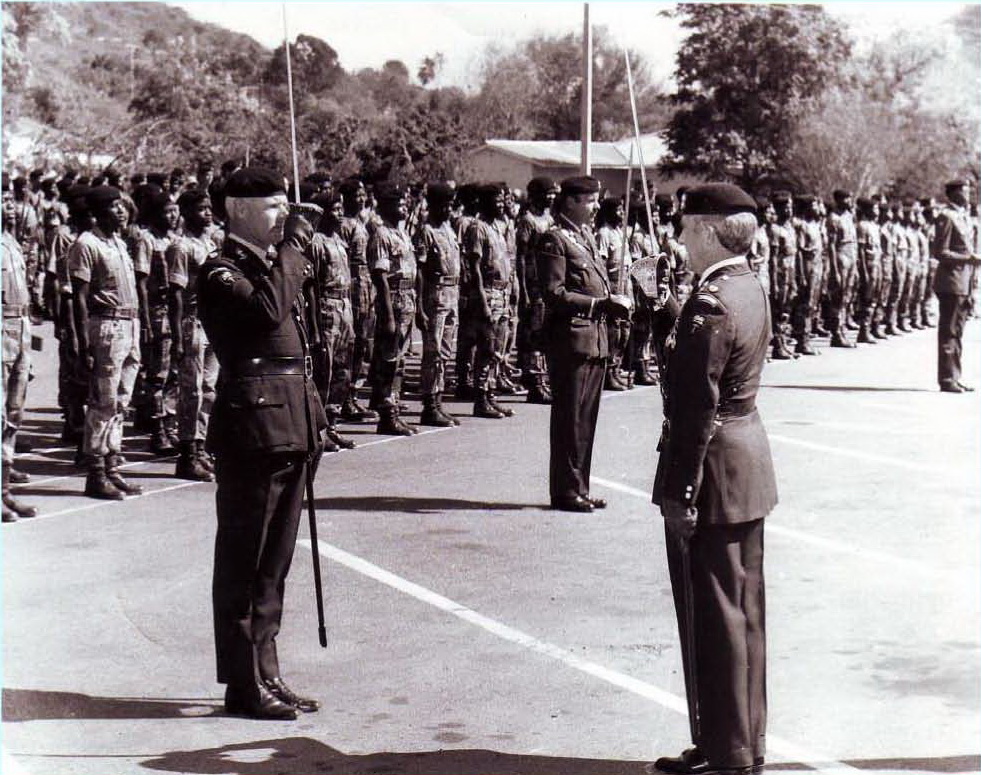
The picture below shows Vic (left, saluting with the sword) as Parade Commander at the Last Official Parade of the Rhodesia Corps of Engineers in 1979……..a sad day indeed and the end of an era but how proud he must have been!!
Vic takes up the post from here…………starting with an interesting and sobering Cordon Sanitaire Fact Sheet:
‘CORDON SANITAIRE’ FACT SHEET
The following illustrates my involvement with the Rhodesian Cordon Sanitaire.
- My initial deployment to Cordon Sanitaire was to take over from Terry Griffin (see previous post) who had trained the first mine laying teams in Mukumbura.
- My second in command was a Corporal Charlie MacQuillan who had recently attested into the Rhodesian Corps of Engineers from the British Army.
- We commenced laying the Portuguese M969 mine. This was followed by the South African R2M1 mine, the South African R2M2 mine, the Rhodesian Engineer manufactured RAP mine (commonly referred to as the ‘Carrot Mine’), and the Italian VS50 mine.
- The Cordon concept was based on the Israeli Defence Force minefield which separates Lebanon from Israel and is called the ‘Blue Line’, the electronics used in Israel were used for the first 50 km or so in Rhodesia but was soon ‘binned’ for financial reasons coupled with the constant triggering of the system by wild animals.
- The total length of the combined minefields is 696 km
- The density of mines was 3,000 mines per kilometer with 300 ploughshares per kilometer for approx 500 kilometers.
- A committee was inaugurated comprising the SADF, the Rhodesian Army, and elements of CSIR in SA and was called the ‘Geisha Committee’. It was formed to discuss, workshop and plan all mine action activities between the two countries.
- One of the senior CSIR members, (name removed) was instrumental in the design and manufacture of the R2M1 and R2M2 AP mines. I was tasked to assist on the ground in the Mukumbura area and established a ‘Seed Minefield’ within our minefield. In this area we laid many mines at predetermined depths and other technical data. On frequent occasions the Professor would travel to the field and I would be instructed to remove selected mines for observation and assessment.
- Accidents involving own troops during laying, maintenance and some clearance numbered 97, of which the majority were traumatic amputations of one leg, and 1 member both legs, (1 above and 1 below the knee) (Sgt. Willem Snyder). Several of the 96 members lost hands, fingers and eyes, 1 unfortunate member Spr Ndlovu lost both hands and blinded in both eyes during the arming of a plough share. The deaths of members numbered 30, however, this figure is not confirmed but estimated by me and several other officers of the Corps. he majority of accidents and ALL the deaths are attributable to the Maintenance phase of the Cordon. I am aware of members being killed when the point Sapper walking down a safe lane was confronted by a snake, normally a Black Mamba or Cobra and he just ran blindly into the minefield and subsequently triggered the trip wire of a plough share instantly dying and often a few of the maintenance team were injured by shrapnel. Additionally other members were killed or severely injured when replacing plough shares during which the 30 metre trip wire was hit by Doves, guinea fowl, small antelope, and turkey buzzards. In the Umtali forest areas where I spent considerable time, several members were injured or killed when the plough share was triggered by falling bark from Gum trees as the Cordon went through many Gum Tree plantations. Again in the Umtali area some 5 accidents were attributed to terrain problems, whilst maintaining the minefield the 15-20 cm. thick soggy/wet leaf mould caused the members to slip/slide and subsequently hit a mine on their rapid descent. One young Sapper lost his leg when he foolishly attempted to retrieve a set of Kudu trophy Horns in the Northern minefield.
- The Cordon, in 99% of cases employed the International Border as the Enemy fence, for obvious political reasons.
- When the terrain dictated that the Cordon could not follow the Border, the proposed route of the field was assessed and this information subjected to a high level detailed Military Appreciation. Changing the minefield routing obviously required high level Political input as it involved, Private land, farms, forestry, National parks, Police, Internal Affairs, and Tribal burial grounds, to mention a few. This appreciation and request was forwarded to Parliament via Engineer Directorate to Army Commander to COMOPS for approval. The agreed rerouting on the Rhodesian side of the border together with detailed maps of the new routing was then subsequently issued from Engineer Directorate.
- The Cordon including all maps, diagrams, drawings, mine stocks and all reports etc., was officially handed over to the New ZANU Commander of the Zimbabwe Corps of Engineers over period April 1980 to December 1980.
Vic continues with anecdotes he recalls from the time:
During the maintenance of the Cordon Sanitaire, we frequently had to deal with wounded terrorists in the field, on one occasion near the Mazoe river bridge on the Northern border with Mocambique we were informed of four terrorists injured in the field, I proceeded with my team, ably protected by “Dads Army” , (the over 50-year-old soldiers)!
On arrival I deployed the protection troops to give me covering fire, gave them strict orders on the rules of engagement and proceeded to clear into the field.
Of the four terrorists, one dead, one youth (more a porter of equipment than a combatant), and two combatants, one had lost both feet and the other, one foot. Both with AK rifles close by and lying with their injuries slightly elevated on packs to reduce pain and bleeding. I gave them the usual warning that if they moved during my clearance in to save them, the troops would not hesitate to take them out.
All prepared, focused and fully hyped, I commenced clearance, when suddenly out of the blue, one of the “old soldiers”, a bank manager, called out to me in a loud and very posh voice:
Quote
“ I say sir, there is no threat here, it appears that all these chaps have been defe(e)ated”
unquote .
That just cracked me up, I needed a few minutes to regain my composure, and focus before resuming clearance.
And another…………………….
First Version of the Ploughshare
Based with Major Henk Meyer 1st. Battalion RLI at Mukumbura,
I had been tasked by Colonel Parker (affectionately called the ‘King’) who was based at Mount Darwin to strengthen the minefield over a certain area as they were expecting a thrust from Mocambique.
I installed 30 trip wire operated devices (First version of the ploughshare, using old pull switch devices.
Major Henk Meyer instructed me to show and explain the procedure to Captain Keith Sampson RhE., and a Selous Scouts Officer Major John Murphy (ex American Military), with parting words from Major Henk, ‘be careful Thackwray’.
I was dressed in Veldskoens, no socks, camo shorts, camo shirt, chest webbing, Camo floppy hat, water bottles and rifle .
We walked about 2 km along the fence with army protection on our left hand side, crossed the minefield at my clearance lane into Mocambique and walked 400 metres along the minefield fence to the position of the devices.
At a safe distance from the devices, I instructed them to wait at the fence whilst I made the device safe, I went in, removed 2 of the 3 ‘keeper mines’ from the base of the device and removed the detonator from the trip wire device, placing the detonator below my lower legs .
I commenced describing the device when (according to the protection force members) a bird some 20 metres down, flew into the trip wire, the detonator blew and I received detonator shrapnel, mainly to face, head, arms, legs and lost an eardrum, fortunately I had my prescription glasses on.
The two very agitated visitors were trying to come through the fence to assist me, I calmed them down stating that I was OK just a little blood, Major John Murphy then said words to the effect that ‘Rhodesians had big balls’. With ringing in my ears I only remember hearing the word balls, to which I immediately and instinctively checked my 6 o’ clock position, all was found to be good and this reaction was enjoyed by my visitors.
I relaid the 2 mines around the base and we walked back the 400 metres and along the 2 km road to base, it was amusing because all the supporting troops were staring at this walking bloodied apparition.
We finally arrived back at RLI base and my shoes were swimming in blood I was an apparition to behold, Major Henk Meyer was not amused and taking off his beret swiped me with it, saying “I told you to be careful Thackwray and what am I going to tell the King (Colonel Parker)”?.
I was casevaced to salisbury two days later.
Below I have included pictures from Vics contributions showing the types of mines he mentions :
Portuguese M969

South African R2M2 (R2M1 was very similar in overall design but had a different ignitor)

Rhodesian Carrot Mine (RAP)
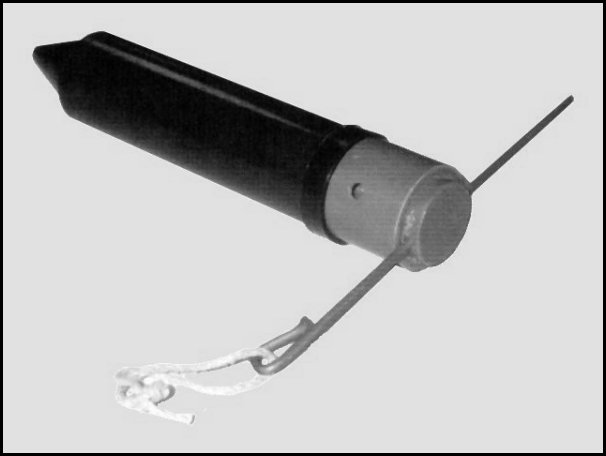
Some of the items may vary in colour from what the Cordon Sanitaire veterans remember but the general shape and design are spot on.
I would like to thank Vic once again for his input here
………..and just before I sign off this post:
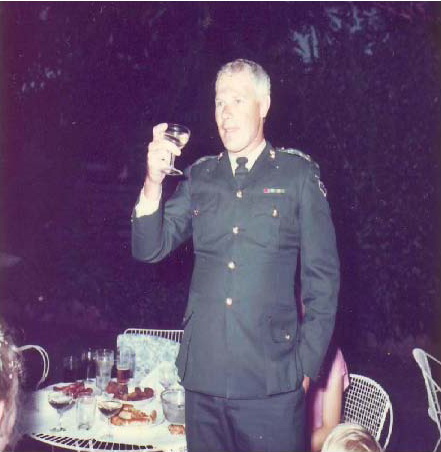
CHEERS VIC!!!!!!
Please also join me on my website dedicated to Rhodesian and South African Military Engineers. Sign up to the forums by using the following link:
http://www.sasappers.net/forum/index.php
Copyright
© Mark Richard Craig and Fatfox9’s Blog, 2009-2014. Unauthorised use and/or duplication of this material without express and written permission from this blog’s author and/or owner is strictly prohibited.
 Fatfox9's Blog