The Road To Mukumbura: Part 2
July 8, 2013
The hypnotic whine of the water-filled tyres on the tarmac and the side-to-side roll of the heavy Rodef Troop Carrying Vehicle (TCV) lulled one to sleep in a surprisingly short period of time. The sun blazed down on us, burning our arms and faces. The matt-painted metal bodywork of the vehicle was hot enough to fry an egg on. We were meant to wear our webbing while traveling in case of an emergency de-bus but the majority of us took it off to gain some comfort. It gets quite irritating having a water- bottle stuck in each of your kidneys for 400 clicks. It would still be a few years before we progressed far enough to have chest-webbing, similar to that worn by the gooks.
Here are the different types of webbing I wore in Rhodesia
Standard Rhodesian Army Webbing complete with FN bayonet frog and bayonet (and kidney bruising water-bottles plus other paraphernalia):

More practical Chest Webbing came a little later and is shown below:

Thanks to Military Photos for the items shown above
Normally I would try to get the seat facing the near-side and up front next to the cab. This had two advantages from my perspective. Firstly if one fell asleep you could use the vehicle cab as a pillow and secondly if a person stood up to stretch their legs they had something to grab onto as the front roll-bar was right next to this position. The cab was also a pretty good wind-deflector. On the Rodef 45 and 75 versions, the passenger side of the cab had a turret at the top and one of the nicest places to be was standing on the softish passenger seat with your head and upper body outside the vehicle. I had many a conversation with blokes at the back from this position and vice-versa.
One of the most irritating things that could happen to you on the back of a TCV was getting hot cigarette ash in your eye. This could be your own ash or someone else’s. Boredom was a big problem on these journeys and smoking seemed to help a lot so plenty of ash flying through the air. Not good for the lungs or the eyes. Most of us smoked Madison, one of local equivalents as we could not get the international brands. Not a bad cigarette though.
 Thanks to cigarettespedia.com
I must have looked like one of those nodding dogs on the back shelf of a ’65 Ford Cortina. As the miles slipped by my head bobbed sleepily up and down. I felt the vehicle driver change down, the revs climbed, brakes coming on and the vehicle slowed. My head banged into the cab with the changed momentum and I was wide awake. It was time for a break and driver change. It couldn’t have come at a better time as I was bursting for a piss.
The Road To Mukumbura
June 22, 2013
We usually left Salisbury at first light, probably nursing massive hangovers. I was always amused by the fact that one could drink gallons of beer but still be thirsty the next morning.
Prior to departure however we would have had to load our vehicles. Cargo could consist of anything from land-mines to letters and fuel to food. It was common practice that whenever word got out that there was a convoy going to Mukumbura, everyone suddenly had urgent kit or personnel to get up there. This regularly resulted in overloading of vehicles and little space left for personnel to sit. One would often find oneself sitting next to ammunition or explosives. Not really ideal but that was the way things worked. Another combination of cargo that didn’t work well was fuel and food. It always seemed that we had to have leaky jerry-cans and bread on the same vehicle. If you have never had a bacon sandwich made with bread that has been splashed with petrol/diesel you haven’t lived in a real man’s world. It gets a bit dodgy when you put a slice of this in the toaster though. There is however nothing like a good old whiff of diesel soaked bread to really whet ones appetite for breakfast.
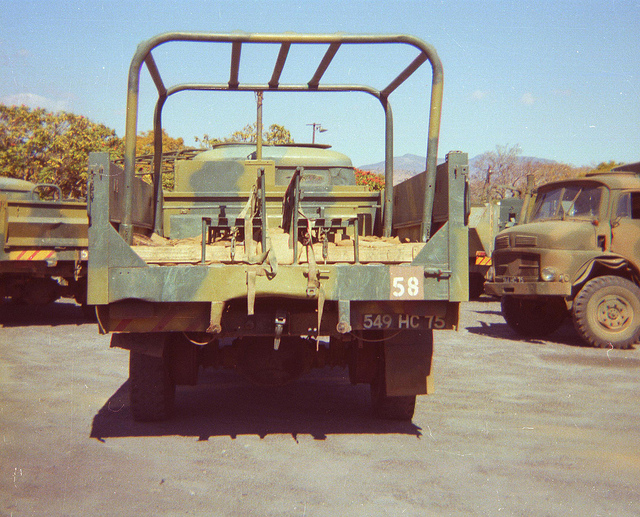
The road to Mukumbura was a long one. Long, hot and dangerous. The sun, wind, or rain could be merciless to the unprotected, and there were a number of places where the gooks could bushwhack us along the way. Not all of our vehicles had canvas covers on and in any case we needed to know what was going on around us if ambushed so our seats were in the middle of the load-bed facing outwards. Here is a picture of a Rodef Troop Carrying Vehicle (TCV), which is actually a Mercedes Benz with a dodgy sanctions-busting name:
(thanks to loosecannon55)
These vehicles were “soft-skinned” and offered no protection from small-arms fire. The seats at the back were fitted with four-point safety belts that were a great help if the vehicle hit a land-mine. Additionally the vehicles had filled sandbags on the floor of the load-bed to stop fragmentation from mine blasts coming through the floor and ripping ones anal region apart. There is no doubt that personnel wearing these seat belts had a much better chance of survival than those who never used them. Standard procedure was to wear them but there will are always be those that know better. As a vehicle it was smooth on the road and a pleasure to drive (once you had got used to the water-filled tyres). In comparison to the Bedford RL it was a dream machine.
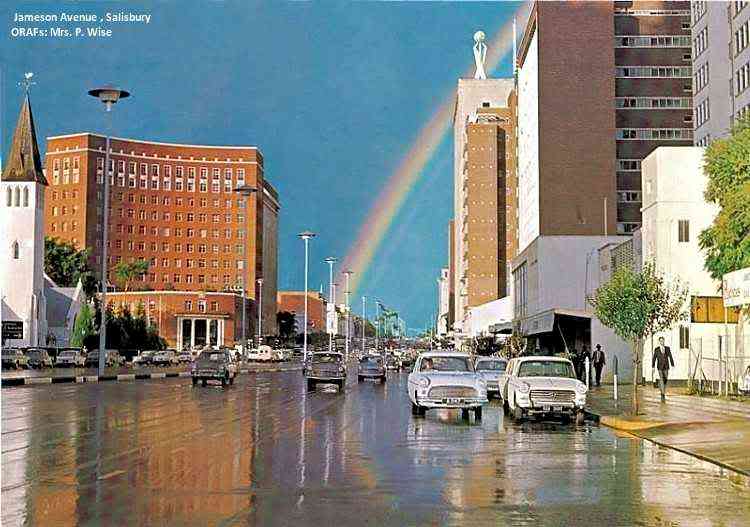
As our convoy snaked it’s way through the streets of Salisbury, heading for the road that would take us north, people on the streets walking to work would wave at us, silently wishing us luck and wondering where we were going.
(thanks to ORAFS and Mrs P Wise)
Once we reached the outskirts of Rhodesia’s capital city it would be time to cock our weapons and switch-on. We were on our way to Indian country.
Mukumbura: Salisbury Sojourn (Part 1)
February 14, 2013
Getting to Mukumbura was a pain in the arse……literally. If you have had the opportunity to sit on the steel benches in the back of a Bedford RL for 400 clicks you will understand exactly what I mean. Your arse goes numb and so does your scrotum for some reason. I have even had pins and needles in my dick during these trips, loosing all sensation and not knowing if it was still an appendage to my body. Here is a picture of a Bedford RL:

Bedford RL
Secondly, and more irritating than numb-nuts was the fact we had to deploy through Salisbury. This involved having to accept the hospitality of either 2 or 3 Engineer Squadron (Rhodesian Corps of Engineers). These units were based at either King George the Sixth Barracks (KGVI), or Cranborne Barracks (also home of the Rhodesian Light Infantry (RLI)). It seemed to many of us from 1 Engineer Squadron (Brady Barracks, Bulawayo), that the Salisbury Squadrons had an air of superiority about them. This was probably a result of Engineer Directorate also being in Salisbury. I cannot say that I enjoyed any of my visits to these units and the sooner we had done what we had to do there and got on our way the better. Having said all of that there were some good men in the Salisbury Squadrons and I made a number of close friends from these units during my 7 years in the Rhodesian Army. Here is a picture of the entrance to Cranborne Barracks:

Our normal stop over was about 2 or three days and during this time we would do retraining, load up any logistics that needed to get to Mukumbura (including anti-personnel mines), and get pissed in the many watering holes in Salisbury. One of these pubs was La Coq D’or which the RLI considered to be their personal domain and woe betide any other Unit that encroached on their territory. There have been a number of memorable punch ups there. Here is a picture of the place (courtesy of New Rhodesian Website):

And a menu cover from way back when:

All good things come to an end however and we had to move on. We had a mission after all…..to lay mines and stop the gooks getting into Rhodesia. We climbed up into the Bedford’s, and with the stench of exhaust fumes polluting the air and stinging our eyes we were off. Wrapped up against the cold in my prickly grey army issue blanket I could still taste the bacon, eggs and coffee we had for breakfast as I settled in for another ball-numbing journey.
Mukumbura (Where the Gobbies* Lay the Mines): Introduction
January 22, 2013
* Gobshite (also referred to as Gobbie, or Gobbies): One who engages in nonsensical chatter or unwanted conversation. For example- What’s that gobshite talking about now?
“Down in Mukumbura where the Gobbies lay the mines,
A Gobbie laid a mine in another Gobbies line,
Said the Gobby to the Gobby, keep on your own line,
And never lay a mine in another Gobbies line”
Minelaying song sung by Rhodesian Sappers laying mines during Cordon Sanitaire operations, Mukumbura.
I have absolutely no idea how I have remembered this song all these years.
The most recent National Service intake of Sappers were referred to as Gobbies.
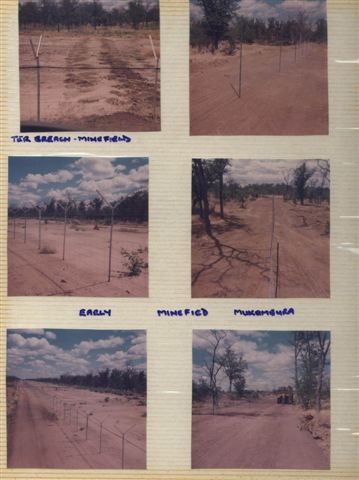
Below is a photo of the early Mukumbura minefield. Note the gook breach in one of them.
Place name: Mukumbura
Latitude: 16° 13′ 57″ S
Longitude: 31° 42′ 31″ E
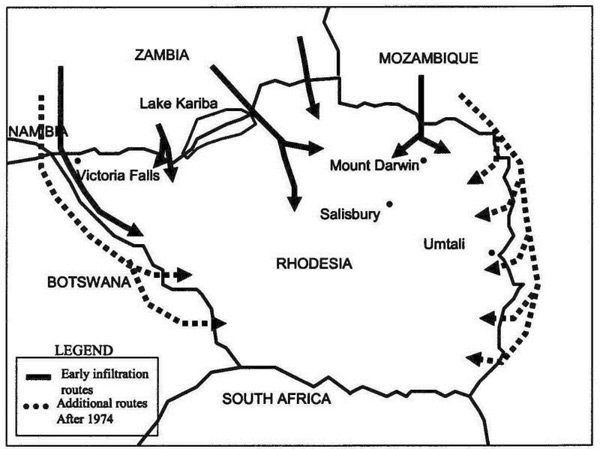
Below is a gook infiltration map. Mukumbura is in the North-East.
Operation Hurricane
The object of Cordon Sanitaire was to use minefields and patrols to channel insurgents into designated areas from which the local population had been removed. They could then be tracked and killed before they reached populated areas.
The first Operation Hurricane “no-go” area was along the Mozambique border in May 1973. Other “no-go” areas were extended along vast stretches of Rhodesian border in an attempt to establish depopulated “free-fire” zones for Security Force operations. This concept that anyone seen moving in an area is considered a terrorist and can be killed was tried in some areas of Vietnam too but was not particularly successful.
More to follow on Mukumbura in the next instalment.
Chasing Gooks With The Infantry
January 21, 2013
Wankie (1 Independent Company): 1974/75-ish
Besides landmine incident call-outs, the days at 1 Indep also consisted of camp guard duties, patrolling the married quarters at night, and escorting ration-runs to deployed call-signs in the Company area of responsibility.
Late one afternoon this somewhat laid-back routine was, without warning, rudely interrupted.
Contact had been made with a large group of gooks and they were on the run. Normally in these types of situations the general idea would be to get as many additional feet on the ground as quickly as possible to track the gooks and kill them. At the same time as the follow-up was taking place, stopper groups would be placed ahead of them and straddling their likely axis of advance.
The best way to get a good grip on the situation was to have an aircraft up above the gooks to give the trackers an idea which way they were heading. Choppers would then drop Fire-Force sticks off to give chase. The choppers would also drop of the stopper-groups into which the gooks would hopefully run. One of the aircraft used for the top-cover and gook tracking was the Cessna Skymaster or as we called it, the “push-pull” due to its engine configuration (one back and one front). This aircraft was also known as the “fuck me-suck me” by many of us. Here she is:

This specific aircraft had the callsign prefix of “Hornet” due to the twin Browning’s at the top looking very much like insect probiscae. These aircraft also carried Frantan bombs that acted very much like Napalm and it was a pleasure to see these being used. Gooks normally quickly lost the urge to do anything bad after one of these was dropped near to them.
The helicopter of choice for the deployment of troops was the good old Alouette 3, also known in the Rhodesian Forces as Cyclone 7. These could be armed with either twin Light Machine Guns (G-Car), or a 20mm cannon (K-Car). The plan would be for G-Cars to drop troops off on the tails of the gooks who would then chase them into the waiting stopper groups (if they were in position) where they would hopefully be killed or captured. This picking up and dropping off of troops took time as the G-Car could only take 5 troops at a time and many opportunities were probably missed because of this lack of an appropriate trooping capability. Here is one of the choppers we used (Beaver Shaw behind the guns and photo by Dominique Hoyet) :

I had managed to get dragged into leading one of the stopper-groups this specific day (by Don Price) and had been dropped off with whatever and whoever was available at the camp. The area that needed to be covered to catch the running gooks was so wide that we had cooks, medics, bottlewashers, and mechanics in the stop-groups. Remember that in the Rhodesian Army we were all Infantrymen first and specialists second. It was in these circumstances that the training model really paid off.
By last light we were still lying there waiting for the gooks to run into us but nothing happened. It gets a little creepy in these situations as you need to be really careful not to shoot your own people chasing the gooks. With non-combat type troops with me this was a real possibility and I knew it. I was not quite sure what the next move was going to be and was hoping that we were not going to be expected to stay out the entire night. Due to the rushed and calamitous deployment, none of us who were normally non-Fire Force troops were carrying warm clothing or rations. As fate would have it I received a radio message that we needed to stay in position for the night. I informed the gentleman on the other end of the line that my callsign was not equipped for a night stop and he (the same Don Price) had the temerity to call us dudes (yes, dudes!) over the air. This annoyed me a bit, but we had a job to do, and we got on with it. I could not have worried less, but the welfare of my troops came first, and we did get the necessary support for the night.
As far as I can remember they never did get any of those gooks either so all-in-all an unsuccessful day all-round and perhaps in some way I contributed to this poor result. I doubt it, although in retrospect I should have been more prepared for this type of call-out though, and I would not be caught out again. It was pretty piss-poor preparation on my part.
I didnt know it at the time but as we flew back to Wankie there was planning taking place in Bulawayo that would soon see me redeployed to a place synonymous with the history of the Rhodesian Corps of Engineers…..Mukumbura!
First Blood…..Sidindi Island (Part 5)
February 28, 2011
I can remember walking past palm trees and what looked like sea sand as we followed Don back down to wherever he had come from…..the Zambezi flowing smoothly on my right hand side….gurgling on its merry journey to the mighty Kariba Dam…..many miles away. Where it crashed over the countless rocks it foamed and sprayed a fine mist……the wind blowing it into our hot and sweaty faces…..cooling and refreshing.
A radio crackled near to me and the 1 Indep stick leader answered with his call-sign. He had a short and sharp conversation with someone on the other end consisting of “copied”, “affirmative”, “say again”…..and finally “roger out”. He moved up closer to me and let me know that a recovery vehicle had arrived but was standing off some distance from the mine victim until I gave the all clear on the road.
Don had diverted us onto a path that left the dirt road and led along the river bank……and it was then we saw a couple of soldiers up ahead….on guard and highly alert. They let Don through and we entered a place of carnage……and what was until a few hours ago an SAS temporary base.
All around us were bits and pieces of kit..neatly piled up as if waiting for collection…webbing, weapons, eating utensils..some damaged by gunfire…the stuff that soldiers carry….and shockingly, a heap of bloody sleeping bags and Rhodesian uniforms….now tattered and ripped apart…blood stains mingling with the camouflage pattern…riddled with bullet holes. There was indeed a certain smell about the place…..a smell I would get to know well……the smell of blood. Nothing else like it. Clearly something bad had happened here….you could feel and see the despair in the faces of the few grim men that were there. Cartridge cases that were not familiar lay scattered all around, the wrappings of first field dressings and used inter-venal drips, some with their tubes still attached littered the ground……the bits and pieces of medical kit that were the signature that some serious shit had gone down not too long ago.
Don took us into a shady part of the camp and sat us down. It was the measure of the man that although he wore the coveted wings of perhaps the finest special forces unit in the world, he treated us as equals at this time. He proceeded to brief us on the events of the past hours…..not in too much detail to endanger security, but enough for us to understand the background as to why we were there, and the seriousness of the situation.
Apparently the SAS were on an external operation in Zambia doing what they do and had been over there for some time. On their return to Rhodesian soil they were well and truly knackered and formed a temporary base at Sidindi Island so that they could rest before being picked up and returned to their main base. They ate and they slept. They had arranged their sleeping positions in two lines close to each other with a narrow path between the two. A guard was posted and the rest slept. Sometime in the early hours of the next morning when one sleeps the deepest a group of terrorists entered the camp and walked down the path between the two rows of sleeping men and machine-gunned them mercilessly as they lay in their sleeping bags. I do not recall if anyone was killed but there were some severe injuries received. Those that could managed to fight the gooks off but the damage was done. They were understandably devastated….but also professionals…..and immediately began the task of helping the injured and getting them out. The blown up Bedford was also part of the reaction force coming to assist them. These gooks who attacked were definitely not the normal run of the mill banditos……they were very clever…they knew there was only one road where help would come from and they had mined it with a successful hit…..a tactic that I would encounter on more than one occasion. They had also clearly observed the SAS go into a temporary base and had waited patiently for their chance to strike……showing great restraint before attacking.
We drank tea and offered what help we could and made our way back up to the road…..all of us deep in thought……and a lot more switched on than when we first arrived. If those who had so audaciously attacked the SAS camp with so much success were still around we had a problem. However we completed our mission without incident or more mines on the raod and the recovery vehicle was able to come in and take the sad old girl away to fight another day.
It was time to return to Wankie……and the gunship was summoned by TR48 radio carried in the recovery vehicle. It was late when we boarded and the pilot informed us he would not be taking us back that evening but rather to the South African Police base at Sidindi (or it could have been Mapeta?) where we were destined to be treated to some real South African hospitality….good food…steaks and boerewors and cold Castle beers…we even had coffee bought to us in bed by the Padre after he had read us all an evening prayer.
I hoped that he was also praying for all the SAS boys we had just left behind.
Sometime later stories about the Sidindi incident began to circulate..some of it obvious bullshit…but the most plausible one was that the sentry, being exhausted just like the rest of them, had fallen asleep at his post and the gooks had simply walked past him and into the camp. I have no proof that this is the case but the importance of an effective guard system remained with me for the rest of my military career. A few years on and in a different country I was to see first hand the result of a sentry falling asleep……except this time I was one of those on the receiving end. The result might not be what you expected.
First Blood…..Sidindi Island (Part 2)
November 19, 2010
On-board Cyclone 7 Gunship………outbound to Sidindi area
The pilot tested and released the brakes on the Alo gunship and we slowly taxied down the runway at FAF1……I was on the back seat….a simple hard bench that could fold up when the chopper was in the casevac role. On either side of me was an infantryman from 1 Indep. The infantry section or “stick” leader sat in a rearwards facing seat next to the pilot. This seat had an olive green cushion for your arse and the seat was armour-plated all round so that whoever sat in it never had his balls shot off by gooks firing from below.
Another troopie sat in the door opening, a position I was later to claim as my own on many chopper rides. There is something pretty fascinating about sitting in a chopper door when the pilot hits a hard port or starboard roll and you literally hang out the machine but cannot fall…centrifugal force apparently….those of you who have experienced this will know what I am talking about. The door gunner was a serious looking fellow who had a flying helmet on that had wires coming out of it that plugged into sockets on the bulkhead..these were his umbilical cord to the pilot….they spoke constantly without a sound coming our way. The weapon on these gunships was the Belgium made 7,62 MAG (Metrallieur a Gas) mounted as twins on a swivel arrangement giving traverse and elevation movement. There was also an optical sight on these weapons. Ammunition was fed into from two ammo boxes attached to the gun mounting.
This was my first chopper ride and as you all know I am shit scared of heights. My arse was nipping at the thought of the lift off and me just inches from the open door….I didn’t know about the centrifugal force theory at this stage.
I watched the pilot closely…..how he gently pumped his feet on the pedals as we taxied…..and how he flicked mysterious buttons on the rather impressive dashboard that had red and green lights on it. His left hand had been continuously holding what looked like a car handbrake between the seats and as I watched he slowly lifted this device and the chopper left the ground and began to gently gain height….I learned later this handbrake thing was called the “collective” and had something quite important to do with the up and down activity of all choppers. Actually if this device broke the chopper was fucked and all aboard in severe shit.
As we climbed I watched as the runway fell away and the buildings below became smaller and smaller…..the cars on the roads looking like the Dinkies I had played with in the sand as a child…..as the pilot swung the machine to port we headed east…..into the rising sun…..and into my first taste of what this war was all about.
The Quarter Masters Stores……
October 13, 2010
1974……Brady Barracks
Time to find out where we were getting posted to.
Rock and Roll was over and we had all returned to the Squadron HQ at Brady Barracks (alias Headquarters 1 Brigade). The Squadron HQ was a rather dilapidated collection of buildings not too far from the Brigades Warrant Officers and Sergeants Mess, which meant nothing to me but is worth mentioning. Inside the HQ it always smelt of paper and stationery and chemicals used for the Gestetner roneo machine. The ones that had some kind of red waxy paper to type on. This specific machine was hand operated and there was always someone there cranking the big black handle on the side that was the trigger to pick up paper, print, and spew out paper the other side. It only printed on newsprint or at least that’s the quality we got with our precis. In those days this was a very serious piece of kit.
Anyway I am getting side-tracked.
I had been informed that my first posting was going to be to a place called Wankie (yes there were some Wankers there)…..up the Victoria Falls road to an outfit named 1 Independent Company, Rhodesia Regiment (1 Indep Coy RR). I was a little disappointed at first as all my mates or most of them anyway were going to Mukumbura in the North-Eastern border area to lay mines on Cordon Sanitaire. I shouldn’t have worried for two reasons. Firstly I would get more than enough tours to various parts of the Cordon, and secondly it was not too bad at 1 Indep once I got used to arrogant Infantry Officers who had more domestic scandals surrounding them than I care to remember. It was really bad there at one stage and the extramarital shagging that went on in the background was the stuff that legends were made of. Extramarital shagging is fine but not in front of the troops…….and no effort was made to be discrete. One of these people doing the shagging actually had the temerity to call me a dude one day because he had sent me and my crew out as a stop group without the opportunity to get fully prepared…….knobber.
My specific job-title was “Mine-Standby”,a really strange coincidence seeing that 1 Indep was based inside an old mine compound in those days. Wankie was one of the biggest collieries in the world at the time and the army had taken over one of the disused compounds. Dozens of little cottages……better than tents that’s for sure. As the job title implied my mission was to stand-by and wait for a landmine to go off somewhere. I would then be flown out by chopper to sweep the road 2 kilometers either side of whatever or whoever the victim was in case the evil gooks had laid additional mines…..a common tactic.
It was about this time (and before my first deployment) that I realised that our Squadron Quarter Master was a rather nasty piece of work and a tosser to boot. He was a bully who seemed to think that everything in the store belonged to him and that all of the kit belonged on the shelf so he could show it off to the Squadron Commander when he was brown-nosing the boss. There is no place in the field for these possessions of his either. If one of us asked for a replacement first field dressing we were asked for the old one. I could name this individual but I wont. He knows who he is…..an infantry officer, not even a Sapper. And I really hope he reads this because by now he realises that we only saluted his rank and not him. There was actually talk of fragging him amoungst us……hope that woke him up. The other ranks in the stores were OK but he needed shooting. The only time I saw him in the bush was to come and count knives and forks……I jest not with you. Woe betide the Troop Sergeant who was a fork down on his camp inventory when the Major came calling. This was tantamount to treason and equaled the loss of the entire vehicle fleet of the Rhodesian Engineer Corps……including all the Pookies!! I saw his name on an e-mail distribution list the other day so he survived the war staying out the combat zone……brave bugger you have to be to survive in the stores. I think he was impotent too.
Anyway enough slagging off the officers for now……but to be honest some of them really deserve it as you will find out later.
And now it was time to draw my weapon and first-line ammo, pack my kit, and depart on some of the greatest adventures of my life.

A much thinner FatFox9 testing the MMD1...1974 Wankie
1974…..Octoberish
Once we had finished our theory phase of training it was time to get out into the field and find out exactly what we had taken on board.
Our explosives training was carried out at Khodwayo Bombing Range and this had been completed earlier on. That had been extremely interesting and we had been taught a variety of demolition skills……steel cutting charges, destruction of landmines and other unexploded ordnance, cratering charges using camouflet sets which had a strange device called a “monkey” that weighed a ton, laying out of detonating cord ringmains and electrical ringmains, and most importantly explosive safety regulations.
There was no buggering about at Khodwayo. The training was presented in a professional way and there was no running or stress situations. This was serious stuff and our first exposure to things that would literally blow your head off if not treated with respect. The instructors understood this and adapted their methods of instruction accordingly. All in all one of the best phases of my training and probably the single most important subject I still use to this day in my chosen profession.
After demolition training it was back to Brady Barracks, unload the Bedfords of all the demolition kit, reload them with all sorts of other weird and wonderful Sapper stuff, most of which was bloody heavy and/or sharp, and we were off to Mzingwane Dam……and this was really going to be fun.

Mzingwane dam
Basic Training……the metamorphosis
May 16, 2010
It has been well recorded that the Rhodesian fighting man/woman were the finest counter-insurgency force in the world at the time and the training we received from day one was designed to ensure that this reputation was never sullied. It was hard and relentless, both physically and mentally. I must mention here that I have never been a small chap of politically correct weight. Those who know me will understand what I mean. I have had a lifelong battle with excess lard and this did not do me any favours during basic training. I really suffered, as did many of my fellow trainees.
However I soon discovered that I had a high level of mental stamina and an above average walking endurance with extremely heavy loads. This was to prove of great benefit to me in the future.
Walking anywhere was considered taboo during basic training and would immediately incur the wrath of our instructors, who appeared to take their greatest pleasure from grinding the less physically adept more than the rest. There were three of them in A Company……and at the time were all evil men according to me. I remember their names and faces to this day but I do not see any value to mention them here. I fully understand they had a difficult job to do but they did seem to wobble along that thin and somewhat blurry line between constructive battle competence/discipline training and sadistic bullying rather frequently. Perhaps this was all part of the grand plan to make us survivors in combat…..I don’t know….. but apparently it worked as I am still here to tell the tale so I have forgiven them a long time ago and in some ways I probably owe them my life many times over.
Basic Training doctrine in the Rhodesian Army had one purpose……to train every recruit to be an infantry fighting platform as their primary function. Even though many of us would later specialise in one of the many and diverse branches of the military machine, each and every one of us could therefore also form part of a fighting infantry section, or “stick” as we called them. With this as the objective much of our time was spent carrying out weapon drills by day and night, days and days of musketry training on the range, section battle drills, bayonet fighting, grenade throwing, map-reading, bush-craft, and a myriad of other black arts and skills that we would need to see without being seen, and kill without being killed.
So between all the boot-polishing, beret shaping, uniform starching, parade ground work, bed-packs, barrack room inspections, guard duties, PT and vehicle debussing drills we actually did some interesting stuff too.
I am not going to spend much more time on the intricacies of Rhodesian Army basic training techniques.
One thing is for sure though and that is that I was extremely happy to have had my request for transfer after Phase One Basics to the Rhodesian Corps of Engineers approved. The truth is that I did not see myself as an infantryman full-stop, and coming from an engineering background the Sappers seemed the way to go. I have never regretted it to this day and my next installment will cover the 8 or so weeks that the Rhodesian Army spent turning me into a Combat Engineer.
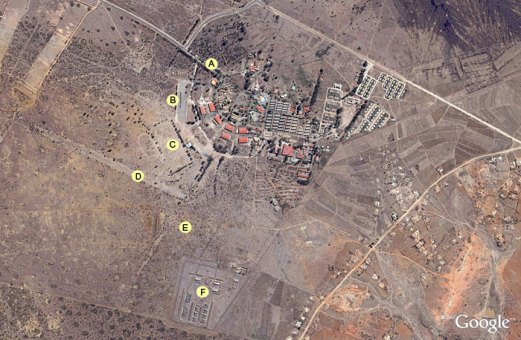
- Llewellyn Barracks (Alan Roberts)
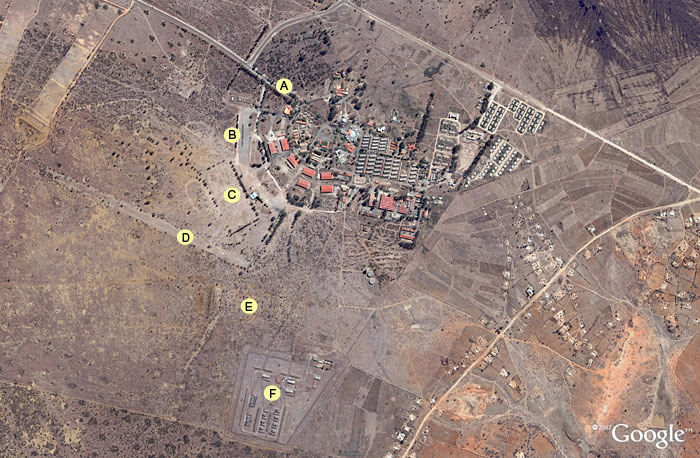
Llewellyn Barracks from 14,000 ft:A) Main Entrance to Llewellyn
B) The parade ground: where many painful hours were spent
C) The sports ground: with rugby posts that we often had to run around during drill on the parade ground
D) The abandoned air strip: around which we had to run most mornings before breakfast
E) The rifle range: now abandoned….you can see the stop-butts just left of the “E”
F) Number Three Guard: where I also spent many painful hours

- Passing-Out Parade-Depot, The Rhodesia Regiment
 Fatfox9's Blog