Mukumbura: Learning The Ropes (Part 4)
February 4, 2014
In this post we will start to have a look at how the Cordon Sanitaire teams operated within (and outside) the minefield boundary. With the amount of mines being laid each day (+-3,000), the loss of concentration due to fatigue, and poor discipline or procedures could be disastrous and indeed fatal. Sadly we have ample evidence of this in our Roll Of Honour and also by the number of our colleagues that lost limbs and their eyesight, although there are other reasons for accidents such as dodgy mines/mchanisms and equipment.
Cordon Sanitaire Work Groups
Group 1: Protection Party
The Protection Party normally consisted of Rhodesian Defence Regiment (RDR) personnel. This unit was, in the majority, manned by Coloured and Asian troops. It was formed with the intention of using their personnel to protect bridges, camps and other infrastructure. They deployed with us on many occasions as our perimeter force protection component. These were interesting individuals, had their own slang (which many of us picked up), and often had a good supply of contraband items, especially exotic tobaccos, the aroma of which could often be smelt wafting through our camp lines. Please see the previous post for more information on this unit.
After we had checked the area for booby-traps the Protection Party would deploy across the safe area of the Cordon, jump over the enemy side fence and melt away into the bush. There they would lurk, looking for gooks who might try and attack us while we were laying mines. Coming under enemy fire is bad enough under “normal” circumstances but inside a live minefield it is disastrous. There is nowhere to take cover as the vegetation is sparse and there would be mass casualties without a doubt. We had no defence as we never carried our weapons while laying mines in case they fell and detonated a mine. Additionally it would not be comfortable working with a rifle slung over your shoulder and would have been a recipe for accidents. Having said that the command and control personnel working inside the minefield with us were armed and would do their best to direct and cover us in the case of an attack.
The Protection Party were also deployed on the friendly side in case of an attack from behind. If this happened we were in deep shit.
Group 2: Echelon Support Vehicles
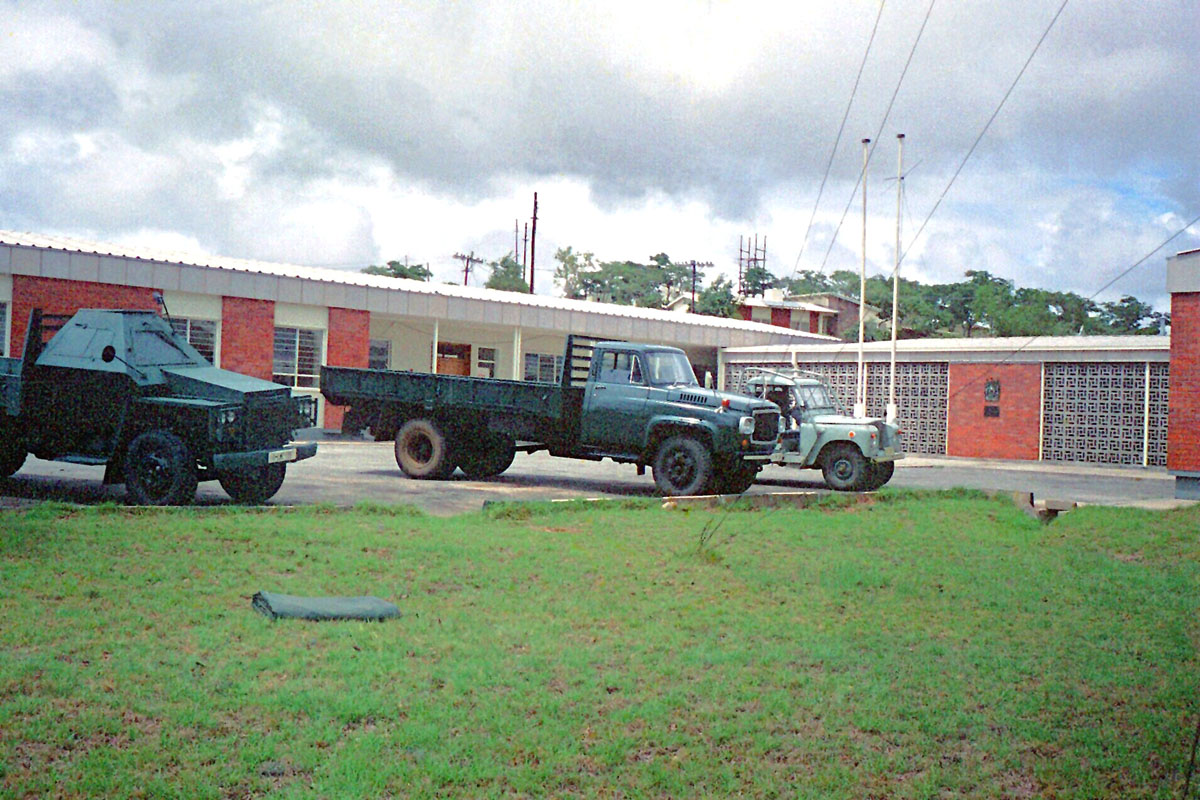
Our Echelon Support Vehicles normally consisted of Bedford RL’s, Rodef 25, 45, and 75 Mercedes Benz clones. The Rodef 25 was actually a Unimog with a dodgy sanctions-busting name. No one was fooled though. Here is a Rodef 25 (newrhodesianforum):

And a Bedford RL in rather smart condition:

Later vehicles were like these MAP’s but I never saw them at Mukumbura:


These vehicles would follow us down the access road as we progressed and carried our mines, water, food, tools and other bits and pieces we needed to do our job. Our medic was also part of this echelon and excellent blokes they were too. Some legends amongst them and they will get a mention in future posts. Needless to say they were highly trained and knew the business. Radio communications for casevac purposes were also checked before work commenced and maintained by the echelon during laying operations.
The Tsetse Fly Officer (see previous posts) and his crew normally formed part of our support echelon personnel too.
Here is a typical Cordon Sanitaire access road running next to the perimeter fence (Terry Griffin):

I would like to talk about “working in echelon” at this point. Working in echelon was a very important principle which we applied when working in the minefield. This principle ensured that at no time was anyone working ahead of fully armed mines. This is why we always started activities on the Charlie Line, second to start would be Bravo Line, and lastly the Alpha Line. No activity ever overtook a similar activity on a line that was to your front. The diagram below demonstrates the principle:
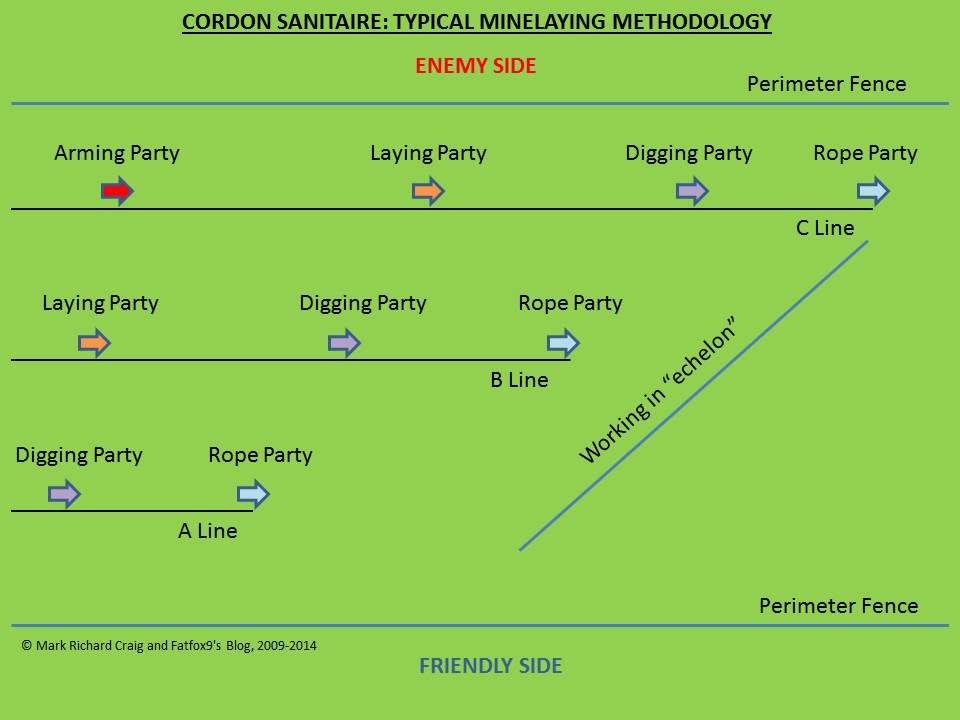
As you can see the Charlie Line is ahead of the Bravo Line and the Alpha Line behind the Bravo Line and Charlie Line. Crucially an Arming Party shall NEVER overtake personnel to their front. In the event of an attack from the Enemy side, our personnel could safely exfiltrate the minefield by moving directly and straight back toward the friendly fence.
We will discuss the remaining minefield parties in the next post.
© Mark Richard Craig and Fatfox9’s Blog, 2009-2014. Unauthorized use and/or duplication of this material without express and written permission from this blog’s author and/or owner is strictly prohibited.
Rhodesian Defence Regiment and Holding Units
January 31, 2014
Ones memory is a strange thing. Working on my next post I realised that I had forgotten to mention an important unit that contributed greatly to our safety during Cordon Sanitaire operations. It would therefore be unfair not to mention them as they may well have saved my life on more than one occasion. These were the men of the Reserve Holding Units and Protection Units of the Rhodesian Army.
Here is their badge and stable belt (rhodesianforces.org):


Their work was varied and important and it would be foolish of me in the extreme to try and write a better and more comprehensive account of these individuals than the one that follows.
I thank the author of ‘FIGHTING FORCES OF RHODESIA’ – VOL. 5, as posted in The New Rhodesian Forum.
THE RHODESIA DEFENCE REGIMENT
THE dark green stable belts of the Protection Units have taken on a new significance in the continuing war against terrorism. Over the years the Re-enforcement Holding Units and the Protection Units have quietly grown, and their deployment has become increasingly important in the defence of Rhodesia’s borders.
On January 1st, 1978, these units were combined to form an official regiment and took their place proudly alongside longer serving regiments of the Rhodesian Army. The Regimental Depot at which servicemen will be trained for the Rhodesian Defence Regiment is at Inkomo, just outside of Salisbury.
The embryo from which the new regiment has grown existed for many years, in the form of the Re-enforcement Holding Units. These were originally purely paper units which were formed at the beginning of 1973 to take on theoretical strength those Coloured and Asian personnel who had completed their Territorial service with the Supply and Transport platoons. Also included were the members of “Dad’s Army”, comprising the older age-group White personnel who had completed Territorial service with the Rhodesia Regiment battalions.
For several years members of the Re-enforcement Holding Units were called up for a short period, once or twice a year, and deployed in non-combatant roles. However, as the war escalated, the need for protection and guard troops increased the task of these personnel, and extended it to a more active role. As a result, in 1974 the Protection Companies were formed on a small basis, embracing the Coloured and Asian members. These two Protection Companies had a more mobile role than the previous Holding Units, and acted as escorts for army convoys transporting supplies and equipment to operational areas. They also guarded encampments and machinery where necessary. The situation remained at this level for three years. During this time, however, the strength of the Protection Companies had been increasing, along with that of the Re-enforcement Holding Units as a growing number of men completed their service with the Territorial Forces.
When the combined strength of the units reached approximately 6 000 it became obvious that such a reservoir of manpower could be more profitably deployed than hitherto, and the suggestion of forming a new regiment was put forward.
Thus the Rhodesian Defence Regiment was born, placing the Protection Companies and Holding Units on a properly co-ordinated and recognised footing.
Two battalions have been formed: the Number 1 Mashonaland Battalion, based at Cranborne Barracks in Salisbury, and the Number 2 Matabeleland Battalion, based at Brady Barracks in Bulawayo. The new regiment has its own Depot at Inkomo, near Salisbury, where the Coloured and Asian National Servicemen are trained, and where older serving members receive pre-deployment training.
These battalions are made up from four different categories of servicemen.
Firstly, there are the National Servicemen from the Coloured and Asian ethnic groups, who are required to serve eighteen months, as are their White counterparts in other regiments.
Secondly, there is the “K” Intake, comprising the 25 to 38 year age group of Coloureds and Asians who had not previously been subject to call-up. This category are now required to serve for eighty-four days. Half this period is spent in training at Inkomo and the second half on deployment.
The third category are the continously embodied volunteers. These are Coloured and Asian members who volunteer for a year of continuous service. At the end of that year they are free to leave or to sign on again for a further year. This arrangement virtually makes them regular members of the regiment. At present there is some discrepancy between conditions of service these continuous volunteers and those of regular members of the Army, but it is hoped that these will be equalised before much longer. As a first step towards achieving this, the first Coloured officer has already been appointed. He is a medical officer, with the rank of Captain, and it is hoped that this will lead the way for future suitably qualified members of the Rhodesia Defence Regiment to be accepted into the permanent force. The Rhodesian Women’s Service, from it’s inception, accepted Coloured recruits as permanent members of the force, and at present there are six Coloured ladies serving their country, several of whom are deployed at Rhodesian Defence Regiment Headquarters at Cranborne.
The fourth category is “Dads Army”, who are the older Whites of over 38 years.
Both battalions are structured to take into account the different tasks required of the companies. The National Servicemen, the “K” intake, and the continuously embodied volunteers are generally deployed on the higher priority tasks, whereas the over 38 year old category, who are liable for a shorter period of commitment than the younger men, are used for more sedentary tasks.
This does tend to result in the formation of companies of seperate ethnic groups, but plans are afoot to include an intake of over 38 years old Coloureds and Asians in the future, in order to create additional companies who would contribute effectively to the force. These intakes would be liable for the same commitment as their White counterparts and would be deployed on similar duties.
A recent innovation has been a pilot group of Coloured National Servicemen who have been given full combat training and then deployed in the field.
The Commander of the Rhodesia Defence Regiment, Lt. Col. Peter Grobbelaar, is extremely satisfied with the way in which the servicemen have adapted to training and given a good account of themselves.
Discipline is strict, as it should be with all effective forces, and Col. Grobbelaar pointed out that the Coloured soldier appears to have the natural aggression which is vital in all combat-troops. Other servicemen will undoubtedly follow along the same paths, taking on an increasing responsibility in the fight against encroaching communism. The step from defensive to combat role has not been particularly difficult since in recent years the members of the Protection Units were required to display a more aggressive role in the face of attacks by the enemy.
After a long period of semi-obscurity, the Protection Units and Dad’s Army have finally found their own identity in the Rhodesia Defence Regiment, with their own insignia and embellishments, and they are obviously bent on proving their worth.
Co-operation and consideration between the various ethnic groups have been excellent. On occassions where units of mixed ethnic groups have been deployed the members of this new and vital regiment have displayed a most responsible attitude in making allowances for the differences in diet and religious practice that must obviously exist. Problems have arisen on occasion, in supplying the required contents of ration packs (for example, a Moslem would require a different ratpack to a non-Moslem), but with the general spirit of co-operation that pervades the regiment, these difficulties have been ironed out.
There is no discrepancy in pay and general conditions between the different ethnic groups of the territorial strength of the new regiment.
Despite their newness, the Rhodesia Defence Regiment posses certain distinctive foibles, one being their own language. The RLI are famed for being incomprehensible to their ordinary listener, but the RDR certainly offer a challenge to the RLI superiority in this matter.
The story is told of the RDR private who, on seeing heavy artillery in the field for the first time, went and called his friend, saying, “Hey, Joe, just come outside and sight the size of this catie” (catapult).
The tale is also told of the radio operator who persisted in asking Control to “Bowl me the ages”. After a considerable pause and a great deal of head-scratching, Control finally realised that the operator was merely asking for a time check.
And, of course, all armies have their own clowns who never seem to quite know why they are there at all, and rather wish they were not. (No doubt the officers also wish they were not.) An RDR private appeared before an officer on a disciplinary offence. When he was given an opportunity to speak he proceeded to ramble on in such a vague and inconsequential manner that in the end the officer stopped him.
“Are you prepared to accept the punishment of the disciplinary officer, or do you elect to stand trial by court martial?” the troopie was asked.
To which the bewildered troopie replied, ‘I’d just like to stand down, sir.”
History does not relate his fate.
From ‘FIGHTING FORCES OF RHODESIA’ – VOL. 5.
Mukumbura: Learning The Ropes (Part 3)
January 30, 2014
Figure 1 in the previous post clearly shows we had three distinct working Rows, namely Row A, Row B and Row C. Row C was always on the enemy side and Row A on the friendly (or home) side. Row B by default was the neutral (middle) line and located more or less equidistant from Row A and Row C
Working Row Methodology (I need to start at the end of the working day to make this easier):
At the end of each working day Dannert Coils (also known as concertina wire) were pulled across the entire width of the minefield, just outside the mined area. In addition to this a small steel pin was driven into the ground at the point where the pulling parties would attach their ropes the next day as their start points. There would be three of these, one for each Row. This more than anything else was to let us know where the boundary between safe (no mines laid) and dangerous ground (mines laid and armed) was. A very simple procedure that made things very clear on the ground. Remember that we had no GPS units in those days so a physical feature on the ground was very useful when using traditional navigation methods.
Here is a picture of Dannert Coils being emplaced (not on the Cordon and for clarification purposes only). A really unpleasant job when they get old and lose their shape. We used a single layer of Dannert Coils. Shown below is a triple concertina fence that will be used as a Field Obstacle.

In Figure 2 below you can see where the Dannert Coil was placed at the end of the working day. I know this does not look very neat but you get the idea and in fact some of our Dannert Coils were in such poor shape they actually looked very similar:
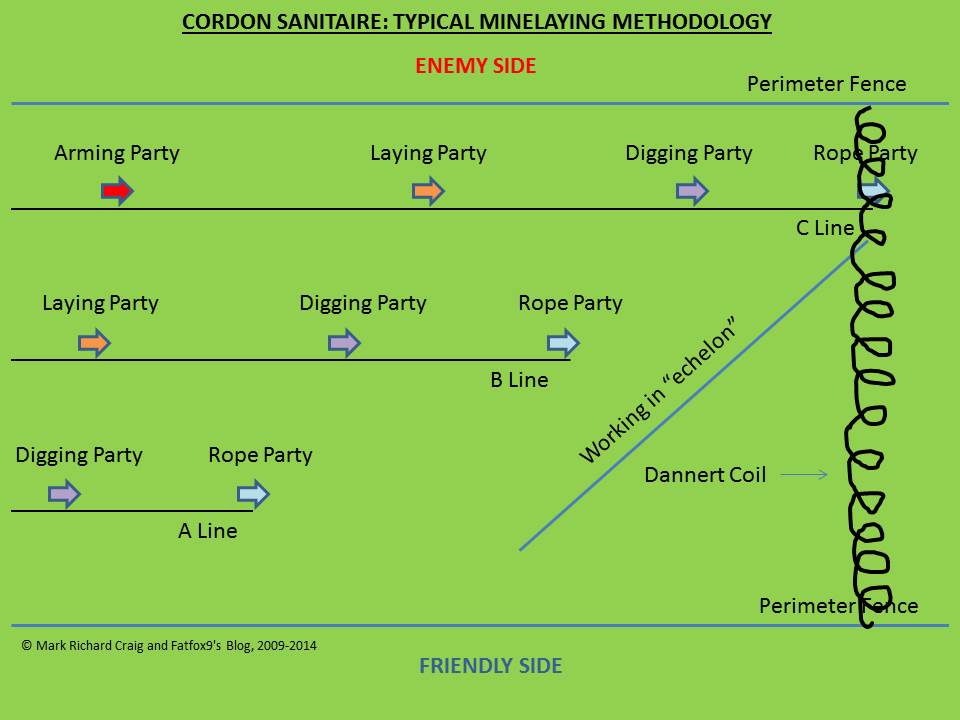
FIGURE 2
Morning Routine:
On arrival at the minefield the first thing to be done was to identify the safe working area and ensure nothing had been tampered with overnight. I always wondered why the gooks never booby-trapped our Dannert Coils or planted mines where they must have known we would be starting work. Perhaps they did in some other areas but I never heard of it. I know if I was a gook I would have had a go at that. In any case we had to be vigilant each morning.
Other things we needed to be switched on for each morning were the following:
- Our access roads were a prime target for the gooks and I do know that some of our convoys were hit by vehicle mines on a number of occasions whilst en-route to the Cordon.
- Wash-Outs: These were mines laid by us in the cordon that wash-out of the minefield boundary fence during heavy rain or flash-flooding. They would then often end up on the road we would be driving down and by default debussing on. This was a particularly dangerous issue for us and a number of our men were seriously injured as a result of wash-outs.
- Booby-traps on the perimeter fences or mines laid in areas where we would access the minefield. Unfortunately we once again had people seriously injured by these cunning gook contrivances.
Activities Inside The Minefield
In the next post we will look at how the mines were positioned and armed, and some of the different mine types we used.
Mukumbura: Learning The Ropes (Part 2)
January 14, 2014
Cordon Sanitaire Mine-laying Operations
Working with explosives is a dangerous business. Make no mistake. Having said that laying mines is not rocket-science but if you don’t keep your wits about you and exercise strict discipline and command and control, people are going to get hurt.
Sadly, there were a number of Rhodesian Sappers killed in our own minefields during laying and minefield maintenance operations. Please spare a moment to pay your respects to these brave men by visiting the Rhodesian Corps of Engineers Role Of Honour at http://www.sasappers.net.
Additionally there are quite a few accident survivors living with missing limbs, blindness and other injuries caused by our own mines. Mines do not differentiate between friend and foe. They kill and maim the layers and the enemy without distinction or warning. I have been in the unenviable position on more than one occasion where I have witnessed our Sappers killed or horribly injured during Cordon Sanitaire operations. I will not discuss the details in this post but I can assure you this type of incident remains very clear in ones mind.
To give you an idea of our mine-laying methodology please look at the following diagram:
FIGURE 1
As you can see we had an Enemy and Friendly Side. In the case of Mukumbura the Enemy Side would be Mozambique, and the Friendly Side, Rhodesia. The two fences were constructed using strands of barbed wire evenly spaced and attached to steel pickets at regular intervals. The lower one meter or so of the fence was also fitted with mesh to stop smaller animals from getting through and detonating mines.
Here are some photos of Cordon Sanitaire, Mukumbura. (Terry Griffin):

Here is a photo of the mine-sign you can see on the fence in the top-left image:
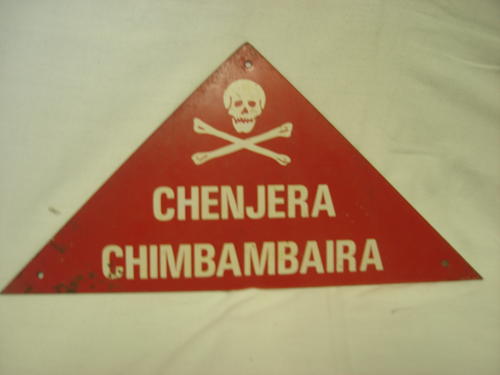
According to Vashona.com, Chenjera Chimbambaira literally translates to “Beware Grenade” in the local (Rhodesian) indigenous vernacular (Shona). Mine-signs were attached to the perimeter fence to warn the locals of the danger of crossing the fence. Unfortunately the warnings were not always heeded resulting in civilian casualties.
In the next post I will discuss the duties of the Rope Party, Digging Party, Laying Party, and Arming Party.
© Mark Richard Craig and Fatfox9’s Blog, 2009-2014. Unauthorised use and/or duplication of this material without express and written permission from this blog’s author and/or owner is strictly prohibited.
The Fly-Men of Cordon Sanitaire
January 10, 2014
Cordon Sanitaire Operations: Rhodesia-Wide
Before I go any further I want to mention some very special people, namely the Tsetse Fly Control crews who normally based up with us.
I had initially thought of including them in the previous post but I feel so strongly about the work these individuals carried out concurrent to our mine-laying operations that I have decided it would be an unforgivable injustice to water-down their sterling contribution to our work and decided to dedicate an entire post to them.
They deserve it.
The Tsetse Fly Teams (North Eastern Border Game Fence or NEBGF crews for Mukumbura operations) accompanied us to the Cordon on most days. These civilian elements were responsible for the construction/maintenance of the fences on the home and enemy sides of the minefield and normally consisted of a manager (Tsetse-Fly Officer) supported by a number of labourers working for him. These teams needed to stay ahead of us at all times. If there were no fences we could not lay mines. It was as simple as that (unless we were carrying out a dodgy operation that was non-Cordon related. Will discuss further down the line). They were very good at their job, normally way ahead of us which was good in some ways, but a disadvantage for them at others. The trick was to keep them within our protective boundary at all times as if they got too far ahead of us they could become too isolated and attacked by the gooks as indeed they were were on some occasions. Although they were armed with the trusty 7,62 x 51 FN Rifle, it was only the single weapon that the Tsetse-Fly Officer carried that was available for the entire team. Not very good odds when attacked by 5, 6 or maybe more gooks with evil intentions. The fight would be very one-sided.
So what exactly is this Tstetse-Fly thing all about? Have you ever heard of Sleeping-Sickness or Trypanosomiasis? It is a tropical disease caused by parasitic protozoans (trypanosomes) which are transmitted by the bite of the tsetse fly. It causes fever, chills, pain in the limbs, and anaemia, and eventually affects the nervous system causing extreme lethargy and death.
See also http://en.wikipedia.org/wiki/Animal_trypanosomiasis.
The Tsetse-Fly is one of the root-causes of Africa’s poverty. No other region of the world suffers the same animal health problems as the tsetse fly imposes on Africa. The Tsetse-Fly thrives in an environment where there are large populations of wildlife providing an unlimited and year-round supply of essential mammalian blood on which they must feed to survive and reproduce. There was an abundance of both game and cattle in the areas we worked in and the main idea of the fences being constructed by the Tsetse-Fly crews was to stop the migration of host animals from one area to the next. It was quite a clever idea to use these fences as minefield perimeters as well. It is pertinent to mention here that in some areas of Cordon Sanitaire operations the fences were not necessarily there for Tsetse-Fly Control, but primarily as minefield fences.
Photos of the fences will be shown in later posts.
This is a Tsetse-Fly. A nasty piece of work:

This map shows the extent of the Tstetse-Fly problem in 1999 (Joe McDaniel-Africa Travel Diary):

Our NEBGF comrades (affectionately known as “The Fly-Men”) were well-loved and tremendously respected. I have many fond memories of working with them (some of them joined the Sappers and vice-versa). They also had permission to shoot game for the pot which was very useful and I recall eating Ron Levy’s kudu biltong and massive steaks many times at Deka Engineer Base which I commanded for some time.
Another memorable incident where I was present was when Keith “Prodder” Byng opened fire with his FN in his tent. Apparently he had been surprised by a cobra that had taken up residence next to his bed and then slithered behind a deep-freeze. Needless to say all hell broke loose as no-one knew where the firing was coming from at first. Interesting days indeed! Sadly Keith passed away some time back. Rest In Peace Brother.
Here is a photo of Keith (right) and another Fly-Man, Stingray Reynolds. Note the improvised hut made out of anti-personnel mine boxes and tarpaulin (John Arkley):

Mostly forgotten it is sad that not much has been written about these brave souls and this small acknowledgment from me is my way of granting them their place in the history of the Rhodesian Corps of Engineers. Without them we could not have done our work on Cordon Sanitaire. They were our family and our Brothers, sharing everyday hardships and dangers with us.
I salute them all and they will never be forgotten. Not by me in any case.
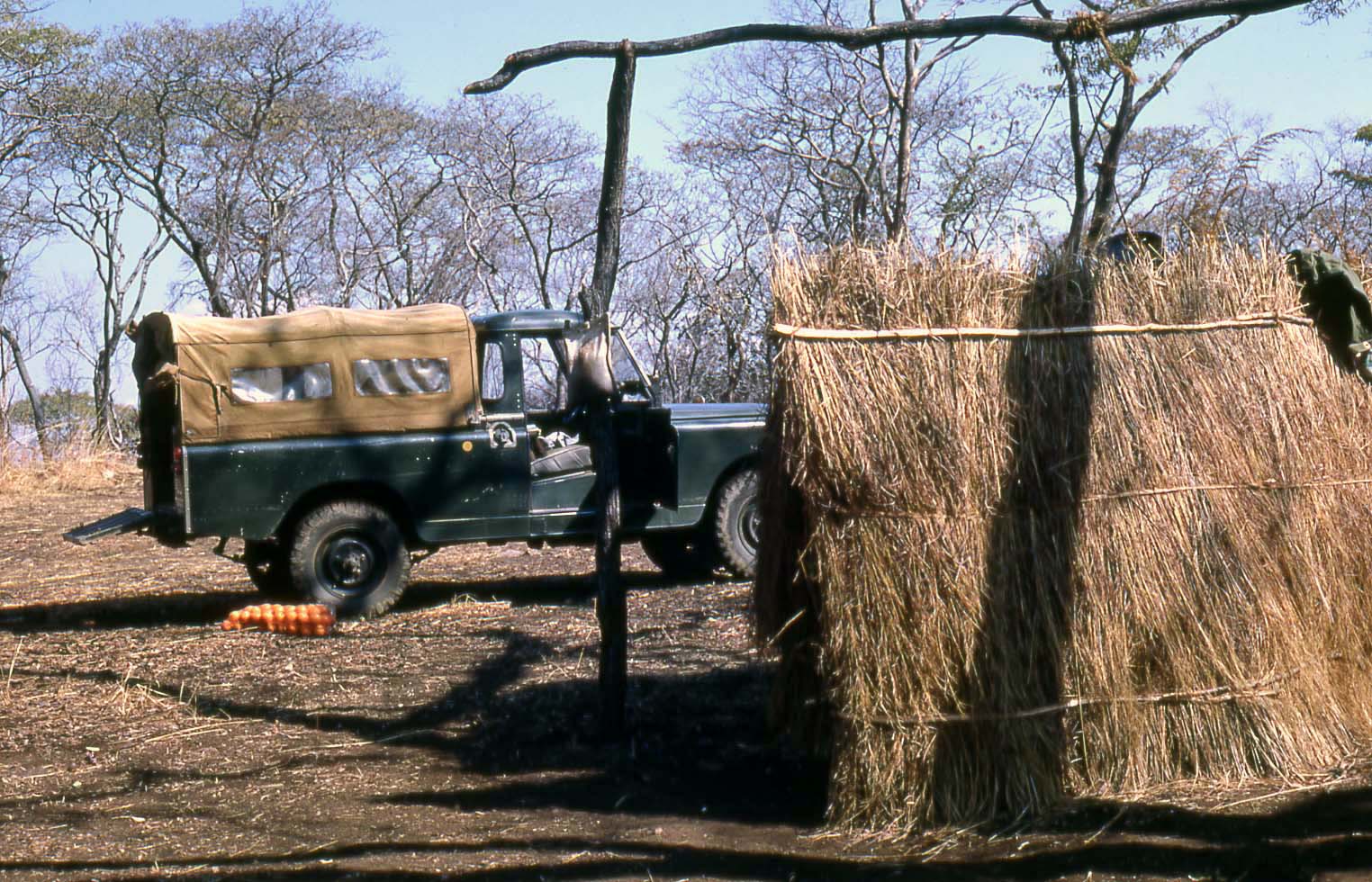
Here is a typical Tsetse-Fly Camp circa 1967 at Urungwe (non-Cordon Sanitaire and added to illustrate the environment). Note the soft-skinned Land Rover. These would later be changed to mine-resistant versions (Joe McDaniel-Africa Travel Diary):

And here is another (Joe McDaniel-Africa Travel Diary):
Here is a mine-resistant Land-Rover-note the roll-bars and weapon mount. They had armour-plate inserts in key positions as well. (Tom King at the wheel, taken c. 1977-8 near Chipinga: New Rhodesian)

Here are some other vehicles used by amoung others, the Fly-Men. Left to right a Puma, Isuzu soft-skin, and another mine-resistant Land-Rover. These shown below in fact are Intaf (Internal Affairs) vehicles. (Nick Baalbergen):
Mukumbura: Learning The Ropes (Part 1)
January 6, 2014
Life at Mukumbura could be a repetitive affair. Our daily routine went something like this:
→ First Light: Reveille and Stand-to (see previous post for details).
A picture of typical first light in the bush……do not be taken in by the serenity. This was a dangerous time of day. (Wild Eye)

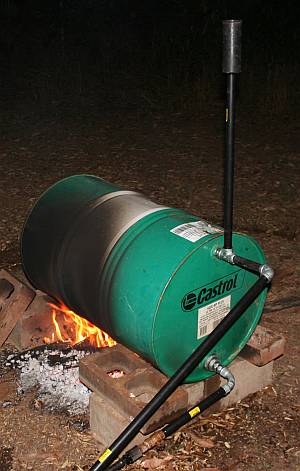
→ Shower/Shave: Hot water supplied by a heating “donkey”. This was an oil-drum affair that got its heat from a wood fire underneath. Water fed by gravity and worked very well. Luxury really considering where we were.
Here is a typical “donkey” (ourterritory.com):
→ Breakfast: This would be a hearty ensemble of the good old pucker English type breakfast. Porridge, cereals, eggs, bacon, fried tomato, baked beans, toast, butter/jam, sauces, tea and coffee. There was always enough to eat except when we were getting near to rat-run day (ration run day). This was indeed the most important meal for us and we enjoyed it immensely. Most of us packed an egg and bacon sandwich for tea.
→ Depart for the minefield: The drive to the minefield (Cordon Sanitaire) was in a convoy consisting of personnel and mine/equipment carrying cargo vehicles (often the same vehicle which was much against the explosive regulations). The journey could take anything from 30 minutes to some hours depending on how far we were working from the camp. Obviously every day we traveled further as the minefield progressed, and thus our deployment time from the camp to work area was ever-increasing.
→ Lay mines: I will discuss in detail shortly.
→ Return to camp: Self explanatory.
→ Unload vehicles: Self explanatory.
→ Late lunch: This was great. T-Bone steaks, eggs, chips, and pudding were a common feed for lunch or supper. One thing the army could do was provide good meat to the men in the field and I am sure many of you who served will agree with me. Some of these T-Bones were huge and we all looked forward to them with great delight.
→ Prepare mines for next day. Load vehicles.
To save time we partly prepared our mines for the next days laying after lunch. This would take the form of inserting booster charges but not removing any safety devices or inserting detonators. The problem we had with some mines was that the boosters and detonators were combined and thus only the safety devices were keeping the mines in a neutral state (meaning that all elements are in place for the device to fire but the safety pin/plate is still to be removed). In other mines the detonators were integral to the mine and this was also a dodgy situation. Tragically, we were to lose 7 of our Sappers at Victoria Falls in a multi-mine uncontrolled detonation with this type of device. Thinking back this pre-preparation was not always ideal or safe but time was the enemy and it was not possible to prepare 3,000 mines each morning before deploying and it needed to be done the day before. Yes, the figure is correct, 3,000 mines per day was our normal laying target for Mukumbura, at least when I was there.
It is not the intent of this blog to teach the reader the mechanics of how mines work but I will be describing some of the items we used in some detail as part of follow-on posts as without this the dangers to us as the mine-layers cannot be fully understood.
→ Last Light: Stand-to (see previous post).
Again, don’t be fooled by the serenity. These were dangerous times and the shadows played games with a mans eyes (petergostelow.com):

→ Supper: Evening meals could be a nice curry or thick beef stew with rice or mashed potatoes. Whatever it was it kept ones tummy full. Again the quality would diminish as we got closer to rat-run day. It was easy to know when rations were due by the amount of bluish-green mould on the bread…….didn’t taste too bad if it was toasted and smothered in similarly decaying cheese though.
→ Leisure Time Utilisation: This was just a fancy army term for socialising with your mates and enjoying the 2-beer limit we had at Mukumbura. If you have never drunk out of a beer bottle that has been stored with meat that is going off in the fridge you have never lived. Just thinking about it makes me all nostalgic. There were dart boards, chess boards, checker boards, cards and dominoes available for us to while away the hours. A lot of us used this time to simply write letters home and relax in preparation for the next days work. A man also needed his solitude and quiet time.
→ Shower and sleep: As for Shower/Shave above.
In the upcoming posts we will look at the types of mines we used throughout Cordon Sanitaire operations country-wide as well as the main mine-laying methodology.
The Road To Mukumbura (Part 5)
December 28, 2013
One of the stops on the long road to Mukumbura was at Mount Darwin. This was always looked forward to with glee by road-weary travellers as there was a canteen situated in the town that was run by the Womens Voluntary Services (WVS). These volunteer and always smiling ladies had an abundant variety of non-army home made food and ice-cold drinks available for dusty-faced and sweaty soldiers either going on ops or returning home. Hot-dogs full of fiery mustard, hamburgers with fresh salad and relish, meat-pies and cakes were almost always available as well as huge urns of tea, coffee and juices. All of these culinary delights were normally free but in some cases and depending where the canteen was situated a small payment was taken, often in the form of a small donation. Some of the funding for the WVS came from the Border Patrol Welfare Fund (whatever that was) too. Wherever the funds came from these establishments were huge morale-boosters. All of us who made use of this hospitality owe a huge debt of gratitude to the sponsors and ladies for making our lives just that little more bearable.
Below is a typical WVS set-up manned by nice smiling ladies packing boxes of goodies for the troops (courtesy of The Herald and ORAFS):

I was kept warm on many a chilly night by hand-knitted gloves, balaclavas, caps and scarves that the WVS also made available during the bitterly cold Rhodesian winters. These were all made by volunteers and came in any colour as long as it was green or black.
The only sad thing about these visits was that they were over too quickly and time was always going to be the enemy. The more these ladies made us feel like we were at home, the more we missed it and perhaps it was easier for us to be on our way as quickly as we could…….away from the false sense of security and the occasional whiff of a ladies perfume.
It was time to leave, and we furtively filled our water bottles with cool-drink and stuffed extra burgers and buns into side pockets for the final leg of the journey. As we stepped outside another convoy came to a noisy and dusty stop outside the canteen. The tell-tale red and blue unit flash on the vehicles indicating they were Engineer Corps vehicles, the same as ours. The only difference was these were taking their passengers home…….ours were taking us to a very different place.
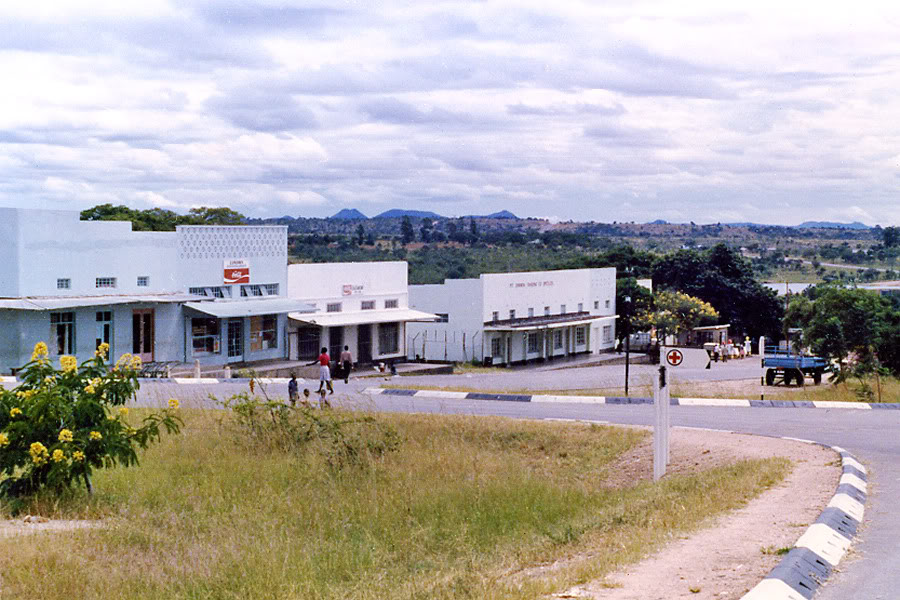
Below is a photo of Mount Darwin in the 80’s but it would not have changed much from when I was there in the early-mid 70’s (thanks to New Rhodesian Forum)

As I strapped myself back into my seat I caught the unmistakable aroma of fried onions and tomato sauce…..I looked down and noticed I had dripped food all over my shirt-front. A trail of yellow egg-yolk mingling with the camouflage pattern. I would scratch it off later when the sun had dried it to a scaly crust.
The engines started, and as we slowly rolled out onto the main road I realised guiltily that I had forgotten to say thank you to anyone for the brief respite we had just enjoyed.
I cocked my rifle, rechecked the safety, and we were gone.
The Road To Mukumbura (Part 4)
July 30, 2013
Let me be clear.
I was never unlucky enough to be ambushed traveling through Ambush Alley in the Mavuradonhas, but I know quite a few people who were. These encounters ranged from ineffectual pot-shots being taken at Rhodesian Security Force convoys to intense firefights, sometimes in the hours of darkness. We had people killed and injured going through the mountains. It was a main personnel and logistic route to the North-East Border with Mozambique. The issue with traversing Ambush Alley was the steeply angled incline of the road and this resulted in straining engines and overheating vehicles. Stopping in an ambush killing-ground is a dodgy business indeed and not for the faint-hearted. To help vehicles get up to the summit of the pass, concrete had been laid on the road surface to help during the heavy rains that could hit the area. Additionally one side of the road was a sheer drop and the other went straight up and so close to the vehicles in some places you could touch the trees. Perfect ambush terrein and the gooks could not be faulted for choosing it as a killing-ground. The photo below will give you a good idea what the terrein and contours were like although it does not do the challenges on the ground justice. The road is clearly visible:

Here is a map which shows the roads we traveled to get through the mountains. As you can see any route you chose to Mukumbura had to go through the mountains called Mavuradonha:

Ambush Alley was still a long way down the road though. Before we got there we would be in for a treat at a place called Mount Darwin. Something to look forward to.
I settled back in my seat, tightening the straps on my harness, and counted the little white distance markers next to the road to keep my mind active.
The Road To Mukumbura (Part 3)
July 14, 2013
I had already unclipped and shrugged off my safety harness before the vehicle had come to a halt. A couple of the lads had started to release the tailgate catches and it fell outwards onto its rubber stoppers with a dull thud. Some of us debussed via the tailgate step or simply jumped over the side of the vehicle, FN in one hand and the other used for balance. The smell of burning oil, hot tyres and exhaust gases filled the air. The heat seemed to make them stronger.
Most of us immediately looked for the nearest tree to pee under, others carrying entrenching tools and bog-roll for more serious business moved further away. This would not be a long stop so no one had tea-making kit out. The best we could expect was a sip of water from our water bottles. There is a funny thing about plastic water-bottles……the water always tastes like plastic……especially when it is warm. Those of you who know this taste will understand what I mean. The best solution to this was to chuck a bag of Jungle Juice from a rat-pack in the water and enjoy the orange-like taste.
It was all silent now. Men cowering from the sun in the shadows cast by the vehicles and trees next to the road. Always vigilant…..looking outwards for gooks…….sweat filled eyes burning, vision blurred and playing tricks.
The only sound was the metallic pinging of the engines and exhausts cooling down.
Drivers walked around their vehicles, checking tyres and cargo, at the same time stretching their limbs. They would change-over with the co-drivers now and perhaps find time to relax a little once back on the road.
As the cab doors slammed shut we made our way back to our seats, strapped-in and readied ourselves for the next stretch of our journey……taking us further into the gook badlands…….closer to Mavhuradonha, the “Place Of Falling Water”.

With every turn of the wheels we were also getting closer to another place….a place infamous in Rhodesian Bush War history……a place called Ambush Alley.
 Fatfox9's Blog