On And Off The Rails (Part 3)
September 26, 2009
Towards the end of 1972 and early 1973…..still in the Rhodesia Railways Mechanical Workshops, Bulawayo
Second Mission: The Erecting Shop
I know what you are thinking. Erecting Shop. What a strange name and why would they call it that? I thought the same myself and of course this part of the workshop complex was always going to be rife for a whole lot of strange comments.
So why is it called the Erecting Shop and what debauched activities take place there? Patience dear reader…..all will soon be revealed.
Towards the end of 1972 I was told that I would be transferred away from the Wagon Shop. My destination was not made clear at that time as there was a lot of shuffling around going on. A large majority of the Journeymen and senior apprentices (3rd, 4th, and 5th years) were spending more and more time in the bush on Territorial Army (TA) call-up duty, and this was putting a severe strain on those of us who either had not yet been called up for National Service, or those that for one or other reason were unable to serve in the Rhodesian Army. I suppose that this was when I first realised that one day I would be going on call-up and others would have the pleasure of cutting up smelly meat wagons.
To be very honest I was extremely sad to be leaving Jack Crilly. He had become like a father to me and mentored me in everything I needed to know about my work and more importantly, about life itself. He treated me as his son. As an apprentice I never earned much money. In my first year I took home 77 Rhodesian Dollars per month. Out of this I had to pay for my lodging, buy clothes, and eat. I had moved into the Railway single quarters in Raylton, the railway suburb right next to the workshops and staff canteen. So I lived in the shadow of where I worked and the sulphur smell of burning coal was ever prevalent. Each month I bought my little book of meal coupons and that’s where I basically ate all my meals. Not bad food, but pretty much the same menu each day.
I got to know quite a few of the married personnel who had their houses next to the single quarters and ever so often I used to get invited round to someones house for a real supper of hot beef stews, hearty vegetables, and guavas and custard. One couple I became very attached to was Bella and Keith Harris. Keith, a giant of a man with a heart as good as gold, was a locomotive fireman…..the tough guys that shovel coal into the ever-hungry maw of a steam engines firebox. And dear Bella….what a wonderful person……she just had a way of making me realise what it must be like to have a real home. Wonderful people who never had too much of the good things in life but shared what they had.
Back to the Erecting Shop.
Erecting Shops are places where things that were previously un-erect (not flaccid as in penis, but rather dismantled) are re-erected. Normally this process involved enormous machines. In this case huge black steam locomotives. Great big Beyer-Garrett monsters that could haul thousands of tons of cargo up and down the many miles of Rhodesian rail tracks.

Beyer-Garrett 15th Class
These were massively powered beasts that prowled Rhodesia’s open spaces taking goods all over the country and over the borders as well.
Life was quite hazardous in the Erecting Shop. What you have to understand is that Rhodesia Railways locomotives could weigh between 30 and 120 tons depending on the model, and when it arrives at the workshops it is still on its bogeys, or wheel units. So it is easy to move about with little shunting engines or winches. However one of the first things that has to be is to remove the bogeys. The only way to do that is by lifting the whole locomotive into the air and pushing the bogeys away. The locomotive, suspended on huge overhead cranes was then lowered onto giant stands. It would remain there for at least 21 days, the time it took for a full strip and rebuild. Rhodesia Railways were known to be one of the most experienced organisations as far as this type of work was concerned.
I have described the removal of the bogeys as if it was a really simple activity but in fact it was an extremely precise and dangerous operation. The first thing that is done before removing the bogeys is that the sanding pipes must be cut off using oxy-acetylene cutting equipment. Sanding pipes are used to spray sand onto the rails in front of the main driving wheels of a locomotive when extra traction is needed, for example on steep inclines. This cutting of pipes was one of my jobs and again rotten meat comes into the story. You see there is a thing called a cow-catcher at the front of all locomotives and their job is to catch cows standing and minding their own business on the track…..basically a massive fast moving 100 ton meat tenderiser. The problem was that the now mushy cow normally got caught up under the locomotive after being hit and bits of pieces of processed meat and bone ended up being sprayed up the front bogey assembly that included the sanding pipes. So we are back to the 3000 degree flame burning minced up rotten beef.

Lifting a locomotive in an Erecting Shop (non-Rhodesia Railways)

A typical Erecting Shop (non-Rhodesia Railways)

Rhodesia Railways Erecting Shop where I worked as an apprentice Plater-Welder
On And Off The Rails (Part 2)
September 14, 2009
January 1972……still in the Rhodesia Railways Mechanical Workshops, Bulawayo
First Mission: Wagon Shop
The Wagon Shop was exactly what the named implied. It was where one would find all types of wagons in various stages of construction or destruction, depending on the activity taking place. Any wagon that needed repairs of any description including complete rebuilds from the frame upwards came to the Wagon Shop. Some of the ones that arrived were in advanced stages of decomposition due to either plain wear and tear, high-speed shunting operations by overzealous locomotive drivers, and in extreme cases; collisions, derailments and/or terrorist action. Clearly some of them would never hear the clickety-clack of the rails again. In most cases things could be put right with the correct application of brute force and profanity…..but there were of course the instances where they were so bent and twisted that they were scrapped for being beyond help of any kind and sent to the graveyard.
It is important to remember that at that time there were heavy sanctions imposed on Rhodesia so the scrapping of a wagon was considered a very serious decision to make. Apparently a person needed superhuman powers of perception and outstanding academic qualifications to make such decisions. This person was known as the Charge-Hand….. basically because he was in charge of all the hands that fixed the wagons and he knew what our grubby fat fingers, big heavy tools, and heating torches could and couldn’t do. I remember him quite well. A pleasant person most of the time as I recall. Unfortunately he used to lose it when under pressure and this seriously impacted on his personality. I used to watch him walking around with a piece of chalk in his hand, writing all kinds of messages for us to read on the side of the newly arrived wagons, detailing its fate……repair, strip, rebuild, cut. And when he was in a particularly foul mood, probably for not getting his leg over the night before, he even wrote the dreaded “scrap” word……gleefully grinning whilst condemning the mute subject of his frustration to the knackers yard…….a shadowy, sinister place that was always cold, damp and dripping. There seemed to be a sadness about the wagons that were laid to rest there……the wicked wind whipping and whistling through their lopsided frames.
I would like to describe two specific types of wagons that remain vivid in my memory. None of my reasons for remembering them are good.
Refrigerator Wagons:
Refrigerator wagons are used to keep meat carcasses and other perishables cold in transit. Obvious you might say. However you need to bear in mind that if the cooling unit breaks down between Wankie and Bulawayo in mid-summer, a refrigerator truck quickly becomes a microwave oven and whatever you were trying to keep cold rapidly begins to decompose into an array of unpleasant odours, strange, slippery, evil coloured liquids, and sodden cardboard boxes that fall apart when lifted, thus spilling their now vile contents all over the show.
It is important to understand at this point that when a cooling unit breaks down the whole refrigerator truck would be sent for repairs so that the entire wagon could have a quick service. I dont need to tell you where they came to…..but I will anyway…….the Wagon Shop.
If you have never had the good fortune of being the first person to open one of these wagons after it has been standing in the sun for a few days, it is going to be quite hard even for me to describe the sickening stench of rotting beef, pork, or lamb that has turned green, blue, and yellow, and has strange pus-like secretions leaking out of the various orifices that such animals have. I do not think I need to elaborate further at this stage as any normal person reading this should have gotten the idea by now.
Try to visualise the following:
Refrigerator wagon comes in for repairs……the first thing that happens is that it gets stripped down.
One of my tasks as a Plater-Welder apprentice was to cut things up with extremely high temperature flames using a combination of oxygen and acetylene gasses. I used to enjoy doing this eversomuch. The problem here was that these trucks had a double skin with insulation in the middle of the inner and outer layers. This insulation was highly inflammable……do you get the picture? A really horrible yellow smoke, that was also toxic, was produced when this insulation caught fire. Secondly, when pieces of rotten meat and old dried blood inside the wagon came into contact with a 3000 degree Celsius flame they naturally began to cook….right in front of my face……..burning rotten meat smell is very different from burning fresh meat smell. So there was none of this tummy rumbling, mouth watering Sunday afternoon barbecue/braaivleis aromas wafting about….none of that at all.
Cattle Wagons:
Cattle Wagons have the opposite job to Refrigerator Wagons. They also look different.
The main functional difference is that one type (Refrigerator) carries dead animals that sway gently on their stainless steel butcher hooks according to the camber of the tracks and appear to be taking part in some kind of synchronised swimming exercise. The other (Cattle) carries live, snorting, snotty, dribbling, very pissed-off bovines, who probably know that they are on Death Row, so also try to get their last hump in on the way. Live cattle also void their bowels and bladders in these Wagons. Which is the root cause of my bad memories of them. Basically the same reason as the Refrigerator wagons…..3000 degree flame in contact with dried or wet soggy cow-dung and urine…….you have the picture and are hopefully imagining the aroma……not like marijuana at all. I have forgotten to mention these wagons were mostly made from wood…..flame+wood=fire=burns to body parts.
There were times when I thought that being in the Wagon Shop was punishment for some long forgotten sin. I was to find out quite soon that there were far worse tasks than cutting up rotten meat, being gassed by flaming toxic insulation, and slipping on fresh, smouldering cow-dung.
And I was also to discover very quickly, the two things that scared the living daylights out of me.

Rhodesia Railways short cattle wagon

Example of a Refrigerator Truck (not Rhodesia Railways)
On And Off The Rails (Part 1)
September 3, 2009
January 1972……Rhodesia Railways Mechanical Workshops, Bulawayo.
There were four of us that year. Apprentice Plater-Welders, a grand title indeed. I was just 17.
We were youngsters straight out of school with apparently not enough academic intelligence to go and get a Degree….lepers compared to the likes of the goody-goody, lardie-dardie-old-school-tie-up-your kilt brigade. You know the ones I mean.
We had ended up in the Welding Shop, a place of alien odours, bright blinding flashing crackling arcs, hissing and spluttering gas flames, flying sparks, clanging metal, phantom wankers, and swearing Journeymen.
The other three were there because they wanted to be….me for the simple fact that my pass rates at school were so bad that I was considered only good enough to melt two pieces of metal together after cutting, bending, and banging them into strange shapes. Being absolutely atrocious at mathematics of any kind, anything slightly numerical would ensure a panic attack of immense proportions, guaranteeing I would never hold a brain surgeons qualification.
I remember Titch Tyzack well. A small man as his name implies, he was the Welding Shop foreman and a true gentlemen who treated all of us with great respect and I don’t think I ever saw him lose his temper once. He issued us with all our new and shiny kit…..oxygen and acetylene gauges with black and red pipes to go with them, chipping hammers, wire brushes, long welding gloves, welding helmets and goggles, and a full length leather apron that was supposed to protect us from going sterile with radiation but actually made one look like Jack the Ripper out on one of his evenings walks around Whitechapel…..aaaah yes and some spats to cover our new and shiny brown safety boots, presumably to stop our victims blood splashing on them during the gut-slashing process.
He also gave me 6 little pieces of triangular aluminium……on it was stamped a number….728775……my employee number…..and they were held together by a special spring clip. I felt very important indeed as these were the currency of the technical stores….with them I would be able to draw all the tools I needed…..as long as I exchanged each tool for one of my precious little discs.
We guarded our discs well…counting them carefully each day, auditing them against the amount of tools in our wooden lockers….much evil could be done with them in the wrong hands.
The time had now come for us to meet our Journeymen, the person who would be our mentor for the next year at least. For those of you who don’t know, many of the Journeymen working in Rhodesia at that time were from foreign and often strange lands. Some of them smelt of garlic. Others had greasy faces. I was destined to be put in the capable hands of a man named Jack Crilly, a tough as nails, broken-nosed Welder from Stockton-on-Tees, who had served his time at the Imperial Chemical Industry (ICI) facility. Jack did not smell of garlic…he was also not greasy….this was very useful as he needed to get up close when he spoke to me about something I had fucked up…..not because I was deaf or anything like that…..it was just so freaking noisy in the workshops that at times it was easier to speak in signs.
During my time as an apprentice I would also be nurtured by a probable ex-IRA gunman who also taught me to play bridge at tea times, a South African who liked to make out he was an underwear fashion photographer, and a Rhodesian who always seemed to be on another planet.
So the scene was set for a great five years….or so I thought.
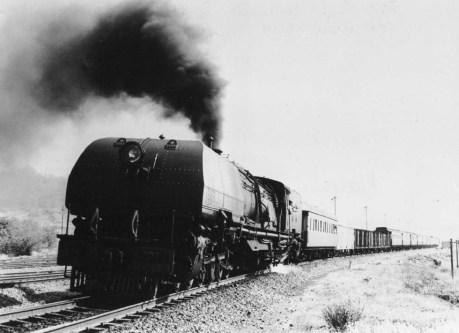
Rhodesia Railways 20th Class Garrett: One Mean Mother Locomotive
 Fatfox9's Blog