Piss Poor Planning: The Debacle of Nyahuku (Part 1)
February 28, 2026
As a member of the Regular army within the Rhodesian Corps of Engineers, it was not unusual to be redeployed to different operational areas to assist where additional manpower or specialist military engineering expertise was required. If you were in-between missions, and idling around at Squadron HQ in Bulawayo (Brady Barracks), you were a prime target for any dodgy task that might be dreamt up by the upper echelons.
The following posts recount one of those occasions.
I was in the Squadron admin office doing my best to look busy, operating the Gestetner machine, rolling off precis for the next intake of recruits from Llewellin Barracks – they would have just finished their basic training, and been selected for Engineers.
There was much to prepare for their arrival, and to be honest I was not into this arranging barracks rooms, stapling A4 sheets together and arranging bed-linen lark – luckily I was about to snivel out of it – although I would have been much better off staying and helping with the incoming Gobbies1.
Someone shouted my name from one of the offices in the HQ. I recognised the voice – it was Staff Sergeant Vic Hydes and he was someone you never kept waiting and I quickly doubled-away to see what he wanted. Vic was often referred to as “Little Hitler”, and it was for a good reason – he was the bloke that had made me swim from one end of Umzingwane Dam, to the other – at night. For more on these aquatic activities please follow this link: https://fatfox9.net/2010/05/22/mzingwane-dam-part-1-combat-engineer-practical-training-phase/.
Vic briefed me, although with the little he knew himself, I was only marginally wiser after leaving his office. The short of it was that hot intelligence (laughing my head off) had been received (laughing again) that a large group of gooks2 were planning to cross into Rhodesia somewhere along a 30 kilometer stretch of the border with Mozambique in an area of East Mashonaland within the next two to three weeks. The general location of the suspected crossing point was within an area known as Nyahuku, and is shown below in the orange circle:
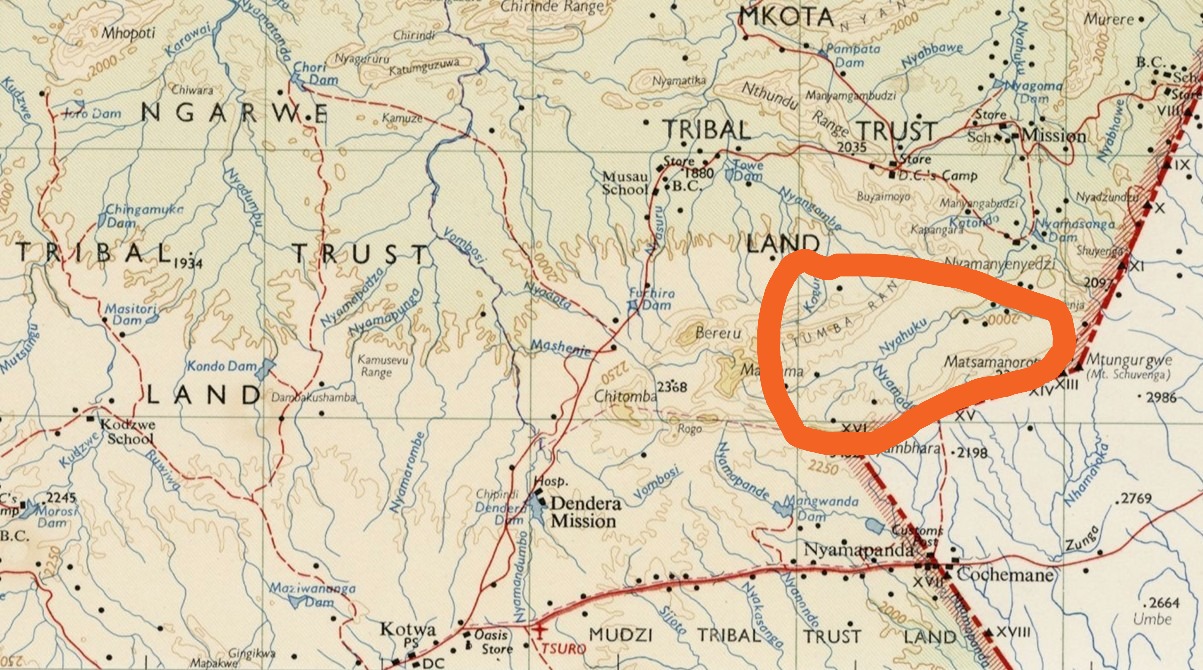
During the day more information came to light and I learnt that we had been tasked, together with elements of 2 Engineer Squadron from Salisbury, to lay a rapid barrier minefield (Cordon Sanitaire pattern – see https://fatfox9.wordpress.com/wp-admin/post.php?post=491&action=edit) to block the suspected enemy line of advance where it would cross the Mozambique/Rhodesian border, and kill them.
Due to the geographic location of the target area, 2 Engineer Squadron would be calling the shots on this one, with overall command, control, administrative and logistic responsibility. 1 Engineer Squadron was only providing personnel.
1 Engineer Squadron would mobilise approximately 30 Territorial Force and National Service Field Troop (NSFT) personnel for this mission and they were due to arrive at Brady Barracks in drips and drabs over the next 48 hours. In the meantime I would be working to get 3 troop carrying vehicles prepped for the 650 kilometer journey that lay ahead of us. Nyahuku was a world away from Bulawayo and it was going to be a monster of a drive of 10 to 15 hours, not including stops. Our route would take us through Salisbury where we would night stop and join the 2 Squadron personnel, and then on to Mtoko the next day. Joint Operations Center (JOC) Mtoko, was a key fire-force and intelligence hub within the Operation Hurricane area, and we would take our last stop there before making the final leg to Nyahuku via Kotwa.
Over the next few days I cobbled together 1 x Unimog 25, and 2 x Rodef 45s for the force that would deploy with me. These were reliable Mercedes-based vehicles and I was pleased that we had these three available for us to use, as we would also be towing a full water bowser and fuel bowser.
On the night before we were due to depart we had a good session in the pub, the usual banter between Regulars, Territorials and National Servicemen continued well into the night. Most of us knew one another – we were a small band of brothers, highly experienced in our craft and more than capable of carrying out the task ahead.
The last thing to be done on the morning we left was to test our TR48 radio for comms with 1 Engineer Squadron ops room, plus inter vehicle comms with A76’s, draw our weapons,/ammunition, and 48 hours of rations per man – 2 rat-packs each.
With vehicles full of fuel and final trips made to empty bladders, we fired the Mercedes engines up, and were on our way before noon, most of the passengers dozing-off before we hit the road to Salisbury.
Salisbury would prove to be where things started going wrong at pace.
More to follow in Part 2
 Fatfox9's Blog