Twin Browning’s On The Bridge (Part 2)
July 31, 2024
Deka Base: Sometime in the mid-1970’s
It started out like like any other morning. Up just after first light, I walked down to the shower block, the fresh fragrance of Colgate Green Apple shampoo, that doubled up as a body wash (it worked really well), already permeating the crisp morning air. There were a few of my Sappers already lathered up and chatting away loudly in their native tongue as they always did. Laughing and taking the piss out of one another, brushing their teeth as a concurrent activity, the added whiff of various toothpaste blends adding to the pleasure of the moment. It smelt like home – and this was my home. I had nowhere else.
Having dried off with a dark green Rhodesian Army towel that we were issued with, I walked back to my billet, and passing the kitchen and serving area, Sinate, our civilian chef on rotation greeted me and asked what he could make for me. He was a good man and well respected within 1 Engineer Squadron, a veteran at many of our bases scattered around the country . A fantastic caterer who could make a banquet out of nothing. My normal breakfast consisted of a couple of fried eggs, bacon, fried tomato and toast – all washed down with coffee drowned in condensed milk. That’s what I ordered and continued on my way.
Belly full and the sun well-up, I put on my chest-webbing, web belt and water bottles. It was time to start moving out to the Kavira Forest, a densely-bushed area, infested with our anti-personnel mines and wag-n-bietjie (wait-a-bit) thorn bushes – a nightmare combination for those with evil intent as well as those of us tasked with maintaining Cordon Sanitaire – the silent sentinel that protected the Rhodesian border areas. Picking up my FN rifle, instinctively checking it was safe, I walked around to the the vehicle pool, the Hippo MPV (see previous post) already quietly idling – my driver waiting patiently for me to give the order to move out. The two 4.5 Mercedes Benz troop carriers, loaded with our spare mines and other minefield paraphernalia, 20 noisy Sappers and our medic, fired up as the drivers hit the start buttons. Diesel exhaust smoke, acrid, and causing some discomfort to the eyes and throat, filled the air. I climbed into the back of the Hippo and walked through the passenger compartment, greeting the Sappers who would travel with me. Settling into the seat next to my driver, I pulled the safety harness over my shoulders and clipped the whole contraption together at the waist belt. Looking at my driver, I gave him the signal to move out, and our little convoy rolled out of our base, past the guardhouse made of teak railway sleepers, and headed off towards the road that would take us to the Kavira Forest. Our A76 radio burst into life as each vehicle checked in to confirm comms – one of the Sappers at the back of my vehicle doing the business.
Magazines clicked as they were attached to weapons and the sound of cocking handles picking up a round in well-oiled working parts punctuated the fact that we had left our safe haven.
There was a hatch directly above my head, and looking up I could see the twin Browning machine guns glinting evilly in the morning sun – ready to deal out death and destruction. Gripping the ridiculous bicycle handle-bar machine gun swivel/trigger system that hung down in front of me, I gave the guns a quick 360 degree spin – they moved smoothly both horizontally and vertically. I had never liked this design and always felt that there must be a better way to fit and operate the guns. I never managed to think of anything though, and apparently neither did anyone else.
We were heading towards the T-junction where we would turn east onto the road that would take us the 50 or so kilometers to our task area – this road was also the main arterial that went to Mlibizi and many other destinations beyond that. I called a stop before we reached the turning-point and switched on the TR48 SSB radio and checked-in with Wankie Engineer HQ based at 4 Indep – this radio check also confirmed that we were mobile and moving to the minefield. I would make another check before minefield maintenance activities commenced to ensure casevac was available if required.
Before moving off I stood up in the tower and cocked the Browning’s – the moving parts sliding back smoothly and locking in place. They were now ready to spew out death at 2,000 rounds per minute between them.
I had decided to remain standing on my seat with my upper body sticking out of the hatch. Warm wind brushed my face as we moved out, and turning around I watched the other two vehicles fall in behind us, the distance between us growing as each vehicle took up a position about 70 meters apart from one another. The reason for this was to stay out of the dust coming from the vehicle ahead of you , and to avoid all vehicles being caught in an enemy killing ground at the same time.
The map below shows the Deka Engineer Base from where we operated from, the intersection (circled in red) where we stopped to make comms with Wankie and cock the Browning’s, and the Gwaai River Bridge. The thin yellow line is the road to the minefield.
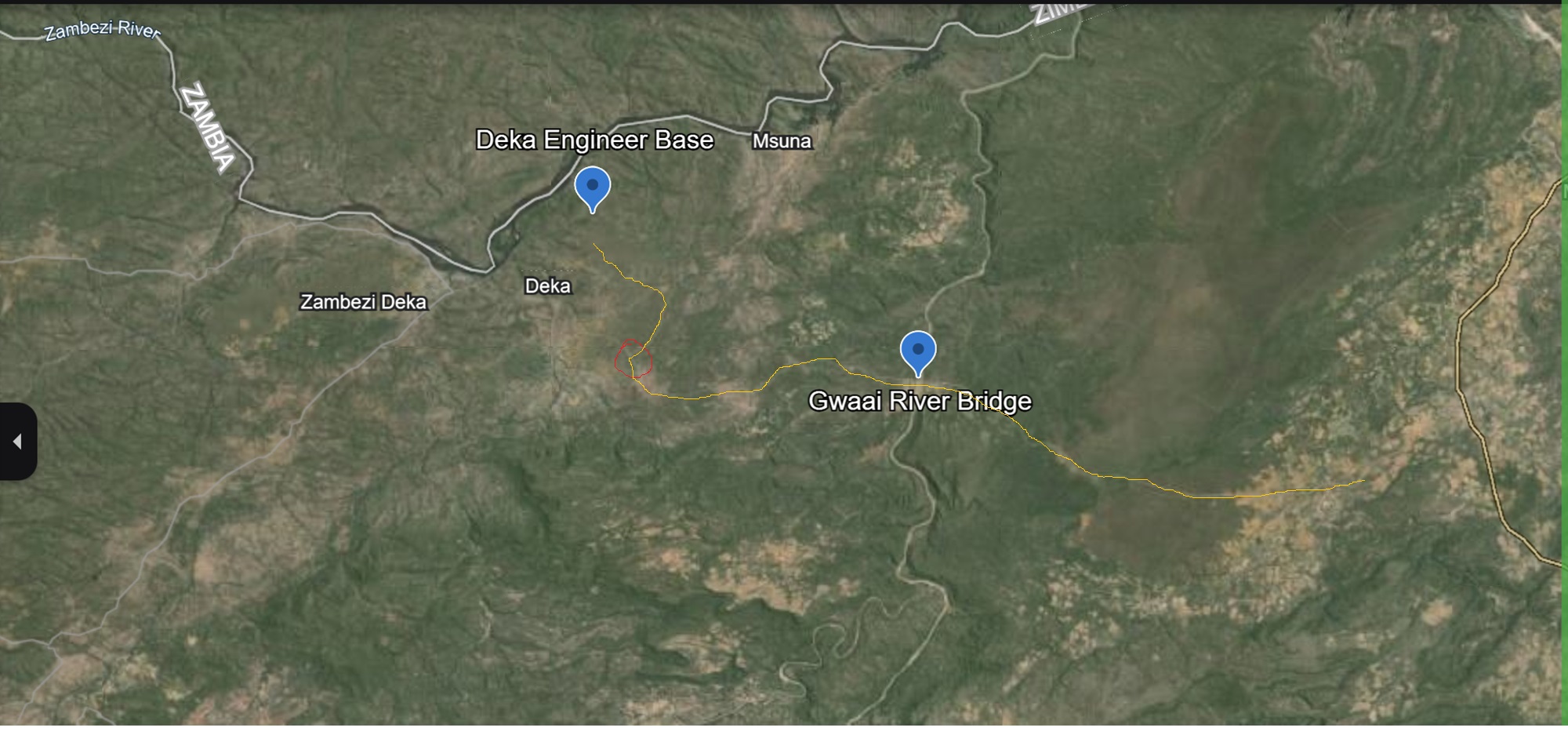
These were monotonous journeys, the same as the ones that we took almost every day with no excitement except for the occasional break down or punctured tyre – real adrenalin pumping stuff. It was very easy to be lulled into a sense of false security after months of the same thing, and ones eyes grew very heavy, very fast – the humming of the engine acting as a lullaby. It was important to ensure we all stayed switched on despite the monotony of it all. I shouted down into the passenger compartment to conduct a radio check with all vehicles…….everyone seemed to be awake and in fact there was now someone standing up in each of the following 4.5 turrets too – weapons at the ready.
As we approached the Gwaai River High Level Bridge (18°09’21″S / 27°01’20″E) we needed to slow our vehicles down to avoid throwing personnel and equipment around as there was always a deeply eroded gully between the end of the dirt road and the approach slab to the concrete bridge decking caused by rain and other heavy vehicles. The Hippo gently mounted the bridge deck and slowly began travelling the 200 meters to the other side. The length of this bridge meant that only 2 of our convoy vehicles would be on the bridge at the same time, considering the tactical distancing we kept between us.
As we approached the half-way point I looked down into the north side of the bridge and immediately noticed a number of people walking up the dry river bed right towards us – I ordered the driver to stop and could saw that the individuals in the river bed were heavily weighted down with an assortment of kit, clearly carrying weapons and without a doubt terrorists. I’m not sure who reacted first but I know that I got back down into the vehicle, brought the guns to bear and commenced to open fire on the guys in the river bed…………….at the same time my troops had debussed left of my vehicle and were engaging the enemy with their FNs and a MAG. From my position inside the vehicle I realised then that this whole bicycle handle bar arrangement was a total waste of space. Firstly there was no real control over the direction of fire, and to a large extent the guns shot at wherever they wanted to. I could see dust flying everywhere down in the river bed, however my vision was restricted by the thick armoured glass which was dusty and cracked. Firing from an elevated position also takes skill as its not as straightforward as one would expect as a fired round will hit high when shooting down and up.
Its pretty amazing how fast a person can run when they are being shot at – these guys in the river bed had bomb-shelled at a rapid pace and had run for cover under the bridge! It was now time to get some control and I ordered a cease-fire, getting my troops to keep an eye out on both sides of the bridge for runners. By now more of my Sappers had arrived from the other vehicles and joined the party. Many sets of eyes were now trained downwards on both sides of the bridge – everyone wanted to be the one to get the first kill. There was no movement from below and I was pretty sure the gooks were just waiting for a chance to run for it. It turned eerily quiet – the heat oppressive, not a bird in the sky. Salty sweat ran into eyes, stinging, and blurring vision at the same time. I knew that my troops were waiting for me to make a decision – and I needed to do this fast.
I used this lull to let HQ know we were in contact with a gang of 7-10 terrorists, providing a six-figure grid-reference – HQ would let Fire Force know at FAF 1 (and provide my call-sign), as well as the BSAP camp at Sibankwazi, our nearest Rhodesian security force support asset.
It is important for my readers to understand that time appears to suspend itself during a contact and events fly by – we were now probably only minutes into the contact but many things had taken place in the blink of an eye. Many by instinct, and many by necessity.
I was conscious that we needed to use our troops in such a way that we could sweep the river-bed to force the gooks to gap it from under the bridge – as well as leave a killer group on the bridge to take them out as they broke cover. Sounded simple enough.
I took command of the sweep team and moved them along the bridge, watching for any runners to the left. Nothing moved as I reached the end of bridge deck and moved left and down into the river-bed. This was a high level bridge and believe me it seemed much higher when right next to it. I knew that this was now a very dangerous situation we were in…….moving down a rocky and steep slope with an enemy at close range intent on killing us. The gooks had holed up right next to the bridge pier, so we could not see them from our current position – we needed to move further down and closer to the river bed. Looking up I could see a few of my lads giving us top-cover in case someone gapped to our side – I was conscious we could be hit by friendly as well as gook fire. Not a situation I relished but too late to turn back now. I trusted my lads to do the right thing. The map below shows the bridge the contact area.
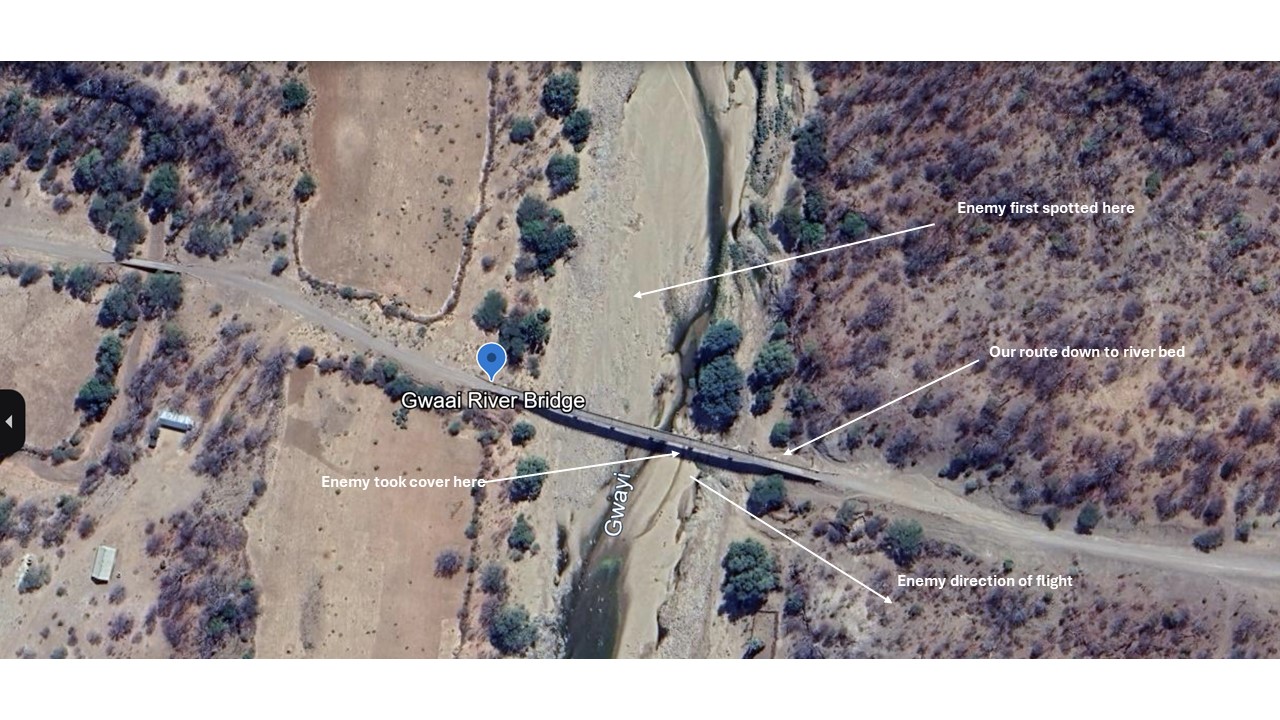
We could smell them we were so close…….fear, sweat, and woodsmoke clinging to clothing. Those who know will recognize my description. Then all hell broke loose as my guys on the bridge opened fire on a target we could not see……the gooks had started to run at pace towards the opposite side of the bridge – we were now in the river bed and they had already vacated the area they were taking cover in. Control was now critical as my sweep team wanted to run after the enemy however they would be moving right into our own gunfire. I called a halt to this idea. By now the gooks had probably put good distance between themselves and the bridge, and we had no kills. I decided not to follow-up and would leave that to the Fire Force and G-Cars who were now very close to where we were and would be given a nice juicy target later in the day. One of pilots called me on VHF and I gave a quick brief – ending with a magnetic bearing which indicated the enemy direction of flight. With a quick thank you and well done…….they disappeared from view…..the sound of their rotor blades fading in the distance. The silence made one feel very alone.
For us it was a disappointment as with the benefit of hind sight there were a number of options open to me besides the tactic I had used to flush the gooks out. I will leave it up to the reader to think of a better way, but in the heat of the moment quick decisions must be made. Perhaps I made the wrong one on the day. Disappointing, yes, but all of my troops would go home – that was also a victory of sorts.
All was not entirely lost though as during a sweep of the contact area and route of flight we found quantities of ammunition, documents, weapons and landmines that the runners had dropped while gapping it. In our own way I would like to believe that my boys and I saved lives that day by removing killing material from the operational area. All of these items would later be handed over to BSAP Special Branch for processing and further distribution as required. That’s the way things worked and I had no problem with that.
The sun was high in the sky as I regrouped my troops at the bridge – it was time to return to Deka Base. There would be no minelaying today, and with luck, the bad guys would be dead before sundown.
I never did find out – but the beers were extra sweet that night.
Copyright
© Mark Richard Craig and Fatfox9’s Blog. Unauthorised use and/or duplication of this material without express and written permission from this blog’s author and/or owner is strictly prohibited.
 Fatfox9's Blog